Alternative schooling in Oregon: is the cure worse than the disease?

School-Choice_banner

More choices don’t always mean better choices.

Oregon, eager to appease vocal parents, gives them lots of K-12 options if they don’t want to send their children to traditional brick-and-mortar public schools.

This being National School Choice Week, alternative schooling advocates are in a particularly celebratory mood. “The landscape of options to meet the learning needs of today’s students is more diverse than ever, ” Kathryn Hickok,  executive vice president of the Cascade Policy Institute, said on Monday, Jan. 27.  “Empowering parents to choose among these options can unlock the unique potential of every child. “

There’s no question that alternative schooling can be seductive. After all, it can offer flexibility, more curriculum choice, self-paced learning, protection from threatening ideas and religious freedom. And I’m inclined to think that parents should have a role to play in conveying important values to their children.

It’s not clear, however, that all the schooling choices out there are better for the children or are adequately preparing young people to succeed and participate in our complex economy.

In addition, the fragmentation of our educational system may be undermining the need for all members of our society to see themselves in common cause – a necessity for the survival of our democracy. Where too many people are isolated from their peers, they may be less likely to see a relationship of mutual commitment and responsibility to others.

A case study: Junction City School District

junctioncitytower

According to the Junction City, OR School District, of all of its  K-12 students in the 2019-2020 school year:

  • 1820 are attending district public schools
  • 74 are attending online public charter schools
  • 37 are being home schooled
  • >52 are attending private schools

Some district students may also be attending brick-and-mortar public charter schools, such as Triangle Lake, Willamette Leadership and Network Charter School, but they are not located within the district’s boundaries.

Students can attend a brick-and-mortar charter school without a release from the Junction City School District and such schools are not required to send the district a roster. The result is that no trail of paperwork is exchanged between the schools regarding Junction City resident students who attend the charter schools.

Online Public Charter Schools

According to the Junction City School District, as of Oct. 2019, district students were attending the following online public charter schools:

  • Oregon Connections Academy  (renamed Oregon Charter Academy in the 2020-2021 school year) – 4 students
  • Baker Web Academy – 42 students
  • Destinations Career Academy of Oregon – 1 student
  • Fossil Distance Learning Programs – 21 students
  • TEACH-NW – 6 students

bakerweblogo1  destinationslogoORCAlogo1  Print

fossiltownlogo

FOSSIL DISTANCE LEARNING ACADEMY

The academic performance of individual students attending the online public charter schools cannot be determined on the basis of available data. Only data on the performance of grades as a whole, based on standardized tests taken in English Language Arts, Mathematics and Science, are public.

That means there’s no way of knowing whether the students living within the Junction City School District who attend these schools are doing well or not.

The Oregon Department of Education does, however, collect data on the online schools, and it is dispiriting. It is clear that the schools are drawing children and money away from public schools while failing to provide a good alternative.

Despite that, the schools, also called cyber and virtual schools, are multiplying like fruit flies. “Other states have… increased oversight of fast-growing online schools,” noted a 2017 report by the Oregon Secretary of State’s Audits Division. “In contrast to these states, Oregon’s laws allow online schools to increase enrollment rapidly regardless of their performance.”

While online charter champions churn out a torrent of supportive stories that assert traditional schools are relics, critics are pummeled as Neanderthals unwilling to accept change.

Oregon’s online public charter schools and the districts sponsoring them are listed below:

Sponsoring District Online School 2018-19 Total Enrollment
Baker SD 5J Baker Web Academy 1,808
Mitchell SD 55 Cascade Virtual Academy 69
North Clackamas SD 12 Clackamas Web Academy 445
Eagle Point SD 9 Crater Lake Charter Academy 292
Mitchell SD 55 Destinations Career Academy of Oregon 38
Fossil SD 21J Fossil Charter School 755
Gervais SD 1 Frontier Charter Academy 303
Mitchell SD 55 Insight School of Oregon Painted Hills 305
Gresham-Barlow SD 10J Metro East Web Academy 522
Santiam Canyon SD 129J Oregon Connections Academy 3,886
North Bend SD 13 Oregon Virtual Academy 1,900
Scio SD 95 Oregon Virtual Education 37
Sheridan SD 48J Sheridan AllPrep Academy 128
Frenchglen SD 16 Silvies River Charter School 432
Estacada SD 108 Summit Learning Charter 1,081
Marcola SD 79J TEACH-NW 306
Fern Ridge SD 28J West Lane Technology Learning Center 73
Harney County SD 4 Oregon Family School 266
Paisley SD 11 Paisley School 215

Source: Oregon Department of Education

Oregon Connections Academy (ORCA), the largest online public charter school in terms of enrollment, is a target of many online school critics who argue that such schools stand out more for their aggressive tactics to recruit and enroll students than for their academic excellence. (The school was renamed Oregon Charter Academy in the 2020-2021 school year)

ORCA was placed on Oregon’s federally mandated improvement list after only 21.9 percent of tested students at the school met or exceeded math standards and 41.8% of tested students met or exceeded English Language Arts standards in 2018-19.

Baker Web Academy hasn’t performed well either. Just 28.1% of tested students at the Academy were proficient in math and 56.5 % of tested students were proficient in English Language Arts in 2018-19.

At TEACH-NW, 77.4% of tested students met or exceeded English Language Arts standards, but just 41.9% of tested students met or exceeded math standards in 2018-2019.

Attendance at online schools isn’t their strong suit either.

ORCA attendance has been dreadful. Regular attendance was only 63.4% during the 2018-19 school year and an average of 59.7% over the past three school years. That indicates chronic absenteeism.

At Destinations Career Academy, regular attendance was a dismal 26% in both the 2018-19 and 2017-18 school years. The online school says it combines traditional high school academics with industry-relevant, career-focused electives. Its poor attendance isn’t a very good start for those who will be eventually expected to show up regularly and on time at work.

Then there are graduation rates.

Graduation rates at all Oregon public schools, including online public charters, are calculated the same way by the Oregon Department of Education (ODE) as an “adjusted cohort graduation rate.” That rate is the percentage of all students who graduate from high school with a diploma within a four-year cohort period after they start 9th grade.

Graduation rates for 2019 are based on students who first entered high school during the 2015-16 School Year.

In 2019, the graduation rate for all Oregon public schools was 80.01%.  For the Junction City School District, it was 85.16%. In sharp contrast, the graduation rate at Baker Web Academy was 62.50% and at Oregon Connections Academy 56.40%.

Only the Fossil Distance Learning Program has had a consistently high graduation rate of 83.33% – 100% over the past several years. It is worth noting, however, that Fossil hasn’t been dealing with as many students with disabilities, English language learners and low-income students as the Junction City School District.

TEACH-NW started in 2017 and Destinations Career Academy of Oregon in 2018, so neither has a graduation rate for a cohort that entered during the 2015-16 school year.

Another way to evaluate school performance is to look at students’ on-track performance, the percent of freshman who have at least 25% of the credits needed to graduate with a regular diploma by the beginning of their sophomore year. Students on-track to graduate by the end of their freshman year are more than twice as likely as students who are off-track to graduate within four years of entering high school.

The 2018-19 on-track average was 85% for all Oregon public schools and 82% for the Junction City School District. In contrast, the average was just 62% at Baker Web Academy and 59% at Oregon Connections Academy.  Data is not available for the other online public schools Junction City School District students attended that year.

Even brick-and-mortar charter schools are critical of their online counterparts. While they may be at the same charter dance, they’re engaged in an increasingly hostile pas de deux.

“For a significant number of “students who are attending full-time, fully online schools, the outcomes are pretty devastating,” M. Karega Rausch, vice president of the National Association of Charter School Authorizers, told attendees at an Education Commission of the States’ National Forum on Education Policy.

What all this data indicates is that most Junction City parents enrolling their children to online public charter schools are not choosing superior alternatives to district schools.

Homeschooling 

How about children who are being homeschooled instead of sent to the traditional public schools?  Is that a superior alternative?

As noted earlier, there are 37 registered homeschoolers in the Junction City School District, a small portion of the estimated 22,000 statewide.

Parents of students between the ages of 6-18 are supposed to notify their local Education Service District (ESD) of their intent to home school within 10 days of beginning to home school, but compliance is not comprehensive.

A homeschooler is expected to take standardized testing by August 15 of the summer following the completion of 3rd, 5th, 8th, and 10th grades, as long as the child has been homeschooled since at least February 15 of the year preceding testing (18 months before the test deadline).

The required tests include grade-level math (concepts, application, skills), reading (comprehension), and language (writing, spelling/grammar, punctuation, etc.)

With the above information, you might be tempted to say that public oversight of homeschoolers is obviously comparable to that of public school because the state knows how all homeschooled students are performing. You’d be wrong.

First, homeschooled students are not required to take common standardized tests that measure academic progress. They can opt out, and many of them do.

Second, homeschoolers’ tests are scored on a percentile, so the score a child gets represents how many people taking the same test got a lower score. In other words, the scores don’t represent how well the child knows the material, only how well the child performs relative to every other homeschooler taking the test. Even then, If a child scores at the 15th percentile or above, then the ESD simply files the report and there’s no follow-up.

Third, homeschoolers don’t have to report their scores to anybody unless their education service district (ESD) asks for them. But the state cares so little about how these children are doing that ESDs almost never request test scores, according to the Oregon Department of Education.

Not that it would make much difference if ESDs did request the test scores.

That’s because homeschoolers would only need to report their composite percentile score. This is an almost useless single percentile representing a child’s performance on all three subjects together. It’s almost as though the state doesn’t really want to know how homeschoolers are doing.

What is clear, then, is that nobody really knows whether Junction City parents who are homeschooling their children are providing them with an equal or superior alternative to District schools.

Private schools

According to the Junction City School District, more than 52 students in the district attend private schools, but obtaining an accurate count is difficult.

“Private schools are not required to report to us as to how many (or which) JC resident students are attending private school,” said Kathleen Rodden-Nord, the district superintendent. “Our estimate is based on when my assistant has called them to inquire about the number.”

The count can also be off because some students whose transfer to an online public charter school was approved by the district are also enrolled in private schools.

According to the Junction City School District, private Schools in the district offering classes within the K-12 band, and their enrollment of district students, include:

  • The Strive Academy (Grades 4-12) – 12
  • Docere Academy of Arts (Grades 7-10) – 11
  • Nature Discovery Christian School (Grades PK-12) – 52

I visited The Strive Academy and Docere Academy of Arts on Jan. 15, 2020 to gather information about their operations.

The Strive Academy

The Strive Academy was hard to find. After driving by the school’s address, 375 Holly Street, several times and seeing no school signs, I figured maybe it had suddenly moved or closed. To find out, I knocked on the door of Martial Arts America, the business at the Holly Street address.

strivedoor

To my surprise, Strive was located inside the business. Outfitted for martial arts training, with striking bags along the wall and a thick mat covering most of the floor, the sole indication of a school in the room was a long table where seven children of varying ages sat with their laptops. The only adults in the room were Ruth Garcia, Strive’s owner and Director, and an assistant. Overall, the scene looked more like a children’s gym/playroom than a school and it was hard to believe much real, intense, creative learning was going on.

striveclassroom

The Strive Academy

Garcia, who has no background in education, said the school serves students in 5th – 12th grade. It has about a dozen students enrolled and a capacity of 15, she said. . All core classes (science, math, social studies and language art) are taken online through Baker Web Academy, which is tuition-free because it is a public online charter school.

For the online classes, Strive says it uses only accredited and approved online schools recognized by the Council for Higher Education Accreditation (CHEA) and the United States Department of Education.

CHEA does not, however, “recognize” any online K-12 schools. “We don’t have anything to do with K-12, only post-secondary education,” said Eric G. Selwyn, CHEA’s Membership and Information Administrator. The U.S. Department of Education doesn’t recognize, approve or accredit any online K-12 schools or programs either.

Most of the students now at Strive initially sought approval from the Junction City School District to transfer to Baker Web Academy, Garcia said. Once enrolled at Baker Web, they also enrolled at Strive.

The academic performance of the individual students at Strive is a true mystery, partly because it is not Strive that is grading them, but Baker Web Academy. Furthermore, the Oregon Department of Education discloses performance measures by grade level, not by individual students.

Docere Academy of Arts

Docere Academy of Arts wasn’t that easy to find either. The school gives its address as 530 W 7th Ave, Junction City, but that address is attached to a building identified on a plaque at the entrance as Christ’s Center.

ChristsCenter

Entrance to Christ’s Center Church

Learning from my experience with Strive, I walked into the building and asked if they knew anything about Docere.  It turned out the church building was a former elementary school and Docere was in a classroom down one of the hallways.

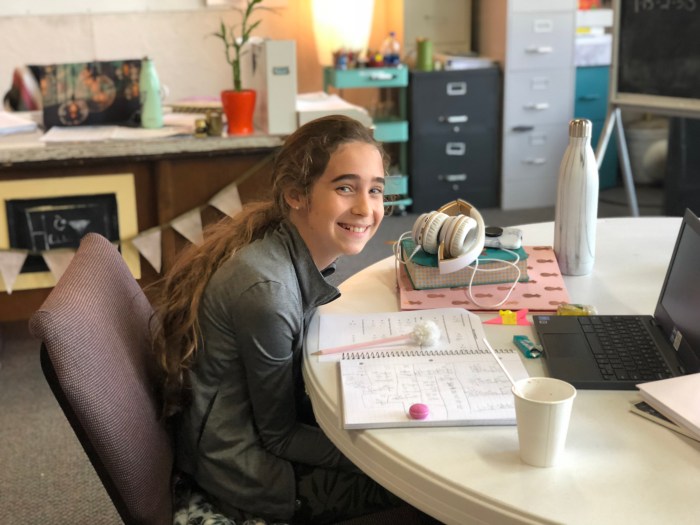
Like Strive, Docere operates in one large room, though Docere’s space is furnished and pleasantly decorated like a traditional classroom setting.
Docereclassroom

A student at the Docere Academy of Arts

Docere embraces John F. Kennedy’s view that, “This country cannot afford to be materially rich and spiritually poor.”

“…my hope and vision is to see a school for girls that starts with the Bible as our foundation for all subjects and to inspire a love for learning and discovering God’s truths through academia and the arts,” the school’s Director and instructor,  Jaymie Starr, says in a standard letter to prospective families and students.

Starr said the school currently serves 11 girls in grades 7-10. As with Strive, all core classes are offered only online, with most students registered at Baker Web Academy and a few with the Junction City School District’s online program, JC Online.

There are two people on Docere’s staff according to its website, Jaymie Starr (also identified as Barbara J. Starr in other records) and her husband, Jeffery Starr.

The website says Jaymie holds an Associate’s of Biblical Studies degree from University of the Nations, which is not accredited by any recognized accreditation body. “The goal of the U of N is to teach students how to apply biblical truth practically and to fulfill the Great Commission (Matthew 28:18-20),” The university’s website says.

Jaymie completed a year of teacher training from U of N through their satellite campus in Tyler, TX.  The program, Teachers For The Nations (TFN), says it teaches how to “train the student to prepare and present Biblically-based lesson plans for every subject in the curriculum.”

According to Docere’s website, Jaymie’s husband, Jeffery Starr, is a Youth Pastor at Christ’s Center Church. He also works as a middle school track and cross country coach at Junction City’s Oaklea Middle School. “I love Jesus, my family and coffee!,” he says on his Facebook page.

Although Docere’s classroom setting is superior to Strive’s, the academic performance of the individual students at Docere  is just as much a mystery. Baker Web Academy is grading them, not Docere, and the Oregon Department of Education discloses performance measures only by grade level, not by individual students.

Then there’s the money

One thing all the alternative schooling arrangements have in common is that somebody is making money.

At Docere, Strive and other private schools that access online coursework through public charter schools, the online classes may be free, but all the private schools have additional charges.

At Strive, all new students pay a $149 processing fee that also covers a martial arts uniform. Then there is a $99 a month charge for a required martial arts class twice a week. In addition, tuition is $300 a month, which covers field trips and instruction in things such as robotics, music, art and first aid. That translates into $3740 for a school year for a new student.

If the school was operating at capacity, it would generate $56,100 of revenue over a 9-month school year. “You’re paying for a safe place, a safe environment,” Garcia said.

At Docere, there’s a registration fee of $100 and a monthly tuition fee of $275 per student with a $50/month sibling discount. The tuition is expected to cover the majority of costs for everything from weekly science labs, dance workshops, and art classes to cooking classes and field trips. Tuition also covers the school’s rent, activity costs, salary for the school director, payments to other teachers, tutor costs, substitutes, supplies, copies and wifi. That translates into $2,575 for a school year for a new student.

With 11 students, the school is generating $28,325 of revenue over a 9-month school year.

The big money, however, isn’t being made by the private schools.  It’s being made by the online public charter schools that provide the coursework.

These schools aren’t collecting tuition from their students. Instead, the mostly poorly performing online schools  are being supported with money diverted from the state’s brick-and-mortar public schools. The Oregon Department of Education distributes State School Fund money to each school district that sponsors a charter school; the district then passes on most of that money to the charter school.

 The Santiam Canyon School District sponsors Oregon Connections Academy, which had the largest enrollment of 3,886 students on Oct. 1, 2019. The State School Fund gave the district $30,419,216.36 for the 2018-19 school year to support that sponsorship.

Oregon law provides that a sponsoring district must pass on to its charter school at least 80 percent of its per-pupil grant for K-8 students and 95 percent of its per pupil grant for grade 9-12 students.

The Santiam Canyon School District chose to retain 1% ($304,192.16) of the State School Fund money it received and then to charge Oregon Connections Academy 3.5% ($1,054,025.85) of the balance as a management fee for the provision of services for the 2018-19 school year. That translated to $1,358,218.01 in revenue to the Santiam Canyon School District and $29,060,998.35 in revenue to Oregon Connections Academy.

Distributions to all the Oregon school districts sponsoring online public charter schools that year are shown below:

County District sponsor Charter school SSF $ rec’d
Linn Santiam Canyon SD 129J Oregon Connections Academy  $  30,419,216.36
Coos North Bend SD 13 Oregon Virtual Academy  $  14,510,307.99
Baker Baker SD 5J Baker Web Academy  $  14,147,825.08
Clackamas Estacada SD 108 Summit Learning Charter  $    8,616,826.86
Wheeler Fossil SD 21J Fossil Charter School  $    5,856,698.56
Multnomah Gresham-Barlow SD 10J Metro East Web Academy  $    4,047,657.29
Clackamas North Clackamas SD 12 Clackamas Web Academy  $    3,511,076.97
Wheeler Mitchell SD 55 Cascade Virtual Academy; Destinations Career Academy of Oregon; Insight School of Oregon-Painted Hills  $    3,409,914.44
Harney Frenchglen SD 16 Silvies River Charter School  $    3,367,207.13
Marion Gervais SD 1 Frontier Charter Academy  $    2,350,696.75
Lane Marcola SD 79J TEACH-NW  $    2,348,684.27
Jackson Eagle Point SD 9 Crater Lake Academy  $    2,256,338.83
Harney Harney County SD 4 Oregon Family School  $    2,032,711.22
Lake Paisley SD 11 Paisley Charter School  $    1,618,021.06
Yamhill Sheridan SD 48J Sheridan All Prep  $    1,047,705.30
Lane Fern Ridge SD 28J West Lane Technology Learning Center  $        579,874.37
Linn Scio SD 95 Oregon Virtual Education  $        232,202.48

Source: Oregon Department of Education

     Oregon’s State School Fund sent $100,352,964.96 to school districts sponsoring online public charter schools for the 2018-2019 school year.

All that money for a mostly substandard education and mediocre results.

Some State School Fund money may also be leaking back to the parents of the online students in the form of cash, debit cards or school-controlled accounts that students and their families are supposed to use for school-related purposes.

In a late 2019 posting to the Junction City School District’s districts website, Rodden-Nord  alleged that some online public charter schools are using State School Fund money to give their students “stipends”  that ranged from $900 per student to at least $2000 per student. “A handful of Junction City families seeking a release from our district to attend a virtual charter program have expressed that they do not want to do JC Online (the district’s online program) because we do not provide such a stipend and they need it, or want it,”  Rodden-Nord said.

The TEACH-NW website confirms that annual so-called “allotments” will be made to students in the 2019-2020 school year as follows, with amounts allocated based on initial enrollment quarter:

According to Phillip Johnson, the Director at TEACH-NW,  allotments can be used to cover academic materials such as textbooks, school supplies, curriculum materials, approved instructional programs (i.e. music, dance), enrichment experiences, educational subscriptions, educational fees, tutoring services, some athletics fees and equipment, field trips, and internet expenses as approved by the student’s Educational Facilitator (assigned teacher).

“All expenditures are closely monitored (daily) by our account supervisor,” Johnson said. “Families do have access to a program issued debit card which is under the direct control of our program (activation, deactivation, loading). We also process reimbursements for those families who prefer to not use their debit card. All expenditures must be directly linked to the student’s Individual Learning Plan (ILP) which is aligned to state standards.  Failure to maintain program compliance results in allotment suspension.”

Amber Jallo, Enrollment Manager at the Fossil Distance Learning Program, said her school also supplies funds to families. “We supply $1500 of ed funds,” she said. “This breaks down to be $750 per semester. These funds can be spent on curriculum, field trips and enrichment.”

Jim Smith, Superintendent of the Fossil School District, added,  “We provide educational funds to purchase curriculum and instruction.  All purchases must meet all requirements provided in our policies. Our students can currently use these funds for curriculum, educational supplies, tutoring, instruction, and field trips.”

Daniel Huld, Superintendent of Baker Charter Schools, said they don’t provide students with any such stipends.

Even if online public charter schools do give some of their State School Fund money to students or their families, they may not be breaking any rules if the funds are intended to be used for school-related expenses.  “To our understanding there is nothing that explicitly prohibits this in the charter school statutes, or in state law that speaks specifically to this issue,” said Jenni Knaus, a Communications Specialist at the Oregon Department of Education.

_______________________

I get it that the alternative education choices reflect a lack of confidence in traditional educational institutions. However, despite the almost messianic belief in alternative schooling held by many supporters, it’s clear from the facts on the ground that they have not found the promised land.

A close look reveals a brutal truth — there are major flaws in many of the alternative options being chosen by Oregon parents and the damage being inflicted on their children could be severe.

All Oregonians, particularly the legislature and governor, should care because education is not just a private good.  Studied indifference or washing our hands of the consequences of educational malfeasance can have serious consequences for the community at large.

As Chester Finn Jr., Distinguished Senior Fellow and President Emeritus at the Thomas B. Fordham Institute, put it, “Once you conclude that education is also a public good—one whose results bear powerfully on our prosperity, our safety, our culture, our governance, and our civic life—you have to recognize that voters and taxpayers have a compelling interest in whether kids are learning what they should…”


Want a free Corvette? Too bad if you live in Oregon.

The owners of a legendary collection of Corvettes are giving them away. Yep. GIVING them away.

The collection consists of 36 Corvettes, one from each production year between 1953, when the car debuted, and 1989. According to the New York Times, the ’53, one of only about 100 that still exist, has been through a 4,000-hour restoration.

53corvette

The original 1953 Corvette

The cars, which have been stored in various garages over the years, are now in a space on New York City’s Lower East Side.

The owners have set up a group called Corvette Heroes and have promised money from ticket sales to the National Guard Educational Foundation. One ticket — one chance to win one of the Corvettes — costs $3. There are discounts for larger purchases: five tickets are $10, 20 tickets go for $25 and so on, up to 7,200 tickets for $5,000, according to the schedule on the Corvette Heroes’ website.

The 36 winners will be chosen at random, said Scott Heller, one of the owners. Another drawing will decide which winner gets which Corvette.

But you can’t enter the sweepstakes if you’re an Oregon resident.

I discovered this when filling out an online entry form today. Every state was listed as an option on the sweepstakes site —- except Oregon. Huh! What’s up.

I went to the site’s FAQ and found this at the top:

Why are you are missing the state of Oregon? The time is February 14, 1859 and the beautiful state of Oregon becomes the 33rd state in our great nation, and for some reason the state attorney general won’t allow us to run our sweepstakes there. Sorry about that but if you are the winner, you need to be a resident of any state, except Oregon. We truly are sorry for this.

Too bad, Oregonians. You can buy one or more of a slew of lottery tickets. You can play video lottery games. You can do online sports betting.

But no Corvette Sweepstakes..

_______________

Hmmm. I wonder. What if a relative or friend who lives in another state enters at your request and wins? They could give the car to you, right?

Nobody’s watching the Democratic debates. Does it matter?

Just 1.9% of Americans watched the Dec. 19 Democratic presidential debate.

APTOPIX Election 2020 Debate

The way things are going, the audience for the 10th and last 2020 Democratic Party presidential debate on Feb. 24, 2020 will be zero.

A total of 15.26 million viewers watched the first debate on June 26, 2019. By the most recent debate on Dec. 19, the number of viewers had sunk like a stone to 6.17 million.

That’s a miniscule 1.9% of Americans.

But it doesn’t matter. What really matters is how the media of all types, particularly social media, interpret the debates to the public and grab elements of the debates to advance agendas.

Social media is the dominant influencer because:

  • National television news has a steadily shrinking audience. In the 2016 presidential race between Hillary Clinton and Donald Trump, only 10 percent of people said national nightly network television news was the most helpful news source.
  • Print newspapers have a steadily shrinking audience. Total circulation of U.S. daily newspapers today, for a U.S. population of 329 million, is less than in 1940, when the U.S. population was 132 million. In the 2016 presidential election, as many people named late night comedy shows as most helpful for political news as named a print newspaper.
  • Local TV news tends to focus on murders, fires, car crashes and the weather, not presidential politics.

Regardless of the issues discussed by the 10 Democrats during the 120 minutes of the second night of the first debate on June 27, 2019, it was a terse exchange between Kamala Harris and Joe Biden about busing that dominated subsequent coverage of the debate and online discussion. “Kamala Harris attacks Joe Biden’s record on busing and working with segregationists in vicious exchange at Democratic debate”  proclaimed the CNBC headline.

Similarly, regardless of the consequential issues discussed by the seven Democrats during the 120 minutes of the Dec. 19 debate, the media, including social media, focused on:

  • Who “won” the debate.
  • Assertions that “the knives came out” for Pete Buttigieg.
  • The vile wine cave.  Elizabeth Warren castigated Buttigieg for holding a fundraiser with rich people in a Napa Valley “wine cave.” Politico reporter Natasha Korecki said that was “the most entertaining” part of the debate. “ The conservative National Review headline read, “Biden Cruises and Buttigieg Takes Fire in the Wine Cave Debate.” The left-leaning Mother Jones said, “The “Wine Cave” Debate Was One of the Campaign’s Most Consequential Arguments.” And the story still has legs. On Sunday, Dec. 22, the New York Times ran a story relating the frustration and disappointment of the wine cave’s owners, both of whom are active Democrats, at being thrust into the public eye in such a negative manner.
  • Elizabeth Warren’s statement that economists are “just wrong” when they argue her proposals for trillions in new taxes will stifle growth and investment.
  • It was a testy night. “The political press, always thirsty for conflict, pounced,” the Columbia Journalism Review noted. “In a push notification, the New York Times alerted readers that we’d seen a “contentious evening”; Dan Balz, of the Washington Postnoted that a “collegial start” had given way to “fireworks.” There was talk of gloves coming offpummeling, and slugfests, and that was just from Politico. Another Politico piece listed the “five most brutal onstage brawls” of the night, complete with a tally chart and boxing-glove emojis.”
  • Diversity is what matters. Time pointed out that the only non-white candidate on stage was Andrew Yang.“This forced the uncomfortable conversation about how the party that talks so big about including diverse voices and that depends on minority voters ended up with such a white set of candidates in a field that was, at one point, historically diverse,” Time said.

In any case, what the American public really cared about, some media observed, wasn’t the debate but the upcoming release of Star Wars: The Rise of Skywalker. The first item in the Dec. 21, 2019 NY Times On Politics newsletter referenced this. “It appears nobody consulted the Jedi Council before scheduling a Democratic debate on the same night “Star Wars: The Rise of Skywalker” opened, the newsletter noted.

Lots of folks have chimed in about all the debates on social media, but they’ve mostly talked to others in their bubble in response to algorithm-delivered news content. As noted in Towards a New Enlightenment? A Transcendent Decade“… the emergence of the political “Twitterverse,” … has become a locus of communication between politicians, citizens, and the press, has coarsened political discourse, fostered “rule by tweet,” and advanced the spread of misinformation.”

tweet

Twitter discourse on national politics also tends to be driven by a very small segment of the population. According to the Pew Research Center, Twitter dialogue by American adults about national politics is driven by a small number of prolific political tweeters. They make up only 6% of all U.S. adults with public accounts on the site, but account for 73% of tweets from American adults that mention national politics.

Furthermore, as a Knight Foundation study  put it, Twitter is “a distorted mirror of Americans’ political views,” because it is dominated by the center left, countered by the extreme right.

Facebook plays a major role in the political debate, too, and not in a good way. As the Columbia Journalism Review reported, “Facebook is a toxic town square.” And that makes it dangerous because, it’s a primary source of political news for a growing segment off the public. A recent study conducted by the Pew Research Center estimated, for example, that more than 60% of Americans got their information about the 2016 US presidential election on Facebook.

Instagram has a growing place in public perception of politics and the debates, too, and could be a flashpoint for online disinformation during the 2020 election. “Disinformation is increasingly based on images as opposed to text,” said Paul Barrett, the author of an NYU report that’s prompted a renewed look at the problem. “Instagram is obviously well-suited for that kind of meme-based activity.”

It’s an engagement powerhouse that attracts far younger users than its parent company, Facebook, according to the NYU report  The report cited a Senate Intelligence Committee report that noted the Internet Research Agency — which led Russia’s disinformation campaigns in the 2016 election — found more engagement on Instagram than any other platform.

So, does it matter whether  fewer and fewer people are actually watching the Democratic debates? Probably not.


The University of Oregon’s School of Journalism and Communication: top notch…or not?

“You’re the top,” wrote lyricist Cole Porter. A lot of Oregonians feel that way about the University of Oregon’s School of Journalism and Communication (SOJC).

SOJClogo

Graduates have a lot of pride in their school. One of the top journalism schools in the country, its champions say.

I’ve been a guest lecturer there and I’ve been impressed with the inquisitive students.

UOlecturehall

Nothing wrong with hometown pride, but does the school deserve the accolades? As a former reporter at The Oregonian, corporate communications manager and still a journalist, I wanted to know the answer.

With dead newspapers across the country, massive personnel cutbacks, and turmoil even at digital news sites, what are the prospects for the 646 students who earned a Bachelor’s degree and the 43 who earned a Master’s or PhD from the SOJC during 2018-19, one of the largest graduating classes in the program’s history?[1]

In many areas, the prospects are poor. “2019 crystallized something media people have known to be true for a while: While digital media dries out in the wake of the VC funding boom of the 2010s, and the country’s regional newspapers are swallowed by corporate consolidation and hedge fund vultures, there is very little stability to be found anywhere,” Maya Kosoff wrote on Dec. 16 in Gen, a Medium publication about politics, power, and culture. “If 2019 signaled a change, it was the realization that not only is the ship sinking, but that there aren’t any lifeboats.”

But SOJC is optimistic. “Today’s thriving creative and media economy offers a wealth of exciting career paths…,” says the SOJC’s website. “No matter which of our four majors you choose, you’ll get a strong foundation and the professional skills and connections to succeed.”

True or academic hyperbole?

wearenumberone

There are almost 500 U.S. schools with higher education journalism programs. Of those, there are 117 schools accredited by the Accrediting Council on Education in Journalism and Mass Communications (ACEJMC), including the University of Oregon’s SOJC.

Leaving aside the question of whether a journalism degree is even a necessary prerequisite for anybody entering the field (After all, Carl Bernstein of Watergate fame dropped out of the University of Maryland and Chuck Todd,  moderator of NBC’s Meet the Press, dropped out of George Washington University), which undergraduate journalism school is the best?

Where does the University of Oregon’s SOJC stand in the rankings? From a mercenary point of view, which program will generate the best pay?

It’s tricky to rely solely on college ranking systems to pick the best journalism school. There are multiple ranking systems and they are all over the map in their selections and the factors they take into account. I recall one highly regarded college rating program, for example, that threw into the mix how many graduates joined the Peace Corps.

The ranking systems also change every year as ideas about how best to measure quality in education change.

U.S. News & World Report says, for example, “over time, the ranking model has put far less emphasis on input measures of quality – which look at characteristics of the students, faculty and other resources going into the educational process – and more emphasis on output measures, which look at the results of the educational process, such as social mobility, six-year graduation and first-year student retention rates.”

Niche lists the University of Oregon 101st in its “2020 Best 4-year Colleges for Communications in America.” Niche is not, however, as prestigious or as often referenced as other ratings services.

College Factual, another data analytics website for higher education, says U of O is 29th in its list of 2020 Best Journalism Colleges in the U.S.”

Journalism-Schools.com ranks the University of Oregon’s SOJC 74th in the nation.

QS World University Rankings ranks the University of Oregon 151st in North America among colleges offering Communication & Media Studies programs.

The highly regarded Forbes America’s Top Colleges 2019 places the University at #191, but doesn’t break down data by major.

Another well-regarded survey, U.S. News & World Report’s U.S. News Best Colleges, places the University of Oregon 104th among national universities, but also doesn’t rank the SOJC.

Do you go with Penn State’s Donald P. Bellisario College of Communications because it’s the biggest program, with 2,670 students in the fall of 2018? How about the University oi Missouri School of Journalism because it was founded in 1908 and is the oldest program? Maybe Columbia University’s Columbia Journalism School because it is uniquely positioned in the media capital of the world and is the home of the Pulitzer Prize? Or the University of Oregon because you plan to stay and work in the Northwest and the SOJC has over 17,000 alumni who could serve as contacts and mentors?

As a paper from the Knight Foundation, which promotes excellence in journalism, put it, “The best journalism school in America is … a mystery. There’s no sensible system for comparing programs or knowing if they are really healthy. The measurements schools now file…turn out to be about as useful as a jumble of mismatched socks.”

How about comparing how the graduates of journalism programs do in the workplace?

How does earning a degree from the University of Oregon’s SOJC work out in terms of finding a good job and moving up the pay ladder?

I asked the school:

  • Does the SOJC attempt to track the career paths of its graduates?
  • If yes, where are the graduates in their careers? Have the recent grads found jobs in their field of study? Are earlier grads still working in their fields of study?
  • What are SOJC grads earning?

“We love our alumni” and “Our alumni mean the world to us,” the SOJC says on its website, but it doesn’t keep track of them.

To my considerable surprise, the OSJC said it didn’t know the answers to my questions. “I can tell you that we do not have job placement data or salary data,” Andra Brichacek, then the OSJC’s  Interim Communication Director, told me earlier this year.

There are, however, other sources of data.

According to the U.S. News & World Report College Compass, median starting salaries by major for alumni of the University of Oregon are:

  • $45,300 for Journalism graduates
  • $46,500 for Public Relations and Advertising
  • $43,600 for Communication and Media Studies

College Factual, a privately-run website designed to assist in college selection, says SOJC journalism graduates earn an average of $37,000 when starting their career and $66,000 at mid-career. This compares with:

  • an average starting salary of $34,766 and a mid-career salary of $62,908 for journalism graduates across the United States.
  • an average starting salary of $36,000 and mid-career salary of $65,000 at mid-career for journalism graduates of the University of Missouri – Columbia
  • an average starting salary of $38,000 and mid-career salary of $87,000 for journalism graduates of Northwestern University.
  • An average starting salary of $44,000 and mid-career salary of $72,000 for journalism graduates of New York University.
  • An average starting salary of $41,000 and mid-career salary of $86,000 for journalism graduates of the University of Southern California.

The U.S. Department of Education is another source of earnings data.

collegescorecard

Under an Obama administration initiative, the government published schoolwide data on debt and earnings for undergraduates. In November 2019, the Trump administration expanded the program by publishing new data allowing comparisons of first-year earnings of graduates based on their college major.

Earnings were measured in 2016-2017 for students who graduated in 2014-2015 and 2015-2016, which are fairly recent.

The data, released as the U.S. Department of Education’s College Scorecard, are based on information provided through federal reporting from institutions, data on federal financial aid, and tax information.

A key weakness of the Scorecard is that the earnings and debt data are based only on students who either took out a federal student loan or received a federal grant in college. Scorecard also doesn’t report the percentage of entering students at every school for which it has earnings data.

Scorecard also calculated student college loan debt to help prospective students determine their ability to repay it considering their expected earnings after graduation.

According to Scorecard, median annual earnings of bachelor’s degree SOJC graduates in their first job were $27,800; for SOJC graduates with a bachelor’s degree in Public Relations, Advertising and Applied Communication median annual earnings were $36,200.

This compares with median annual earnings in their first job of:

  • $37,300 for journalism graduates and $33,900 for Communication and Media Studies graduates of the University of Missouri – Columbia.
  • $42,000 for journalism graduates and $42,600 for Communication and Media Studies graduates of Northwestern University.
  • $33,500 for journalism graduates and $42,900 for Communication and Media Studies graduates of Boston University
  • $40,600 for journalism graduates and $39,200 for Communication and Media Studies graduates of the University of Southern California.

Then there’s a database is provided by Payscale, a salary negotiation tool. Their College Salary Report database provides self-reported earnings data by college for alumni who use their website tool.

Only nonprofit or public schools for which PayScale has a statistically significant sample are included.  Salary figures combine base annual salary or hourly wage, bonuses, profit sharing, tips, commissions, overtime, and other forms of cash earnings, as applicable.

Based upon PayScale survey data*, students graduating from the University of Oregon with accredited degrees in Journalism realize early-career earnings of $37,201 and mid-career earnings of $66,153.

For comparison, students graduating from the University of Missouri – Columbia Based with a degree in Journalism will have average early-career earnings of $36,000 and average mid-career earnings of $65,000.

What else might be relevant in comparing programs?

College Scorecard shows how much student loan debt people can expect to owe based on their choice of major. Not only is that useful information overall, but the presumption is that the lower the ratio of student debt to income is for a given major, the higher the value of the investment in that major.

At the University of Oregon, median total debt for graduates with a degree in journalism is $21,030. For graduates with a degree in public relations, advertising and applied communication it is $21,500.

Compare that with the University of Missouri – Columbia: median total debt for students with a degree in Journalism is $23,250 and median earnings are $37,300; median total debt for students with a degree in Communication and Media Studies is $23,250 and median earnings are $33,900.

So, now where does the University of Oregon’s SOJC stand? Hard to tell.

First, it needs to be understood that the ranking programs are unreliable. No matter what the ranking factors and algorithms, it’s been widely reported that schools game the system and falsify data. There have been efforts, for example, to manipulate faculty salary reports, alter reported class sizes, highlight academic expenditures and minimize administrative overhead, and even give low ratings to competing schools and programs.

In 2019, Richard Vetter, who had administered Forbes’ Best Colleges rankings, wrote a Forbes article, Are Universities Increasingly Liars And Con Artists,” I think one consequence of the moral decline is that universities increasingly lie and cheat, both their customers (students) and the general public,” he wrote.

Jason Brennan and Phillip Magness wrote in Cracks in the Ivory Tower: The Moral Mess of Higher Education that universities engaged in a wide range of highly deceptive marketing and other practices that were  morally untenable.

With all this understood, the University of Oregon’s SOJC probably isn’t at the top overall, but for an individual student it might be.

I’m not trying to be wishy-washy. I know that, as with talk radio hosts, nuance can be difficult for an opinion writer.

But just an evocative photo of a bucolic campus doesn’t tell the whole story about a college, ratings are only part of the story.  Evidence suggests enrolling at a top-tier university with a highly ranked journalism/communications program isn’t necessarily key to getting a good education or having a successful career in those fields.

While there is some evidence that a college’s quality (or its reputation for quality) can have an impact on professional success, it may be a massive institutional deceit that obtaining a journalism degree at one well-regarded college versus another school is critical.

A research effort by Gallup, in partnership with Purdue University and Lumina Foundation, found there’s no difference in subsequent workplace engagement or a college graduate’s well-being if they attended a highly selective institution or a top 100-ranked school in U.S. News & World Report.

The study found it was students who were closely engaged with faculty or participated in an internship-type program who were more likely to be engaged at work and have high well-being after graduation.

The study also found a relationship between the level of student debt and a graduate’s well-being and working experience. “It turns out that student debt…hinders the individual life prospects of students who borrow too much of it,” said Purdue President Mitch Daniels.

In addition, graduates who had at least one professor who made them excited about learning, cared about them as a person, and was a mentor, had more than double the odds of being engaged at work and thriving in well-being.

Then there was the time-to-graduation factor. The Gallup-Purdue research revealed that graduates who finished their degrees in four years doubled their odds of being engaged at work and that more thrived.

So, despite my plan to reach a firm conclusion on where the University of Oregon’s SOJC stands in the panoply of options, I’m going to leave you a bit up in the air with, “It depends.”

You will have to just gather all the needed information and decide for yourself.

As the leadership scholar Robert Greenleaf observed, “On an important decision one rarely has 100% of the information needed for a good decision no matter how much one spends or how long one waits. And, if one waits too long, he has a different problem and has to start all over.”

__________________________________

[1]

Bachelor’s degrees by concentration:

Journalism: 141

Advertising: 308

Media Studies: 16

Public Relations: 218


Master’s and PhDs by concentration:

Advertising and Brand Responsibility: 11

Journalism: 10

Media Studies: 4

Multimedia Journalism: 8

Strategic Communication: 10

Source: University of Oregon School of Journalism and Communication


Compassion without limits: Multnomah County wants more money to address homelessness

homeless1daymaintrash

It looks like Multnomah County has a vested interest in sustaining homeless problems.

On Thursday, Dec. 5, the Multnomah County Commission is scheduled to vote on whether to send a steadily increasing amount of hotel, motel and motor vehicle rental taxes intended for spurring tourism in the Portland metro area to programs aimed at addressing homeless problems in the the county.

Portland’s City Council and the Metro Council have already given their OK to the plan. It would involve amending a Visitor Facilities Intergovernmental Agreement (VFIA) originally signed in 2001.

If you just looked at the agenda for the Dec. 5 Commission meeting, you probably wouldn’t know what’s going on. Agenda item R.6 says:

“Resolution approving the Second Amended and Restated Visitor Facilities Intergovernmental Agreement (Second Amended and Restated VFIGA) between the City of Portland, Multnomah County, and Metro Regional Government. Presenters: William Glasson and Eric Arellano. (10 min)”

What does homelessness have to do with tourism, you might ask.  Bureaucrats and politicians have an answer. The resolution says dealing with homeless problems will “improve the visitor experience”. Specifically, it says:

“The Parties recognize that the area’s economic success has not been uniformly shared by the community and a vulnerable portion of the population has been negatively impacted by rapid increases in housing costs. An increased allocation from the (Visitor Facilities Trust Account ) VFTA as an additive source of funds to support the significant existing regional investments in affordable housing and supportive services to address the root causes of homelessness and its associated livability and safety concerns is appropriate, and will (i) improve conditions for the community and people experiencing homelessness, (ii) improve the visitor experience, and (iii) help Portland remain a desirable travel and tourism destination.”

And without saying so directly, the resolution seems to assume the homeless problem won’t get better with the additional money because the amount going to Multnomah County would steadily increase, more than doubling by 2022. In other words, it looks like the county does better if homelessness persists.

An analysis of the resolution prepared by the Department of County Management says:

“This funding will pay for livability and supportive services, and related operations costs, supporting programs and projects funded by proceeds of the City and Metro bonds approved by voters in 2016 ($258.4 million) and 2018 ($652.8 million)  affordable housing bond measure , respectively, to create affordable homes for low-income individuals.”

Multnomah County already gets $750,000 a year. If the resolution is approved, that would significantly increase to:

  • $2,500,000 in fiscal year (FY) 2019-20 and FY 2020-21,
  • $3,250,000 in FY 2021-22
  • $3,775,000 in FY 2022-23
  • $5,250,000 for FY 2023-24 and beyond.

In other words, the Portland Metro Area is already stressed spending millions every year fighting homelessness, recent bond measures promise much more, and now Multnomah County wants to grab even more (from tourism revenue, no less) to grow its homelessness bureaucracy, feed social-services providers and hype its compassion.

Is this really necessary?

Today may be “Giving Tuesday,” but do we really need to starve other community priorities, bastardize the meaning of tourism promotion, and embrace compassion without limits by endorsing measures like this?

Galling presidential pardons: a bipartisan thing

On Nov. 15, President Trump intervened in the cases of three U.S. service members accused of war crimes.

pardons

Trump signed an Executive Grant of Clemency (Full Pardon) for Army First Lieutenant Clint Lorance, an Executive Grant of Clemency (Full Pardon) for Army Major Mathew Golsteyn, both of whom were accused of murder in Afghanistan, and an order directing the promotion of Special Warfare Operator First Class Edward R. Gallagher to the grade of E-7, the rank he held before he was tried and found not guilty of nearly all of the charges against him.

In taking this action, Trump incurred the wrath of politicians, pundits and many in the general public.

A U.S. defense official told CNN that there’s concern among the department’s leadership that Trump’s pardons could undermine the military’s justice system. CNN and the New York Times also reported that senior Pentagon leadership, including Defense Secretary Mark Esper, urged Trump not to intervene in the three cases.

According to Task & Purpose,  a news site covering the military, several former military leaders echoed the same concerns.

“As President Trump intervenes in war crimes cases on behalf of individuals accused or convicted of war crimes, he … undermines decades of precedent in American military justice that has contributed to making our country’s fighting forces the envy of the world,” Gen. Charles Krulak, former commandant of the Marine Corps, said in a statement.

“I can honestly say I have not talked to a single military officer who would be in favor of pardoning any one of these three,” Gary Solis, a combat veteran and former military attorney who now teaches the laws of war at the Georgetown University Law Center and the George Washington University Law School, told Military.com.

But as contemptible and unwise as Trump’s actions are to many, he is hardly the first president to take such questionable actions.

Barack Obama issued 212 pardons and 1,715 commutations, including one of a 35-year prison sentence given to former U.S. Army soldier Bradley/Chelsea Manning for the largest leak of classified data in U.S. history to WikiLeaks.

President Bill Clinton, never one to be embarrassed by his actions, pardoned his brother Roger Clinton after Roger served a year in prison after pleading guilty to cocaine distribution charges.

In August 1999, President Bill Clinton also commuted the sentences of 16 members of FALN, a Puerto Rican paramilitary organization that had set off 120 bombs in the United States, mostly in New York City and Chicago. The commutation was opposed by the U.S. Attorney’s Office, the FBI, and the Federal Bureau of Prisons and  Congress condemned Clinton’s action by votes of 95–2 in the Senate and 311–41 in the House.

But Clinton’s most egregious pardon was one he issued on his last day in office, January 20, 2001, when, against the advice of White House aides he pardoned Marc Rich, a former hedge-fund manager. Rich had fled the U.S. during his prosecution and was living in Switzerland at the time. Rich owed $48 million in taxes and had been charged with 51 counts of tax fraud.

ThatsRich

Marc Rich

At the time of the pardon, Rich was No. 6 on the government’s list of most wanted fugitives and had been on the lam, albeit a luxurious one, for 16 years, ever since his 1983 indictment by a grand jury.

Rich’s ex-wife had donated to the Democratic National Committee, the Clinton Presidential Library and Hillary Clinton’s New York Senate campaign, raising considerable suspicion about the pardon and leading former President Jimmy Carter to call the pardon “disgraceful.”

A New York Times editorial called the pardon “a shocking abuse of presidential power.” The liberal New Republic said it “is often mentioned as Exhibit A of Clintonian sliminess.” Not that such allegations ever seemed to bother the Clintons.

And the Clintons reaped benefits from the pardon even after Rich’s death in 2013, as Rich’s former business partners, lawyers, advisers and friends continued to shower millions of dollars on the Clintons.

Of course, Clinton isn’t the only “last day in office” pardoner. Remember Peter, Paul and Mary? In 1970, Peter Yarrow was convicted of taking “improper liberties” with a 14-year-old fan, for which he spent three months in jail. On his last day in office, President Jimmy Carter granted Yarrow a pardon.

President George H.W. Bush was roundly condemned for pardoning, commuting the sentences and rescinding the convictions of six people convicted in the Iran-Contra arms-for-hostages scandal during Reagan’s presidency,

Reagan stepped up, too, pardoning New York Yankees owner George Steinbrenner after he pleaded guilty to illegally contributing to Nixon’s campaign.

Then there’s Nixon. In 1974, President Gerald Ford granted a “full, free and absolute pardon” to his predecessor Richard Nixon “for all offenses against the United States.” This broadly unpopular action was the only time a president has received a pardon. It caused a huge firestorm because Nixon was so unpopular and because there was suspicion that Ford secretly promised to pardon Nixon in exchange for him resigning and allowing Vice President Ford to succeed him.

So much for punishing bad behavior.

Defending the dedicated employees of the U.S. Department of State: you can help

Former U.S. Ambassador to Ukraine Marie Yovanovitch

Former U.S. ambassador to Ukraine Marie L. Yovonovitch (center), whose abrupt ouster in May has become a focus of House impeachment investigators.

U.S.  State Department officials have stepped up to at great personal risk to testify before Congress or speak out publicly about the Trump Administration’s’ foreign policy improprieties. One of the costs of their courage is legal expenses.

Early in my professional career, when I was heavily involved in international treaty negotiations, I worked closely with talented Foreign Service Officers and other employees at the Department of State. To a man and woman, they were there because of their love of country and unwavering commitment to its best ideals. They deserve Americans’ support.

U.S._Department_of_State_official_seal.svg

Here’s a way you can help.

The American Foreign Service Association (AFSA) has a Legal Defense Fund (LDF) to provide financial assistance to members in cases involving issues of significant institutional importance to the Foreign Service.

Sometimes cases come along where AFSA is unable to provide the time or legal expertise that is required. It is in such instances that the LDF can provide financial support which assists the member in retaining an outside attorney with expertise in a particular area of law. “Unfortunately, this is one of those times,” the AFSA says. “We have members in need as a result of the ongoing Congressional impeachment investigation. “

I just made a contribution. If you agree, put your money where your mind is and make a contribution, too.  (Donations to the LDF are not tax deductible.)

 For more information and donation instructions, visit:

American Foreign Service Association’s Legal Defense Fund


Oregon Connections Academy/Oregon Charter Academy: another failing online charter school

orcanarrowlogo

Oregon Connections Academy (ORCA), an online statewide charter school with 153 teachers serving about 4500 students, has been placed on the state’s a federally mandated improvement list. (The school was renamed Oregon Charter Academy in the 2020-2021 school year)

I’m not surprised.

I took a close look at ORCA in 2017 and it was clear the school had problems, but I figured things might get better. They haven’t.

Just look at the numbers.

Only 21.9 percent of tested students at the school met or exceeded  math standards in 2018-2019, down from an already abysmal 22.7% in 2017-18.

English language arts (ELA) achievement has been poor, too. Only 41.8% of tested students met or exceeded ELA standards in 2018-2019 and an average of just 42.8% met or exceeded the standards over the past three school years.

School attendance is dreadful as well. Regular attendance during the 2018-19 school year was only 63.4%, and an average of 59.7% over the past three school years. That indicates chronic absenteeism. In 2018 – 2019, just 71% of the school’s students attended more than 90% of their enrolled school days.

Then there are graduation rates and college attendance. Graduation rates at all Oregon public schools, including virtual charters, are calculated the same way by the Oregon Department of Education (ODE) as an “adjusted cohort graduation rate.” That rate is the percentage of all students who graduate from high school with a diploma within a four-year cohort period after they start 9th grade.

Only 57.1% of students in ORCA’s 2014-15 cohort graduated in four years and an average of 61.1% in the past three school years. There was no improvement with students in ORCA’s 2015-16 cohort, who were seniors in 2018-2019. Only 57% of those students graduated in four years.


Oregon 2014-15 Cohort Rates for Students Entering High School in 2011-12: 73.82%

Oregon 2017-18 Cohort Rates for Students Entering High School in 2014-15: 78.70%


And of ORCA’s graduates, only 41% enrolled in a two or four year college within one year of completing high school, as reported by the National Student Clearinghouse.

WHY DOES OREGON TOLERATE THIS?

ORCAgraduation

An Oregon Connections Academy graduation ceremony

ORCA’s performance fits with national statistics for online charter schools. Nearly three-quarters of students enrolled in virtual charters are attending a high school where fewer than half graduate in four years, according to an analysis by the Education Week Research Center.

I’ve written before about Oregon’s virtual public charter schools. New data reveals that Oregon Connections Academy, and Oregon’s public virtual charter schools as a whole, are still failing their students and the parents who enroll them.

A recent study highlighted by Chalkbeat, an education newsletter, found that students who attended an online charter school in Georgia saw large declines in test scores. Of equal concern, the study concluded that ever attending a virtual school is associated with a 10-percentage point reduction in the probability of ever graduating from high school. “This is early evidence that full-time virtual schools as a type of school choice could be harmful to students’ learning and future economic opportunities, as well as a sub-optimal use of taxpayer money,” the study reported.

________________________

Suggested readings:

OREGON’S PUBLIC VIRTUAL CHARTER SCHOOLS DON’T COMPUTE

ALTERNATIVE SCHOOLING IN OREGON: IS THE CURE WORSE THAN THE DISEASE?

__________________________

Despite that truth, the schools, also called cyber and online schools, are multiplying like fruit flies. Supporters are intoxicated by their potential and doubters are being pummeled as technical Neanderthals unwilling to accept change.

Virtual charters have taken root across the country and continue to grow, though at a slower rate than in the past.

They are part of a movement that is exploding across the country and enjoys the support of President Donald Trump. Trump has called school choice “the civil rights issue of our time” and appointed Betsy DeVos, a fierce advocate of charter schools, Secretary of Education.

“Families want and deserve access to all educational options, including charter schools, private schools and virtual schools,” DeVos said in 2015, before becoming Secretary.

On June 13, 2017, after being confirmed as Secretary of Education, DeVos told the National Alliance for Public Charter Schools, “…as a nation, we are simply not doing a good enough job educating our kids. A system that denies parents the freedom to choose the education that best suits their children’s individual and unique needs denies them a basic human right. It is un-American, and it is fundamentally unjust.”

BetsyDeVosDonaldTrump

Secretary of Education Betsy DeVos (R) with President Donald Trump

But the evidence clearly shows that within the charter school movement, the virtual charter industry is not “all about the kids.”

The growth of full-time public virtual charter schools in Oregon offers a case study of a misplaced faith in choice and technology.

ORCA, based in Mill City, is Oregon’s largest public virtual charter school. As noted earlier, its current enrollment is given as about 4500, but that number fluctuates throughout the school year.  On Oct. 1, 2015, for example, the standard date for calculating charter school enrollment in Oregon, ORCA said it had 3,789 enrolled students. But 950 students left during the school year, and others enrolled. At one point during the year, total enrollment went as high as 5,631. At the end of the school year, 4035 students were enrolled.

CLASHING SENTIMENTS

Students, parents and teachers both praise and assail ORCA.

“All in all, ORCA is a fantastic educational experience for those who don’t fit the mold for brick and mortar schools,” a student told a school rating organization.

“This was the perfect fit for our family!,” Andrea Potter Kruse posted on Facebook. “My son was bored in class and getting into trouble. There was horrible communication from the school. We made the switch and my son is loving school again.”

“…my kiddo used to hide in the back of the class and not participate during lessons,” SC wrote about ORCA on Sitejabber. “He’s currently getting the best education of his life. It works for us.”

“Our daughter…has lost motivation and doesn’t really seem to care,” Alyssa E. commented about ORCA on Sitejabber. “At this point, she does the least amount required, which is essentially a lot of busy work and multiple-choice questions.. The teachers are limited by the horrible interface and limitations of the online learning platform. Connections Academy is essentially the K-12 equivalent of the troubled for-profit colleges.”

“Unless your child…has zero interest in doing anything but sitting at the computer for 7-10 hours a day, then I really don’t think this is what you are looking for as an alternative to regular school,” said a parent. “Don’t do this to your child!”

Some teachers praise ORCA for having a hardworking professional staff, flexible schedules, and a commitment to children first.

Other teachers complain about high student/teacher ratios, a revolving door of employees, poor management and profit-driven policies. “Sometimes the bottom line is the goal and not student achievement,” said one teacher.

Both sides of the virtual charter school debate are fighting a raging propaganda war that is almost Darwinian in nature.

Virtual charter champions churn out a torrent of supportive stories, arguing that traditional schools are relics and choice wouldn’t be so necessary if traditional public schools hadn’t utterly failed to meet the needs of children.

Critics argue just as vociferously that the online schools rob traditional brick and mortar public schools of students and public money, lack accountability, exacerbate inequalities of opportunity and worst of all, fail to educate.

IN THE BEGINNING

The public charter school movement in the U.S. has moved quickly from the margins to the mainstream.

Minnesota passed the first state public charter school law in the United States in 1991. The first charter school opened 25 years ago in St. Paul, Minnesota in September 1992.

Still, the virtual public charter sector barely existed in the United States prior to 2000, but it has grown rapidly since then. The siren song of technology as an education savior, particularly for disaffected students who want a non-traditional school setting, is proving irresistible to many parents and children.

Since enacting a charter school law in 1999, Oregon has become home to 21 virtual public charter schools, according to the Oregon Department of Education:

Virtual Public Charter School

School District Sponsor

page1image3151351488

Baker Web Academy

Baker SD 5J

Cascade Virtual Academy

Mitchell SD

Clackamas Web Academy

page1image3151288656North Clackamas SD 12

Crater Lake Charter Academy

Eagle Point SD 9

Dallas Community School

Dallas SD 2

Destinations Career Academy of Oregon

page1image3151234976Mitchell SD 55

Fossil Charter School

Fossil SD 21J

Frontier Charter Academy

Gervais SD 1

Insight School of Oregon-Painted Hills

Mitchell SD

Metro East Web Academy

Gresham-Barlow SD 10J

Oregon Connections Academy

page1image3151253920Santiam Canyon SD

Oregon Family School

Harney County SD 4

Oregon Virtual Academy

North Bend SD 13

Oregon Virtual Education

Scio SD 95

Paisley School

Paisley SD 11

Sheridan AllPrep Academy

Sheridan SD 48J

Silvies River Charter School

Frenchglen SD 16

Summit Learning Charter

Estacada SD 108

TEACH-NW

Marcola SD 79J

West Lane Technology Learning Center

Fern Ridge SD 28J

Willamette Connections Academy

Scio SD 95

SHOW ME THE MONEY

Charter schools in Oregon, including virtual charters, are publicly funded, so parents don’t pay tuition. Instead, the Oregon Department of Education distributes State School Fund money to each school district that sponsors a charter school.

Oregon law provides that a sponsoring district must pass on to its charter school at least 80 percent of its per-pupil grant for K-8 students and 95 percent of its per pupil grant for grade 9-12 students.

The system leads to big disparities among sponsoring districts in what they keep and what they pass on to the charter schools. This, in turn, can lead to “sponsor shopping” by charter school operators looking for maximum financial return and minimum oversight.

Ohio once encountered an egregious example of sponsor shopping. Charter school operators there that failed to get authorized or renewed by one sponsor simply shopped around for another.

“It’s been too easy for bad schools to find accommodating sponsors to keep them going…at least partly because sponsors in Ohio have earned fees for selling services to schools even when the schools in their portfolio produce poor results,” wrote two charter school supporters, Alan Rosskamm, CEO of Breakthrough Charter Schools, and Nina Rees, president and CEO of the National Alliance for Public Charter Schools.

Under ORCA’s 2005 contract with its initial sponsor, the Scio School District, Scio kept 10 percent of the State School Fund money it received for ORCA students in grades K-8 and 5 percent of the money it received for students in grades 9-12.

In 2005-2006, that translated into $311,358, half of which Scio had to send to the home districts of its ORCA students under Oregon’s charter law at the time.

As ORCA’s enrollment grew, so did the amount of State School Fund money retained by Sic. In the 2014-15 school year, the Scio district retained $1,886,498.34, half of which it had to send to the home districts of its ORCA students.

Scio was ecstatic to see the ORCA money rolling in and looking forward to the windfall continuing.

But while the Scio District and ORCA were in the midst of negotiations on a new contract, ORCA unexpectedly jumped ship. Abandoning Scio, ORCA signed a new contract with the nearby Santiam Canyon School District. The contract began with the 2015-2016 school year.

ORCA’s switch left the Scio School District perplexed and bitter. Not only was ORCA’s departure a shock, but it meant a big hit to Scio’s budget. Scio School District Superintendent Gary Tempel called the revenue loss “devastating” to the tiny district. But the switch was a bonanza for Santiam Canyon.

Charter schools have become cash cows for many school districts that sponsor them. This is even more true since the Oregon Legislature amended the charter school law in 2015 to eliminate the requirement that the sponsoring districts send half of the money they earned back to the home districts of their students. So Santiam Canyon got to keep all of the State School Fund money it held back.

Why, out of Oregon’s 197 school districts, did ORCA decide to switch to Santiam Canyon?

It was probably no coincidence that Todd A. Miller, appointed superintendent of the Santiam Canyon District in July 2013, served as ORCA’s executive director from April 2011 – June 2013.

The other key factor was likely money.

Instead of insisting on the same deal Scio had with ORCA, the Santiam Canyon district agreed to keep just 1 percent of the State School Fund money it received for ORCA.

ORCA also agreed to pay the district a 3.5 percent management fee to support things such as state reporting, business services, special education and other support services, but the payoff to ORCA (and Scio) was still substantial.

In 2014-15, Scio had retained $1,886,498 of the State School Fund money it received because of its sponsorship of ORCA. In 2015-16, Santiam Canyon retained just $1,362,272.49 of the State School Fund money it received because of its ORCA sponsorship. Not only did Santiam Canyon come out ahead because it didn’t have to share any of its money with the home districts of ORCA’s students, but ORCA paid its sponsor $532,235 less with the switch.

Miller defended the deal. “This fee structure does pass through more funds to ORCA than they previously received, yet the school board and I felt this arrangement was balanced for both of us and helped them add additional services to support struggling students,” Miller said.

REELING THEM IN

Oregon started with tough charter school enrollment restrictions.

The state’s charter law initially required that 80 percent of a public charter school’s student body live in the sponsor’s district and that no more than 10 percent of a district’s students could go to a charter school.

Those restrictions, however, lasted only five years. Charter schools can now recruit throughout the state with no limits.

ORCA is particularly aggressive in recruiting new students. Oregonians would be hard pressed to miss the ubiquitous ORCA television ads promoting the school.

The ads, which don’t even use the words “charter school,” are persuasive blends of Wall Street and Madison Avenue that fit right in with Connections Academy’s profit-driven culture.

The result has been a rapid expansion of enrollment at ORCA and other Oregon virtual charters.

Even though I said earlier that ORCA has about 4500 students, it’s actually hard to pin down exactly how many students attend Oregon’s virtual public charter schools at any given time. That’s because enrollment fluctuates wildly during and between school years, with some students going back and forth like ping pong balls.

“Many families enroll in virtual school for a short period of time to address a short-term issue or challenge, academically, socially or personally,” said Allison Galvin, ORCA’s executive director. “Once the family has navigated through the issue, they may decide to return to their previous school. Other families may find online school the perfect fit and remain enrolled.”

ORCA’s NEST

The original vision for Oregon’s charter schools was that they would be small, locally run institutions that would be innovative and flexible. But over time the virtual charter system has become profit-propelled and the structure has changed.

ORCA is a prime example of that. The school is like the smallest wooden figure in a classic Russian matryoshka doll, where wooden dolls nestle one inside the other.

russiannestingdolls2

ORCA is a not- for-profit corporation governed by a Board of Directors.

The Board has a Professional Services Agreement with a for-profit company, Connections Academy of Oregon, LLC (CAO), to operate and manage the school, under the direction of the Board of Directors.

CAO is a wholly owned subsidiary of Connections Education LLC (CE), a MD-based for-profit. CE is a division of UK-based Pearson PLC (LSE:PSON; NYSE: PSO), which reported annual revenue of $5.511 billion in 2018.

Critics of outsourcing the management of charter schools to companies like Pearson argue that it siphons off already limited school resources for service fees, profits, other layers of administration and costly marketing programs, such as television ads and online campaigns.

ACADEMIC NON-PERFORMANCE

ORCA says its curriculum “develops critical thinking and problem-solving skills” and “builds a solid foundation in reading, writing, and mathematics.”

ORCA says that in a 2019 Parent Satisfaction Survey, families gave the school high marks,  A high level of 95 percent of the parents agreed that the program’s curriculum is high quality and that their child is satisfied with the program.

But if they looked closely at academic performance data, parents and students might not be so pleased.

ORCA may offer a superior option for some students, but for many students it does not.

This is consistent with a 2016 national study of virtual charter schools which concluded, “Multiple or expanded measures of school performance reveal that virtual school outcomes continued to lag significantly behind that of traditional brick-and-mortar schools.”

Standard test results for ORCA back that up.

ORCA officials said any evaluation of their academic performance needs to take into account that ORCA takes on many students who stumbled at their former traditional brick-and-mortar public schools. “We have a huge population of struggling learners,” Galvin said.

Research bears this out, documenting that students in virtual charter schools are more likely to come from the lower academic segments of traditional brick-and-mortar public schools.

But other research reveals that it’s the struggling learners who are least likely to be well served by online coursework. In other words, while struggling students are the ones most in need of traditional in-person courses, shuttling them off to online schools is exactly what they don’t need.

The same holds true for college students. Research on students taking online college courses indicates that virtual learning is most challenging for the least well-prepared students.

“These students consistently perform worse in an online setting than they do in face-to-face classrooms; taking online courses increases their likelihood of dropping out and otherwise impedes progress through college,concluded a Brookings Institute study on the “Promises and pitfalls of online education.”

Michael Petrilli, Executive Director of the Fordham Institute, made this point in remarks at an Education Commission of the States’ National Forum on Education Policy.

Because full-time virtual schools require “a kid who’s pretty driven, who has a pretty supportive home environment” for the best chance at success, Petrilli argued, “the schools would benefit from more selectivity and individual review of applications to determine fit, which is not now permitted at public virtual charter schools.”

Research on virtual charter school performance outcomes across the country generally paints a distressing picture linked to test-based outcomes.

A report from the Center for Research on Education Outcomes (CREDO) at Stanford University concluded that the majority of virtual charter school students showed poor learning growth in math and reading when compared to comparable students in traditional brick-and-mortar public schools.

The study also highlighted an intriguing finding, that the problem isn’t charter schools per se, but virtual charters. Being an online school matters more than being a charter school, “the report said.The principal impacts of attending an online charter school appear to be primarily driven by the online aspect of the school, rather than the fact it is a charter school.”

A 2017 CREDO report went even further, concluding that charter school operators with a for-profit orientation post significantly lower student academic gains than those with a non-profit status.

Virtual charter school advocates have an unending list of reasons for their poor performance.

Galvin also attributed ORCA’s low graduation rate to many of the students being way behind in credits when they arrived at the school, so bringing them up to speed can be a long and difficult task.

Left unsaid is that the transfer of many of these students to ORCA may, in a perverse sort of way, help the traditional public schools they come from. That’s because it removes academically struggling students from the rolls, improving graduation rates.

Research suggests this is a national problem.

“School officials nationwide dodge accountability ratings by steering low achievers to alternative programs,” ProPublica, an independent, nonprofit newsroom, has reported.

“When low achieving students leave, for instance, average school test scores increase,” said a report from the California Legislative Analysts’s Office. “This gives the appearance that the school is improving, and it allows the school to focus on the education needs of the more motivated students that remain. In addition, when students marked as ‘problems’ or ‘trouble makers’ drop out, they relieve educators of administrative headaches. As a result, inattention to the needs of these types of students can actually make schools appear more successful.”

COMPUTING ALONE

In E.M. Forster’s 1909 dystopian story “The Machine Stops,” people live alone in small solitary rooms deep under the surface of the earth. Relying on “the Machine” to keep the technology running that allows them to survive, they connect, though rarely, via a Skype-like function on a blue optic plate.

Virtual education can be like that for young people, alienating and isolating.

“A real course creates intellectual joy, at least in some,” Mark Edmundson, a professor of English at the University of Virginia, wrote in a New York Times column. “I don’t think an Internet course ever will. Internet learning promises to make intellectual life more sterile and abstract than it already is — and also, for teachers and for students alike, far more lonely.”

Some assume that virtual schooling for K-12 students must be appropriate and effective because it’s already been proven to work in higher education.

But even in higher education, there are doubts about the suitability of virtual instruction because of its focus on the individual rather than the group. “Learning at its best is a collective enterprise, something we’ve known since Socrates,” Edmundson wrote.

Studies show that the vast majority of students in online K-12 schools suffer because of isolation and the lack of a structured learning environment with required classroom attendance.

Then there’s the question of whether virtual charter schools that take students away from the daily face-to-face interaction of traditional public schools are exacerbating the fraying of the social fabric. That trend was explained in “Bowling Alone”, Robert Putnam’s provocative writing on civic disengagement in the United States.

A powerful tide that once pulled Americans into deep engagement in their communities reversed itself in the late 20th century and has pulled us apart from one another and our communities, Putnam wrote. The result is a society of isolated individuals deficient in social capital.

A “Social Capital Project” report prepared by the staff of a Congressional Committee observed that as Americans interact less with each other, particularly with people outside their immediate circle of family and friends, we trust those outside that circle less. But building broad relationships is exactly what’s needed to collectively develop community, the feeling of being part of something bigger than our close personal network.

In other words, k-12 virtual schooling may be one of the things compromising the health of America’s associational life.

 THE VERDICT IS IN

 The Center for Education Reform, a school choice advocacy group, said recently that the evolution of the charter school movement “…elevated educational choice to its current state as an invaluable good and an essential component of public education.”

Not so fast.

The charter school movement overall may have made significant gains, but the rapid, almost unrestrained, expansion of K-12 virtual charter schools is showing itself to be a mistake.

A 2015 Organization for Economic Cooperation and Development study found that technology use could positively impact student learning, but only if used in moderation. Overexposure to computers and the Internet actually causes educational outcomes to drop, the study found.

“Students who use computers very frequently at school do much worse, even accounting for social background and student demographics,” the report said.

Similarly, a RAND Corporation study found that students with low test scores who enrolled in online-only schools tended to fall even further behind, rather than recover loses.

At the same time, the movement of big business into the cyber charter school movement is revealing a questionable embrace of for-profit over non-profit public institutions.

What started as individualized efforts by non-profits to serve small, centralized groups of students online has morphed into a huge national business. Already, about 70 percent of students enrolled in virtual charters across the U.S. are attending schools managed by big for-profit companies such as Connections Academy and K12 Inc.

The desire for school choice is understandable, but numerous studies have concluded that full-time virtual charter schools are not the right option for many K-12 students.

“Current online charter schools may be a good fit for some students, but the evidence suggests that online charters don’t serve very well the relatively atypical set of students that currently attend these schools, much less the general population,” said Stanford’s CREDO in a report. “Academic benefits from online charter schools are currently the exception rather than the rule.”

In the same vein, a 2017 report from the Colorado-based National Education Policy Center (NEPC) concluded, “There is…little high-quality systematic evidence that the rapid expansion of (virtual charter schools) the past several years is wise. Research has …consistently found that students enrolled in full-time virtual schools have performed at levels well below their face-to-face counterparts.”

A Fordham Institute study of virtual charter schools reached similar conclusions. “Online schools offer an efficient way to diversify—and even democratize—education in a connected world,” the study said. “Yet they have received negative, but well-deserved, attention concerning their poor academic performance, attrition rates, and ill capacity to educate the types of students who enroll in them.”

The National Education Association (NEA), never hesitant to raise doubts about charter schools, has piled on, too. In July 2017, 7,000 delegates to the NEA’s Annual Meeting approved a policy statement calling for prohibitions on for-profit charter school operations. “…virtual charter schools are never an appropriate part of the public education system as they cannot provide students with a well-rounded, complete educational experience,” the NEA said.

In 2019, The National Education Policy Center cited “the overwhelming evidence of poor performance by full-time virtual…schools”  and recommended: Slow or stop the growth in the number of virtual schools and the size of their enrollments until the reasons for their relatively poor performance have been identified and addressed.”

There’s even an antagonistic split within the charter school sector.

While brick-and mortar and virtual charter schools may be at the same dance, they’re engaged in an increasingly hostile pas de deux.

For a significant number of “students who are attending full-time, fully online schools, the outcomes are pretty devastating,” M. Karega Rausch, vice president of the National Association of Charter School Authorizers, told attendees at a 2017 panel at an Education Commission of the States’ National Forum on Education Policy.

Other national charter school advocates have also blasted the virtual charter schools sector for chronic underperformance.

The National Alliance for Public Charter Schools, the 50-State Campaign for Achievement Now (50CAN) and the National Association of Charter School Authorizers (NACSA) has reported that “…too many of these (full-time virtual charter) schools are not providing a quality educational program to the vast majority of their students, while enrolling too many who are simply not a good fit for attending a fully online school.”

Their report emphasized:

  • “The well-documented, disturbingly low performance by too many full-time virtual charter public schools should serve as a call to action to state leaders and authorizers across the country.
  • It is time for state leaders to make the tough policy changes necessary to ensure that this model works more effectively than it currently does for the students it serves.
  • It is also time for authorizers to close chronically low-performing virtual charter schools.”

There’s also concern that virtual-charters are siphoning off money from other public schools, particularly some that are already in serious financial trouble.

“Some will argue that because we’re not serving those students, the loss of funding shouldn’t be an issue,” said Beth Graser, the Hillsboro School District’s Communications Director. But because those students don’t leave in perfect sets of 30, all from the same grade and the same school, it doesn’t really reduce our costs because we still have to maintain the same levels of staffing and other services.”

Pulling money out of traditional brick and mortar public schools to support virtual charters is thought by many critics to be especially egregious when some of that money goes not to education, but to for-profit management companies.

Oregon’s charter funding rules are also reason for concern.

With the potential for wide variations in sponsoring district fees and levels of oversight, it can be lucrative for virtual charters to go sponsor shopping.

In addition, school districts, particularly small struggling ones that are supposed to oversee the charters they sponsor, have a strong financial incentive to provide more lenient oversight and to ignore problems that might jeopardize the charter’s payments to the district.

Another issue is the wide disparity in amounts of state school fund money sponsoring districts are skimming off the top, leaving varying amounts for actually educating students.

The only groups finding positive results for full-time virtual charters, “have been advocacy organizations supporting charter schools and school choice—and the for-profit corporations operating many virtual schools,” the NEPC claims.

Even though charter schools are public, the movement is being driven, in part, by a loss of faith in traditional public institutions.

A recent Gallup survey reported that Americans have very low confidence in many major institutions. Education has taken a particularly hard hit. While per-pupil expenditures at K-12 schools have been rising, public confidence has been falling. According to Gallup, only 29% of Americans have a “great deal” or “quite a lot” of confidence in the public schools, down from 58 percent in 1973.

Nevertheless, it’s clear that virtual charter schools, given their track record and use of public money, are not the answer.

The market alone cannot be relied upon to provide quality control over virtual charter schools. As Chester Finn Jr., President Emeritus at the Fordham Institute, put it, operating on the principal that quality is in the eye of the beholder, and ignoring school outcomes, is “idiocy,”. “It arises from the view—long since dismissed by every respectable economist—that education is a private good and the public has no interest in an educated citizenry.”

“Once you conclude that education is also a public good—one whose results bear powerfully on our prosperity, our safety, our culture, our governance, and our civic life—you have to recognize that voters and taxpayers have a compelling interest in whether kids are learning what they should, at least in schools that call themselves ‘public,’ “ Finn said.

Despite serious reservations about the efficacy of K-12 virtual charter schools and reams of data calling into question their impact versus brick-and-mortar traditional public schools and even brick-and mortar charter schools, there’s almost sycophantic adoration of the schools by the parents of many attendees and families are increasingly turning to them for their children’s education.

It may be because the debate about virtual charter schools is more about people’s values than academic performance. To a lot of parents and students, virtual charters are really about independence, bonding with like-minded parents, having the option of choice, and escaping from what are perceived as stifling, monopolistic government bureaucracies.

Living in a cocoon of misinformation, they’re not interested in contrary data. And as neuroscientist Tali Sharot observed in her book, “The Influential Mind,” it is hard to convince people with just data. When presented with hard evidence that contradicts their deeply held beliefs, people often work overtime to find reasons to defend those beliefs rather than modify them.

In the 2017 book issued by the Center for Education Reform, the authors argued that these parents should be trusted to make good decisions for their children. “We believe that parents (who see their child come home from school every day) are better able than bureaucrats (who see mostly standardized tests scores) to judge the quality of the school they’ve chosen,” they said.

But the fact is that many K-12 virtual charter schools are like tribute bands, just a facsimile of real education.

Relying solely on the presumed wisdom of the parents to determine the suitability of virtual charter schools is a grievous mistake with potentially damaging consequences for Oregon’s, and America’s, children.


The union campaign at Burgerville: a quixotic quest

burgervillestrike

Local news is replete with stories about the failure of contract negotiations between Burgerville and the Burgerville Workers Union ands the threat of a worker strike, but most are failing to point out a critical fact — only 111 Burgerville employees at a total of five of the company’s 47 locations have even voted to form a union.

Furthermore, of the 142 employees who were working in those five locations during their respective votes, only 94 of them were still employed at Burgerville as of mid-2019 and the lead organizers of the unionizing effort at three of the five restaurants no longer worked at the company

It’s also likely that most of  the employees now threatening an “imminent” strike will not be at Burgerville long-term because the fast-food industry is grappling with record employee turnover.

According to MIT Technology Review, the turnover rate in the fast-food industry is 150%. In other words, the typical fast food restaurant is seeing its entire workforce, plus half of its new hires, replaced in 12 months.

Burgerville is doing better, perhaps because of its expansive benefits, including health insurance, vacation pay and financial wellness training. Still, the annual turnover rate across all its restaurants in 2018 was 83% (up from 71% in 2017), according to the company.

The union has reportedly asked for a $5 hourly increase for all unionized workers; Burgerville has offered a $1 an hour increase for all workers, which would put them 6 months ahead of a state-mandated minimum-wage increase.

The union says Burgerville’s proposed pay raise is “miserly.” Is it?

According to Glassdoor, a website where current and former employees anonymously review companies and anonymously submit and view salaries, average base pay for hourly crew members is currently $12.  When factoring in bonuses and additional compensation, a crew member at Burgerville can expect to make an average annual salary of $25,298.

For comparison, the typical McDonald’s crew member makes $9 per hour, according to Glassdoor. When factoring in bonuses and additional compensation, a crew member at McDonald’s can expect to make an average annual salary of $19,242.

The typical Wendy’s Crew Member makes $9 per hour., Glassdoor says.  When factoring in bonuses and additional compensation, a Crew Member at Wendy’s can expect to make an average annual salary of $18,738.

In other words, the average hourly pay of Burgerville crew members is already higher than at key competitors.

Could Burgerville afford to pay its employees more? It’s a private company owned by The Holland Inc., so it doesn’t make its financials public. The economy is strong, however, and the fast-food, or quick service restaurant (QSR), industry in the United States, has been doing well, particularly in 2018 and 2019. Workers have reason to believe Burgerville has benefited.

I understand workers’ desire to share in America’s prosperity, but any increase in wages crunches the bottom line and in a highly competitive marketplace only some of additional labor costs can be passed on to price sensitive consumers. The preferred solution for many fast-food businesses is reducing, not increasing, labor costs, largely by leveraging technology to employ fewer people.

Then, of course, there’s the question of whether the union’s demand for “a living wage” at Burgerville is even realistic.

According to a Living Wage Calculator developed by MIT, A living wage is the hourly rate that an individual in a household must earn to support his or herself and their family. The assumption is that the sole provider is working full-time (2080 hours per year).

The Calculator says a living wage for two adults, with one working, and one child in Multnomah County is $26.06 an hour or $54,205 a year. It is delusional to think Burgerville will pay that much to an easily replaceable crew member with limited skills and an expected short tenure.

The fact is, rather than pushing for unattainable wages at Burgerville, current crew members would be better off enhancing their job skills and/or education to qualify for higher paying employment elsewhere.