“Domestic Terrorism”: the next excuse for an erosion of civil liberties?

dayton

Dayton, Ohio – 9 dead; El Paso, TX – 22 dead; Virginia Beach, VA – 12 dead; Umpqua Community College, OR – 9 dead; Columbine High School, CO – 15 dead; Marjorie Stoneman Douglas High School, FL – 17 dead; Orlando, FL – 49 dead; Sutherland Springs, TX – 27 dead; Sandy Hook, CT – 28 dead; Las Vegas, NV – 59 dead.

And the tragic list goes on and on.

The perceived threat of mass shootings by American citizens now dwarfs the threat of attacks by Islamist terrorists, according to a recent Fox News poll. 60 percent fear the former more than the latter.

The poll revealed that this attitude holds true for Democrats and Republicans, liberals and conservatives, men and women, whites with and without a college degree, urban, suburban, and rural residents, and (by a margin of 53 percent to 23 percent) gun owners.

With this kind of public fear, it’s not surprising that there’s now a lot of talk about what should be done, what current laws need to be better enforced, what new laws are needed and what resources should be devoted to combating a rising threat.

“Now is the time to move past the politics that have prevented needed action, to get started on a comprehensive review of the actual threat and to recommend possible and substantive plans to public officials at the federal, state and local levels,” say Javed Ali, a Towsley Policymaker in Residence at the University of Michigan’s Gerald R. Ford School of Public Policy, and Josh Kirshner, former special assistant to the Under Secretary of State for Arms Control and International Security.

John R. Alle and Brett McGurk, former special presidential envoys for the Global Coalition to Counter ISIS, asserted a similar view in an Aug. 6 Washington Post opinion column: “The United States now faces a new national security threat. The enemy is not the Islamic State but domestic and homegrown white nationalist terrorism. And “terrorism” is the term that must be used.”

History shows us, however, that we should be extremely cautious about over-reacting in the heat of the moment, heading pell-mell down the road of tougher, more intrusive measures designed to counter what is perceived as a rising threat.

Caution was certainly not the byword when, immediately following the September 11, 2001 terrorist attacks, Congress considered The USA PATRIOT Act (officially titled the “Uniting and Strengthening America by Providing Appropriate Tools Required to Intercept and Obstruct Terrorism Act”).

The American Civil Liberties Union urged Congress to reject the Patriot Act. “The American Civil Liberties Union believes that the USA PATRIOT Act gives the Attorney General and federal law enforcement unnecessary and permanent new powers to violate civil liberties that go far beyond the stated goal of fighting international terrorism,” the ACLU said in a letter to Senators.  “These new and unchecked powers could be used against American citizens who are not under criminal investigation, immigrants who are here within our borders legally, and also against those whose First Amendment activities are deemed to be threats to national security by the Attorney General.”

But the objections of the ACLU and others went unheeded. President George W. Bush signed the Patriot Act into law on October 26, 2001.

As the Constitutional Rights Foundation noted, “Soon after September 11, U.S. Attorney General John Ashcroft brought before Congress a list of recommended changes in the law to combat terrorism. Some of these measures had long been opposed by members of Congress as infringing on the rights of Americans. But September 11 had swept away all previous objections.”

Sept11

Still, vociferous critics of the hastily written Patriot Act quickly emerged after it went into effect.

The Electronic Frontier Foundation said the law “gives sweeping search and surveillance to domestic law enforcement and foreign intelligence agencies and eliminates checks and balances that previously gave courts the opportunity to ensure that those powers were not abused.” The law and potential follow-up legislation “threaten the basic rights of millions of Americans,” the Foundation said.

The 9/11 Commission led by former New Jersey Governor Tom Keane and former Indiana Congressman Lee Hamilton, put forward a broad swath of recommendations that generated objections, too.

Critics said, for example, that the recommendations could lead to such things as: privacy violations; the development of massive databases about citizens who were not the targets of criminal investigations; lowering the bar for launching foreign intelligence wiretaps and searches; exposing people to guilt by association.

Another fast-track move after 9/11 was the creation of a massive Department of Homeland Security (DHS) because of concerns about the lack of coordination and intelligence sharing among government agencies. was a central concern that led to the cabinet department’s creation.

The Homeland Security Act of 2002 became law on November 25, 2002, combining 22 different federal departments and agencies. Today it has more than 240,000 employeesin a sprawling federal bureaucracy and is widely accused of general mismanagement, misallocated investment, and civil liberties abuse.

A Washington Post investigation found that many DHS employees said they had “a dysfunctional work environment” with “abysmal morale.”

Making its job more difficult, a complex tangle of 90 congressional committees and subcommittees oversee DHS. I’ve worked on the Hill and I assure you that level of Congressional connections is simply unmanageable.

Keane and Hamilton have now resurfaced to advocate another commission on domestic terrorism similar to theirs with a similar mandate. Who knows what mischief could occur in another commission with this charge.

Robert M. Chesney, Director of the Robert Strauss Center for International Security and Law at the University of Texas School of Law, has written in Lawfare about whether a federal ‘Domestic Terrorism’ statute should be created, a purely domestic surveillance system should be established or legislation should be passed to create a domestic version of the designated foreign terrorist organization list, complete with a ban on material support to such groups.

In the aftermath of recent mass shootings, President Trump vowed Monday to give federal law enforcement “whatever they need” to investigate and disrupt hate crimes and domestic terrorism.

Republican Sen. Martha McSally of Arizona and Democratic Rep. Adam Schiff of California have already introduced bills that would provide federal law enforcement with tools to combat domestic terrorism. Both bills they raise domestic terrorism to the moral equivalent of international terrorism,

The McSally and Schiff bills are essentially the same. Both would create a new crime of domestic terrorism, making it illegal to kill, kidnap or assault another person; create a substantial risk of serious bodily injury by intentionally destroying or damaging property; or threaten to do so “with the intent to intimidate or coerce a civilian population, influence the policy of a government by intimidation or coercion[,] or affect the conduct of a government by mass destruction, assassination or kidnapping,” in the language of the House bill. The wording of the Senate bill is substantively similar.

Both bills also amend 18 U.S.C. § 2339A, which makes it a crime to provide material support or resources “knowing or intending that they be used in preparation for, or in carrying out, a violation of” certain statutes. The new provision adds to that list of crimes the new domestic terrorism offense.

“These bills would provide much-needed tools to federal agents and prosecutors who sometimes find themselves without adequate means for addressing domestic terrorism,” Barbara McQuade, a Professor of Law at the University of Michigan Law School, has argued in Lawfare.

But federal action could also lead to surveillance systems of once unimaginable breadth, all in the name of security. China is already well on the way to showing what can happen.

China is close to having 600 million surveillance cameras watching its population.  “The cameras feed government databases in real time and, with the assistance of sophisticated facial-recognition software,” F.H. Buckley wrote on Aug. 29  in the Wall Street Journal. “Beijing eventually expects to be able to identify everyone, everywhere within three seconds of anything happening. That may deter crime, but it will also enable the government to monitor people it thinks undesirable.”


chinasurveillance

China’s facial recognition technology identifies visitors in a display at the Digital China Exhibition in Fuzhou, Fujian province, in May 2019.

Then there’s China’s emerging Social Credit System. Under this system, the government plans to create a big data–enabled surveillance infrastructure to manage, monitor, and predict the trustworthiness of its people and implement a punishment/reward system based on scores.

Proposals for combating domestic terrorism in the U.S. are also surfacing at the state level.

In New Mexico, for example, the governor, key lawmakers and members of law enforcement have said they will pursue several initiatives. Proposals include increasing penalties for hate crimes, improving mental health care, proposing additional gun safety legislation and creating a state counterterrorism unit.

And in Texas, the governor is launching a domestic terrorism task force that will analyze current and emerging state threats to improve prevention strategies.

All of this activity, and likely more to come, increases the likelihood of actions that are done in haste, not well thought out and potentially endanger civil liberties.

“…proposals tend either to be duplicative of laws that already exist or expansive in ways that violate First Amendment rights of speech and association,” David Cole, the legal director of the American Civil Liberties Union, told the New York Times earlier this month.

Former Obama Chief of Staff Rahm Emanuel advised never letting a crisis go to waste. Politicians and ideologues are unlikely to let the much- hyped threat of domestic terrorism go to waste.

Then there’s the law of unintended consequences. As James Risen, Senior National Security Correspondent at The Intercept, a left-leaning online news outlet, put it, “…simplistic answers like launching a domestic war on terror would certainly lead to unintended consequences that would cascade for decades, and might be worse than those that stemmed from the original global war on terror.”

A lot to think about.

.


The Gannett/GateHouse deal: diminishing diversity of thought in American media

killingjournalism

If you want to see how a multi-outlet media company can play politics, take a look at Sinclair Broadcast Group.

According to Acronym, a progressive organization focused on winning elections through innovative digital advertising and organizing programs, much of the spending by Donald Trump’s re-election campaign on Facebook + Google last week focused on the release of the campaign’s new red “Keep America Great” hats.  Right in sync, over the weekend, Sinclair, the conservative owner or operator of 191 television stations in the U.S., promoted “news” stories about the availability of the hats.

The planned merger of two other American media giants, Gannett and GateHouse Media, announced on Aug. 5, 2019, could bring more such coordinated propagandizing.

If the merger goes forward, it will not end well.

(UPDATE: The Columbia Journalism Review reported on Oct. 9, 2019 that GateHouse’s acquisition of Gannett is set to go through before the end of the year, Nieman Lab’s Ken Doctor reports. Once it does, the combined company could lay off as many as 3,000 employees (the equivalent of rival chain McClatchy’s entire workforce), though the cuts are likely to fall mostly on the business side, sparing newsrooms for now. Gannett and GateHouse shareholders will vote on the deal November 14.)

GateHouse’s acquisition of Gannett is set to go through before the end of the year, Nieman Lab’s Ken Doctor reports. Once it does, the combined company could lay off as many as 3,000 employees (the equivalent of rival chain McClatchy’s entire workforce), though the cuts are likely to fall mostly on the business side, sparing newsrooms for now. Gannett and GateHouse shareholders will vote on the deal November 14.

  • GateHouse’s acquisition of Gannett is set to go through before the end of the year, Nieman Lab’s Ken Doctor reports. Once it does, the combined company could lay off as many as 3,000 employees (the equivalent of rival chain McClatchy’s entire workforce), though the cuts are likely to fall mostly on the business side, sparing newsrooms for now. Gannett and GateHouse shareholders will vote on the deal November 14.

Completion of the deal would mean the creation of a massive media company with 263 daily media organizations across 47 states and Guam, plus USA TODAY and hundreds of weekly and community papers.

Newspapers across the country may be struggling, but this deal isn’t the best solution. It will lead to centralized editorial control, stifle local creativity, guarantee additional pressure to impose draconian cost cuts and bring brutal widespread layoffs.

Consolidation can also have major consequences in the coverage of elections.

horse race reporting research elections politics

A study published in the Journal of Political Communication found that corporate-owned and large-chain newspapers were more likely to publish stories that frame elections as a competitive game than newspapers with a single owner.

Researchers for the study were Johanna Dunaway, an associate professor of communication at Texas A&M University, and Regina G. Lawrence, associate dean of the University of Oregon’s School of Journalism and Communication Portland.

When journalists covering elections focus primarily on who’s winning or losing — instead of on policy issues — voters, candidates and the news industry itself suffer, a growing body of research has found, according to Journalist’s Resource.

Denise-Marie Ordway, a writer for Journalist’s Resource, says academic studies find that horse race reporting is linked to:

  • Distrust in politicians.
  • Distrust of news outlets.
  • An uninformed electorate.
  • Inaccurate reporting of opinion poll data.

Ordway adds that horse race reporting:

  • Is detrimental to female political candidates, who tend to focus on policy issues to build credibility.
  • Gives an advantage to novel and unusual candidates.
  • Shortchanges third-party candidates, who often are overlooked or ignored because their chances of winning are slim compared to Republican and Democratic candidates.


GateHouse, owned by the private equity firm New Media Investment Group (NYSE: NEWM), already has a reputation for aggressive cost-cutting and layoffs at properties it owns.

In Oregon, multiple rounds of layoffs have taken place since GateHouse took over The Register-Guard in Eugene on March 1, 2018,

“What’s happening with the Guard isn’t unique to the Guard,” Tim Gleason, former dean of the University of Oregon’s School of Journalism and Communication, told the Eugene Weekly.”It’s what’s happening all over the country as these venture capital firms buy newspapers and then largely gut them,”

In May 2019, Gatehouse laid off staff at a wide swath of papers it owns, including The Columbus Dispatch, the Lakeland (Florida) Ledger, the Daytona Beach News-Journal, the Worcester (Massachusetts) Telegram & Gazette. the Providence Journal and The Beaver County (Pennsylvania) Times.  The Times newsroom had 60 staffers in the early 2000s; it is now down to 12 to put out a three-section paper six days a week.

Robert Kuttner and Hildy Zenger lay much of the blame for the evisceration of local newspapers on private equity companies like GateHouse.

“The malign genius of the private equity business model…is that it allows the absentee owner to drive a paper into the ground, but extract exorbitant profits along the way from management fees, dividends, and tax break,” they wrote in The American Prospect., a progressive political and public policy magazine.

“By the time the paper is a hollow shell, the private equity company can exit and move on, having more than made back its investment.”

It’s not a pretty picture.


Much ado about nothing: Joaquin Castro and Trump campaign contributors

Well, cry me a river.

crymeariver

This past Tuesday, Rep. Joaquin Castro (D – TX), brother of Democratic presidential hopeful Julián Castro, posted on Twitter the names of 44 San Antonio, TX residents who have contributed the maximum allowed under federal law to President Trump’s reelection campaign.

“Their contributions are fueling a campaign of hate that labels Hispanic immigrants as ‘invaders,’ “ the tweet said.

From the firestorm of criticism that erupted, you’d think Castro paid a group of Antifa thugs to attack conservative journalist Andy Ngo.

“Democrats want to talk about inciting violence? This naming of private citizens and their employers is reckless and irresponsible,” Trump campaign communications director Tim Murtaugh said in a statement. “He is endangering the safety of people he is supposed to be representing.”

“People should not be personally targeted for their political views, period,” House Minority Whip Steve Scalise (R-La.), who was shot and during a Congressional baseball game two years ago, posted on Twitter.  “This isn’t a game. It’s dangerous, and lives are at stake. I know this firsthand.”

Seven Republican members of the House Freedom Caucus, which includes many of the more conservative House Republicans, have even called on the House Ethics Committee to investigate Castro for his Twitter post.

“Posting a target list of private citizens simply for supporting his political opponent is antithetical to our principles and serves to suppress the free speech and free association rights of Americans,” the lawmakers wrote in a letter sent to the Ethics panel Friday.

“Joaquin Castro shared personal info on Trump donors. Despicable!,” Donald Trump Jr. said in a text message to the president’s supporters.

Cry me a river!

The fact is all the information Castro tweeted is readily available to the public.

Federal Election Commission (FEC) guidelines provide that individuals can contribute up to $2,800 to federal candidates per election, with a primary and general election counting as separate elections. That means a donor can give $5,600 combined. Cash contributions of $50 or less can be anonymous.

Once contributions add up to more than $200 during a two-year cycle to a particular candidate, campaigns are required to report the donations to the FEC. Reports must include the amount donated, the date of receipt, and the contributor’s name, address, occupation, and employer.

All that data is then posted on the FEC’s website, which can be easily accessed by me, you, Tim Murtaugh, Steve Scalise, the House Freedom Caucus,  Donald Trump Jr. and anybody else, even the Russians.

The non-partisan non-profit Center for Responsive Politics also aggregates the FEC data in multiple formats on the website Open Secrets.

So, if you want fake political news, here it is.

Is TriMet “riding the winds of change”? Not really.

Portland-Streetcar-cm

Think TriMet’s New Electric Buses Run on Wind Power? Think Again.

By Rachel Dawson

TriMet unveiled five new battery-electric buses (BEBs) in April 2019, the sides of which all donned images of windmills and sweeping gusts of wind. The BEBs each cost around $1 million, nearly twice as much as a traditional diesel bus. And these buses are just the beginning: The TriMet board voted last year to replace the entire fleet with battery-electric buses for $1.18 billion by 2040, a $500 million premium over a diesel fleet.

TriMet has been hailed an environmental hero for “riding the winds of change.” TriMet Spokesperson Roberta Altstadt claimed that TriMet was the first in the United States to “operate an electric bus on 100% renewable energy.” Without further research, it would be easy to think that TriMet’s new buses ran on clean wind energy. And that is exactlywhat TriMet is hoping you would think. But you would be wrong.

If the buses don’t run on 100% wind power, how is TriMet able to get away with saying they do?

TriMet spends $228.75 per month on what are known as renewable energy certificates (RECs) from PGE. RECs are a tradable commodity sold by renewable energy facilities (such as wind farms) to the wholesale market, that purport to represent the “environmental amenities” of certain renewable energy projects. By purchasing the RECs, TriMet has bought the legal right to claim it is using renewable energy; however, the agency has not purchased any energy itself.

This would be like my paying someone else to exercise at the gym for me, and then telling my family and friends I go to the gym. The person I pay reaps both financial and physical benefits while I merely get to pretend I have them.

Supporters of RECs claim the certificates offset fossil fuels and pay for the generation of new renewable energy. However, these claims are not entirely accurate. According to Daniel Press, a Professor of Environmental Studies at UC Santa Cruz, “RECs do little to reduce emissions in the real world because they have become too cheap to shift energy markets or incentivize businesses to build new turbines.” The income generated from RECs does not come close to the millions needed to construct more wind turbines, which means that RECs themselves don’t offset fossil fuels.

Despite its claims, it would be impossible for TriMet to run on 100% wind power unless it disconnected from the regional mixed grid and hooked up to its own personal wind farm. Even then, TriMet would be forced to rely on other backup power sources due to the volatility of wind generation.

While a wind turbine may be available to produce energy around 90% of the time, the average wind farm in the United States in 2018 had a capacity factor of only 37.4%. The capacity factor refers to the amount of energy produced in a year as a fraction of the farm’s maximum capacity. Wind farms produce electricity when winds reach about nine miles per hour and stop at roughly 55 mph to prevent equipment damage. If the wind isn’t blowing (or isn’t blowing strongly enough), little to no power can be generated.

This poses problems, as the electrical grid requires constant equilibrium or blackouts will result—power supply must meet energy demand. Every megawatt of wind power has to be backed up by an equal amount of traditional, “non-green” sources like coal and natural gas to account for times when wind energy isn’t generated. This would be like keeping a car constantly running at home in case the one you’re driving on the road fails.

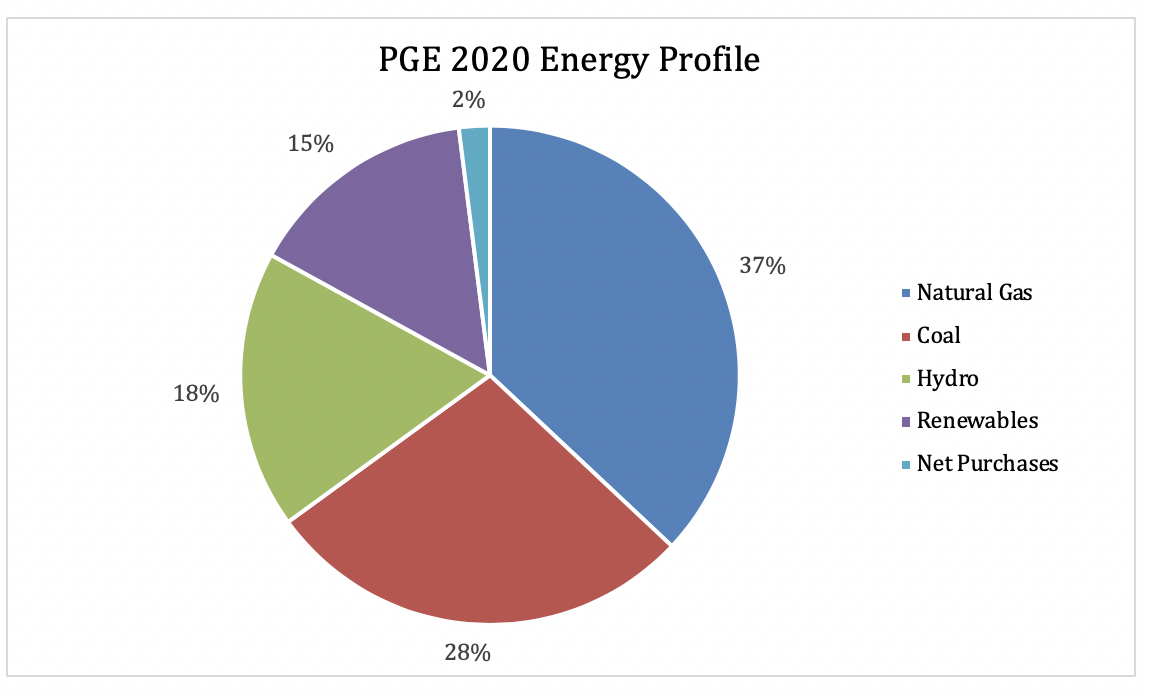
Instead of a wind farm, TriMet receives its electricity from Portland General Electric, the same mixed grid your home is likely powered by. In 2020, this mixed grid will be made up of 37% natural gas, 28% coal, 18% hydro, 15% renewables, and 2% purchased power (power purchased on the wholesale market). Since wind only makes up a portion of renewables used by PGE, less than 15% of the electricity used by the “wind” buses is powered by wind. A greater percentage of the electricity used by TriMet’s BEBs comes from coal plants than wind farms.

If TriMet were honest with its riders, it would replace the windmills on the sides of the new buses with coal, natural gas, and hydroelectric power plants. In the name of accuracy, TriMet could place a windmill in the corner, demonstrating the small percentage of power generated by wind farms.

So instead of riding the “winds of change,” keep in mind that you’re just riding a really expensive bus.

Rachel Dawson is a Policy Analyst at Cascade Policy Institute, Oregon’s free market public policy research organization.


The Baltimore brouhaha: Trump is an attention whore and the media are complicit

President Trump threw out the lure last Saturday and the media leaped at it like steelhead going after spinners. For almost a week now, the the media has been salivating over the Cummings/Baltimore story, playing right into Trump’s hands.

Spinning-fishing-for-steelhead

I’m sure that Trump, a manipulative narcissist if there ever was one, has been absolutely loving it.

“Rep, Elijah Cummings (D-MD) has been a brutal bully, shouting and screaming at the great men & women of Border Patrol about conditions at the Southern Border, when actually his Baltimore district is FAR WORSE and more dangerous. His district is considered the Worst in the USA…..,,” Trump Tweeted to start it all..

“….As proven last week during a Congressional tour, the Border is clean, efficient & well run, just very crowded,” Trump continued. “Cumming District is a disgusting, rat and rodent infested mess. If he spent more time in Baltimore, maybe he could help clean up this very dangerous & filthy place.”

According to Politico’s Daniel Lippman, despite Trump’s public anti-media screeds, he religiously reads four daily newspapers — The New York Times, The Washington Post, The Wall Street Journal and the New York Post, as well was a daily print-out of the Drudge Report, all of which have covered the Cummings/Baltimore contretemps like a thick blanket.

Thankfully, at least one outlet, the babylonbee.com, a satirical news site, has approached he whole tempest as a joke with stories such as, Futuristic, Utopian Paradise Of Baltimore Completely Baffled By Trump’s Attacks:

“BALTIMORE, MD—President Trump launched into a deranged attack against the city of Baltimore, calling it “a disgusting, rat and rodent infested mess” and a place “no human being would want to live.” This caused extreme confusion within the city — as, having been run exclusively by Democrats for decades and decades, it is a nearly perfect, progressive utopia and a beacon of hope to all.”

But most news outlets have pursued the Cummings/Baltimore stories with the kind of moral outrage and hand-wringing usually reserved for stories of great import.

The New York Times, for example, has been all over the story, with headlines like, “The Rot You Smell is a Racist Potus,” “Trump Accuses Black Congressman and Allies of Being Racist,” and “Some very Specific Things the President Could do to Help Baltimore.”

The Times went so far as to run a story featuring Trevor Noah of The Daily Show defending Baltimore and Fox News asked Dallas Cowboys wide receiver Tavon Austin, who grew up in Baltimore, what he thought about Trump’s comments. Even though Austin said he hadn’t even read Trump’s comments about Baltimore, Fox gave him an opportunity to opine on the city’s tough times.

On the Sunday, July 28 talk shows, commentators couldn’t stay away from the topic, relishing the chance to fulminate ad nauseam about Trump, racism, inequality, inner-city troubles, etc.

Tuesday evening’s network news shows continued with one quoting Trump saying that living in Baltimore is like “living in hell” and interviewing residents for their reactions.

Online news outlets have latched onto the story too. On Tuesday, The Bulwark, an American conservative news and opinion website, ran a 1048-word story, Republicans Can Defend Elijah Cummings Any Time Now. Huffpost has gone wild with Cummings/Baltimore stories, too, posting eight different stories just on Tuesday.

And the whole thing has presented an opportunity for all sorts of detestable people to raise their profile, aided and abetted by the media. For example, Al Sharpton, who shows up repeatedly at hot spots like Nadia Vulvokov in the Netflix series Russian Doll, has jumped on the Cummings/Baltimore flap.

At a Monday news conference in Baltimore with former Maryland lieutenant governor Michael Steele (R), Sharpton said Trump “has a particular venom for blacks and people of color.”

The story continued to draw in the media on Wednesday (July 31). A CBSN reporter, for example, asked a Republican National Committee official whether the controversy would alienate voters of color from the Republican Party.

House Speaker Nancy Pelosi (D-CA), also apparently unable to move on, continued the barrage on Thursday, saying Trump should ask “slumlord” Jared Kushner about Baltimore. Here comments generated multiple news stories, including a lengthy story on The Hill and television news stories across the country.

The hand-wringing continued on Friday, Aug. 2, as academics and politicians worked to find an angle they could exploit. William A. Donohue, a Distinguished Professor of Communication at Michigan State University, wrote a piece for The Conversation, an online publication, likening Trump referring to Baltimore as a “disgusting rat and rodent infested mess” to the “pattern of dehumanizing language in the lead-up to the genocide committed by the Turks against Armenians, where Armenians were “dangerous microbes.” Donohue went so far as to equate Trump’s remarks to Germans describing Jews as “Untermenschen,” or subhumans, during the Holocaust.

All of the country’s major news outlets, and many secondary ones, have been rabidly pursuing the Cummings/Baltimore story, elevating it to major coverage, as though it matters.

If the media had simply ignored Trump’s blathering, it would have died a natural, and appropriate, death.  OK, maybe the Baltimore Sun had a reason to go with news coverage and a scathing editorial, but that’s it.

TrumpTweeting

Instead, major media have seen in Trump’s tweetstorm an opportunity to promote rancorous public disputes and contrived mud fights, just as the Eugene Robinson, a Washington Post columnist, observed that the “clear intent of the (CNN) moderation was to spark fights” in Tuesday night’s Democratic debate.

Atlantic magazine writer Adam Serwer got it right. “The mainstream press has internalized Trump’s own reality-show standards for what counts as a significant political development,” Server wrote. “All the world is trashy television, and the president and his opposition are merely producers.”

Trump’s Cummings/Baltimore tweet storms were designed to be a distraction, and they’ve worked particularly well with an American media with a hive mentality, a kind of “On est tous dans le même bain, ” and a consistent race to the bottom. It’s likepornography has gotten more and more crude and explicit in order to compete for attention.

Trump’s outrageous tweets divert the world’s attention, and reporters, from real issues that matter. He manipulates the media by transforming out-of-the-blue poisonous rants into free, must-cover press opportunities. “I remain astonished by the ability of this former reality TV star to be our assignment editor,” bemoaned Kyle Pope, editor of the Columbia Journalism Review.

Frankly, Trump has led the media by the nose, as they’ve pursued audiences with ferocity, their eyes more than ever on the bottom line in this difficult time for journalism.

As a Wall Street Journal opinion column by Holman W. Jenkins Jr. put it, “He delights in making us dance to tunes he wantonly types out in the wee hours.” Jenkins went on to mourn “…the apparent ease with which he elicits ritualized behavior from our media.”

When are the media going to wise up?

Enough already! Random modern annoyances.

Enough already!

Killing me softly with kindness

I get it that businesses want to keep their customers happy. But do they need to follow up every interaction with emails cluttering up my inbox asking me if I liked their service and urging me to rate them?

star-ratings-blog3

Usually the rating offered is a 1-5 star scale, but sometimes it’s a lengthy questionnaire that would take an entire lunch hour to complete.

Today I received not only a ranking quiz, but a full-on e-newsletter from my optometrist. I was, of course, thrilled to learn from an almost 300 word bio on a new optometrist that “…in his free time, you can find him with his wife, two young daughters, and large dog adventuring outdoors, dreaming up new house and yard projects, and honing his culinary and barista skills.”

Isn’t that special?

Please, just leave me alone.


The last straw

Banning plastic straws in the U.S. is more about virtue signaling than preventing plastic pollution.

The fact is, five Asian countries – China, Indonesia, the Philippines, Vietnam and Thailand – account for up to 60 percent of the plastic waste leaking into the ocean, according the Ocean Conservancy and the McKinsey Center for Business and Environment.

More than 8 million tons of plastic waste ends up in the ocean every year. Most of it is washed into the ocean by rivers, with 93% of it coming from just 10 of rivers, according to the Helmholtz Center for Environmental Research in Germany. The Yangtze is the main culprit, pouring more plastic into the sea than the other nine rivers combined.

img

The infamous 10 rivers

I’ve spent some wonderful time in the Philippines, one of the major plastic polluters, but you can’t miss the streams and coastal areas inundated with waste.

manilatrash

A waterway in Manila, the Philippines

The waste got so bad on on Boracay, a stunningly beautiful small island I’ve visited in the center of the Philippine archipelago, that the government shut down tourism for six months in 2017 so a massive clean-up could take place.

So let’s get off the pointless plastic straw bans. As Angela Logomasini, a researcher at the Competitive Enterprise Institute said, while plastic buildup in waterways and oceans is a problem, it’s not one that will be affected by straw bans (emphasis in original).

“The problem is a disposal problem,” she said. “Most of it is in Asia and Africa because they have open dumps and they pour tons of trash into the ocean. They don’t have the proper disposal methods. If you dispose of something properly, it’s not a problem.”


Here’s a tip

Gone into a shop lately and found yourself confronting a tablet screen or phone-like device with various generous tip options? One option is “No tip”, but that requires a purposeful action the cashier and other customers in line behind you can see. So out of guilt, you hit one of the % options instead. The practice is particularly egregious at businesses where you didn’t used to tip at all, but now feel pressured to do so.

It’s plain and simple coercion.

payments-signatures

And it gets worse. If you buy a $2.85 espresso and the screen offers 15%, 20% and 25% tip options, you are likely to hit 15%, generating a tip of 43 cents. If a business wants to jack that up, it can give you $1, $2, or $3 options on purchases below $10, instead of a percentage. If you pick $1, you have paid a 35% tip. Devious, but effective.

It might make some sense at businesses like restaurants where the waiters and waitresses are getting state-approved hourly pay less than the minimum wage, with the expectation they will make up the difference in tips. But everywhere?

Give me a break!


Nickel-and-dimed

The store clerk ambushed me, asking if I wanted to round up my bill to the nearest dollar and contribute the difference to a non-profit of the store’s choice. Another case of checkout charity., which also includes direct requests for non-profit donations at the cash register.

checkoutcharity

More than $486 million was raised in the United States in 2018 by a group of 79 point-of-sale fundraising campaigns that each garnered in excess of $1 million in contributions, according to Engage for Good, a cause marketing organization. That was up from the $441.63 million raised by 73 checkout campaigns in 2016.

Even online shoppers are being hit up.

eBay for Charity has held the top spot on the online checkout charity list since its inception in 2012, Engage for Good reports.  In 2018, the program raised $69 million in the United States and $101.6 million globally by allowing sellers to contribute a portion of their sales to charity and inviting buyers to make a voluntary donation to one of more than 66,000 charities.

My question – why should I contribute to an obvious effort by the company to burnish its corporate social responsibility (CSR) credentials? If the company cares, let it donate its own money.

Moreover, why should I donate to a cause with limited transparency, with no information in front of me on where all the money’s going, the past performance of the charity or its impact?

And what about transparency? The Better Business Bureau has asked:  What role does the store play in supporting the charity besides your donation? Does the store receive a match for any of the donations? Does the store get a tax write off? Does the store charge the charity administrative fees? What percentage is donated directly to the charity?

Sure, my donation isn’t likely to be much, but it may well end up being part of a multi-million dollar campaign. Checkout charitable giving also tends to be done without thoughtful consideration, similar to often derided impulse buying.

My thinking? Better to skip the checkout donation appeals. Instead, sit down once a year, decide what you care about, research what non-profits do a good job of addressing your concerns, then give to them. That’ll do it right.


Camouflaged “news” outlets: Is Oregon next?

Fake news. Biased news. Slanted news. Real news. What’s the difference? It’s getting harder to tell them apart.

Maine knows that. Now Michigan, Pennsylvania, Florida, and Wisconsin are about to confront the same confusion.

Maine became a test site for camouflaged news in 2018 when a “news” website of anonymous origin, the Maine Examiner, popped up.

Leaked Email: Ben Chin Says Lewiston Voters “Bunch of Racists”According to a legitimate news outlet, The Bangor (ME) Daily News, the website gained attention in the run-up to a December 2018 mayoral runoff in Lewiston, ME. when it posted several negative articles about the progressive candidate, Ben Chin. One article contained real, leaked campaign emails in which Chin said he encountered “a bunch of racists” while campaigning. Chin lost the election, partly because of the Examiner’s reporting.

(It later turned out that the emails were leaked to Chin’s Republican opponent, Shane Bouchard, by a woman working as a mole in Chin’s campaign who was having an affair with Bouchard. Bouchard resigned as mayor in March 2019 after the woman leaked some of his text messages. They included one in which he described elderly black people as “antique farm equipment”  and another in which he appeared to compare a meeting with his fellow Republicans to a Ku Klux Klan gathering. And you thought only states like New York and Illinois had juicy political scandals)

A top Maine Republican Party official later admitted to state ethics watchdogs that he was behind the Maine Examiner.

Progressive Democrats in Maine lambasted the Examiner’s deceptions, but national progressives and Democrats are apparently preparing to emulate the Examiner’s approach.

Priorities USA, a Democratic Super PAC, is planning to put $100 million into a project to flood swing states — many of which have lost their local papers — with stories favorable to the Democratic agenda, Vice News reported on July 24, 2019.

Four “news” outlets staffed by Democratic operatives will publish state-specific information across social media in Michigan, Pennsylvania, Florida, and Wisconsin, Vice News said.

Priorities USA Communication Director Josh Schwerin tried to gloss over the sabotage effort with a disingenuous statement that Priorities’ “news” was a necessary response to the sharp decline in local news outlets.

“This should be covered by local news, but local news is dying,” Schwerin told VICE News. “Our hope is that we can help fill that hole a bit with paid media…”

What’s not clear is whether the true sponsor of Priorities’ “news” coverage will be completely or partially hidden, as is the case with a conservative-leaning national “news” site called The Free Telegraph.

Only if a viewer clicks on a barely discernable “About” at the bottom of the site is it revealed The Free Telegraph “is a conservative news and commentary platform made possible through the generous support of the Republican Governors Association.”

Then there’s Virginia, home of the Dogwood, “your source for Virginia news.”

Home - The Dogwood

If readers click on “About,” they get this: “As the number of local news outlets declines in Virginia and across the country and the amount of digital information surges, it’s hard to know where to turn. We want to fill the gap – and your social feeds – with content that is thoughtful, engaging, inspiring and motivating. We’ll bring you the story behind the story and explore how our readers’ lives are impacted by the news of the day. Our reporting is honest, to-the-point and in the service of our readers.”

If readers want to know who’s behind the news site, they can click on this: Owned by For What It’s Worth Media, Inc.. This will tell them something similar to Priorities USA’s stated rationale for its jump into the news business: “As the number of local news outlets declines across the country and the amount of digital information surges, it’s hard to know where to turn. We want to fill the gap – and your social feeds – with content that is thoughtful, inspiring and motivating.”

What the Dogwood doesn’t say is it also wants to fill the gap with progressive-leaning “news” coverage. Nor does it say that progressive non-profit digital organization, Acronym, has pledged to invest $1 million in the Dogwood and says it plans to invest in other state-based news properties, which could include states such as Arizona, North Carolina, and Pennsylvania.

If you prefer your news with a more conservative bent, there’s The California Republican. Here you can read a story about how the Washington, D.C. chapter of Antifa sent a message to Texas Republican Sen. Ted Cruz by chasing him out of a restaurant, telling the Texas senator that he is “not safe” or an item headlined, “In-N-Out boycott fails miserably in Central Valley.” You can even read about signings by Fresno State’s football program.

But you won’t know the identity of the site’s publisher unless you see the barely visible text at the bottom of the home page, “Paid for by the Devin Nunes Campaign Committee – FEC ID #C00370056.” Nunes is a Republican representative of California’s 22nd District in Congress.

With a steadily shrinking cadre of legitimate news staff and outlets and the rise of political actors willing to play fast and loose with ethics, could Oregon be far behind in this race to the bottom in camouflaged “news reporting”?

One step by Gov. Brown; one giant leap in thwarting democracy in Oregon

Dirty-politics........


Where’s the outrage?

Gov. Kate Brown signed a bill today that effectively cancels petitions signed by thousands of Oregonians calling for a public vote on the Democrats’ $2 billion business tax (HB 3427).

In Oregon, that’s called democracy in action. In the rest of the country, that would be called dirty politics.

In June, the Governor signed a $2 billion $2.6 billion business tax bill (HB 3427).  Distressed Oregonians responded by starting a referendum petition (Petition #301) that would have put the tax on the ballot. The Democrat supermajority in the State Legislature cut off the nascent effort at the knees by passing a bill (HB 2164) that retroactively changed the language and wording of the original tax, canceling out the petition to that point because it referenced the original text.

“HB 2164 is designed to look like a cosmetic language change to a 40-page tax bill, but it contains poison words designed to murder the voter campaign to pass petition #301 (the repeal petition),” the Taxpayer Association of Oregon said on July 17. “….it is borderline criminal to rob the people of their right to vote on matters they care about. Politicians should not be able to subvert and void the people from using their initiative process to petition their government.”

“This subversive tactic of changing the laws in the middle of the process while people are trying to change the laws has never been done before in modern Oregon political history,” the Taxpayer Association said today.  “This subversive and vote-canceling attack can now be used to stop ANY petition effort that the public might wish to bring to the ballot.” (bold in original)

Having achieved a supermajority in the 2019 Legislative session, the Democrats have ignored their ethical responsibility to Oregonians and abused their power

“What kind of fool do you take me for?”, asked one of the Three Stooges in Saved By The Belle. Oregon voters should be asking the same thing of Democratic legislators and Gov. Brown.


“America is an idea, not a geography,” says Lyft

america-is-an-idea-not-a-geography-12-153-likes-declaration-59742592

The ride-hailing company Lyft, apparently deciding that it needs to reinforce its progressive bona fides, is out with slick copy announcing that it plans to provide $150,000 in ride credits to 50 immigration/refugee groups around the country. Portland-based Unite Oregon  will be the Lyft credit recipient in Oregon.

“As part of our Lyft Relief Rides program, we have provided each organization with Lyft credit to help with their transportation needs, including but not limited to, getting immigrants and refugees to legal/court appointments,” Lyft announced on July 10, 2019.

The company claims it is “Taking a stand for immigrant rights,” but the tagline for the campaign,  “America is an idea, not a geography”, is sophistry that undermines the country’s legitimate efforts to enforce immigration law.

OpenBorderssign

The Democratic candidates for their party’s presidential nomination may be advocating policies that are almost the equivalent of open borders, but the fact is, America is both an idea AND a geography, and Americans want that geography protected and immigration laws enforced.

Businesses have been trying to position themselves as good corporate citizens for years in order to bring about a more favorable operating environment, but earlier efforts focused on neutral moves like raising public awareness of such things as charitable contributions, employee volunteerism and hiring veterans.

Lyft’s move is just the latest example of companies more willing to take public stands on truly controversial issues in order to raise their public profile… and sell more products.

In this case, though, it is naïve in the extreme for an American corporation to proselytize in a kind of hippy-dippy, enlightened way that borders have no place in international relations in the modern world in order to position itself as “woke.”.

All recent presidents have taken the position that protection of U.S. borders is essential.

“All Americans, not only in the states most heavily affected but in every place in this country, are rightly disturbed by the large numbers of illegal aliens entering our country,” which is why “our administration has moved aggressively to secure our borders,” President Bill Clinton said in his 1995 State of the Union address.

“That is our direct message to the families in Central America: Do not send your children to the borders,” President Obama said in a 2014 interview with ABC News. The U.S. Border Patrol, he said, should be able to “stem the flow of illegal crossings and speed the return of those who do cross over … Undocumented workers broke our immigration laws, and I believe that they must be held accountable.”

It’s true that most Americans oppose deporting all the immigrants in the U.S. illegally, but, according to Gallup, about 75 percent want an increase in border patrols to stop the flow of more undocumented immigrants.

They do NOT want an immigration free-for-all based on the concept that “America is an idea, not a geography.”

Taxes and Oregon’s 2019 legislature: a new low in abuse of political power

powercorrupts


“Political expediency corrupts moral integrity, language and truth itself,” journalist Dorian Lynskey writes in a new book on George Orwell’s “1984.”

The Democrats running Oregon’s state government have shown the truth of that.

Efforts by Oregon’s Democrats to derail a public vote on a gross receipts tax reveal that, as put by conservative writer Jim Swift, “Being an asshole has now become a feature, not a bug,” in politics.

Setting a new low in political shenanigans in the 2019 session, Democrats began by passing a gross receipts tax on sales inside the state’s borders that exceed $1 million, whether or not the business makes a profit.

The tax, equivalent to a sales tax, is expected to raise $2 billion per biennium. This less than three years after almost 60% of Oregon voters rejected Measure 97, a ballot measure that would have imposed a state gross receipts tax.

In an insulting, arrogant move to protect their revenue-raising blitz, the Democrats then passed a bill (SB 116) setting a particularly inconvenient election date if a tax repeal petition then seeking signatures qualified for the ballot. Rather than having the vote take place during the general election in 2020, when there’s likely to be high interest and participation, the bill provided for a special election on January 21, 2020.

I guess they figured picking Christmas or New Year’s Day for the vote would be too obvious an attempt at manipulation.

Adding insult to injury, the Democrats then passed another bill (HB 2164) which changed the language of the original tax. At the time, The Oregonian reported only that the bill “makes largely technical changes to the new business tax lawmakers passed earlier in the session to fund education.” But it was much more significant than that. If Gov. Brown signs the bill, it will invalidate all the signatures already gathered on a repeal petition referencing the previous language.

“HB 2164 is designed to look like a cosmetic language change to a 40-page tax bill, but it contains poison words designed to murder the voter campaign to pass petition #301 (the repeal petition),” said the Taxpayer Association of Oregon.  “….it is borderline criminal to rob the people of their right to vote on matters they care about. Politicians should not be able to subvert and void the people from using their initiative process to petition their government.”

Having achieved a supermajority in the 2019 Legislative session, the Democrats proceeded to ignore their ethical responsibility to Oregonians and abuse their power, vividly illustrating the observation of Lord Acton, the 19th-century British historian: “Power tends to corrupt. Absolute power corrupts absolutely.”

As Senate President Peter Courtney, D-Salem, said at the end of the Legislative session, “I thought we were overreaching before we started. I think we did.”

“What kind of fool do you take me for?”, asked one of the Three Stooges in Saved By The Belle. Oregon voters should be asking the same thing of Democratic legislators.