Washington Square’s travails: Is J.C. Penney next?

washington-square-mall-washington-square-mall3_54_990x660_201404220152

Whither Washington Square?

On Oct. 15, 2018, Sears Holdings Corp. (SHLD) filed for Chapter 11 bankruptcy, listing $6.9 billion in assets and $11.3 billion in liabilities in the filing. At that point, Sears had lost 96% of its value since it began trading under the SHLD ticker in May 2003.

Sears, one of Washington Square’s anchor stores, is closing before the year is out.

Is J.C. Penney next?

JCPenneyClosing

“Few retailers have experienced losses in revenue, reputation and customers like JC Penney,” Brittain Ladd, a Forbes contributor, wrote earlier this year.  “At 116 years old, the company has never been closer to death.”

In its most recent quarterly report on Nov. 15, 2018, J. C. Penney reported lower sales and a wider net loss in the quarter. It also reduced its sales guidance for the year, even in a strong climate for consumer spending.

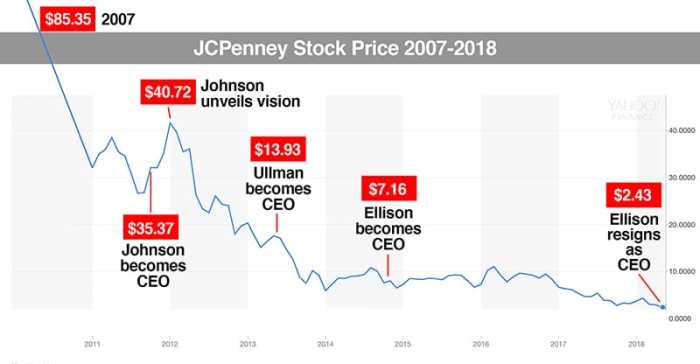
The company’s stock closed on Dec. 14, 2018 at $1.20 a share, down from its 52-week high of $4.75 a share, its 5-year high of $11.57 a share on March 18, 2016 and its maximum of $82.23 a share on March 23, 2007.

The company has been trying to adjust to the changing retail environment for years, frantically shifting strategies and CEOs.

The most disastrous CEO was Ron Johnson, who joined the company in June 2011. He was supposed to be a magic man, given his successful oversight of Apple’s retail stores and his work at Target.

Johnson tried to move J.C. Penney into a more youth-oriented company in an upmarket space that scorned price-slashing promotions. Top accomplish his objectives, he brought in a bunch of new people, some from Apple, who didn’t mix well with J.C. Penney’s established workers. One Apple veteran, Michael Fisher, “… went so far as to deride the holdovers as DOPES, or dumb old Penney’s employees,”  Jennifer Reingold  wrote in Fortune. “Some veterans retaliated by calling the new team the Bad Apples.”

To say the least, Johnson’s radical makeover bombed as customers bolted in droves and the company recorded a $1 billion loss in 2012.

On April 8, 2013, J.C. Penney’s board accepted Johnson’s resignation.   “The Johnson era at JC Penney will go down in history as one of the most destructive reigns by any CEO in any company—ever,”  Ladd wrote.

Johnson was succeeded by Myron Ullman, who had been CEO before Johnson from December 2004 to October 2011. Ullman stayed on from April 2013 to July 2015. He then , turned the job over to Marvin Ellison and charged him with bringing the company back from the brink of disaster. Ellison made some improvements, but abandoned ship in May 2018 to lead home improvement company, Lowe’s.

Looking just at J.C. Penney’s stock price, it’s not easy to figure out which CEO had failed the most at that point. The stock dove 65% under Ullman’s first tour as CEO, 54% under Johnson, 58% under Ullman’s second tour and 66% under Ellison.

penneystockprice

On Aug. 16, 2018, J.C. Penney reported a year-over-year revenue decline of 7.5 percent to $2.76 billion and a net loss of $101 million in its second quarter. Investors were not pleased. They sent the company’s stock below $2 a share, the lowest since it listed on the New York Stock Exchange in 1929, Reuters reported. The stock closed on Aug. 16 at $1.76.

Searching for its next CEO, Board Chairman Ron Tysoe obviously had Ron Johnson in mind when he told the Dallas Morning News, “We’re not looking for someone to reinvent J.C. Penney.”

The board’s choice for next CEO, Jill Soltau, joined J.C. Penney on October 15, 2018. She previously served as president and CEO at Jo-Ann Stores LLC, a specialty retailer of crafts and fabrics.

Shortly after Soltau’s appointment, the company reported that in the three months ending Nov. 3, 2018 its sales fell 5.8% to $2.65 billion and its net loss for the quarter grew to $151 million, up from $125 million in the same quarter a year earlier. Looking ahead, the company said it expected same-store sales to fall in the low-single digits for the fiscal year.

Despite thousands of recent store closures around the country, including the Portland metro area, retail analysts generally agree that the clearing out of stores still has a way to go.  The Wall Street Journal recently reported that the United States has 23.6 square feet of retail space per capita, compared with 2.7 square feet for Europe, according to the International Council of Shopping Centers.

Some of that U.S. space has to go and  J.C. Penney’s store at Washington Square could be one off the victims.

Abortions in Oregon: legal, safer and more rare?


abortionprocon2

Both sides of the often rancorous abortion debate, with all its fierce moral complexity, should be pleased.

Embracing former President Bill Clinton’s dictum that abortions should be “safe, legal, and rare,” Oregon has steadfastly protected the right to an abortion, becoming one of the first states to legalize abortion (SB 193) in 1969.

Oregon ‘s law legalized abortion during the first 150 days of pregnancy, allowing a licensed physician to perform an abortion on an Oregon resident in the following circumstances:

  • The baby has a physical or mental handicap
  • The baby was conceived by rape or other criminal intercourse
  • The pregnancy poses a substantial risk to the mother’s physical or mental health.

The law also required all abortions to be performed by a physician and in a hospital. Before any abortion took place, two physicians had to certify in writing that the woman’s circumstances justified the abortion.

Oregon’s most recent effort to protect access to abortions was the resounding defeat in November 2018 of Ballot Measure 106, a proposed constitutional amendment that would have barred the use of public funds to pay for abortions, affecting government employees and people on Medicaid.

After nationwide legalization of abortion in 1973 with the U.S. Supreme Court’s Roe v. Wade decision, the total number, rate (number of abortions per 1,000 women aged 15–44 years), and ratio (number of abortions per 1,000 live births) of reported induced legal abortions across Oregon and the U.S. increased rapidly.

Abortions in the U.S. reached their highest level in 1990 at 1,429,247, before decreasing at a generally steady pace. The U.S. abortion ratio increased from 196 in 1973 to 358 in 1979 and then stayed nearly stable through 1981. The ratio peaked at 364 per 1,000 in 1984 and has generally declined since then.

The incidence of abortion has varied considerably, however, across subpopulations and remains higher in some demographic groups than others.  Economically disadvantaged women, for example, make up a significant and increasing portion of abortion patients.

Collecting abortion data

There is no national requirement for abortion data reporting. That leaves the collection of abortion data in the United States too a voluntary system operated principally by the U.S. Centers for Disease Control (CDC) and the Guttmacher Institute, a nonprofit research organization that supports legal abortion.

The CDC’s data collection process is neither as expansive or rigorous as Guttmacher’s.

The CDC began abortion surveillance in 1969 to document the number and characteristics of women obtaining legal induced abortions.

The CDC gathers information submitted voluntarily by states and reporting areas (New York City and the District of Columbia) that conduct abortion surveillance.

However, not all states regularly report abortion data to the CDC. The CDC’s  “Abortion Surveillance — United States, 2015”  report, for example, includes only data that were provided by the central health agencies of 49 reporting areas (the District of Columbia, New York City  and 47 states). It does not include data on abortions in California, Maryland, and New Hampshire.

Guttmacher’s data gathering process is more comprehensive. Surveys are mailed to the “known universe” of abortion providers, including potential new providers the Institute identifies.

This is followed by multiple mailings, phone calls, faxes, and emails to providers that don’t respond. Guttmacher also makes estimates based on state health department data and reasonable projections from other sources of data.

The different methodologies consistently result in different numbers. For example, according to the CDC, 8,794 induced legal abortions were performed in Oregon in 1974, the first year after Roe v. Wade. Guttmacher, on the other hand, figured there were 13,390 that year.

Behavioral changes with respect to induced abortion over time are better  understood , however, more by shifts in abortion rates (abortions per 1000 women ages 15-44), which account for population change, then by changes in the number of abortions.

Using CDC data, Oregon’s abortion rates were 20.0 in 2000, 13.2 in 2010, and 10.9 in 2015.  Guttmacher, on the other hand, used different data to put Oregon’s abortion rates at 23.53 in 2000, 14.59 in 2010 and 12.45 in 2015.  

In any case, the abortion data cited for Oregon in any given year by both the CDC and Guttmacher are not the actual number of Oregon women who had abortions. That’s because not all abortions that occur in Oregon are provided to state residents. Some patients may have traveled from other states; likewise, some individuals from Oregon may have traveled to another state for an abortion.

According to CDC data, about 11.2 percent of abortions in Oregon in 2015 were for out-of-state residents.

Abortions may be performed for non-residents for a variety of reasons, including easier access to services in Oregon than in neighboring states or more restrictive rules in other states.

Abortion is legal in Idaho, for example, but there are restrictions such as state-directed counseling intended to discourage women from having abortions, a 24-hour waiting period and a requirement for parental consent if the patient is a minor. Other abortions may be performed on women who live in Northern California, for example, and find it more convenient to access a Southern Oregon facility.

Still, the data provide a window into the overall trends and demographics of who is seeking abortions.

Data on the number of induced legal abortions in Oregon, compiled by the CDC and the Guttmacher Institute since 1973, are as follows:

Induced legal abortions in Oregon

Year

CDC Data

Guttmacher Data


1973

7,447

11,440

1974

8,794

13,390

1975

10,641

13,270

1976

12,590

12,820

1977

13,163

15,050

1978

13,605

14,450

1979

14,501

17,690

1980

15,735

17,670

1981

14,799

15,990

1982

12,807

16,350

1983

12,064

N/A

1984

13,133

15,310

1985

12,056

15,230

1986

11,217

N/A

1987

11,147

14,370

1988

13,309

15,960

1989

13,928

N/A

1990

13,658

N/A

1991

14,310

16,580

1992

12,685

16,060

1993

12,961

N/A

1994

13,392

N/A

1995

14,079

15,5909

1996

13,767

15,050

1997

14,834

N/A

1998

14,344

N/A

1999

14,145

16,700

2000

13,658

17,010

2001

14,272

N/A

2002

13,172

N/A

2003

12,622

N/A

2004

11,443

13,320

2005

11,602

13,200

2006

11,732

12,246

2007

11,883

13,370

2008

10,610

12,920

2009

10,801

10,801

2010

9,990

11,010

2011

9,567

10,690

2012

9,016

N/A

2013

8,287

9,130

2014

8,231

9,330

2015

8,610

N/A

Recent abortion  data

In 2015, the most recent year for which the CDC has submitted a “Abortion Surveillance — United States” report, the abortion rate (abortions per 1000 women ages 15-44) in Oregon decreased across all age groups.

Women in their 20s accounted for 57.2% of all Oregon abortions in 2015, women in their 30s for 28.1%. The CDC reported 922 abortions by adolescents (age 19 and below) in Oregon in 2015.; 56 of those abortions (6.1% of the total) were by children below the age of 16.

The CDC also reported the following with respect to abortions in Oregon in 2015:

  • 9% were performed during, or before, the 13th week of gestation.
  • 7% were performed during, or after, the 21stweek of gestation.
  • 39% were performed as medical (nonsurgical) abortions (up from 14% in 2005).
  • 19% of abortions were performed on married women; 81% on unmarried women.
  • Abortions by known race/ethnicity of women in Oregon in 2015 were: Non-Hispanic white – 70.8%; Non-Hispanic Black – 6%; Non-Hispanic Other – 10%; Hispanic: 13.2%. 

As for the safety of abortions, the CDC calculated the number of deaths and case-fatality rates per 100,000 legal abortions for abortion-related deaths by type of abortion during 1973–2014.

In 1973, the year of the Roe v. Wade decision, there were 47 deaths associated with abortions in the U.S., according to the CDC., with 25 from legal induced abortions, 19 from illegal induced abortions and 3 in cases where it is unknown whether the abortion was induced or spontaneous.

 The CDC defines an abortion as legal if it was performed by a licensed clinician within the limits of state law. An abortion is defined as illegal if it was performed by any person other than a licensed clinician.

During 1973-1977, 149 abortion-related deaths were reported to the CDC, a rate of 2.09 deaths per 100,000 legal abortions.

The number of deaths and case-fatality rates have since dropped significantly.

In 2014, there were 6 deaths associated with abortions in the U.S., according to the CDC., all in connection with legal induced abortions, and the rate of deaths per 100,000 legal abortions declined to .79 during 2008-2014.

Why fewer abortions?

While the reduction in abortions in the United States and Oregon over time is a settled matter, the reasons for the decline are not.

There are a multitude of possible explanations for the decline.

The onslaught of state laws intended to make abortion a more difficult choice may be one reason.

For example, according to the National Right to Life Committee Inc., five states (Kentucky, Louisiana, North Carolina, Texas and Wisconsin) require that an ultrasound be performed prior to an abortion. The screen must be displayed so the mother can view it and a description of the image of the unborn child must be given. “Providing a ‘window to the womb,’ ultrasound images give a mother the unique opportunity to see her living unborn child in ‘real time.’,” the Committee said in a Jan. 2018 report.

Kristi Hamrick, a spokesperson for Americans United for Life, believes new  laws requiring ultrasounds have been “game-changers” in reducing abortions.

The adoption by some states of informed consent requirements pushed by anti-abortion activists is another example of state actions that may be dissuading some women from abortions. Twenty-seven states now have informed consent laws in place.

In 1989, Pennsylvania amended its Abortion Control Act to require:

  • the person undergoing the abortion to give informed consent and receive mandatory counseling, including alternatives to abortion.
  • a 24-hour waiting period between the counseling appointment and the procedure itself.
  • parental consent for minors, with available judicial bypass.
  • a spousal notification requirement.
  • reporting requirements for providers.

The state’s Planned Parenthood association challenged the statute, but the U.S. Supreme Court, in a 5-4 decision (Planned Parenthood v. Casey, 505 U.S. 833 (1992)), held that the standard for whether a state could enact a restriction to abortion access was whether that restriction placed an “undue burden” on the person seeking the abortion. The Court ruled that only the spousal notification requirement was an undue burden.

Michigan’s Republican-led House took a step to discourage abortion on Dec. 13 when it approved a bill that would permanently prohibit doctors from using an Internet web camera to prescribe medication to induce an abortion. Right to Life of Michigan pushed for the measure, according to the Detroit News

Supporters said the bill, which is headed to Gov. Rick Snyder’s desk,  is a safety measure for medication that can have side effects. Critics say the regulation is designed to limit access to legal abortions, particularly for women who live in rural areas without a doctor nearby and who increasingly rely on Internet exams.

In another case, Mississippi ‘s Democratic attorney general filed a notice of appeal Dec. 17 supporting a Mississippi law that would ban most abortions after 15 weeks. U.S. District Judge Carlton Reeves issued a temporary injunction in March 2018 to prevent the state from enforcing the law. and then a more extensive ruling on Nov. 20,  2018 finding that the law “unequivocally” violates women’s constitutional rights. , Mississippi ‘s attorney general Hood plans to ask the 5th U.S. Circuit Court of Appeals to overturn Reeves’ decision about the constitutionality of the law

It’s also possible that fewer women are having abortions because they may want an abortion but can’t easily access a distant clinic.

In Mississippi, for example, there is only one abortion clinic, run by the Jackson Women’s Health Organization (JWHO). Its state-licensed facility is in Jackson, Mississippi’s capital.

In large areas of Eastern Oregon and some parts of the Southern Oregon coast it’s 90-180 miles to a clinic, according to a Guttmacher  analysis. “Traveling long distances can impose a substantial burden on women with respect to transportation costs, travel duration, time off work, and arrangement of childcare, particularly for women who are economically disadvantaged,” The Lancet, a public health journal, reported.

The strongest reason fewer women are having abortions is likely because the effective use of contraceptives, including long-acting reversible contraceptives (or LARCs) like IUDs and implants, is resulting in fewer unwanted pregnancies.

And then there are serious efforts underway to develop better contraceptives for men. The Seattle Times just reported, for example, that University of Washington researchers are working with Seattle-area couples to test a contraceptive gel for men. The gel works by reducing sperm production when applied daily on the upper arms or shoulders. Early trials are also underway at the the University on a pill for men that reduces levels of testosterone and other hormones responsible for sperm production.

Some abortion opponents see other factors at work in the declining abortion numbers.

Hamrick believes abortion numbers are also going down because public sentiment is turning against abortion.

The Pew Research Center says, however, that as of 2018, public support for legal abortion remains as high as it has been in two decades of polling. Currently, 58% say abortion should be legal in all or most cases, while 37% say it should be illegal in all or most cases, Pew reported in Oct. 2018.

But the public’s views on abortion are not absolutist. According to the Pew report, more than half of the U.S. says that in most – but not all – cases, abortion should be legal (34%) or illegal (22%). Fewer take the position that in all cases abortion should be either legal (25%) or illegal (15%).

Challenging the numbers

It’s also possible, of course, that the decline in the number of reported abortions is a mirage, that the data is inadequate and unreliable.

One outspoken critic of current data is the Charlotte Lozier Institute, which says its goal “…is to promote deeper public understanding of the value of human life, motherhood, and fatherhood, and to identify policies and practices that will protect life…”

“An examination of state and federal reporting policies makes clear…that the system now in place is poorly suited to determine whether or not, in fact, abortion is becoming significantly less frequent and to what degree, especially in year-over-year comparisons where published data is delayed, non-existent, or available only from a single source with a history of close ties to the industry itself,” Charles Donovan and Nora Sullivan wrote in a Lozier Institute article.

It’s also possible that the decline in the abortions numbers is due to the ease of self-administered, and unreported, medical abortions.

Medical abortion is not the same as emergency contraception, or the morning-after pill. Emergency contraception prevents a pregnancy.  Medical abortion is used to terminate an unwanted pregnancy.

The FDA-approved regimen for medication abortion consists of two medications available by prescription: mifepristone, which works by blocking progesterone (a hormone needed for a pregnancy to continue); and misoprostol, taken 24–48 hours later, which induces contractions and ends the pregnancy. 

According to the CDC, reported medication abortions are becoming increasingly common, growing from 11.3% of all abortions in 2006 to 24.2% in 2015. 

Guttmacher says that with safe and effective models for self-managed abortion care now in place, some women, including those who distrust the medical system, may be opting to self-manage an abortion for increased privacy and autonomy and, quite reasonably, not reporting their actions..

Some medical abortions may also not be reported because they are done illegally by non-physician health care providers in states that require abortions to be performed only by physicians.  In such cases, non-physicians risk prosecution and penalties under the law, so there is more motivation to conceal than to report.

Then there’s the availability of medical abortion drugs online. The Atlantic reported in October on the launch of an online service started by a doctor based outside the U.S. called Aid Access that screens women for their eligibility to take medical abortion drugs and then ships the drugs to an approved customer. It’s unlikely the users of this service submit reports to state health agencies.

What’s next?

Whatever the national attitudes, Oregon is likely to continue to be a welcoming state for abortions. The total number and the rate of abortions may still, however, come down, particularly because of the use of better contraceptives.

Some other states will continue their efforts to keep the abortion numbers and rates down through restrictive measures.

A July 2018 report  by Guttmacher said 29 states already had enough abortion restrictions in effect to be considered either hostile or extremely hostile to abortion rights; four states in the “extremely hostile” category also had so-called “trigger” laws on the books that would immediately ban abortion if Roe v. Wade were overturned.

Many state legislators are continuing their efforts to further restrict reproductive rights or access to care.. “In the first six months of 2018, 11 states enacted 22 new abortion restrictions and four states moved to impose new restrictions on providers that can receive public funds for family planning programs,” the Guttmacher report said.

And the beat goes on.



No favors for Sen. Merkley

merkleyprez

Senator Jeff Merkley (D-OR) wants the Oregon Legislature to give him a special deal — allow him to run for president and the U.S. Senate at the same time in 2020. Right now that’s against the law in Oregon.

There’s a certain “The rules shouldn’t apply to me” arrogance about Merkley’s move.

Democrats in the Legislature may want to bolster their guy, but the Legislature should just say no!

If Merkley wants to run for president, he needs to relinquish his $174,000 annual Senate salary, his fancy digs in the Hart Senate Office Building, and his subsidized health care, sycophantic staff, and free and reserved parking spots at DC-area airports.

As the saying goes, Merkley shouldn’t be able to have his cake and eat it, too. He should respect the law, not try to bend it to satisfy a self-centered agenda and encourage even more public disillusionment with politics.


The Judge Vance D. Day Defense Fund: Where the money came from….and where it went.

judge-vance-day-koin

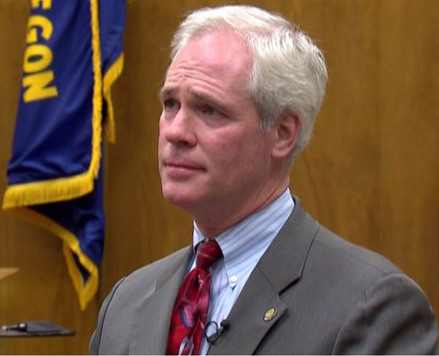
Vance D. Day


The Judge Vance D. Day imbroglio was a financial bonanza for a conservative Virginia-based fundraising firm and a slew of attorneys from around the country.

But in the end, it was all for nothing, zilch, squat.

Day, who had ordered his staff to screen out same-sex couples wanting Day to marry them, claimed that all his legal troubles came about because he was being targeted for his religious beliefs.

In January 2016, the Oregon Commission on Judicial Fitness and Disability, dealing with a 13-count complaint, found Day had violated the Oregon Code of Judicial Conduct on eight of the counts relating to his judicial and public behavior. The Commission unanimously recommended Day’s removal from the bench and filed its recommendation with the Oregon Supreme Court.

The Commission also took issue with efforts by Judge Day to tie the Commission’s actions to his refusal to perform same-sex marriages.[1]

In so many ways, Judge Day’s actions seemed to be less about principles than testing his boundaries.

Declaring that he’d been denied due process and his freedom of speech and religion had been violated, Day aggressively pursued vindication, even appealing his suspension to the U.S. Supreme Court.

Day also faced criminal charges, two counts of illegal possession of a firearm by a felon and two counts of first-degree official misconduct, for allegedly allowing a felon he knew to handle a firearm.

Day argued that he was being persecuted for his Christian beliefs. “Throughout the Commission’s prosecution of Judge Day is an open disdain and hostility towards the religious beliefs of those whose faith honors marriage between one man and one woman,” his attorneys said in a brief to the U.S. Supreme Court.

On Sept. 3, 2015, the Oregon Government Ethics Commission approved an application to create a legal defense fund for Day, permitted under an Oregon law that allows public officials to create a trust fund to defray the cost of legal bills related to their duties.

Subsequently, Randall J. Adams, a Mt. Angel, OR attorney, established the Vance D. Day Legal Expense Trust Fund with Adams as its trustee.

A “Defend Judge Day” website also went up saying Day’s defense “will likely cost hundreds of thousands of dollars” and soliciting donations.[2]

At the outset, donations didn’t exactly roll in by the barrel.

During the July 1 – Sept. 30, 2015 quarter, contributions totaled just $25,880.

Of that, $20,000 came from the Terre Haute, ID-based James Madison Center for Free Speech.  The Center was founded in 1997 at the instigation of Sen. Mitch McConnel and attorney James Bopp Jr., the legal mind behind the Supreme Court’s Citizens United campaign finance decision.

Bopp told Slate he founded the Center to serve as a right-leaning counterweight to the American Civil Liberties Union.

Another $2500 came from Ames Research Laboratories of Salem, OR. The company’s President/CEO is William Ames Curtright,. He identifies himself as “Dr.” William Ames Curtright on his company’s and other websites, though he has only received an honorary doctorate from Rivier College in New Hampshire.

Curtright is the founder and Chairman of Turner, OR-based Gathering of the Eagles, described on its website as “a consortium of over 60 Tea Party and patriotic groups.”

Virgil and Shirley Lucas of Salem, OR also stepped up to get things started with a $2500 donation, as did several other Oregonians with $100 – $200 contributions.

The next quarter, Sept. 1 – Dec. 31, 2015, brought in $131,252.26, but again the bulk of it, $92,438.87, came from Bopp’s James Madison Center for Free Speech.

Contributions only dribbled in through 2016 (Q1 – $7,893.53; Q2 – $5,300; Q3 –  $345; Q4 – $4,275).

The fundraising effort ramped up the following year, not long after the Washington Times ran an article headlined, “In Oregon, the left targets an evangelical GOP judge.”

But the key to increased donations was bringing on board on May 1, 2017 Eberle Associates, Inc., a Virginia-based professional direct-mail fundraising company.

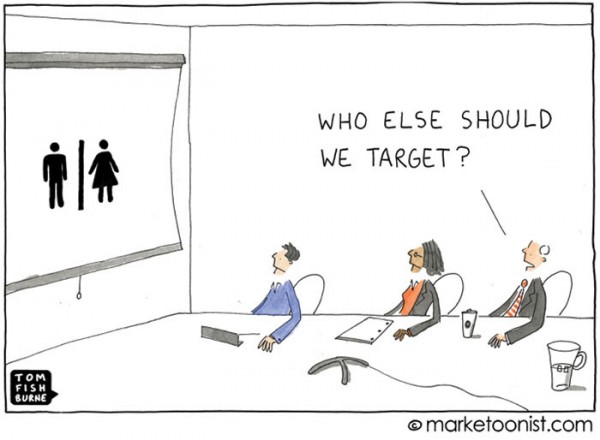
directmailcartoon

Properly targeted, direct mail can be a potent fundraising tool.

Eberle came with stellar conservative liberal bona fides. It had raised money for multiple conservative political groups and campaigns, including Ronald Reagan’s presidential campaigns,  Oliver North,  American Border Patrol, FreedomWorks and Pray In Jesus Name.

Donations flowing from Eberle’s work on behalf of Judge Day escalated rapidly as bushels of contributions began to roll in from across the country.

Patricia Boles of Prattville, AL, Gary Gilbert of New Braunfels, TX and Joan Lusk of West Palm Beach, FL each sent in $100. Martha Jones of Bremen, GA and Richard Porter of Winnetka, IL each donated $1000. Mary Peterson of Yuma, AZ sent in $5,000 and Mr. and Mrs. John Lottis of Sparta, AZ chipped in $3,500.

By Q3 2017, with Eberle churning out direct mail appeals, many featuring Day’s refusal to perform same-sex marriages, revenue increased to $254,803.51.

By Sept. 30, 2018, the most recent period for which public data is available, fundraising revenue totaled $2,008,658.54. The whole effort seemed like quite a success story.

But fundraising expenses, including $1,290,383 in payments to Eberle and $6,021.38 in payments for other related services, totaled $1,296,404.38.

That means Eberle chewed up 64 percent of all fundraising receipts. According to NonProfit Quarterly, “The agencies that set acceptable fundraising percentage limits say that on average an organization’s fundraising expenses throughout the year should not represent more than 35 percent of the donations raised, and most organizations come in significantly below that benchmark.” Some professional fundraisers say the best practice target should be 12-20 cent per dollar raised.

After all fundraising payments that left just $712,254.20 for other expenses, principally for lawyers.

And there was a slew of lawyers at the trough. Here’s the full list and the amount paid to each as of Sept. 30, 2018:

  • Hart Wagner Trial Attorney, Portland, OR: $167,640.96
  • Sherlag DeMuniz LLP, Portland, OR: $161,827.63
  • The Bopp Law Firm, PC, Terre Haute, IN: $88,566.65
  • Spooner & Much PC, Salem, OR: $51,848.35
  • Michael B. Dye, Attorney at Law, Salem, OR: $22,975
  • Randall J. Adams, Mt. Angel, OR: $21,074.50
  • Harrang Long Gary Rudnik PC, Eugene, OR: $6,610.58

Some other payments by the Trust Fund have gone to:

  • Craig J. Bryan, Psy.D., University of Utah (An Assistant Professor in Clinical Psychology, Bryan currently researches suicidal behaviors and suicide prevention strategies, and psychological health and resiliency, particularly with respect to members of the military): $9,900
  • Nash Investigations, Inc, Siletz, OR (Private Investigator): $4,453.05
  • Carroll Consulting LLC, Grande Ronde, OR (Private Investigator; personal investigations): $6,628.33
  • Naegeli Deposition & Trial, Portland, OR (Deposition fees): $1,252.84
  • Beovich Walter & Friend Inc, Portland, OR (Court Reporters): $9,294.43

All the money, lawyers and investigators sounds pretty impressive. How could Judge Day lose with this kind of firepower?

But he did.

  • Despite Day’s efforts to explain and defend his behavior, the Oregon Commission on Judicial Fitness and Disability unanimously recommended his removal from the bench
  • The Oregon Supreme Court imposed a three-year suspension, without pay, on Day.
  • The U.S. Supreme Court refused to hear an appeal from Day, leaving in place the three-year suspension against him imposed by the Oregon Supreme Court.
  • Criminal charges against Day were dropped when a key witness declined to participate.

Day tried to salvage a small victory, declaring, “I’m the first person to ever push back against the decades of liberal elites in Oregon government.”

But the fact is that all the aggressive nationwide fundraising and all those spendy lawyers accomplished nothing, zilch, squat.

______________________________________________________

[1]“Prior to the hearing in this case, Judge Day engaged in an organized media campaign designed to create the impression that the only reason for the investigation of his conduct is his position regarding same sex marriage,” said the Oregon Commission on Judicial Fitness and Disability’s Commission’s Jan. 25, 2016 Opinion. “To this end, Judge Day made repeated public assertions that he was being unfairly attacked by this investigation due solely to his religious beliefs concerning same sex marriage. Judge Day made these statements despite the fact that his position on same sex marriage was not discovered by the Commission until after the investigation was well underway. His assertions in this regard were intentionally deceptive to the public.”


[2]“Oregon judges must rely on their own resources or the help of friends and supporters to mount a defense,” the website said. “We, the supporters and friends of Judge Vance Day, respectfully ask you to financially support and defend a judge’s rights to religious and political speech under the First Amendment to the United States Constitution. If we don’t defend our republic – we are doomed to lose it.”


Can’t We Talk? Paris, Portland and Protests

Portland is turning into Paris

paris_youthsprotest

A Paris protest.

Protests are a recurring presence in Paris, a nearly constant inarticulate howl of anguish.

If it isn’t nurses demonstrating against budget cuts and staff shortages or faculties mobilizing against proposed university reforms, it’s protests over French labor reforms or the arrival of a controversial foreign leader.

As in Paris, protesters and counter-protesters outraged at all sorts of things turn up everywhere in Portland at all sorts of venues these days. Former president George H.W. Bush once called Portland Little Beirut, a description that still holds.

portlandprotest

A Portland protest.

In early November protesters gathered on Waterfront Park demanding that Robert Mueller’s investigation be protected from interference by the Trump administration and objecting to the selection of Matthew Whitaker as acting Attorney General.  Indivisible Portland and Nasty Women Get Shit Done PDX organized the protest, which even drew Sen. Ron Wyden who chanted “this is what democracy looks like” with the crowd.

In October, protesters marched to protest police use of deadly force after Portland Police officers on patrol near the intersection of SW 4th Avenue and Harvey Milk shot and killed a 27-year-old man.

Also in October, police in riot gear broke up a fight at a Portland protest between the right-wing group Patriot Prayer and leftist Antifa counter protesters.

During June-July, protesters set up camp behind the Immigration and Customs Enforcement (ICE) building on Portland’s South Waterfront, insisting that ICE be abolished. The protesters vowed that their camp would continue operating until ICE shut down, but Portland Police cleared the protest encampment in late July.

The right to protest is a long-standing protection afforded by the U.S. constitution, but protests, many of which spiral out of control, have become a primary means of communication in Portland.

Don’t like the results of an election? Take to the streets, block traffic, assault people. Object to how the city is handling homelessness? Disrupt City Council meetings with shouted grievances.

Bothered by police actions? Camp out in front of Mayor Wheeler’s Portland Heights home, spread refuse, write “ACAB” (all cops are bastards) in chalk on his sidewalk, brag online about urinating in front of the mayor’s house in full view of police. It’s no wonder Wheeler was recently overheard muttering that he can’t wait for his term to be over.

Frankly, all this is getting us nowhere. A shift to civil discourse intended to enhance understanding would accomplish so much more.

“Civility is simply demonstrating respect for the dignity of our fellow humans— even those humans with whom we have sharp disagreement,” Rabbi Steve Gutow said at an Episcopal Church’s event, Civil Discourse in America. “Civility is allowing others to speak, and having the humility to admit that we may have something to learn. Civility favors truth over cheap gain, and patience over knee-jerk judgment.”

Given the complexities and nuances of the many issues before us, it’s often unclear what is right or wrong, what is ethical, or what the consequences of a policy will be compared with what is intended.

Unlike unruly protests, respectful exchanges of diverse viewpoints that reveal our common humanity and avoid demonizing the “other”support civic mutuality and critical empathy, strengthening democracy.

In disruptive times like these, that’s what we need most.

As James Calvin Davis said in In Defense of Civility, “When we open wide the doors of public discourse, when we extend civility and respect to all citizens and demand it from them as well, we lay the groundwork for an enriched public discourse that might just make some progress, some move toward greater understanding on the issues that most divide us.”


Hold on Oregonians. A tax tsunami is coming.


TaxTsunami

A tsunami of taxes is about to wash over Oregon.

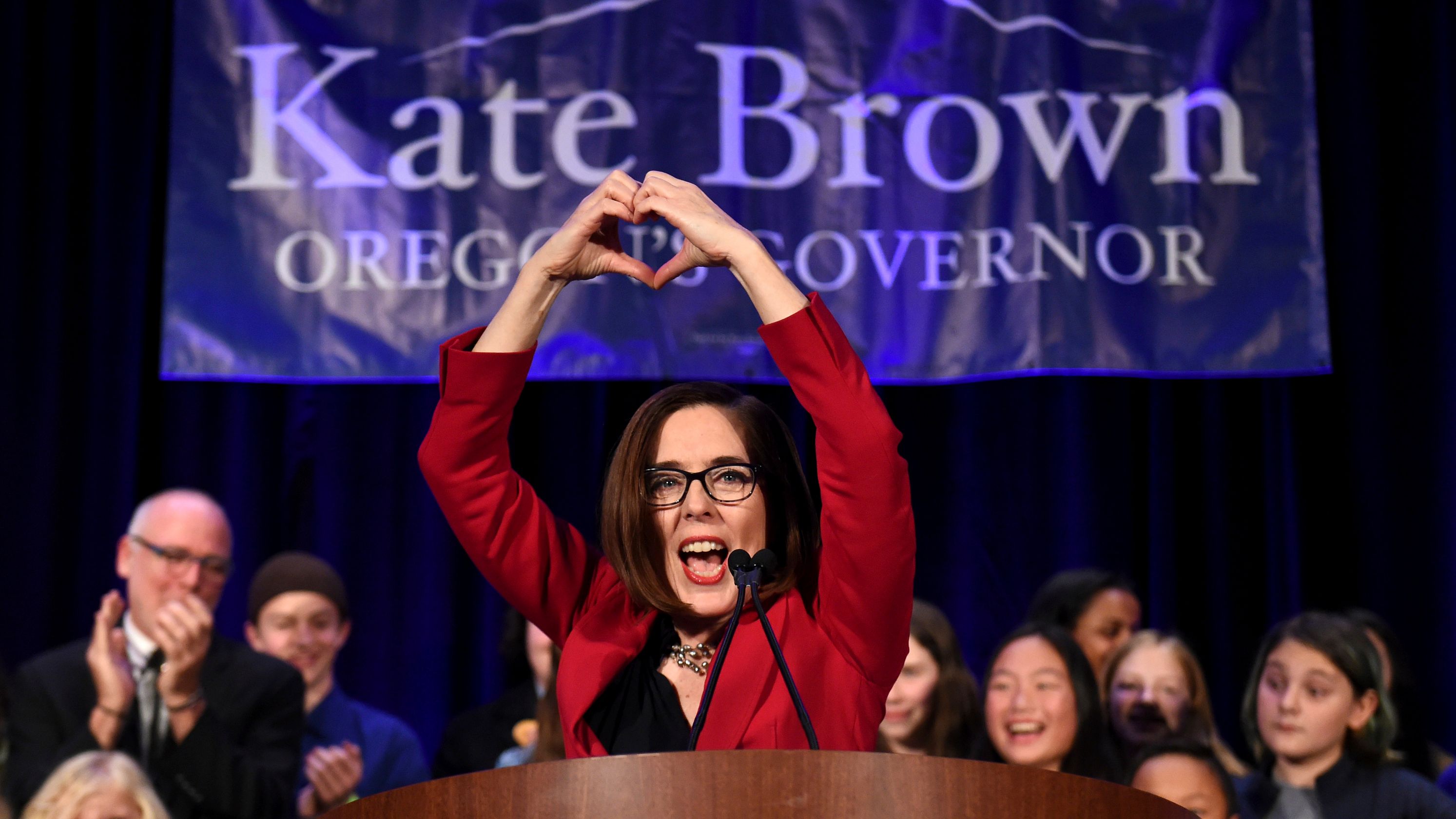
The Democrats’ supermajority takeover of the Oregon Legislature, along with Kate Brown’s reelection, are the reason.

So, if you’ve seen your pay go up because of Trump’s tax overhaul (which, by the way, Democrats in Congress want to roll back) or a pay raise, get ready to see your gains disappear.

A Joint Interim Committee on Student Success that’s been touring the state gathering ideas on education policies and spending has already come up with an expensive wish list that includes:

  • Expanding career-technical education programs, including funding the $300 million that voters approved for high school programs with Ballot Measure 98 in 1916.
  • Extending the school year.
  • Fully funding the latest version of the Quality Education Model  all at once or over a specific period, such as three years. This could include: limiting class sizes (requiring more teachers and facilities); increasing the counselor-to-student ratio; adding counselors, librarians, TAG specialists, arts, music and physical education teachers; increasing spending on Pre-K programs; and reducing class sizes in the early grades and in schools with larger shares of students with higher needs.The State School Fund requirement to fund K-12 schools at a level   recommended by the Quality Education Commission (QEC) is estimated at $10.734 billion in the 2019-21 biennium, $1.963 billion more than the funding required to maintain the Current Service Level—that is, to keep up with inflation and enrollment growth.

An activist Legislature controlled by the Democrats, and supported by a Democrat governor, may also:

  • Modify Measure 5 to increase property tax revenue.
  • Seek a new gross receipts tax or value-added tax charged to businesses.
  • Set a cap on greenhouse emissions and require companies to buy pollution permits to cover their emissions.

And let’s not forget the likelihood of new sin taxes on tobacco and alcohol, including e-cigarettes, as proposed in the Oregon Health Authority’s draft 2019-21 budget.  That budget proposes increasing the cigarette tax from $1.33 to $3.33 a pack and the retail price of beer, wine and cider by 10 percent. The new taxes would cost consumers an estimated $830 million to help cover growing Medicaid costs.

sintaxcartoon

Then, of course, there are the measures just passed in Portland and the Metro Area, including:

  • Measure 26-201, Portland Clean Energy Initiative. Created a 1 percent surcharge tax or gross receipts tax on large retailers to pay for clean energy projects and job training. Before Nov. 6, supporters of the measure estimated it would cost affected businesses $30 million a year while opponents estimated it could cost affected businesses up to $79 million a year.
  • Measure 26-199 authorized $652.8 million in bonds to fund affordable housing in Washington, Clackamas, and Multnomah counties. The regional bond will cost 24 cents per $1,000 of assessed property value, or $60 per year for a home with an assessed value of $250,000.

And don’t forget the multiple local money measures on the ballot on Nov. 6.

Voters in the North Clackamas School District, for example, approved Local Option Levy 2018, a levy intended to address an anticipated $17 million operating shortfall to maintain current programs beginning in 2019. The levy will be collected through a property tax charged at a rate per $1,000 of assessed will be up to $1.63 per $1,000 of assessed property value. Homes with a median assessed value of $221,800 will pay up to $30 per month.

And in Eugene, voters in Eugene School District 4J passed Measure 20-297, a $319.3 million school improvement measure. Property tax rates will increase by about $0.66 per $1,000 of assessed value. Property taxes will increase by about $11 a month or $135 a year for the median homeowner in the district, with an assessed property value of $204,000.

And how about off-the-cuff proposals from politicians, such as Jo Ann Hardesty, who will be sworn-in as a Portland city commissioner in January. During her campaign she said she’d like to put a $2.50 tax on Uber and Lyft rides, which would, of course be paid by passengers.

Because the bulk of a tsunami lies beneath the sea surface, tsunamis are hard to detect when they travel across the open ocean and they can arrive unexpectedly. So consider this an early warning. Even if you can’t see it yet, a tax tsunami is coming.

Oregon voter turnout: not really all that great

Ididnotvote

A multi-university study has concluded that voting in Oregon is easier than anywhere else in the U.S.

But despite Oregon’s efforts, the fact is voter turnout isn’t all that great.

In the just concluded 2018 midterm elections, 1,99,142 Oregonians voted. That was just 61 percent of the state’s voting-eligible population.

The voting-eligible population includes all persons eligible to vote regardless of voter registration status. The voting-age population is all persons over the age of 18, including persons who are ineligible to vote, such as non-citizens, felons (depending on state law), and mentally incapacitated persons. Registered voters are persons who have recorded their name in the voting register and are entitled legally to cast a vote.

When talking about election turnout, state officials and politicians are usually referring to the percent of registered voters who vote so the number looks better.

In the just concluded 2018 midterm elections, for example, registered voters totaled 2,762,622 and, as noted earlier, 1,902,953 ballots were turned in as of Nov. 8, 2018, according to the Secretary of State’s online election report. The Secretary of State reported that this translated into 68.88 percent turnout.

This number is deceptive, however, because a lot of Oregonians in the voting-age population haven’t registered. If the number for Oregon’s total voting-eligible population, 3,113,178, is used instead, then, as noted previously, the turnout was 61 percent. That’s not bad, but it’s disappointing because it means four of every ten voting-eligible Oregonians skipped voting.

Still, that’s far better than the 49.2 percent turnout for the U.S. as a whole, less than half of those eligible after $5.2 billion in political spending.

And it is certainly better than the historic national rate. In fact, the last time more people turned out for a midterm election was in 1914, when 50.4 percent of eligible voters went to the polls.Midterm turnout was at its highest level in 104 years, according to an analysis first obtained by Axios. A little more than 49 percent of eligible voters cast a ballot in the 2018 elections. The last time more people turned out in a midterm was in 1914, which was when 50.4 percent of eligible voters went to the polls.

The following table, using data from the Oregon Secretary of State’s Elections Division and the United States Election Project, shows Oregon’s voting-eligible population and actual voters in other recent general elections:

Year    Voting-eligible pop.   No. of voters      Percent      

2016          3,024,174                     2,051,452           61.7

2014          2,887,517                     1,541,782            50.9

2012          2,836,101                     1,820,507            63.1

2010          2,760, 607                     1,487,210           53.9

2008          2,700,327                      1,845,251            68.3

2006          2,628,937                      1,399,650            53.2

2004         2,550,887                      1,851,671             72.6

2002          2,495,730                        1,293,756          51.8

2000          2,364,402                        1,559,215          65.9


(Correction: added maps) Kate Brown’s Victory: Another Tale of Two Oregons

katebrownvictory

Two Oregons are alive and well.

All Knute Buehler needed to do on Nov. 5 was look at the county-by-county maps of Oregon’s past gubernatorial elections to see that he had a tough row to hoe to become Oregon’s next governor.

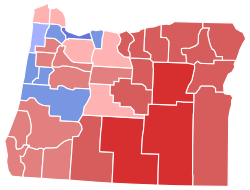
Take a look at a map of the 2014 election for governor:

John Kitzhaber: Blue; Dennis Richardson: Red

oregongovrace2014

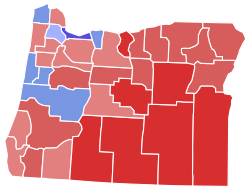
And here’s a map of the 2010 election for governor:

John Kitzhaber: Blue; Chris Dudley: Red

oregon2010govElection

The 2018 election played out in the same pattern, with the Democrat (Kate Brown in this case) carrying Lane, Benton, Lincoln, Clatsop, Washington, Multnomah and Hood River counties.

And, as in the past, Multnomah County really saved the Democrat’s bacon, giving Brown at least 241,524 votes and Buehler only 71,903. That kind of margin for Brown is pretty hard to overcome.

Buehler overwhelmed Brown in counties such as Linn, Douglas, Josephine, Coos, Klamath, Umatilla, Union and Crook, but the voting population of these counties was far too small to swing the election in Buehler’s favor.

brown2018electionmap


Nov. 6, 2018 Election Results for Governor of Oregon


County Brown Buehler Starnes Rpt.
Multnomah
241,524
71,903
5,334
93%
Clackamas
85,679
93,823
4,472
92
Washington
104,056
74,934
4,097
63
Lane
94,957
66,690
5,584
100
Jackson
41,233
50,738
4,126
93
Marion
43,178
50,557
2,799
100
Deschutes
39,050
48,300
2,662
100
Linn
15,894
32,182
2,213
100
Douglas
11,536
31,878
2,421
89
Yamhill
17,274
23,705
1,458
91
Benton
26,023
14,645
1,190
100
Josephine
11,797
23,808
1,679
83
Polk
14,799
18,603
1,033
100
Coos
9,442
16,231
1,263
100
Klamath
6,190
18,863
1,348
91
Lincoln
12,367
9,738
803
100
Umatilla
6,941
14,987
874
100
Clatsop
8,389
7,834
576
100
Columbia
6,582
8,867
679
61
Tillamook
5,569
6,561
458
100
Union
2,854
7,941
439
84
Crook
2,234
8,423
417
88
Curry
4,056
6,365
435
96
Wasco
4,476
5,753
418
100
Hood River
6,286
3,711
263
100
Malheur
2,122
5,960
362
100
Jefferson
2,564
5,427
379
100
Baker
1,557
5,995
345
100
Grant
641
2,919
151
80
Wallowa
1,018
2,511
136
92
Morrow
829
2,510
162
80
Harney
577
2,714
124
67
Lake
415
2,411
141
74
Gilliam
218
690
46
100
Sherman
188
729
32
100
Wheeler
158
593
38
100
Source: New York Times

The numbers are in and they aren’t good for Special Olympics Oregon

specialolympicslogo

Earlier this year it became clear that Special Olympics Oregon was struggling through a long-term financial crisis. Britt Carlson Oase, the organization’s chief executive officer, told The Oregonian that its financial condition had worsened in 2017, but it wouldn’t know how much worse until the Independent Auditor’s Report for the year was completed.

That report by CPA Richard Winkel is finally in. Now we now know how bad things really were in 2017.

According to Winkel’s report, Special Olympics Oregon’s revenues in 2017 totaled $6,8 million, down $1 million from 2016. Meanwhile, 2017 expenses totaled $8.1 million, about level with 2016. That left the organization with total net assets deficit of $417,196, substantially less than its total net assets of $944,000 at the end of 2016.

One sign of the organization’s problems in 2017 was a decline in contributions. During the year ended December 31, 2017 the organization received $618,610 in contributions from direct marketing, down from $870,838 in 2016. Total contributions were also down, slipping from $2,534,178 in 2016 to $2,203,519 in 2017.

Another indicator of trouble is the situation with its line of credit. According to Winkel’s 2017 report, Special Olympics Oregon maintains a line of credit for up to $1,000,000, secured by all of the organization’s assets and bearing interest at 3.5%. The line was extended to mature on April 20, 2018. At December 31, 2017, $1,000,000 was outstanding.

The agreement with the bank requires that the organization maintain a minimum tangible net worth (interpreted by the bank to mean total net asset balances) of not less than $1,000,000, measured annually. The agreement also requires that, for 30 consecutive days during the calendar year, the aggregate principal advances outstanding under the note should not exceed $500,000.

As of and for the year ended December 31, 2017, the organization was not in compliance with either covenant. In September 2018, the short term note payable was renegotiated with the lender forgiving $500,000 and the remaining balance refinanced through a short term note with a private lender that has not been disclosed. The short-term note is payable at the earlier of December 2019 or on demand. The note bears interest at 2.195% per annum and is unsecured. Interest is payable at maturity.

Then there’s the “going concern” requirement. The management of non-profits are required to assess whether there are conditions or events that raise substantial doubt about the organization’s ability to continue as a going concern within one year after the financial statements are issued.

Winkel’s reportsaid that the 2017 financial statements reported a decrease in unrestricted net assets of $886,142 and a decrease in total net assets of $1,361,493. That followed decreases in net assets in 2016, 2015 and 2014. As a result, the organization’s cumulative unrestricted net assets deficit has increased from ($1,304,800) at December 31, 2016 to ($2,190,942) at December 31, 2017.

In addition, during 2017, outstanding trade payables grew by $325,601 and the line of credit increased by $348,768. At December 31, 2017, current liabilities exceeded current assets by $1,619,913. All of these factors affect the organization’s liquidity, the 2017 report said.

“The Organization’s ability to continue as a going concern is dependent on many factors, including successful efforts to raise additional contributions and grants and successful cost reduction plans,” the report concluded.

Steps Special Olympics Oregon is taking to address the “going concern” issue include: new management; dramatic cost reductions, including staff downsizing; moving to donated office space; and pausing the Summer and Fall 2018 and Winter 2019 State Games.

Margaret Hunt, CEO of the nonprofit from 2003 to May of this year, portrayed the organization’s current troubles as part of the normal ebb and flow of a typical nonprofit’s finances. “There are always ups and downs in the nonprofit world,” she told The Oregonian.

Financial reports make clear, however, that Special Olympics of Oregon has been in trouble for years and that 2017 continued the trend.

Will 2018 be an improvement? Can the organization dig itself out of this mess? A lot of kids and parents are staying tuned.

The Eagle has landed: a message for our times

frstman

This time of divisiveness, outrage, combativeness and disillusionment is a good time to look back at a time of hope, lump-in-your-throat patriotism and pride in America when we set a moon landing as a goal and achieved it.

“We choose to go to the moon in this decade and do the other things, not because they are easy, but because they are hard,” President John F. Kennedy said in a rousing speech at Rice University on September 12th, 1962.

At 10:56 p.m. EDT on July 20, 1969, astronaut Neil Armstrong, born in the small town of Wapakoneta, Ohio, planted the first human foot on another world. With more than half a billion people watching on television, he climbed down the ladder and proclaimed: “That’s one small step for a man, one giant leap for mankind.” (› Play Audio)

The astronauts left behind an American flag, a patch honoring the fallen Apollo 1 crew, and a plaque on one of Eagle’s legs that reads, “Here men from the planet Earth first set foot upon the moon. July 1969 A.D. We came in peace for all mankind.”

I still remember being glued to the television through the entire tense and thrilling event, transfixed by the sublime vision of Americans on the moon, in the living room of my family’s Connecticut home.

I was vividly reminded of that time of optimism and common purpose during another tumultuous period in our history when I watched Steven Spielberg‘s movie “First Man” yesterday. (View trailer)

Retelling the story of the American space program from its initiation in the 1960s to the Apollo 11 mission through the lens of Armstrong’s life, the movie unfolds the setbacks, obstacles and tragedies that led to the ultimate triumph and launched us into a new era of science, technology and discovery.

It’s important to remember, though, that the ’60s were also a time of ferment. President Kennedy, Robert Kennedy, Martin Luther King and Malcolm X were slain, race riots broke out, urban decline was on the upswing, and the country was going through the national trauma of Vietnam.

On top of all that, protests against the draft were escalating, Cesar Chavez was pushing for agricultural boycotts, the Bay of Pigs Invasion failed, the Cuban Missile Crisis had Americans fearing nuclear war, the militant Black Panthers emerged and National Guardsmen shot and killed four Kent State students at an anti-war protest.

As one historian put it, “In the 1960s, dissidents shook the very foundation of U.S. civil society.”

But America came through it all.

The same will hold true today if we commit to a better future. America can still be the shining “city upon a hill” that John Winthrop, an early pilgrim, described.

“In my mind, it was a tall proud city built on rocks stronger than oceans, wind swept, God blessed, and teeming with people of all kinds living in harmony and peace,” Ronald Reagan said in his farewell address. “…after 200 years, two centuries, she still stands strong and true on the granite ridge, and her glow has held steady no matter what storm.”

So, take a break from your hectic life and spend a couple hours in a darkened theater watching “First Man”. You will celebrate America’s triumphs and emerge with a strengthened belief that this too shall pass.