Only in California

mindcontrol

Jovanka Beckles, a Democratic Socialist running in an East Bay Assembly race in District 15, has expressed sympathy for people in her district who believe they have been victims of hostile mind-controlling space weapons and suffered head pains as a result.She even went so far as to win passage of a Richmond city council resolution expressing sympathy for such “targeted individuals”.

On her website, Becklessays she also “consulted with police who agreed to treat these individuals with more respect.”

According to a Bay Area TV station, since the resolution passed, the Richmond Police Department has been fielding calls from people throughout the world who feel targeted by anything from surveillance to mind control to insidious nanotechnology.

Richmond Mayor Tom Butt said his office has been receiving requests for help as well, including a message from a woman living in her car in Carson City, Nevada, who says she has been electronically stalked but has received no help from law enforcement.


Hijacking Oregon Justice– Part II (It’s worse than you think)

Hijacker_(Mercenary)_(Earth-616)_in_Astonishing_Ant-Man_Vol_1_3_001

I wrote previously  that former Portland City Commissioner Steve Novick has been hired by Attorney General Ellen Rosenblum’s Oregon Department of Justice as a Special Assistant Attorney General (SAAG).

Novick’s entire salary is being paid by an out-of-state private source, New York University’s State Energy & Environmental Impact Center, which is backed by Bloomberg Philanthropies. The Center is covering Novick’s legal fellowship with the aim of strengthening state attorney general offices in their crusade against the Trump administration’s environmental policies.

Creation of the Impact Center was spurred by former New York Attorney General Eric Schneiderman, who resigned his post in May 2018 amid assault claims by 4 women. t was an unexpected fall from grace for a rising star in Democratic politics who had portrayed himself as a relentless opponent of President Trump.

The guiding force behind Bloomberg Philanthropies is Michael Bloomberg, the founder of the global data and media company, Bloomberg LP, and a former Mayor of New York City. Bloomberg Philanthropies made a grant almost $6 million to the Center in August 2017. Earlier this month, Bloomberg announced that he re-registered as a Democrat, saying the party must “provide the checks and balances our nation needs so badly.” He is known to be toying with the idea of running for president in 2020 as a Democrat.

According to The Hill, an online political news site, Bloomberg has reserved more than $30 million in TV advertising for Democratic candidates in swing districts in the final two weeks before the midterm elections. Bloomberg has pledged to spend $80 million to help Democrats take back the House.

Bloomberg Philanthropies providing external funding to Rosenbloom to push a policy agenda is bad enough. But it’s worse, much worse.

I dug further and found that Rosenblum’s is one of TEN State attorney general offices where 14 NYU Law Fellows are working as a Special Assistant Attorney General (SAAG).

And although 22 State Attorney’s General are Democrats and 27 are Republicans (one is independent), every single one of the Attorney’s General taking in an NYU Law Fellow is a Democrat:

Illinois: Lisa Murray Madigan

Maryland: Brian E. Frosh

Massachusetts: Maura T. Healey

New Mexico: Hector Hugo Balderas Jr.

New York: Barbara Dale Underwood

Oregon: Ellen F. Rosenblum,

Pennsylvania: Josh Shapiro

Washington: Robert Watson Ferguson

Washington, D.C: Karl Racine

Virginia: Mark Herring

The Impact Center claims to be non-partisan, but that’s hardly the case.

“Each of the attorney general offices chosen to participate in the initial phase of the fellowship program has demonstrated a commitment to advancing progressive policies on clean energy, the environment and climate change,” David J. Hayes, executive director of the Impact Center, said on Oct.17, 2017. Hayes was deputy secretary and chief operating officer of the Department of the Interior for Presidents Clinton and Obama.

Should billionaire activists be able to bankroll “special assistant attorneys general” as an almost invisible legal army in state law enforcement offices to pursue ideological agendas?

I don’t think so. Do you?

Hijacking Oregon Justice


Kate Brown

Oregon Gov. Kate Brown

Former Portland City Commissioner Steve Novick was hired by  Gov. Kate Brown’s Oregon Department of Justice in June 2018 as a Special Assistant Attorney General (SAAG).

Sounds simple and straightforward. It’s not.

It’s just plan wrong and Brown and her Attorney General, Ellen Rosenblum, shouldn’t be allowed to get away with it.

Oregon’s Cascade Policy Institute is pointing out that Novick’s entire salary is being paid by an out-of-state private source, New York University’s State Energy & Environmental Impact Center, which is backed by Bloomberg Philanthropies. The Center is covering Novick’s legal fellowship with the aim of strengthening state attorney general offices in their crusade against the Trump administration’s environmental policies.

The unprecedented practice of providing external funding to state attorneys general to push a policy agenda ought to raise ethical concerns, the Cascade Policy Institute asserts, and justifiably so. As attorney Andrew Grossman put it: “What you’re talking about is law enforcement for hire….Really, what’s being done is circumventing our normal mode of government.”

In August 2018, Competitive Enterprise Institute published a report by Christopher Horner which details the roots and function of the SAAG program. Law Enforcement for Rent: How Special Interests Fund Climate Policy through State Attorneys General describes the genesis of the SAAG program as an informal coalition between states, spearheaded by former New York Attorney General Eric Schneiderman.

According to Justus Armstrong, a Research Associate at Cascade Policy Institute, a letter included in the report’s appendix from Schneiderman and Vermont Attorney General William Sorrell to Oregon Attorney General Ellen Rosenblum shows she was invited to a March 2016 meeting of this coalition. The letter describes the program as “an important part of the national effort to ensure the adoption of stronger federal climate and energy policies.” Correspondence between members of the coalition (also compiled by Horner) expresses a desire to collaborate on targeting companies in the energy industry with regulatory and enforcement tools.

This same environmental policy agenda drives NYU’s Center, as expressed in its communication with state attorneys general. Emails state that the “opportunity to potentially hire an NYU Fellow is open to all state attorneys general who demonstrate a need and commitment to defending environmental values and advancing progressive clean energy, climate change, and environmental legal positions.” NYU’s website directs interested attorneys general to demonstrate a need for outside funding to pursue these legal positions.

If this sounds questionable, imagine a similar practice being used to serve other political agendas. If a nonprofit backed by Charles and David Koch offered to fund a position in a state to provide legal assistance on regulatory matters, would it be considered a conflict of interest? If the National Rifle Association were bankrolling state employees to serve as a “resource” on gun law enforcement, would it raise red flags? This isn’t simply about protecting the environment versus not. It’s a question of impropriety and corruption. NYU states in its agreements that fellows owe their loyalty solely to the state attorney general once they’re assigned there, but SAAGs like Novick are still being paid by an outside source while working on behalf of the state.

According to the Associated Press, Oregon deputy legislative counsel Marisa James said in a Sept. 11, 2018 legal analysis that the fellowship program violates state law because special assistant attorney general Steve Novick is paid by an entity other than the state and reports to the center and the attorney general.

“We conclude that some aspects of Mr. Novick’s appointment conflict with the Attorney General’s authority to appoint assistants under ORS 180.140,” Ms. Jacobs said in a letter obtained by The Washington Free Beacon.

Oregon Deputy Attorney General Frederick Boss disagreed, arguing in a Sept. 24, 2018 letter that the arrangement is “consistent with many longstanding SAAG appointments in areas like tobacco enforcement, bond issuance, and complex health care transactions.”

It appears that Rosenblum was anxious about the ethical gray areas of this arrangement from the start. Emails from within the DOJ show that Rosenblum instructed the DOJ not to use the word “volunteer” to describe Novick’s position in his hiring paperwork. The obfuscating language of the hiring process is notable: In reality, Novick isn’t working as a “volunteer” or a “research fellow,” but as an environmental lawyer, as he has been for years. Rosenblum also showed apprehension about the potential media attention the unprecedented arrangement could draw, as one email states:

“We need to be sure we are prepared to explain his position to the media, who, no doubt, will be interested. (Because he is being paid by an outside entity—which is quite unusual I think)….”

As Armstrong notes, Novick’s position is quite unusual indeed, and Oregonians deserve an explanation. Regardless of one’s views on Novick, Rosenblum, or Bloomberg’s environmental policy agenda, embedding privately funded legal counsel in our justice department is a conflict of interest. The Attorney General’s office should be loyal to Oregon citizens, not out-of-state donors, and should uphold the law rather than push a legislative agenda.


An obituary addendum: Never Forget. Never Again

Lake Oswego resident James Burdett Thayer’s obituary in The Sunday Oregonian mentioned that on May 4, 1945 his Army platoon discovered and liberated the Nazis’ Gunskirchen Lager concentration camp in Austria.

USsoldiersenterCamp

U.S. soldiers enter the Gunskirchen Lager concentration camp

But there’s so much more to the story.

71stCame

Major Cameron Coffman, Fort Thomas, Ky., Public Relations Officer of the 71st Division, visited Gunskirchen Lager on the afternoon of May 4, shortly after its liberation by American troops. The news release he wrote about Gunskirchen is gut-wrenching:

With the 71st Division of the Third Army in Austria, May 4, 1945: Nazism at its worst was unfolded in stark reality before Doughboys of the 71st Infantry Division today when they stumbled upon a carefully concealed concentration camp six kilometers north of Lambach, Austria, which held 18,000 persons who were not true “Aryan” or whose political opinions were contrary to Hitler’s “New Order”.

My days of reading about Hun atrocities were over. I visited that camp today. The living and dead evidence of horror and brutality beyond one’s imagination was there, lying and crawling and shuffling, in stinking, ankle-deep mud and human excrement. The sight and smell made your stomach do funny things like an egg-beater churning within. It was impossible to count the dead, but 200 emaciated corpses would be a very conservative estimate. For the most part they had died during the past two days, but there were many other rotting bodies inside the barracks beside living human beings who were too weak to move.

concentratoncampprisoner

Gunskirchen Lager concentration camp prisoner

It is practically impossible to describe in decent or printable words the state of degradation in which the German guards had permitted the camp to fall. Located in a dense patch of pine trees, well-hidden from the main highway as well as from the air, the site was well-suited for the slimy, vermin-infested living conditions that existed there. To call the camp a pig sty would be doing injustice to a self-respecting pig. The sight was appalling, and the odor that reached you a hundred yards or so from the camp site was nauseating.

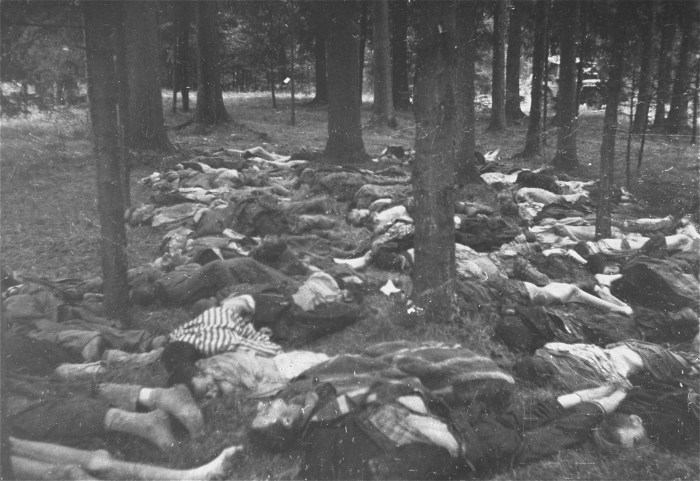
campbodies

Bodies of Gunskirchen Lager concentration camp victims in the nearby woods

Traveling into the camp along a narrow wagon road was an experience in dodging the multitude of dazed men, women, and children fleeing from the horrors of this living hell. The natural impulse of these people after the Americans arrived was one of hysteria – a desire to escape — to leave that place forever behind them. The road was clogged with hundreds, but many did not get far. Dozens died before they had gone but a few hundred yards from their “hell-hole” prison, Americans soldiers cussed violently in disgust as their trucks roared past the grotesque figures in the ditches and shuffling feebly along the road.

As we entered the first building the sight that met our startled gaze was enough to bring forth a censorable exclamation from a sergeant who had seen the bloodiest fighting this war has offered. He spat disgustedly on the filthv dirt floor and left the building which was originally built for 300 but now housed approximately 3,000. Row upon row of living skeletons, jammed so closely together that it was impossible for some to turn over, even if they could have generated enough strength to do so, met our eyes. Those too weak to move deficated where they lay. The place was crawling with lice. A pair of feet, black in death, protruded from underneath a tattered blanket just six inches from a haggard old Jew who was resting on his elbow and feebly attempting to wave to us.

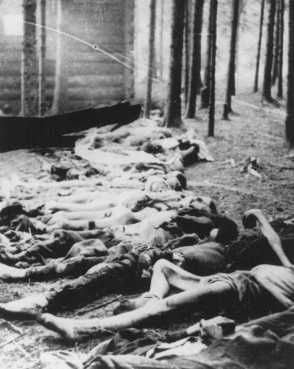
executedprisoners

Bodies of prisoners executed by the Nazis at the Gunskirchen Lager concentration camp

A little girl, doubled with the gnawing pains of starvation, cried pitifully for help. A dead man rotted beside her. An English-speaking Jew from Ohio hummed, “The Yanks Are Coming”, then broke out crying. A Jewish Rabbi tripped over a dead body as he scurried toward me with strength he must have been saving for the arrival of the American forces. He kissed the back of my gloved hand and clutched my sleeve with a talon-like grip as he lifted his face toward heaven. I could not understand what he said, but it was a prayer. I did not have to understand his spoken word.

Few of those remaining in the building could stand on their feet. The earth was dank and a chilled wind cut the smell of death and filth. Small fires of straw added to the revolting odors that filled the air. One man crawled over several prostrate bodies and patted the toe of my muddy combat boot in child-like manner.

campcorpses

Corpses found by American soldiers at the Gunskirchen Lager concentration camp

Everywhere we turned the pathetic cry of “wasser” (water) met our ears. An English-speaking Czechoslovakian woman told us that they had received no food or water for five days. The appearances of the starving horde more than verified her statement. A lieutenant stooped to feed one creature a bit of chocolate. The man died in his arm. That lieutenant, formerly an officer in the Czech Army, fingered his pistol nervously as he eyed a group of German soldiers forcibly digging a grave outside. I also pumped a cartridge in my automatic. As I left him there were tears streaming down his face. His mother was last reported in a concentration camp “somewhere in Germany”.

Before our arrival conditions had been so crowded that all could not lie down to sleep at one time. Those with strength enough to stand took turns sleeping. The dead were buried in mass graves behind the so-called barracks, but the death rate became so high that unburied piles of dead remained with the living. Many of these unfortunates were using the corpses as pillows. I counted 27 in one heap in a dark pine grove in the camp area. It was not a pretty sight.

An unforgettable drama was enacted when a sergeant of our group of five raced out of one building, his face flaming with rage. The sergeant, a Jewish boy of Polish descent, had found three of his relatives lying in the filth of that barracks. They are sleeping tonight between white sheets for the first time in three years in one of the better homes in Lambach. Their diet of a daily cup of anemic soup has suddenly changed to eggs, milk, and bread. A Yank with an M-l rifle casually drops in at regular intervals to see how they are faring.

Military government and medical personnel of the 71st Division were busy at work before we left the camp two hours later attempting to bring relief to the chaos of suffering the fleeing Germans had left behind.

Extended supply lines made the food situation a major problem until ingenious doughboys discovered a German supply train nearby. Captain William R. Swope, Lexington, Ky., assisted by an excited Austrian girl brakeman, drove the train onto a siding near the camp. Physical force was necessary for order when the first food lines were organized as it was the first these hunger-sated persons had seen in many days.

A scene on the return trip to Lambach was a fitting climax to the horror we had left. Two “fugitives from hell” were ravenously tearing the entrails from a long-dead horse and gulping huge bites. Another sergeant, whose mother and father disappeared into a Nazi concentration camp three long years, ago, turned his head and in a tear-choked voice remarked:

“And Hitler wanted to rule the world.”

neverforget

With no opponent, Oregon’s House Majority Leader is raking in contributions.

RobertByrdmoney

Sen. Robert Byrd 

Oregon’s House Majority Leader, Democrat Jennifer Williamson has collected $159,060 in campaign donations as of Sept. 21, 2018 in advance of the Nov. 6 election, according to the Oregon Secretary of State.

Her opponent? Nobody.

Center for Public Integrity analysis of National Institute on Money in Politics data shows that Williamson is one of at least 26 legislative leaders in statehouses across America who are raking in cash despite running unopposed this year.

jennifer

Jennifer Williamson

“The safe legislators represent an attractive prospect for statehouse lobbyists and power-seekers: the sure bet,” the Center reported. “Contributions to these influential politicians can buy face time and favor with those who set state legislative agendas, experts say. The money also compounds their power: Legislative leaders use their pots of gold to buy presents to thank supporters, for example, or give to fellow lawmakers’ campaigns to reward them for voting with their party.”

Williamson’s larger contributors include:

  • United Food and Commercial Workers International Union, AFL-CIO, CLC – $10,000
  • Service Employees International Union Local 49 Committee on Political Education (4213) – $6,500
  • Oregon Nurses Political Action Committee – $6,000
  • Oregon Hospital Political Action Committee – $5,000
  • Oregon Beverage PAC – $6,000
  • Citizen Action for Political Education (33) – $5,250
  • Oregon PERS Retirees PAC – $2,500
  • Oregon Trial Lawyers Association PAC – $5,000
  • Pharmaceutical Research and Manufacturers of America – $5,000
  • Confederated Tribes of the Grand Ronde – $3,000
  • Joint Council of Teamsters No. 37 Political Fund (80) – $5,000

How has Williamson been spending all that money?

The biggest chunk, $70,550.00 of $144,531.45 in total expenditures, went to Future PAC, House Builders. That’s the campaign arm of the Oregon House Democrats. In other words, Williamson’s committee simply served as a conduit to fund Future PAC.

Baily Dahlke, a Legislative Assistant in the House Democratic Office, was paid $5,743.18. Aer Lingus was paid $2,080.70 and Alaska Airlines $2,491.66. Lyft got $260.97 and Uber $273.16. Another $645.00 went to Dutch Bros. Several Democratic candidates got small amounts and a lot of the rest simply went to miscellaneous expenditures.

You can be sure more eager, opportunistic contributors will come forward before the election in hopes their early display of support will pay off and cement their relationship with a politician and a party they can count on.

America’s Never-Ending Wars (continued)

A U.S. soldier killed in Afghanistan in an insider attack by a member of the Afghan National Police on Sept. 3 was on his 13th deployment.

TimothyBolyard

According to Task & Purpose, a military-focused news site, U.S. Army Command Sgt. Maj. Timothy A. Bolyard, 42, was the highest enlisted soldier in the 1st Squadron, 38th Cavalry Regiment, which deployed to Afghanistan with the 1st Security Force Assistance Brigade (SFAB) in March. Bolyard had previously earned six Bronze Stars — two with valor devices.

Afghan military commander Gen. Abdul Raziq told Stars & Stripes that the attack began after gunfire “erupted from a police Humvee, hitting American servicemembers in the back.”

Meltdown: the debacle at Special Olympics Oregon

SpecialOlympicsOR

The recently disclosed financial meltdown at Special Olympics of Oregon shouldn’t have come as a surprise to the members of its board. If it did, they were either not paying attention or they were the victims of the endless capacity of people for self-delusion.

Margaret Hunt, CEO of the nonprofit from 2003 to May of this year, portrayed the organization’s current troubles as part of the normal ebb and flow of a typical nonprofit’s finances. “There are always ups and downs in the nonprofit world,” she told The Oregonian.

But the nonprofit’s financial filings going back to 2003 show that the only years its expenses exceeded its revenues from 2003-2013 were in 2007 and 2008. It covered a $525,979 deficit in 2007 with balances from 2006. In 2008, it faced a $666,361 deficit, but it recovered, restoring its net assets or fund balances to 1,484,764 by 2013.

The following year, however, was a fiscal fiasco, with expenses exceeding revenue by $506,464, necessitating another dip into its net assets to cover the overspending. Some recovery came in 2015, when revenues increased by about $1 million, but 2016 brought another revenue dip of about $700,000, resulting in $325,280 of expenses over revenues.

Britt Carlson Oase, appointed Special Olympics Oregon’s CEO in June, attributed the financial problems to a mismatch between the program spending and charitable giving. In other words, the nonprofit spent more than it took in.

Things got even worse in 2017, Oase told The Oregonian earlier this month. Few details are available, however, because Special Olympics has not yet filed its 2017 financial report to the Internal Revenue Service and the organization has not made public a 2017 financial report by its CPA, GaryMcGee & Co. LLP.

The nonprofit’s tenuous position was evident, however in the CPA’s 2016 report.

The 2016 financial statements reported a net operating loss of $131,850 and a decline in total net assets of $269,156. This followed operating losses in 2014 and 2015, and a decline in new grant and contribution commitments in 2016.

As a result, the organization’s cumulative unrestricted net asset deficit increased from negative $1,172,950 in 2015 to negative $1,304,800 at December 31, 2016.

In addition, during 2016, outstanding trade payables, money the nonprofit owed to suppliers for goods or services, grew by $328,082, and cash balances declined to $58,360, representing only 5 days of operating outflows.

As of the end of 2016, current liabilities were greater than current assets by $282,346 and after the 2016 report, out-standing trade payables increased to more than $1.0 million.

According to the CPA’s annual report for 2016, the organization had outstanding borrowings of $651,232 on its line of credit, which increased to $1 million as of September 30, 2017.

In other words, even if Special Olympics Oregon had pulled off a decent 2017, it would have been in trouble.

The CPA’s report said that as of October 31, 2017, Special Olympics of Oregon did not expect to be in compliance with certain financial covenants under the credit agreement. “If unable to continue to obtain amendments from the Lender that waive compliance with these financial covenants, the Lender could place the organization in default under the terms of the Credit Agreement,” the report said. A default “may severely or completely constrain the organization’s ability to continue to operate its business…”

Pretty alarming stuff.

Demographics are Debilitating a Resurgent China

UPDATES

  • January 2026:  For the fourth year in a row, China reported more deaths than births in 2025 as its birthrate plunged to a record low, leaving its population smaller and older. The government said 7.92 million babies were born in 2025, down from 9.54 million in 2024. The number of people who died in 2025, 11.31 million, continued to climb. The number of births for every 1,000 people fell to 5.63, the lowest level on record since the founding of the People’s Republic of China, according to official government data. “If China could somehow sustain 7.92 million births per year from now on, its population would eventually stabilize at roughly 625 million, far below today’s 1.405 billion,” Jesús Fernández-Villaverde, a Professor of Economics at the University of Pennsylvania, posted on X. “In reality, as smaller cohorts reach childbearing age, births will fall well below 7.92 million. Hence, 625 million is a very generous upper bound, even under implausibly optimistic assumptions about life expectancy. Put differently, there were fewer births in China in 2025 than in 1776, the year the United States declared independence.”
  • July 2024 : A United Nations forecast published shows how quickly China is aging, a demographic crunch that the U.N. predicts will cut China’s population by more than half by the end of the century. Wall Street Journal, July 11, 2024. With the number of babies in free fall—fewer than 10 million were born in 2022, compared with around 16 million in 2012—China is headed toward a demographic collapse. China’s population, now around 1.4 billion, is likely to drop to just around half a billion by 2100, according to some projections. Wall Street Journal, Jan. 2, 2024.

_____________________________

America is fixated on the threat of China as an emerging world power. But we ignore the fact that China’s long-term prognosis is not good.

Data released today revealed that China’s population has begun to shrink after a long decline in its birthrate that will likely continue. For the first time since 1961, China’s population actually shrank last year, by 850,000, to 1.412 billion. “The trend, coupled with an increase in life expectancy, has hastened a worrying event: The day when the country will not have enough people of working age to fuel a growing economy,” the New York Times reported.

There’s no question that China has achieved unprecedented economic success, but decisions on population growth made in the 1970s are coming back to haunt the country. That was when the government set a goal of limiting most families to one child in order to deal with  huge and rapidly growing population.

The policy was formalized on September 25, 1980 in a public letter published by the Central Committee of the Chinese Community Party, calling upon all families in China to adhere to the one-child policy.

But however well intended, the policy has had significant unintended consequences that will burden China for years to come and threaten its political and economic power: too sharp a drop in birth rates and too many old people.

In 1979, Liang Zhongtang, a Chinese economist and demographer, insisted that the one-child policy would be a “terrible tragedy” that would turn China into a “breathless, lifeless society without a future,” but he was ignored.

OneChildPoster

The rigorous enforcement of the policy quickly got ugly, with a particularly devastating impact on female babies, as families favored having male children.

NPR reported on the consequences of the one-child policy in China’s Rudong County in Jiangsu province.

The county launched a family planning pilot program in the 1960s. “Having a second child wasn’t allowed, so we had to work on (pregnant women) and persuade them to have an abortion,” Chen Jieru, the Communist Party secretary of a village at the time, told NPR.

The result? The policy, in combination with an exodus of young people to cities for better opportunities, left the county’s young population shriveled while the elderly population has exploded.

The increasing number of the elderly is soon going to be a problem across China. There are now five workers to each retiree, but in a little more than 20 years that is projected to shift to 1.6 workers to every one retiree. “It spells shrunken tax coffers, reduced consumer spending and all-around diminished productivity,” said Mei Fong in her recently issued book, “One Child – the story of China’s most radical experiment.”

A senior Chinese economist, Liu Mingkang, speaking at the Asia Global Dialogue in 2012, said China’s population growth will end as soon as 2020 when its population will peak at 1.6 billion.

Youhua Chen, a demographer at China’s Nanjing University, gained some notoriety by warning about a sharp drop ahead for China’s population. The decline will be accompanied by soaring health care and pension costs, and collapsing real estate markets, he warned.

Prof. Chen has predicted that China’s population will peak at about 1.4 billion and then fall precipitously to 500 million. His graph is below.

GraphImage

Title: Figure 1   Estimated China Population Growth 1950-2100   (Black line): Low (Plan, Program, Prospects…)   (Pink line): Medium (Plan, Program, Prospects…)   (Blue line):  High (Plan, Program, Prospects)   Graph courtesy of Mei Fong, Fellow, New America

If Prof. Chen is right, this means lots of problems.

“These problems will compromise economic development, strain social harmony, and place the traditional Chinese family structure under severe pressure; in fact, they could shake Chinese civilization to its very foundations,” said Nicholas Eberstadt, Henry Wendt Scholar in Political Economy with the American Enterprise Institute.

China has recently loosened the one-child restrictions, but it hasn’t resulted in a baby boom. So the prediction still holds that in the near future India may overtake China as the world’s most populous state, and India, which some are already calling an emerging superpower, will keep growing while China declines.

According to RAND, a research organization that develops solutions to public policy challenges , the Chinese government has implemented a range of pro-natalist policies aimed at reversing fertility decline, including the universal two-child policy in 2015 and the three-child policy in 2021, yet these policy measures have not corrected China’s plummeting total fertility rate or birth rate. A 2025 RAND report, Pronatalist Pivot: Assessing China’s Policy Efforts to Boost Fertility, assesses China’s policy responses to demographic challenges from 2015 to 2025 and considers how China’s experience can inform U.S. policy responses to fertility decline and related demographic challenges.

“When you see a country’s population decline, the country will definitely degrade into a second-rate one,” said Yao Yang, an economist with Peking University’s China Center for Economic Research.

America’s never-ending wars

wargraves

“We have reached an important point where the end (of the Vietnam War) begins to come into view.” – General William C. Westmoreland speaking to the National Press Club November 21, 1967.

 “We stand together for a new and better future for Afghanistan — a future free from terror, war, and want.”- President George W. Bush and Chairman Hamid Karzai, January 28, 2002

“Major combat operations in Iraq have ended. In the battle of Iraq, the United States and our allies have prevailed.” – President George W. Bush, May 1, 2003


Chief Warrant Officer 3 Taylor J. Galvin, a married father of two, died Monday from injuries he received in a helicopter crash in Iraq on on his ninth, yes ninth, combat deployment to Iraq and Afghanistan.

taylor galvin_1534860610209.png_12870778_ver1.0_1280_720

Galvin, 34, was an MH-60M Black Hawk helicopter pilot assigned to the 160th Special Operations Aviation Regiment (Airborne) at Fort Campbell, Kentucky – the same unit that reportedly flew Navy SEALs into Pakistan for the 2011 raid that killed Osama bin Laden according to Task & Purpose, a news site for veterans.

Since joining the Army in 2003, Galvin had deployed twice in support of Operation Iraqi Freedom, three times in support of Operation Enduring Freedom, and four times as part of Operation Inherent Resolve, according to a news release from his unit.

“God Bless the Fallen and their Families,” said one online commenter.

“17 years and counting, and nothing to show for all this blood, money, disabilities and loss,” said another.

And the Iraq and Afghanistan wars are just part of America’s never-ending wars.

Only a few years after the United States and its allies had won WWII,  the U.S. began supporting the French with military assistance in their war against the Viet Minh in Vietnam. On May 1, 1950, President Truman approved the allocation of $10 million to the Department of Defense to cover the early shipment of urgently needed military assistance items to Indochina, thus taking the first crucial decision regarding U.S. military involvement in Vietnam.

According to the infamous Pentagon Papers, the rationale of the decision was provided by the U.S. view that the Soviet-controlled expansion of communism both in Asia and in Europe required, in the interests of U.S. national security, a counter in Indochina.

In March of 1965,  the first U.S. ground combat unit deployed to Vietnam landed at Danang. One of those Marines, Lieutenant Philip J. Caputo, later wrote a classic Vietnam War memoir, A Rumor of War.

VietnamLarryBurrows

U.S, Marines in Vietnam. Oct. 1966

U.S. military actions seem to have persisted every year thereafter.

As of Oct. 2017, the US military was conducting counterterror activities in 76 countries, according to the Costs of War project at Brown University.

CostsOfWarProject

Currently, there are 76 total countries affected by the U.S. engagement into counterterror.
The U.S. counterterror war consists of air and drone strikes, training in counterterrorism, combat troops and U.S. military bases.
Watson Institue- Brown University  Cost of War.

Why is America perpetually at war?

Perhaps, with no military draft to spur civilian concern, we’ve begun to accept war as part of the natural condition.

As West Point graduate and historian Andrew J. Bacevich, who lost a son in Vietnam, put it, “Once, the avoidance of war figured as a national priority. On those occasions when war proved unavoidable, the idea was to end the conflict as expeditiously as possible on favorable terms. These precepts no longer apply. With war transformed into a perpetual endeavor, expectations have changed. In Washington, war has become tolerable, an enterprise to be managed rather than terminated as quickly as possible.”

Never-ending war as a “tolerable” condition. How bleak.


Kate Brown’s TV ads: Just the facts, ma’am

A lawyer for Gov. Kate Brown’s campaign sent a letter to 10 Oregon television stations on Monday claiming that an ad titled “Scary”,  issued by Priority Oregon, a business-oriented nonprofit, contains an allegation that “is a clear, unambiguous false statement of fact.”

If the governor is looking for false statements in political commercials, she should be looking at her own.

negative political ad cartoon

A campaign committee calling itself Defend Oregon’s Values is identified as the purchaser of a current television ad  attacking Republican gubernatorial candidate Knute Buehler. The ad aims to convince Oregonians that Buehler would be a threat to abortion rights.

If you look up Defend Oregon’s values on the Oregon Secretary of State’s website you find it is a committee established by Service Employees International Union (SEIU) Local 49. But if you look deeper you find that the committee  is actually an arm of Gov. Kate Brown’s campaign. According to the state Elections Division, the group is a “candidate-controlled committee” working on Brown’s behalf.

Its financial report shows that the committee was initially seeded with a July 13, 2018 contribution of $100,000, all of it from the Kate Brown Committee. Three days later, on July 16, the committee paid $96,000 to Targeted Platform Media LLC of Annapolis, MD for broadcast advertising on television and radio.

So Defend Oregon’s values is hardly an independent committee. But who would know that without digging deeper?

So much for truth in advertising.