Zimbabwe’s fate: Uganda redux?

Every day, reports of hate-driven devastation in some distant (or nearby) locale remind me that human evolution includes the repetition of atrocities on a scale that defies all reason.

              “Survivor Cafe” by Elizabeth Rosner


The people in the streets of Harare, Zimbabwe’s capital, were ecstatic earlier this week, celebrating and dancing in the streets.

Zimbabweans celebrate in the morning sun after President Mugabe resigned in Harare

After 37 years in power, Robert Mugabe had resigned as president on Tuesday, Nov. 21.

“We’re very hopeful that change is coming, it’s just so exciting for us,” Zee Musuna told a CBC News reporter in Harare. “Today has been a bright and beautiful day for all of us, because it’s the news we’ve been waiting for for a long, long time,” said his companion, Zviko Barikano.

zee-musuna-and-zviko-barikano

Zee Musuna (L) and Zviko Barikano

If you knew Uganda’s post-colonial history, you would understand why such optimism for Zimbabwe could well be short-lived.


A SIDENOTE: My interest in Uganda is based on personal experience. I graduated from the University of Denver in 1967 with a B.A. in International Relations focusing on Africa and was accepted into a graduate program in African development at Makerere University, part of the University of East Africa in Kampala. I was thrilled, but my draft board was not. This was, after all, during the increasingly bloody Vietnam War and the United States was heading toward instituting a draft. My draft board strongly cautioned me against leaving the country, dashing my Africa plans, but not diminishing my interest in the continent. Since then, I have often found myself wondering whether I would have survived Uganda’s turmoil if I’d gone there.

Makerere

University of East Africa, Kampala, Uganda


Uganda, adjacent to Kenya in East Africa, became independent from Britain in 1962.

map-of-east-africa-community

The people in the streets of Kampala, Uganda’s capitol, were ecstatic, celebrating and dancing in the streets..

ugandaIndependence

The country’s new leader, Milton Obote, was initially hailed as a man of conscience and dedication.

obote1962

Milton Obote in 1962

Over time, however, Obote’s commitment to democratic rule eroded and he became increasingly autocratic and repressive.

In 1964, anti-Obote elements tried to push him out. Obote arrested the principal plotters and suspended the 1962 constitution.

In 1967, Obote introduced a new constitution that further strengthened his executive powers. That same year he promoted an ally, Idi Amin, to brigadier general and in 1968 to major general. By 1969 Uganda was effectively an oppressive one party state.

IdiAmin

Idi Amin

In January 1971, Amin deposed Obote, dissolved the government and took sole control of the state.

People in the streets of Kampala were ecstatic, celebrating and dancing in the streets.

But it didn’t take long for euphoria to turn to horror as Amin turned to savagery against his own countrymen, initiating what the New York Times called “an 8-year reign of terror”. The Amin cabal quickly morphed into a despotic regime, wreaking havoc on Uganda’s economy and its people.

“If one historical figure could be said to embody the continent as it is stereotypically imagined — dark, dangerous, atavistic and charged with sexual magnetism — it would be Idi Amin Dada,” said Andrew Rice, author of “The Teeth May Smile But the Heart Does Not Forget. Murder and Memory in Uganda.”

 The International Commission of Jurists in Geneva estimated the number of people killed by Amin at 80,000-300,000. Exile organizations and Amnesty International estimated 500,000.

In 1979, Amin fled Uganda, eventually finding sanctuary in Saudi Arabia, and Yusufu Lule was installed as president.

People in the streets of Kampala were ecstatic, celebrating and dancing in the streets.

Yusufu Lule lasted just 68 days, before being replaced by Godfrey Binaisa. He was overthrown by supporters of former Ugandan president Milton Obote in May 1980.

People in the streets of Kampala were ecstatic.

Following an election of questionable legitimacy, Obote was sworn in as president for a five-year term on December 15 1980, promising a government of national conciliation.

Setting the tone for his rule, Obote made a memorable speech in western Uganda to a gigantic audience.

obotebushenyi

Obote’s memorable speech at Bushenyi on May 27, 1980

“The liberation of Uganda last year gave us a new lease of life and opportunity to bury our past differences and build a new nation based on unity, peace and prosperity and erect democratic institutions,” he said. “Fellow countrymen, let us therefore take a vow here and now that never again shall we allow a situation to develop in our country which through disunity would enable any individual or, for that matter a group of people to wrest control of our country, destroy our democratic institutions, plunder our natural resources or tamper with the freedom and personal liberty of our citizens.”

But Obote quickly showed himself to be no democratic peacemaker. This time, his five years of rule were marked with bloody conflicts and violent repression.

Obote resumed Idi Amin’s habits of restricting all media, ordering the arrest and torture of opponents, and pushing thousands of refugees into bordering Sudan. During Obote’s second term, thousands died from starvation, massacre or warfare.

In an Amnesty International 1985 report, the organization cited an estimate made by the U.S. Assistant Secretary of State for Human Rights and Humanitarian Affairs that between 100,000 and 200,000 people died during Obote’s second term of office. A 1992 Library of Congress country study on Uganda stated that estimates for how many people died between 1981 and 1985 is as high as 500,000 people.

So much for “unity, peace and prosperity”.

The seeds of Obote’s repeat failure were sown at the outset of his rule when several former anti-Amin soldiers, led by Yoweri Museveni, fled and launched a guerrilla war against Obote’s regime.

In 1985, Obote was toppled a second time, receiving political asylum in Zambia.

His successor? None other than Museveni, who led a rebel army to victory and became president of Uganda in 1986.

People in the streets of Kampala were ecstatic, celebrating and dancing in the streets.

Thirty-two years later Museveni is still president and the mood is less exuberant.

Museveni-HiPipo-5Star-News

Yoweri Museveni

According to the Smithsonian, many Western governments regard Uganda as a qualified success from a development standpoint. But that growth is largely confined to the south and Kampala. Elsewhere, deep poverty is the rule.

With a per capita income of $240, Uganda is among the world’s poorest countries, with 44 percent of citizens living below the national poverty line. The nation ranks 146th out of 177 countries on the U.N.’s Human Development Index, a composite measure of life expectancy, education and living standard. Donor countries and international lending agencies cover half of Uganda’s annual budget.

In a “Uganda 2016 Human Rights Report”, the U.S. Department of State said serious human rights problems in Uganda included lack of respect for individual integrity (unlawful killings, torture, arbitrary detention, and other abuse of suspects and detainees); restrictions on civil liberties (freedoms of press, expression, assembly, association, and political participation); and violence and discrimination against marginalized groups.

Other human rights problems included harsh prison conditions, lengthy pretrial detention, official corruption, biased application of the law, societal violence, trafficking in persons, and child labor, the report said.

Museveni appears to still retain support, according to the Smithsonian, but his autocratic drift and systemic corruption risks wrecking his legacy.

A Nov. 21, 2017 report titled “Uganda’s Slow Slide Into Crisis” by the International Crisis Group, a Brussels, Belgium-based organization, is not optimistic about what will happen when Museveni leaves (or dies).

“The public appears to have little confidence that Museveni’s departure will be followed by a constitutional transfer of power,” said the International Crisis Group’s report. “Many expect that groups left out of power will confront the government. In response, the military might step in…”

“Major violence is unlikely for now, but Uganda nonetheless faces the gradual fraying of order, security and governance. Discontent is growing, particularly among youth…,” the group said.

Hard to say how long it will be before the long-suffering people of Uganda are again ecstatic, celebrating and dancing in the streets of Kampala.

dancinginthestreetsofkampala

Weinstein abused the press, too.

The only reason one will respect you as a journalist is because of your integrity. Your integrity is based on your credibility. Your credibility comes from your truthfulness.

Shaka Ssali, a Ugandan born American journalist

DirtyHarvey

Sexual harassment isn’t Harvey Weinstein’s only sin and women weren’t his only victims. He has also wounded journalists.

Yes, I know, the public’s mistrust of the media is already extreme, but the Weinstein imbroglio has made things worse. It did so by using journalists in his effort to discredit his accusers and employing fake journalists to ferret out damaging information on them.

I’m sensitive to this because I worked as a reporter for 10 years and learned a lot of lessons about the importance of honesty and trust in journalism.

I once investigated an apparent scam artist who was purportedly bilking people out of their money. I was making a lot of progress when the man got suspicious and asked if I was a reporter. I figured it was OK to fudge, so I hemmed and hawed and didn’t admit that I was. When I told my editor what I’d done he pulled me off the story. “We do not conceal our identity as a reporter when asked,” he said. “It undermines our credibility.”

weinsteinsSpies

In the Weinstein case, clearly, no such standards of truthfulness or integrity applied to:

  • Black Cube, a private intelligence agency hired by Weinstein to undermine his accusers (Ronan Farrow, who broke the Weinstein spying story in the New Yorker, identified Black Cube as a key player in the Weinstein case).
  • Dylan Howard, the chief content officer of American Media Inc., publisher of the National Enquirer, who passed on to Weinstein’s people information gleaned by his reporters.
  • The freelance writer hired by Black Cube who passed on information from women with allegations against Weinstein, including the actress Annabella Sciorra, who later went public in The New Yorker with a rape allegation against Weinstein, or
  • Other journalists enlisted by Weinstein to uncover information he could use to compromise the credibility of women he’d abused.

Unfortunately, Weinstein isn’t the only guilty party in the reporter impersonation game. Recent incidents include:

  • In April 2017, Barron’s, a prominent financial magazine, said it had learned that somebody posing as one of its reporters contacted investment researchers, a hedge fund and the editor of the Capitol Forum, a Washington media outfit, about a controversial stock.
  • On Nov. 15, the Washington Post reported that a robocall from someone posing as a Post reporter offering money for “damaging remarks” about Alabama Republican Roy Moore was fake.
  • Earlier this month, the Associated Press reported that on Nov. 13, 2017, a three-judge panel of the U.S. Court of Appeals for the District of Columbia Circuit heard arguments in a case that grew out of an FBI agent pretending to be an Associated Press journalist as part of an investigation into bomb threats at a high school in Washington state.

In 2015, AP’s general counsel, Karen Kaiser, wrote to then-U.S. Attorney General Eric H. Holder Jr. that the government’s conduct in the Washington case raised “serious constitutional concerns.”

“I think it could erode people’s trust in reporters if one of your sources doesn’t know whether you’re really a reporter or the police,” Aaron Caplan, a professor at Loyola Law School, told the Los Angeles Times. “They may be less willing to share information with you. That hurts the public.”

That’s equally true if the public isn’t sure if doesn’t know if you are a real reporter investigating a story or a snitch for the story’s subject.

The behavior of Weinstein’s minions is a shameful abuse of journalism. The media and the public are going to be dealing with its repercussions for a very long time.


Gov. Brown’s new solar power orders are a stealth tax.

Gov. Kate Brown must figure that if Barack Obama could govern by executive order, so can she.

So right before she was to head for Germany to attend the United Nations climate talks she imposed new taxes through Executive Orders 17-20 and 17-21 with absolutely no public debate.

brownsolar

Yeah, higher housing costs!

Brown doesn’t call her Executive Orders a tax. She calls them a direction to the state Department of Business and Consumer Services’ Building Code Division (BCD) to amend the state’s codes with respect to making new residential and commercial structures “solar ready”. She also mandated that all new parking structures for home and commercial buildings be wired for a charger for an electric vehicle by October 2022.

But all this will cost builders extra money, and they will pass those costs on to homebuyers and building users.

So, at a time when the state is struggling with a lack of affordable housing, Gov. Brown is unilaterally imposing additional costs on Oregonians to burnish her credentials with the environmental lobby. Would those now endorsing Brown’s move be as pleased if she had unilaterally eliminated some environmentally- friendly sections of the state’s building code?

There is always a cost associated with retrofitting a building to accommodate solar. With the proper solar ready preparations, these measures may cost less if done at the time of building construction. But the decision on whether to impose a requirement for solar ready structures should be made in a public process.

Building code amendments are typically accomplished by legislative action or the adoption of proposals from the public. Legislative action takes time and requires public hearings. If a member of the public proposes an amendment, the Division insists that proposals:

  1. Be shared with people and organizations that will be impacted.
  2. Be accompanied by substantiating evidence or information to support the change
  3. Include the cost impact the change would have on building construction.

Brown didn’t bother with any of these steps, including projecting costs. She probably doesn’t know what all this is going to cost….or care..

Oregonians should see Brown’s move for what it is, a new tax on homebuyers and a dangerous level of executive overreach.


.


“I’m sorry” isn’t enough for the UCLA basketball players

Talk about privilege.

UCLAPlayers

UCLA basketball players Cody Riley (L),  LiAngelo Ball (C) and Jalen Hill (R) at a news conference on Nov. 15, 2017.

UCLA freshman basketball players Cody Riley, LiAngelo Ball and Jalen Hill are hardly run-of-the-mill children. They were recruited to the UCLA not because of their academic promise, but because they were top-notch basketball players. That’s what got them their free ride at the school.

And their detention in Hangzhou China wasn’t because one of them mischievously left a store with a pack of gum without paying for it. Far from it. They were arrested for allegedly stealing sunglasses from a Louis Vuitton store. Such sunglasses typically run $600 – $2000.

And their heists went beyond that. Chinese police have surveillance footage of the three shoplifting in three, yes three, stores in a high-end shopping center. These guys were on a shoplifting spree.

Anybody else pulling this stuff in China would be in prison. But these guys avoided prison sentences because of their celebrity and the intervention of no less than the President of the United States.

“Everyone’s making it a big deal,” said LiAngelo’s father, LaVar. “It ain’t that big a deal.”

But it was a big deal. And these aren’t naïve college kids from the sticks. For example, LiAngelo’s older brother, Lonzo, is a Los Angeles Lakers point guard and his 16-year-old brother, LaMelo, is a high school sophomore who has already committed to play basketball at UCLA and has launched his own $395 Melo Ball 1 sneakers.

A suspension after the ritualistic “I’m sorry” shouldn’t let these three off the hook. Their basketball careers at UCLA shouldn’t be suspended. They should be over.

Hy·poc·ri·sy in action: Oregon Senate Committee approves appointments by Gov. Brown that will undermine PERS

PERScartoon

Oregon legislators of both parties, with some help from Gov. Kate Brown, took care of their own today (Nov 13) and set up a raid on an already burdened PERS in the process.

The Senate Committee on Rules and Appointments, meeting in a packed Hearing Room B at the State Capitol, approved Gov. Brown’s appointment of two state senators, Richard Devlin (D-Tualatin) and Ted Ferrioli (R-John Day), to high-paying positions on the Northwest Power and Conservation Council.

committeeHeAringSen. Devlin (L) and Sen. Ferrioli (R) appear before the Senate Committee on Rules and Appointments

The Council is a federally funded panel that provides policy and planning leadership on regional power, fish and wildlife issues. Though the Council is a regional body with representatives from four states (Oregon, Washington, Idaho, Montana), Oregon members are considered state employees and take advantage of state benefits, including PERS.

As members of the Legislature, Devlin and Ferrioli are each paid an annual salary of $24,216. At the committee meeting, Ferrioli acknowledged that his new job will be a “lucrative position”. As members of the Council, they will each make $120,000 a year.

Neither man noted that the appointments will also mean big retirement rewards.   Conveniently for Devlin and Ferrioli, they have each been appointed to three-year terms. Lifetime retirement benefits under PERS are designed to provide approximately 45 percent of a state employee’s final average salary at retirement. Final average salary is generally the average of the highest three consecutive years or 1/3 of total salary in the last 36 months of employment.

That means Devlin and Ferrioli will likely end up exploiting PERS for big payouts, potentially rewarding them with hundreds of thousands of extra dollars in benefits. This when PERS is already overwhelmed with billions of dollars in unfunded actuarial liabilities (UAL) and a task force appointed by Brown has just released a report outlining drastic measures that could be taken to partially address the problem.

johnmitchell2

Attorney General John Mitchell

“Watch what we do, not what we say,” President Nixon’s Attorney General, John Mitchell, told the press at the start of Nixon’s presidency in 1969.  Oregonians should do the same with the constant blathering of Gov. Brown and legislators about PERS’ deplorable financial condition and their determination to address the problem. Words, just words.

Virginia’s Nov. 7 election: rural vs. urban is the story

urbanrural

“Democrats sweep in Virginia…as voters reject ‘Trumpism’, “ said OregonLive.

I’m not sure it’s that simple.

If you look at maps that break down election results by county in Virginia you will quickly see that it wasn’t so much Trumpism vs. Liberals as urban vs. rural. The Democratic gubernatorial candidate won by sweeping heavily liberal urban areas, but lost by big margins in rural areas.

It reminds me of statewide Oregon elections.

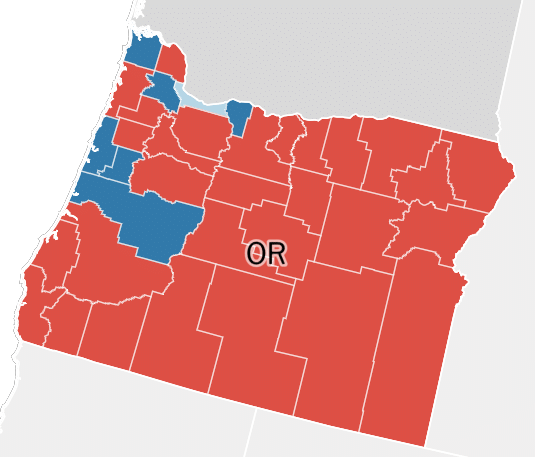
In 2016, when Kate Brown won the race for governor, her win was derived almost entirely from higher population urban areas, including counties with academic centers, such as the University of Oregon (Lane County) and Oregon State University (Benton County)

brownmap2

BLUE: Kate Brown; RED: Bud Pierce

John Kitzhaber’s 2014 race against Dennis Richardson followed the same pattern:

govenorsracepng

BLUE: Kitzhaber; RED: Richardsonn

Now look at the results of the Nov. 2017 governor’s race in Virginia, where voters chose Democrat Ralph Northam over Republican Ed Gillespie 54 percent to 45 percent.

votesharemapvirginia

RED: Gillespie    BLUE: Northam

The New York Times reported  that Lt. Gov. Ralph S. Northam won the race against Republican Ed Gillespie with huge margins in vote-rich metropolitan Virginia, and especially the populous Washington suburbs in Northern Virginia.

For example, in Northern Virginia’s Fairfax County, Virginia’s largest county (and where I used to live when working in Wash., D.C.) twice as many voters supported Northam than Gillespie. Northam also carried Northern Virginia’s Loudoun County by more than 23,000 votes — a 20-point spread.

Maps on the New York Times website  also show Northam’s big vote advantages in other urban areas, including Richmond (The State Capitol), Norfolk (Home to the largest U.S. Navy base in the world, Naval Station Norfolk, and one of NATO’s two Strategic Command headquarters, Roanoke ( Roanoke College , Hollins University and Virginia Tech  are in the area), and Harrisonburg (home to James Madison University, with an enrollment of 21,000 students).

Northam also did well in southeastern Virginia, where the state’s large black population is heavily concentrate. Northam also comes from Virginia’s eastern shore,

Meanwhile, Gillespie rolled up huge margins in rural areas, sometimes 70-80 percent of the vote. In southwest Virginia’s Scott County, for example, Gillespie took 81.4 percent, Northam 17.7 percent. The problem is all the rural areas couldn’t override Northam’s vote in populous urban areas.  Gillespie’s win got him just 4996 votes in Scott County., while Gillespie’s 67.9 percent win in Fairfax County got him 254,919 votes.

“Rural Virginia, mostly stuck with the GOP brand and backed Gillespie at almost the same levels as Trump,” Geoffrey Skelley, associate editor of Sabato’s Crystal Ball at the University of Virginia Center for Politics, told the New York Times. “However, the problem for the rural areas is that Gillespie didn’t make any inroads in the Urban Crescent, meaning that the more urban and suburban parts of the state trumped the heavily Republican vote in areas such as Southwest Virginia, Southside, and the Shenandoah Valley.

This election suggests that the state’s politics may remain very polarized, with urban areas being very Democratic, suburban and exurban areas leaning Democratic, and rural areas voting heavily Republican.”

In other words, despite the Democrat’s success this week, it’s no sure thing that 2018 will see a Democratic sweep.


/

]’;

Just Say No! Stop Gov. Brown from helping former legislators cash in on PERS

GovBrownFastOne

What, me try to pull a fast one?

Oregon’s Senate Rules Committee needs to straighten up and fly right when it considers proposed appointments by Gov. Kate Brown one week from today.

Brown has nominated Sen. Richard Devlin (D-Tualatin) and Sen. Ted Ferrioli (R-John Day) to the Northwest Power & Conservation Council, a federally funded panel that provides policy and planning leadership on regional power, fish and wildlife issues.

The Senate Rules Committee is scheduled to consider the nominations on Nov. 13. It should just say no.

If the two men, neither of whom have power and conservation expertise, are approved for the Council positions, not only will they each make $120,000 a year, but they’ll likely end up exploiting PERS for big payouts. That’s because their pensions will be calculated using their new high salaries, potentially rewarding them with hundreds of thousands of extra dollars. This when PERS is already overwhelmed with billions of dollars in unfunded liabilities.

I remember when smug Enron executives tried to intimidate Oregon Public Utility Commissioners in an effort to secure approval for Enron’s takeover of PGE. Commissioner Joan H. Smith blasted the Enron people at a hearing for assuming Oregonians were simple-minded country bumpkins . “Do you think we all just fell off a turnip truck,” she said.

Gov. Brown must think the members of the Senate Rules Committee just did.

Members of the Senate Interim Committee on Rules and Executive Appointments


Chair Senate Majority Leader Ginny Burdick
Vice-Chair Senate Republican Leader Ted Ferrioli
Member Senator Lee Beyer
Member Senator Brian Boquist
Member Senator Arnie Roblan


Double dealing with PERS: enough of Gov. Brown’s shenanigans

kate-brown-10x8-d383f11824f1b171

What, me two-faced?

What one hand giveth, another taketh away.

Gov. Kate Brown knows how it works.

Just as a task force she appointed puts out a report on how PERS’ massive unfunded actuarial liability (UAL) might be reduced, Brown appoints two legislators to jobs that will drain PERS of hundreds of thousands of dollars.

The Task Force, which Brown charged with identifying options to generate additional funding to reduce the PERS UAL by up to $5 billion over the next five years, issued its report yesterday (Nov. 1). Ideas put forward in the report to generate revenue for PERS , which would impact all Oregonians, include:

  • Privatize state universities
  • Sell surplus port and airport property
  • Sell additional Common School Fund land assets
  • Expand the types of gaming the Oregon Lottery offers and direct revenue from these new options toward PERS
  • Impose a charge for new water rights based on market prices.
  • Sell or do an IPO of SAIF
  • Institute more aggressive foreclosures on properties with property tax and other liens (“Cities could use their own discretion to use the streamlined process (in order to make sure they don’t evict 85-year old grandmothers,” the report notes.)
  • Increase OLCC’s flexibility to operate the spirits business to maximize profits; Increase alcohol licensing fees and excise taxes on beer and wine; impose a surcharge on all distilled spirit (liquor) sales in Oregon, calculated as a percentage of the retail sales price (e.g., 1%, 5%, or 10%).

While all this revenue-raising analysis is going on, Gov. Brown is proposing to undermine PERS’ financial health by conspiring with Sen. Richard Devlin (D-Tualatin) and Sen. Ted Ferrioli (R-John Day) to enrich the legislators, fleece PERS and drive up the costs of PERS payers, such as schools and local governments.

As I’ve pointed out previously, on Oct. 23, Brown nominated Devlin and Ferrioli to the Northwest Power & Conservation Council, a federally funded panel that provides policy and planning leadership on regional power, fish and wildlife issues. The Senate Rules Committee is scheduled to consider the nominations on Nov. 13.

The council positions come with a $120,000 annual salary, substantially more than Devlin and Ferrioli have been making from their legislative salaries.

Furthermore, as The Oregonian’s Ted Sickinger reported this past week, both men will likely end up raiding PERS for big payouts.

The jobs “…will allow both legislators to double dip, turbocharge their public pensions, or both,” Sickinger reported.

As Sickinger explained it:

“Ferrioli already draws a $33,083 annual pension from the Public Employees Retirement System. That benefit stems from 6½ years working for the Oregon Department of Veterans Affairs in the late ’70s and early ’80s…And because he is already at retirement age, he is allowed to double dip, continuing to collect it while working full time at the council.

Meanwhile, Ferrioli is eligible for a separate pension for his 20 years of legislative service. And if his Senate colleagues confirm him to the new position, that pension will be calculated using his new higher salary and the extra years of service he earns at the power council, according to PERS.

It’s unclear how much service credit Ferrioli earned during his years at the Legislature, given the part-time work. But assuming he sticks with the job for the first three-year term, the new salary could quintuple his legislative pension, which could translate to hundreds of thousands of dollars in extra benefits over the course of his retirement (emphasis mine). And he could start drawing that while continuing to work at the council.

Devlin, too, could see a similar multiplier in his legislative pension if confirmed. He, too, has 20 years of legislative service and is eligible to start drawing his pension. But if he holds off, the new salary and service at the power council would balloon those benefits after three years.”

This brazen attempt to exploit PERS when it is already suffering from billions in unfunded liabilities needs to be cut off at the pass.

If they want to maintain their reputations as public servants, Devlin and Ferrioli should either decline the Council appointments or they should refuse any additional PERS benefits that may arise because of them.

And Gov. Brown and the Legislature need to put a stop to this practice of raiding PERS to enrich former Legislators. It’s time to stop taking Oregonians for rubes.


The Manafort Indictment: one charge is bogus

foreignagent

The Department of Justice unveiled indictments of former Trump campaign chairman Paul Manafort today (Oct. 30).

The indictment contains 12 counts. conspiracy against the United States, conspiracy to launder money, unregistered agent of a foreign principal, false and misleading FARA statements, false statements, and seven counts of failure to file reports of foreign bank and financial accounts.

One charge in particular intrigued me, that Manafort acted as an unregistered agent of a foreign principal under the the federal Foreign Agents Registration Act (FARA), enacted in 1938 to counter Nazi propagandists and amended in 1966 to regulate political and economic lobbyists.

The fact is FARA is a paper tiger, frequently ignored and rarely enforced.

FARA requires persons acting as agents of foreign principals in a political or quasi-political capacity to make periodic public disclosure of their relationship with the foreign principal, as well as activities, receipts and disbursements in support of those activities. There are about  2,000 foreign agents registered under the Act representing more than 100 countries.

The Center for Public Integrity released a study, “The hired guns who advocate for the world’s worst human rights abusers” – a research report that highlighted the PR firms that make the most money representing clients that violate human rights.

The study said FARA records revealed that “that the 50 countries with the worst human rights violation records have spent $168 million on American lobbyists and public relations specialists since 2010.”

The fact is, Washington, D.C. is packed with public relations professionals and lobbyists who work for foreign governments, many of them with reputations for corruption and human rights abuses.

Another fact is that the registration process under FARA  is often altogether ignored or treated as an afterthought, with many registrants filing retroactive registrations, or only supplying partial submissions.

An internal DoJ audit of the NSD’s enforcement and administration of FARA, conducted in 2016, found that only 23 percent of filings from 2013 to 2015 were filed on time—62 percent were submitted late.[6] Likewise, only 44 percent submitted their supplemental statements in a timely fashion, and 10 percent did not submit any follow-up supplemental materials.

“The Congress didn’t necessarily want to have a strong enforcement mechanism, ” said Kenneth Doyle, the Senior Editor for Bloomberg’s Money & Politics Report. ” There are principal reasons in terms of the First Amendment and not wanting to be too tough on people’s ability to petition the government, and then there are practical reasons of not wanting to be too tough on lobbyists who are important to the way that Washington works. I think they did it deliberately, saying, ‘Well, we’ll have a disclosure system, but it’s not going to have a strong enforcement mechanism and we’ll see what happens.”


Abuse of Power: Gov. Kate Brown’s PERS Payoff

Kate Brown

Why is Gov. Kate Brown laughing?

Co-conspirators Gov. Kate Brown (D), Sen. Richard Devlin (D-Tualatin) and Sen. Ted Ferrioli (R-John Day) have concocted a bipartisan scheme to enrich the legislators and fleece the Public Employees Retirement System (PERS).

This while a task force appointed by Gov. Brown has been trying to determine the best ways to slash the the crushing PERS debt by $5 billion. The task Force’s report is expected to be submitted on Nov. 1. The PERS Board has predicted that if solutions aren’t found, PERS costs could rise from 17 percent of state and local government annual payrolls to 34 percent in 2021. That would be likely to force worker layoffs.

And you thought Oregon was a corruption-free state.

On Oct. 23, Brown nominated Devlin and Ferrioli to the Northwest Power & Conservation Council, a federally funded panel that provides policy and planning leadership on regional power, fish and wildlife issues. The Senate Rules Committee is scheduled to consider the nominations on Nov. 13.

Neither legislator will bring any expertise in regional power, fish and wildlife issues to the Council. Devlin, 65, is a retired corrections officer and private investigator. Ferrioli, 66, is a retired public relations executive.

But their lack of expertise is not the most egregious issue. It’s their exploitation of the public purse.

First, the council positions come with a $120,000 annual salary, substantially more than Devlin and Ferrioli have been making from their legislative salaries.

Second, as The Oregonian’s Ted Sickinger reported this past week, both men will be raiding PERS for big payouts.

The jobs “…will allow both legislators to double dip, turbocharge their public pensions, or both,” Sickinger reported.

This is how Sickinger put it:

“Ferrioli already draws a $33,083 annual pension from the Public Employees Retirement System. That benefit stems from 6½ years working for the Oregon Department of Veterans Affairs in the late ’70s and early ’80s…And because he is already at retirement age, he is allowed to double dip, continuing to collect it while working full time at the council.

Meanwhile, Ferrioli is eligible for a separate pension for his 20 years of legislative service. And if his Senate colleagues confirm him to the new position, that pension will be calculated using his new higher salary and the extra years of service he earns at the power council, according to PERS.

It’s unclear how much service credit Ferrioli earned during his years at the Legislature, given the part-time work. But assuming he sticks with the job for the first three-year term, the new salary could quintuple his legislative pension, which could translate to hundreds of thousands of dollars in extra benefits over the course of his retirement (emphasis mine). And he could start drawing that while continuing to work at the council.

Devlin, too, could see a similar multiplier in his legislative pension if confirmed. He, too, has 20 years of legislative service and is eligible to start drawing his pension. But if he holds off, the new salary and service at the power council would balloon those benefits after three years.”

This brazen attempt to exploit PERS, which Brown, Devlin and Ferrioli know is already in deep trouble, needs to be cut off at the pass.

If they want to maintain their reputations as public servants, Devlin and Ferrioli should either decline the Council appointments or they should refuse any additional PERS benefits that may arise because of them.

Gov. Brown needs to stop taking Oregonians for rubes. It’s time to put a stop to this abuse of the system.