Gov. Ralph Northam’s Permanent Record

“When I was a child, I spoke like a child, I thought like a child, I reasoned like a child. When I became a man, I gave up childish ways.”

 1 Corinthians 13:11

permanent-record

\Remember when you were in school and got caught doing something wrong?

Some authority figure would say in a deep, threatening tone, “This is going on your permanent record.” Blemished forever, you thought.

But at some point later in life you realized they were bluffing. There was no permanent record. You could reinvent yourself, put the past behind you, or at least those school years of sometimes questionable behavior.

The fact was, just like a boat doesn’t care about its wake, nobody cared about your youth, except, perhaps, for a few buddies who lived through it with you.

Not any more.

Virginia Governor Ralph Northam, now 59 years old, is painfully aware of that.

The recent emergence of a photo on Northam’s 1984 yearbook page at Eastern Virginia Medical School— featuring one person in blackface and one person in a Ku Klux Klan-style robe and hood — spurred a cascade of righteous condemnation and demands from both sides of the aisle, including just about all the deeply moral 2020 Democratic hopefuls, that Northam resign,

”The photo of Ralph Northam’s yearbook that surfaced yesterday is both racist and inexcusable,” brayed the Democratic Governors Association in a statement. “It is time for Gov. Northam to step aside and allow Virginia to move forward.”

“We now know what Ralph Northam did when he thought no one was watching,” announced Rep. Karen Bass (D-CA), chair of the Congressional Black Caucus. “The person in that photo can’t be trusted to lead. Governor Northam must resign immediately.”

In this case, the damning photo surfaced because one or more of Northam’s former classmates, outraged about some pro-abortion comments he made, tipped off Big League Politics, a conservative website.  More common, however, is the discovery in the online sewer of some long-ago questionable behavior or contentious remark.

And now the media universe is even more fired up.

On Feb. 7, Virginia’s Attorney General, Mark Herring, who’s third in line for the governorship, revealed that he and some friends “put on wigs and brown makeup” when they dressed as rappers at a University of Virginia party in 1980 when he was 19 years old. The mob is salivating over that transgression.

Feb. 7 also brought news that the State Senate’s top Republican, 72-year-old Majority Leader Thomas K. Norment Jr., had been managing editor 51 years ago of a 1968 Virginia Military Institute yearbook containing racist slurs and photographs, some including blackface.

Ferreting out youthful indiscretions is clearly now the name of the game in political journalism.

It sells papers and drives the curious to online news, stirs up a firestorm of outrage on social media and offers opportunities for political grandstanding.

It’s clear there’s a market for long-ago and forgotten, but potentially salacious or accusatory, stuff dug up by political parties and their partisan and activist allies.

But it raises serious questions about exactly how much culpability should be assigned to the actions of young people decades later, whether some youthful indiscretions have a right to be forgotten.

What’s a person‘s moral responsibility for actions of the past? Should somebody whose adult life has been honorable and well-intentioned be found wanting for youthful errors?

“Before the internet, young people who made mistakes—from embarrassing statements to minor crimes—that ended up in the public record eventually benefitted from ‘privacy-by-obscurity,” John Simpson, privacy project director at Consumer Watchdog, a progressive non-profit, said recently.  “Those things slipped out of the general consciousness of the public. Now, a youthful offense can remain at the top of search results indefinitely.”

Some theorists liken moral responsibility to a metaphorical ledger of life. “To be blameworthy is to have a debit on one’s ledger, and to be praiseworthy is to have a credit on one’s ledger…and entries on one’s ledger are made in permanent ink,” Andrew C. Khoury and Benjamin Matheson explained in the Journal of the American Philosophical Association.

But Khoury and Matheson argue that blameworthiness, unlike diamonds, should not be forever.

Whether a person deserves blame for a past action, or not, depends on many things – most of all on “how far and how deeply the individual has changed,” they say. In other words, blameworthiness can diminish through time.

An adult, as research shows, is not necessarily blameworthy for her actions as a child because the adult shares none of distinctive psychological states (e.g. beliefs, desires, or intentions) of the child, and these distinctive psychological features were essential to her committing an inappropriate act, Khoury and Matheson say.

Jonathan Last, an editor of The Weekly Standard, has pointed out that America’s juvenile justice system operates on the same principle, thatyoung people should not be held to the same standards of moral culpability as adults, that they aren’t fully capable of understanding the consequences of their actions.

“Personality is subject to a lifelong series of relatively small changes—particularly in adolescence and early adulthood, but continuing even into older age,” reported a study, Personality Stability From Age 14 to Age 77 Years“(This) can lead to personality in older age being quite different from personality in childhood.”

Or, as Khoury wrote, “..when confronted with the issue of moral responsibility for actions long since passed, we need to not only consider the nature of the past transgression but also how far and how deeply the individual has changed.”

The mob, particularly social media vigilantes, will likely continue to ignore all this. But they should remember the proverb, ‘Those who live in glass houses shouldn’t throw stones.”


2020: Will the mainstream media make a difference?

trumpandreporters

There’s a lot of tortured handwringing going on among the mainstream media about how they covered the 2016 presidential race and what they need to do to fix things for 2020.

“…we have a chance to do things differently than we did the last time around – to redeem ourselves,” columnist Frank Bruni opined in The New York Times on Jan. 13, 2018. “Our success or failure will affect our stature at a time of rickety public trust in us.”

Bruni’s column focused on the role of the “mainstream, establishment media” and its responsibility to clean up its act, to avoid writing about the spectacle and cover, instead, substance, fitness for office and competing visions of government.

Sounds all very serious and high-minded. But Bruni’s angst is too late.

The fact is, what the mainstream, establishment print and television media have to say about politics simply doesn’t matter as much anymore because people are going elsewhere to find out what’s going on and what people think about it.

“The conversation that should concern everyone, in both media and politics, is not about what gets covered,” Peter Hamby recently wrote in Vanity Fair.  “It’s about what gets attention.”

“At a time when technology is transforming voter behavior at unprecedented speed, this is a problem that the mainstream media, even on its best behavior, cannot possibly solve without a drastic reimagining of what journalism is and how it reaches contemporary audiences.”

Diminishing influence

newspaperreaders1950

In 1950, almost every American household read a daily newspaper

In 1950, almost every American household read a daily newspaper. By 2000, only 50 percent of Americans read a printed newspaper on a daily basis.

As I write this in Jan. 2019, I’m sitting at a large, bustling coffee shop. A couple dozen people of all ages are busily engaged at their laptops. Not a single person is reading a newspaper.

The fact is fewer Americans read a daily newspaper today than in 1950, while the U.S. population has more than doubled. And the prognosis isn’t good. With just 2 percent of teenagers reading a newspaper on a regular basis, few are developing a newspaper reading habit.

Unlike the individualized, algorithm-determined, constantly updated news delivered to consumers online, print newspapers offer identical mass communications to their customers. And by the time the news in print newspapers reaches the intended audience, not only is it stale, but it has been superceded by newer news.

During the 2016 election, a survey of U.S. adults by the Pew Research Center revealed  that print versions of both local and national newspapers were named as key sources for election news and information by only 3% and 2% of respondents respectively. Late night comedy shows did just as well as sources at 3%.  (Maybe that explains why Sen. Kirsten Gillibrand (D-NY) announced she was forming a presidential exploratory committee during a Jan. 15 appearance on “The Late Show with Stephen Colbert”)

pewresearch2016electiontable

And even if you did read print newspapers during the election, policy issues — what the nominees would do if elected—got little press coverage in print outlets. In the 2016 general election, policy issues accounted for just 10 percent of the news coverage—less than a fourth the space given to the horserace between the candidates, according to a Shorenstein Center study.

And even if you did read print newspapers during the election, policy issues — what the nominees would do if elected—got little press coverage in print outlets. In the 2016 general election, policy issues accounted for just 10 percent of the news coverage—less than a fourth the space given to the horserace between the candidates, according to a Shorenstein Center study.

All this has translated into a drastic reduction in the influence of newspaper editorial endorsements.

“Once upon a time, a newspaper endorsement for a political candidate was about as good as it got,” Philip Bump wrote in the Washington Post  a couple weeks before the 2016 election. “In the era before the internet…big, important newspapers could shift the fortunes of people seeking the presidency. Nowadays, that’s … less of the case.”

Of the 269 U.S. newspapers that dispensed their wisdom by endorsing a presidential candidate in 2016, 240 endorsed Hillary Clinton and just 18 endorsed Donald Trump. Libertarian Gary Johnson secured nine endorsements and independent conservative Evan McMullin got one.

trumpendorsement

Of the top 100 largest newspapers in America with the largest circulations, just two endorsed Trump,

As Politico media reporter Hadas Gold tweeted when Trump’s stunning victory became clear, “… newspaper endorsements DO NOT MATTER.”

That may be partly due to slipping public respect for the mainstream media.  In a Pew Research Center survey taken shortly after the November 2016 balloting, only one in five respondents gave the press a grade of “B” or higher for its performance. Four of five graded its performance as a “C” or lower, with half of them giving it an “F.”

Declining newspaper circulation

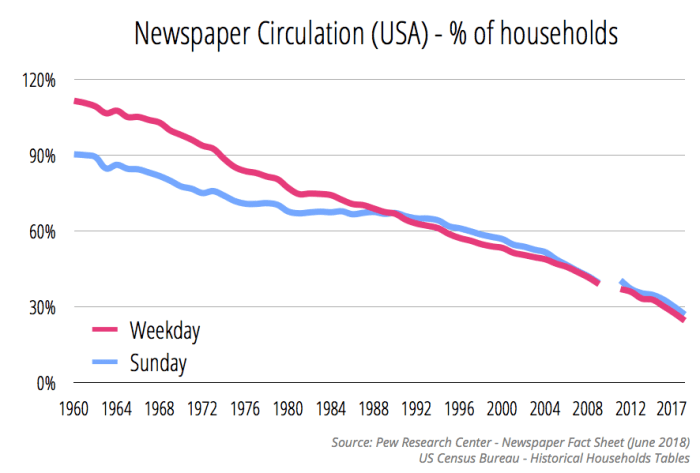
Much of the waning influence of print newspapers can also be attributed to circulation declines (or the reverse).
newspapercirculationpercentofhouseholds

In 1960, nearly 120 percent of households bought a daily newspaper (i.e. there were 1.2 papers sold per household). By 2017, fewer than 30 percent of households bought a daily newspaper.

In 1990, circulation of U.S. daily newspapers totaled 62.3 million weekday and 62.6 million Sunday. By 2009, circulation had sunk to 55.8 million daily and 59.4 million Sunday.

According to the Pew Research Center, in 2016, despite the excitement and turmoil of the national elections, weekday and Sunday circulation for U.S. daily newspapers – both print and digital – fell 8%, marking the 28th consecutive year of declines. Weekday circulation fell to 35 million and Sunday circulation to 38 million – the lowest levels since 1945.

The following year, the first of Tump’s term, was equally discouraging. Estimated total U.S. daily newspaper circulation (print and digital combined) in 2017 was 31 million for weekday and 34 million for Sunday, down 11% and 10%, respectively, from 2016.

Some of that decline is because the United States has lost almost 1,800 papers since 2004, including more than 60 dailies and 1,700 weeklies, leaving 7,112 in the country, according to The School of Media and Journalism at UNC.

California lost the most dailies of any state. In one case, the 140-year-old, 500-circulation Gridley Herald used to serve Gridley (population 6,000) in the central California county of Butte, 60 miles from Sacramento. On Aug. 29, 2018, the paper’s staff and the community were notified by the paper’s owner, GateHouse Media, that the final issue of the twice-weekly paper would be published the next day.

Daily newspaper circulation in California totaled about 5.7 million 15 years ago. In 2018, that was cut in half to 2.8 million.

If print circulation continues to drop at current rates, as many as one-half of the nation’s surviving dailies will no longer be in print by 2021, predicts Nicco Mele, director of the Shorenstein Center for Media, Politics and Public Policy at Harvard University..

One of the most striking examples of decline is in Silicon Valley. The San Jose Mercury News, rebranded as The Mercury News in 2016, was once an influential publication with about 400 reporters, editors, photographers, and artists.

According to The Columbia Journalism Review, the Mercury News was one of the first daily newspapers in the U.S. with an online presence, the first to put all its content on that site, the first to use the site to break news, and one of the first to migrate its growing online content to the web.

Its commitment to innovation and hard news led to daily circulation of 200,258 in 2009 making it the fifth largest daily newspaper in the United States.

But subsequent years of bad business decisions, declining classified advertising (including job listings), layoffs, McClatchy’s purchase of the paper’s owner, Knight Ridder, in 2006, and the subsequent sale of the Mercury News to the MediaNews Group caused the paper to slip. “…sadly the San Jose Merc is a mere shadow of its former self,” commented one online reviewer.

Not that long ago, the San Jose paper proclaimed itself “The Newspaper of Silicon Valley,” media business analyst Ken Doctor wrote in Newsonomics. “Silicon Valley has done quite well, becoming the global economic engine and driving great regional affluence. But the economically fecund region has become — in less than a decade — a news desert.”

Here at home, The Oregonian, a paper with a long and storied history, is a story of decline, too.

oregonianbuildingold

The Oregonian Building, at the corner at the intersection of S.W. Sixth and Alder, occupied by the paper during 1892-1948.

In 1950, when Advance Publications bought the paper, its daily circulation was 214,916. For quite a while, things looked promising.

I joined The Oregonian as a business and politics reporter in 1987. It was a robust, well-respected paper, with a proud past and a much-anticipated future. Daily circulation was 319,624; Sunday circulation 375,914.

When I left the paper 10 years later in 1997 to take a corporate communications job, daily circulation was 360,000, Sunday circulation 450,000. It looked like the paper was on a roll.

But good times were not ahead. By 2012, daily circulation had sunk to 228,599, only slightly higher than in 1950. In subsequent years, daily circulation continued to slump, despite robust population growth in the Portland Metro Area.

Meanwhile, talented reporters have fled in droves, some pushed out, others motivated by buy-outs. At the same time the once powerful paper’s clout has diminished as it has abandoned rural Oregon and 7-day-a-week print distribution.

By 2018, The Oregonian had a print circulation of just 158,000 and distributed  to 15 fewer counties in Oregon and Washington than it did in 2004, when it had a circulation of 338,000, according to a UNC report on The Expanding News Desert.

A few smaller local Oregon papers are thriving, but most are suffering, too. And all of them have a tough time covering state and national politics consistently and with any depth.

Oregon Public Broadcasting OPB recently reported that Western Communications, which owns seven newspapers across the West, including the Bulletin in Bend, the Baker City Herald and the La Grande Observer, “is on the brink of foreclosure.” The company hasn’t paid nearly $1 million owed in local property taxes and interest and is between three and five years behind on taxes in counties across Oregon, OPB reported.

Comprehensive political coverage by the Eugene Register Guard is threatened, too. On March 1, 2018, GateHouse Media, the same company that closed the Gridley Herald, acquired the Register Guard, which had survived more than 90 years of independent, family ownership.

GateHouse publishes 130 daily newspapers. It has a reputation for tightfisted financial management accompanied by staff layoffs. It’s impact on the Register Guard has fit that pattern. In Dec. 2017, before the GateHouse takeover, the editorial and news staff at The Register-Guard totaled 42, according to the paper’s staff directory. Today the directory lists 27, of which just 12 are identified as reporters..

Not only has the Register Guard staff shrunk; so has its daily circulation, dropping from 54,325 in 2011 to 41,280 today.

“What’s happening with the Guard isn’t unique to the Guard,” Tim Gleason,professor and former dean at the University of Oregon School of Journalism and Communication, told the Eugene Weekly. “It’s what’s happening all over the country as these venture capital firms buy newspapers and then largely gut them.”

Of course, newspapers are being gutted whether or not they are investment targets.

In early January 2019, the Dallas Morning News eliminated 43 jobs, according to the Columbia Journalism Review, half of them in the newsroom, with the cuts  hitting reporters covering immigration, transportation, the environment, and the courts.

On Friday, February 1, The McClatchy Company, which owns properties such as the Miami Herald and the Kansas City Star, emailed staffers to announce that 450 employees would be offered voluntary buyouts as part of a “functional realignment,” essentially signaling that the jobs have been marked out of the budget. The news was first reported by the Miami New Times.

If print newspaper circulation across the board continues to drop at current rates, as many as one-half of the nation’s surviving dailies will no longer be in print by 2021, predicts Nicco Mele, director of the Shorenstein Center for Media, Politics and Public Policy at Harvard.

None of this is good news if you want an educated, informed public in a position to make wise judgments about public policy.

“The way to prevent irregular interpositions of the people is to give them full information of their affairs through the channel of the public papers, and to contrive that those papers should penetrate the whole mass of the people,” wrote Thomas Jefferson in 1787.

That is as true today.

How about network television news?

Given the decline of local print media, local network TV news is one of the few remaining sources of locally-focused journalism covering political issues, but local TV news has been experiencing declines as well.

Just from 2016 to 2017, the portion of Americans who often rely on local TV for their news fell 9 percentage points, from 46% to 37%, according to the Pew Research Center. Still, local tv news shows have multiple opportunities to cover educate their audience. The problem is that covering public policy is rarely their forte and it’s not what their audience is seeking.

Instead, local TV news is the outlet of choice by adults for weather, breaking news and traffic reports, although young adults are more likely to turn to the Internet, according to Pew Research.

Public policy and politics coverage is also suffering with a decline in the audiences for the national network news shows of NBC, ABC and CBS, although some scholars believe television news viewing has little effect on issue learning. In other words,  watching increasing quantities of television news will not lead to greater knowledge about political issues because of the paucity of real issue information. You may know more about polls and personalities, but not so much about political issues that affect your life.

Remember when the family used to gather in the living room every night for the evening news, either the Huntley-Brinkley Report, CBS Evening News with Walter Cronkite or ABC Evening News with Frank Reynolds and Howard K. Smith? That was so long ago.

family-gathered-around-tv-500x214

All three network evening news shows have been losing audience steadily since then. By 1998, the three network evening newscasts reached a combined average of only about 30.4 million viewers in a country with a population of 276 million.

In 2016, even with a turbulent presidential campaign, the average viewership for the ABC, CBS and NBC evening newscasts was 24 million, according to a Pew Research Center  analysis.

Compare that to the ratings of a single showing of 2016’s number one primetime TV show, The Big Bang Theory, which averaged 19.9 million viewers, or with Super Bowl 50 on Feb. 7, 2016, which got 112.6 million average viewers, according to Nielsen.

By the 2017-18 television season, ABC’s evening news had an average of 8.6 million viewers, NBC Nightly News 8.15 million and CBS Evening News 6.2 million. That’s a total of 22.95 million.


lonesomerhodes

Lonesome Rhodes, a master manipulator.

In Elia Kazan’s classic movie “A Face in the Crowd,” Lonesome Rhodes, played brilliantly by Andy Griffiths, rises from an itinerant Ozark guitar picker to a local media rabble-rouser to TV superstar and a political power. “I’m not just an entertainer. I’m an influence, a wielder of opinion, a force… a force!”, he exclaimed at one point.

Newspaper publishers and TV news anchors may once have felt the same way, but their days are numbered.

This doesn’t mean, however, that the demand for news is going to collapse. It just means there’s going to be a need for more imagination in formatting and delivering it in ways that grab an audience and rewards them for their attention.

Vanity Fair’s Peter Hamby cited a twice-daily news show produced by NBC that runs on Snapchat. According to Digiday, the brief show, Stay Tuned, was created specifically for the vertical-screen mobile experience. In 2018, Stay Tuned averaged 25 – 35 million unique viewers per month on Snapchat, according to data provided to NBC News by Snap. Only one-third of that audience also watches, reads or listens to NBC News content on other platforms, so two-thirds are a new NBC audience.

To top it off, about 75 percent of the “Stay Tuned” audience is under 25 and 90 percent is under 34, according to Snapchat, a significant accomplishment given that reaching younger audiences has provers to be a challenge for traditional print and network TV.

So the future isn’t all grim. It will just be different.


Merkley’s perjury charge: much ado about nothing

sen_jeff_merkleyperjury

Jeff Merkley, Oregon’s junior senator and potential aspirant for the Democratic presidential nomination, got the media publicity he wanted when he asked the FBI on Friday to open a perjury investigation into Homeland Security Secretary Kirstjen Nielsen.

In a press release posted on his website, Merkley said he asked for the investigation “…after new documents show that Nielsen lied in sworn testimony to Congress about the administration’s family separation policy.”

To add to the allure of his charge, Merkley said he obtained the incriminating document from a whistleblower,

Following up on his press release, Merkley tweeted:

“I’m formally requesting that the @FBI investigate whether @SecNielsen committed perjury during her testimony under oath before @HouseJudiciary. The memo I released yesterday flat-out contradicts her statement that there was no child separation policy.”

But there’s one problem. The document, which Merkley said proved his case, proves no such thing.

The document, available here, is, in fact, quite clearly a draft of options, with multiple comments and suggested edits. Titled “Policy Options to Respond to Border Surge of Illegal Immigration,” it lays out options for dealing with 16 issues, including: Increase prosecution of family unit parents; Separate family units; Adjudication of cases in immigration court; and Interpretation of special immigrant juvenile visas.

As Roll Call, a newspaper and website that reports news of legislative and political maneuverings on Capitol Hill, has reported, the memo shows that “…officials from the Departments of Justice and Homeland Security were exploring (emphasis added) family separation polices as a deterrent for illegal immigrants…”

In the same vein, the New York Times reported the document “…showed that Ms. Nielsen’s staff considered a range of options for dealing with the influx of families seeking asylum, including a policy that would ‘separate family units.’ “

A spokeswoman for the Homeland Security department also has denied Merkley’s charges. “What this predecisional, predeliberative memo — as well as previously leaked predecisional, predeliberative documents — shows is that the secretary was provided a menu of options to prevent the humanitarian crisis we predicted at that time and which has manifested itself today,” the spokeswoman, Katie Waldman, said to the New York Times in an email.

So Merkley ginned up a controversy out of thin air. But what the hell, he got a lot of media coverage. Isn’t that what it’s really all about?

Gov. Kate Brown’s 2019 inaugural address (annotated to reflect reality)

browninauguraladdress2019

Gov. Kate  Brown delivering inaugural address, Jan. 14, 2019

Good afternoon everyone. (At least I can say that with a straight face.)

Thank you all so much for being here. (And, boy, am I glad to be here, instead of at home because I lost to that rich dude, Knute)

Senate President Peter Courtney, Speaker Tina Kotek, thank you. (Yea, we got a supermajority this time, so we can raise taxes like crazy. People don’t call me “Governor Gimmee” for nothing.)

To our Tribal Chairs and leaders, welcome. (Keep those campaign contributions coming and I’ll do what I can to help you. But, by the way, I see Confederated Tribes of Grand Ronde, operator of the Spirit Mountain Casino, donated only $55,000 to the Kate Brown Committee. You can do better. You folks are rolling in dough.)

To newly elected legislators, congratulations and welcome. (Sorry, but this doesn’t include you, Rep. Cheri Helt R-Bend, or any of your weenie Republican colleagues)

It’s an incredible honor to serve Oregon for four more years. (And, whew, now I don’t have to look for a job)

Today is a little bittersweet for me, as this ceremony marks my final four years as governor of (Oregon (That’s 1460 days, you sad sack Republicans). But, aside from how this feels for me (Am I looking humble enough?), this is an important moment for our state.

In many ways, Oregon is progressing (See how I snuck in “progressive”?) on ground that many of our neighbors wish they could tread. (Except, of course, for our gigantic unfunded PERS liabilities, our embarrassing high school graduation rate, homeless people camping and using drugs all over the place, an affordable housing crisis, unbearable traffic congestion in the Portland Metro Area, a broken state foster care system, and so on.)

Our unemployment rate is the lowest on record.

We have one of the fastest job growth rates in the country.

And in November, Oregonians defeated ballot measures that would have moved us backwards. Together, we used our vote to affirm Oregon values.

In many ways we stand alone. (What does that tell you?)

For years we have struggled to overcome the impacts of recession on our state revenue, to build up adequate funding for our education system, and stabilize access to health care.

For many families, the cost of housing, health care, child care, and higher education are all outpacing wage growth. (So forget about any cost-saving efforts or consideration of efficiencies. instead, we’re going to tax everybody and their brother to within an inch of their life, because that’s what we Democrats do, folks.)

And all of this is against the backdrop of a federal government that has never been in more disarray. (Like my dig at Trump?)

Now is the time to put our state on a better path forward.

The first step is to ensure that our democracy is strong. And fight every effort to undermine it.

Voting is our country’s greatest collective responsibility, and we must vigorously safeguard the sanctity of our elections. While our elections institutions are amongst the best in the nation, we have more work to do to ensure that every single voice is heard.

I will work for campaign finance reform, fight for paid postage on our ballots, and expand our automatic voter registration system. (Yeah, I know, I’ve promised campaign finance reform  before and nothing has changed. Ignore the fact that Democrats have held the governorship since 1992 and the House and Senate since 2013, so I suppose we could have successfully tackled this issue before now if we were really serious about it)

I’d welcome your help. (Particularly your hard-earned money)

While other states are rolling back voting rights, Oregon is leading the way.

Vote by mail and Oregon’s motor voter have made it so that we have one of the highest voter participation rates in the country.

But when it comes to campaign finance, we are still the wild wild west. This needs to end. (Please ignore the fact that, as Forbes has pointed out, I’ve embraced the highly unethical practice of soliciting campaign cash from state contractors and that OpentheBooks.com found 557 state vendors gave $2.6 million in political donations to me– as secretary of state and governor – since 2012, while reaping $4.4 billion in state payments.)

No one should be able to buy a megaphone so loud that it drowns out all the other voices. (Are ya listening, Phil? By the way, please pay no attention to the large contributions I received in 2018 from labor unions (SEIU PACS- $500,000; Oregon Education Association PAC – $200,000; AFSCME – $100,000; American Federation of Teachers – $100,000; United Food & Commercial Workers, AFL/CIO – $100,000), Michael Bloomberg’s gun control non-profit –  $500,000, the pro-choice political action committee Emily’s List – $750,000), and the Democratic Governor’s Association – $1,025,000)

Next, we are facing an affordability crisis in health care and housing that needs to be addressed immediately.

Health care is a fundamental right. (Isn’t everything?)

Because of the work we’ve done to expand the Oregon Health Plan, today 94 percent of adults have access. (Please ignore the fact that Oregon’s Medicaid spending has experienced explosive budget-busting growth, posing extreme fiscal challenges. You see, Obamacare called for states to expand Medicaid to low income adults and provided federal funds to cover 100 percent of the costs of the newly eligible people from 2014 through 2016. The federal matching rate was then set to decrease over the next four years to 90 percent in 2020. Oregon’s legislature even went so far as to extend Medicaid to children brought to the United States illegally. Coverage began at the start of this year)

And because of the work we did to pass Cover All Kids, every single one of our children has access. (Including, by the way, an estimated 14,000 children of undocumented residents. The cost of extending health care to these children during an 18 month-period that started on Jan. 1, 2018 was projected to total $36.1 million, according to the state Department of Administrative Services. Sure, all this could be medical malpractice at the expense of all you U.S. citizens, but that’s not my problem. Besides, it let me appeal to my liberal base).

Let’s work together to make sure every Oregonian has the health care they need. (No expense is too much, right?)

We can’t keep doing the same thing expecting a different result, which is why I’m going to ask you to try something new.

If you approve a $20 million bonding package early this session, we can speed up construction of 200 units of permanent housing for the chronically homeless.

We also need to help Oregonians who have homes but are struggling with the high cost of rent. When problems arise, they need technical assistance to stay in their homes and not end up on the streets. We can help landlords and tenants navigate this tight housing market.

Speaker Kotek and Senator Burdick have innovative proposals that will give renters some peace of mind. (Ok, you and I know their rent control idea will be counterproductive, but lots of leftists want this and they don’t know economics. I read somewhere that “next to bombing, rent control is the most effective technique so far known for destroying cities.” Please don’t challenge me with quotes like that. And don’t bring up that researchers, using new data tracking individuals’ migration in San Francisco, found that rent control “increased renters’ probabilities of staying at their addresses by nearly 20%.” That meant apartment turnover went down. People with changing circumstances who would normally seek out other housing stayed where they were. That reduced the availability of their apartments to prospective new tenants. The researchers also found that landlords subject to rent control reduced rental housing supply by 15%, actually causing city-wide rent increases.)

Oregon families are counting on us. (Or at least current renters. People looking for new rental properties, maybe not so much)

\During my entire time as Governor, I have focused on spending every taxpayer dollar wisely. (Oops. Is my nose growing longer? I hope you’ve forgotten about such things as: the waste and incompetence at the Oregon Health Authority; how the Oregon Office of Emergency Management misspent $3 million in federal grants, triggering an audit and leaving the agency in the red;  that Oregon’s government waste hotline has been a waste of money; that for the past 13 years, Oregon government ignored its own requirement that large state agencies should have internal auditors keeping track of spending and rooting out waste and inefficiency.)

I am focused on several important items this session. And I put them in my budget.

First, adding internal auditors (I know, it’s about time, after 13 years), who will ensure that every state agency is delivering the level of service that Oregonians expect while saving every penny they can along the way.

Second, eliminating backlogs and decreasing wait times in critical areas, like child-care licensing and food safety inspections.

Third, modernizing the way we deliver services and purchase goods. We can save taxpayer dollars if we streamline the way state government does business. Especially by implementing a new centralized procurement system.

While we tackle today’s pressing fiscal challenges (I know, I’m not really tackling PERS, but what the hell), we also must address the challenges of our future.

Today, we stand at a turning point, with an opportunity to put Oregon on a better path forward.

I look forward to signing our clean energy jobs bill this session. (And I’m really looking forward to the $700 million a year the program is going to generate. Oh boy, oh boy!)

Higher education also needs to be more affordable and more accessible to Oregon families. The good news is, our current strong economy gives us the best chance in a generation to address persistent, structural challenges in our education system. The time is now. If we wait, we’ll only fall further behind when the economy eventually falters. (So let’s pass big tax increases now, when the economy is good, that Oregonians will have to pay when the economy sours in 2020)

At one time, every Oregonian was proud of our education system. It was a promise that if you chose to put down roots in Oregon, your children would receive a world-class education and have the opportunity to achieve their dreams. But over the past couple of decades we have failed to deliver on that promise. (Sure, I know we Democrats have been in charge for most of that time, but I don’t want to remind you of that)

How our state provides for the needs of our children is a marker of who we are as a community. After years of underinvestment, it’s going to take more than just additional funding to bring our schools back to a level we can be proud of.  (I have to admit, though, that I’m not sure when that proud period was. The four-year cohort graduation rate was 66.4% in 2010, 66% in 2000, 71.65% in 1990, the year Oregon voters passed Ballot Measure 5)  

We have failed our students of color and we have left rural Oregon behind. Now is the time to close that opportunity gap. (Ah ha, I’ve discovered rural oregon, which voted across the board for Knute Buehler)

Our education system is in desperate need of repair, reform, and reinvestment. It’s like an old house that hasn’t been maintained. The longer we wait, the more it will cost to fix it.

I will work with you, the business community, teachers, and parents to fund K-12 schools at a level that ensures our districts aren’t forced to make cuts. (But mostly I will work with the education unions and Nike. You see, in late November 2018, they got together to launch a coalition to push an expansive tax package through the legislature without any commitment to address problems with PERS. A lot of Oregonians who voted for me and other Democrats in November 2018 probably didn’t realize they were voting to raise their taxes big time. Too bad. A tsunami of taxes is about to wash over the state and wreak havoc with Oregonians’ budgets. if you’ve seen your pay go up because of Trump’s tax overhaul (which, by the way, Democrats in Congress want to roll back) or a pay raise, get ready to see your gains disappear down a tax rat hole. You gotta love it.)

My budget also includes resources to stabilize PERS rates for schools. This is in addition to the dedicated investments we began last year.

The unfunded liability in PERS is not going away. We must accelerate our work to stabilize PERS rates so that new dollars go directly into the classroom. (Sounds good, huh? But don’t expect any real progress on addressing PERS’ unfunded liability.)

We agree that we need to attract, train, and retain the best teachers in the country.

And we agree that we have to keep tuition affordable and open the doors to higher education. (Did I forget to mention that the share of state money in our state university budgets has been declining for years?)

My expectation is that these investments we’re making in education will improve outcomes for all of our kids. (If they don’t, I’ll be long gone and at least the education unions will be happy. That’s what’s really important after all the money they’ve contributed to my campaigns.)

Urban and rural, Democrat and Republican. We do what we’ve done time and again: put politics aside and serve the people of Oregon. (So long as the solutions are from the progressive grab bag.)

Today we have a choice. Are we willing to do the work to make the dream of a better Oregon come true?

We are.

The time is now. Our future is in front of us. (Isn’t that a terrific meaningless cliché? Or maybe I should have said “the future is now” or “the future is coming”) We have to turn the corner and make it a reality. Together we can build a better Oregon.

Thank you.

Rent control: another bad idea out of Salem

“Next to bombing, rent control is the most effective technique so far known for destroying cities.”   Assar Lindbeck, Professor of Economics


Four Civilians Killed by US Airstrikes in Syria's Deir Ezzor

“We have to keep people in their homes.”

That’s what Felisa Haggis, political director of Service Employees International Union Local 49, told Willamette Week in an argument for rent control.

That’s exactly what will happen, more people will stay in their homes longer, if Oregon’s Legislature approves a proposal by the Democrat leadership that would set an annual rent increase cap of 7 percent plus inflation.

A Working Paper just released by the Stanford Graduate School of Business backs up this statement.

But that’s not necessarily a good thing.

Using new data tracking individuals’ migration in San Francisco, researchers found that rent control “increased renters’ probabilities of staying at their addresses by nearly 20%.” That meant apartment turnover went down. People with changing circumstances who would normally seek out other housing stayed where they were. That reduced the availability of their apartments to prospective new tenants.

This was particularly the case with older households and households that had been living in their rent-controlled apartment for a number of years.

Howard Husock, vice president for research and publications at the Manhattan Institute, recently told Pew Trusts  that older people who live in rent-stabilized apartments have no incentive to leave.

“As a result, you’ve got a lot of young people in New York City doubled and tripled up,” Husock said. “And you’ve got affluent old people living in large [rent-stabilized] apartments with empty bedrooms where their kids once lived.”

“Longtime renters who have been living in rent-controlled units benefit greatly from rent control, while newcomers end up paying higher rents because the supply of available units is constricted,” the Working Paper said.

The Stanford researchers also found that landlords subject to rent control reduced rental housing supply by 15%, actually causing city-wide rent increases.

“As a result, you’ve got a lot of young people in New York City doubled and tripled up,” Husock said. “And you’ve got affluent old people living in large [rent-stabilized] apartments with empty bedrooms where their kids once lived.”

The Working Paper explained that landlords facing rent control regulations are more likely to convert units into condos or redevelop buildings to circumvent regulations, such as by demolishing their old housing and building new rental housing exempt from rent control.

This further reduces rental stock and drives up rents. Rent-controlled buildings were almost 10% more likely to convert to a condo or a Tenancy in Common, the researchers found.

Supporters argue rent control is the quickest and easiest way to provide relief to renters in danger of being priced out of their home, but the fact is it just makes the problem worse

In other words, rent control advocates in Salem are actually working against the best interests of a lot of the people they say they want to help.


Elizabeth Warren is starting off on the wrong foot

warreniniowa

Sen. Warren in the midst of a crowd in Storm Lake, Iowa

Just like President Trump, Sen. Elizabeth Warren is already fact-challenged.

Shortly after formally entering the 2020 presidential race on Dec. 31, Warren tried to highlight her commitment to the working class in an Iowa stump speech that called for a return to better days:

“When I was a kid, a minimum-wage job in America would support a family of three,” she said. “It would pay the mortgage, it would keep the utilities on; it would put food on the table. Today, a minimum-wage job in America will not keep a momma and a baby out of poverty. Think about that difference.”

Not so fast, Senator.

The fact is the good old days weren’t that good for minimum wage workers and their families.

Warren was born in Oklahoma City, OK on June 22, 1949, the fourth child of middle-class parents Pauline and Donald Jones Herring. She lived in Norman, OK until she was 11 years old, so she would have been a child of 10 there in 1959.

The federal minimum wage in 1959 was $1 an hour. A worker earning that amount and working 40 hours a week would have earned $2,080 a year.

Median family income in the United States in 1959 was $5,650, according to the U.S. Census. Mississippi took the honor of being the state with the lowest median family income, $2,884.

Oklahoma’s median income came in at $4,620 and Cleveland County, where Norman, OK is located, had a median family income of $5,067.

In other words, a family with one member employed full time and earning a minimum wage of $2,080 a year would have been hard-pressed to “pay the mortgage,…keep the utilities on; (and) put food on the table.”

In fact, families of three with an annual income of $2,080 and families of four with an annual income of $2973 would have been considered to be living in poverty in 1959, according to the U.S. Census Bureau.

The reality? A family with one wage earner working full time for a minimum wage in 1959 wasn’t really much better off than a similar family today.

Somebody working full-time at today’s federal minimum wage of $7.25 an hour earns just $15,080 a year – below the poverty line for even a family of two and $9,000 below the $23,850 poverty level for a family of four.

So, before she gets too nostalgic for the good old days, and before she makes another stump speech in her presidential campaign, Sen. Warren needs to do some homework.


Dear Oregon taxpayers: Nike is not your friend

Oregon business leaders voted Nike, Inc. Oregon’s Most Admired Company Across all Industries in 2018.

Given Nike’s history of gaming Oregon’s tax system, it’s hard to understand why.

niketaxavoidance

Nike has been skilled at staying ahead of the taxman in  Oregon.

Nike’s early tax avoidance efforts focused on aggressively lobbying Oregon’s Legislature to adopt a single sales factor system for taxing corporate income.

In 1965, Oregon adopted provisions that provided a method for dividing corporate taxable income among states according to each state’s share of a corporation’s property, payroll and sales.

Each of those factors was given equal weight until 1991 when the state shifted to 50% weighted sales and 25% for payroll and property. In 2003 the sales factor increased to 80%. In 2005, under pressure from Nike and some other large multistate employers,the state moved entirely to single sales factor, meaning 100% for sales and 0% for payroll or property.

The shift meant that Nike, with large portions of its property and payroll in Oregon, but a small share of its U.S. sales, was in a position to shave a hefty amount from its corporate income tax bill.

The Oregon Department of Revenue estimated that the shift 10 single sales factor would reduce total tax revenue by $77.6 million in the 2005-07 biennium alone.

Nike was thrilled, but as time went on it wanted more. In particular, it wanted to cement the single-sales factor system in place for the long-term.

In 2013, behind-the-scenes maneuvering by Nike resulted in a deal under which the state promised not to change Nike’s single sales factor tax treatment for 30 years if the company agreed to expand in Oregon. That meant Nike would be exempt if the state decided to include measures such as payroll or property value in its corporate income tax calculations.

taxavoidance

Nike was thrilled again, but some tax policy experts criticized the deal. “… enacting legislation that for practical purposes is directed to, at most, a handful of companies is not ideal tax policy, as this policy provides benefits to certain taxpayers that are not available to the vast majority of other companies,” a Grant Thornton LLP paper said.

Nike’s next move came in 2018, when public employee unions wanted to get a ballot measure passed that would require Oregon companies to reveal to the public the state taxes they pay.

Nike wasn’t thrilled with that prospect, so it cut a deal with public employee unions and Gov. Kate Brown to kill the measure. In return, Brown and the unions got assurances that Nike would oppose  Initiative Petition 31, a measure that would make it harder for the legislature to raise taxes, and Initiative Petition 37 that would ban taxes on food in OregonAt that point, supporters of both initiatives had already turned in enough signatures to get the proposals on the ballot as Measures 103 and 104.

The deal, secured by an alliance of strange bedfellows, protected Nike from the threat of having to disclose how much it pays in taxes and, in turn, how much tax revenue the state gave up by agreeing to the single sales factor tax.

Coming out a winner again, Nike protected its narrow self-interest at the expense of full corporate transparency and Oregon taxpayers at large.

As Gov. Brown and the unions had hoped, the anti-tax initiatives went down to defeat in the Nov. 2018 election. Not only that, but the Democrats, with help from campaign contributions by Nike, won a supermajority in the state House and Senate. That will give them the ability to craft statewide bond measures and to raise taxes without Republican support.

And that’s exactly what the Democrats plan to do, raise taxes…a lot.

taxes-2

In late November 2018, Nike, public employee unions and a group of long-term care providers launched a coalition to push an expansive tax package through the Legislature without any commitment to address problems with the the state’s Public Employees Retirement System (PERS).

A lot of Oregonians who voted for Democrats in November 2018 probably didn’t realize they were voting to raise their taxes big time, but a tsunami of taxes is about to wash over the state and wreak havoc with Oregonians’ budgets.

If you’ve seen your pay go up because of Trump’s tax overhaul (which, by the way, Democrats in Congress want to roll back) or a pay raise, get ready to see your gains disappear down a tax rat hole.

Gov. Brown has proposed a $23.6 billion General Fund and Lottery Funds budget for 2019-2021.  The proposal includes $1.9 billion more for education and more money for the Oregon Health Plan, combating climate change, battling homelessness and modernizing Oregon’s computer systems.

But even with Brown’s proposed budget increase the state could be short $623 million, according to the Legislative Fiscal Office and Department of Administrative Services. That could mean pressure for even more taxes.

When 1 in 3 Americans can’t name their state’s governor, 4 of 5 can’t say who their state legislator is and consistent statewide media coverage of the goings–on in Salem is limited,  Oregon’s Democrats probably figure they can raise taxes as they please without much blowback from the public.

And Nike probably figures it can rely on its carefully curated social responsibility reputation to protect itself and avoid being singled out by Oregonians as an instigator and enabler of higher taxes on everybody but itself.

After all, what’s good for Nike is good for Oregon, right?


Destroying the murals at Glencoe Elementary: An assault on reason.

glencoiemural1

The student-produced mural at Glencoe Elementary School

The fact that so much art has been defaced and destroyed over time is evidence of its deep significance, argues David Freedberg, an art history professor at Columbia University.

The principal and staff of Portland’s Glencoe Elementary School should have thought about this before deciding to paint over and remove murals painted on the school’s walls by hundreds of 5th graders every year since 1984.

“We look at this as trauma-informed professionals and through an equity lens,” 13 members of Glencoe’s staff wrote in a Dec. 19 letter to Willamette Week trying to justify the decision.

“Many of the images are upsetting and problematic,” Glencoe’s staff wrote in their letter.  “The decision to cover them was a relief to many.”

I’m sure it was.

God knows, school administrators and teachers don’t want to raise difficult questions, expose children to different values, stimulate their intellect, give children opportunities to question established truths.

And schools certainly don’t want to expose children to deep moral issues.

Like slavery.

“…there are some images that are not relevant to our students or ones we want to represent our Glencoe community (such as) Tom Sawyer paddling a slave on a raft,“ Glencoe’s principal, Lori Clark, wrote in the school’s Oct. 19, 2018 online newsletter.

Indeed.

glencoiemural2

The portion of the Glencoe mural showing Huck Finn and the slave, Jim, on a raft.

(Aside from the fact Clark doesn’t seem to know it is Huck Finn, not Tom Sawyer, on the raft), God knows you don’t want elementary schools to acknowledge that slavery was a stain on America’s history. Or, for that matter, that Mark Twain’s The Adventures of Huckleberry Finn, one of America’s greatest novels, tells a story of a rebellious boy and a runaway slave seeking liberation upon the waters of the Mississippi.

The Glencoe affair reminds me of efforts by misguided people to ban books that are unorthodox or defy social norms.

Schools have banned Khaled Hosseini’s The Kite Runner because it includes sexual violence and was thought to “lead to terrorism” and “promote Islam.”

Harper Lee’s To Kill a Mockingbird, an American classic, has been banned in schools because of violence and its use of the N-word.

Even books in the Harry Potter series have been banned for promoting magic.

“Original writing often pushes boundaries in topic, theme, plot, and structure,” says Regan McMahon, a children’s book reviewer. “Exploring complex topics like sexuality, violence, substance abuse, suicide, and racism through well-drawn characters lets kids contemplate morality and vast aspects of the human condition, build empathy for people unlike themselves, and possibly discover a mirror of their own experience. “

Art, including art created by children from their own experiences, can do the same.

The job of teachers is to illuminate history, provide context and encourage children to seek and express ideas, not to see all issues through an “equity lens” and shield children from difficult truths about America’s past.

________________

NOTE: In a Dec. 14, 2018 online letter to the parents of Glencoe Elementary children, Principal Lori Clark said: “PPS is rescheduling the project to paint over the murals. One of the artists has granted us permission to paint over the murals with which he assisted. The other artist has retained an attorney regarding the mural projects he facilitated. At this point, the district’s legal counsel will be working with the artist to determine next steps.” Three removable mural panels were auctioned off at a school Open House on December 6, 2018.

Washington Square’s travails: Is J.C. Penney next?

washington-square-mall-washington-square-mall3_54_990x660_201404220152

Whither Washington Square?

On Oct. 15, 2018, Sears Holdings Corp. (SHLD) filed for Chapter 11 bankruptcy, listing $6.9 billion in assets and $11.3 billion in liabilities in the filing. At that point, Sears had lost 96% of its value since it began trading under the SHLD ticker in May 2003.

Sears, one of Washington Square’s anchor stores, is closing before the year is out.

Is J.C. Penney next?

JCPenneyClosing

“Few retailers have experienced losses in revenue, reputation and customers like JC Penney,” Brittain Ladd, a Forbes contributor, wrote earlier this year.  “At 116 years old, the company has never been closer to death.”

In its most recent quarterly report on Nov. 15, 2018, J. C. Penney reported lower sales and a wider net loss in the quarter. It also reduced its sales guidance for the year, even in a strong climate for consumer spending.

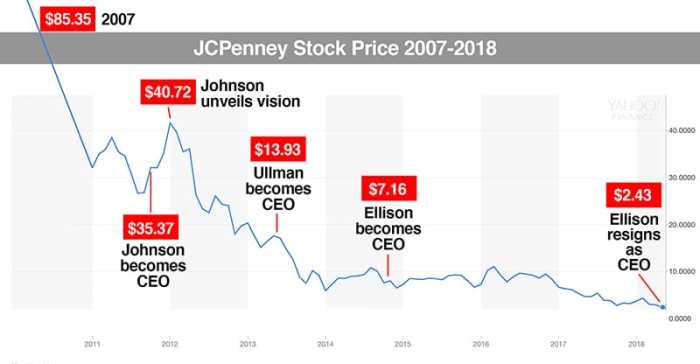
The company’s stock closed on Dec. 14, 2018 at $1.20 a share, down from its 52-week high of $4.75 a share, its 5-year high of $11.57 a share on March 18, 2016 and its maximum of $82.23 a share on March 23, 2007.

The company has been trying to adjust to the changing retail environment for years, frantically shifting strategies and CEOs.

The most disastrous CEO was Ron Johnson, who joined the company in June 2011. He was supposed to be a magic man, given his successful oversight of Apple’s retail stores and his work at Target.

Johnson tried to move J.C. Penney into a more youth-oriented company in an upmarket space that scorned price-slashing promotions. Top accomplish his objectives, he brought in a bunch of new people, some from Apple, who didn’t mix well with J.C. Penney’s established workers. One Apple veteran, Michael Fisher, “… went so far as to deride the holdovers as DOPES, or dumb old Penney’s employees,”  Jennifer Reingold  wrote in Fortune. “Some veterans retaliated by calling the new team the Bad Apples.”

To say the least, Johnson’s radical makeover bombed as customers bolted in droves and the company recorded a $1 billion loss in 2012.

On April 8, 2013, J.C. Penney’s board accepted Johnson’s resignation.   “The Johnson era at JC Penney will go down in history as one of the most destructive reigns by any CEO in any company—ever,”  Ladd wrote.

Johnson was succeeded by Myron Ullman, who had been CEO before Johnson from December 2004 to October 2011. Ullman stayed on from April 2013 to July 2015. He then , turned the job over to Marvin Ellison and charged him with bringing the company back from the brink of disaster. Ellison made some improvements, but abandoned ship in May 2018 to lead home improvement company, Lowe’s.

Looking just at J.C. Penney’s stock price, it’s not easy to figure out which CEO had failed the most at that point. The stock dove 65% under Ullman’s first tour as CEO, 54% under Johnson, 58% under Ullman’s second tour and 66% under Ellison.

penneystockprice

On Aug. 16, 2018, J.C. Penney reported a year-over-year revenue decline of 7.5 percent to $2.76 billion and a net loss of $101 million in its second quarter. Investors were not pleased. They sent the company’s stock below $2 a share, the lowest since it listed on the New York Stock Exchange in 1929, Reuters reported. The stock closed on Aug. 16 at $1.76.

Searching for its next CEO, Board Chairman Ron Tysoe obviously had Ron Johnson in mind when he told the Dallas Morning News, “We’re not looking for someone to reinvent J.C. Penney.”

The board’s choice for next CEO, Jill Soltau, joined J.C. Penney on October 15, 2018. She previously served as president and CEO at Jo-Ann Stores LLC, a specialty retailer of crafts and fabrics.

Shortly after Soltau’s appointment, the company reported that in the three months ending Nov. 3, 2018 its sales fell 5.8% to $2.65 billion and its net loss for the quarter grew to $151 million, up from $125 million in the same quarter a year earlier. Looking ahead, the company said it expected same-store sales to fall in the low-single digits for the fiscal year.

Despite thousands of recent store closures around the country, including the Portland metro area, retail analysts generally agree that the clearing out of stores still has a way to go.  The Wall Street Journal recently reported that the United States has 23.6 square feet of retail space per capita, compared with 2.7 square feet for Europe, according to the International Council of Shopping Centers.

Some of that U.S. space has to go and  J.C. Penney’s store at Washington Square could be one off the victims.

Abortions in Oregon: legal, safer and more rare?


abortionprocon2

Both sides of the often rancorous abortion debate, with all its fierce moral complexity, should be pleased.

Embracing former President Bill Clinton’s dictum that abortions should be “safe, legal, and rare,” Oregon has steadfastly protected the right to an abortion, becoming one of the first states to legalize abortion (SB 193) in 1969.

Oregon ‘s law legalized abortion during the first 150 days of pregnancy, allowing a licensed physician to perform an abortion on an Oregon resident in the following circumstances:

  • The baby has a physical or mental handicap
  • The baby was conceived by rape or other criminal intercourse
  • The pregnancy poses a substantial risk to the mother’s physical or mental health.

The law also required all abortions to be performed by a physician and in a hospital. Before any abortion took place, two physicians had to certify in writing that the woman’s circumstances justified the abortion.

Oregon’s most recent effort to protect access to abortions was the resounding defeat in November 2018 of Ballot Measure 106, a proposed constitutional amendment that would have barred the use of public funds to pay for abortions, affecting government employees and people on Medicaid.

After nationwide legalization of abortion in 1973 with the U.S. Supreme Court’s Roe v. Wade decision, the total number, rate (number of abortions per 1,000 women aged 15–44 years), and ratio (number of abortions per 1,000 live births) of reported induced legal abortions across Oregon and the U.S. increased rapidly.

Abortions in the U.S. reached their highest level in 1990 at 1,429,247, before decreasing at a generally steady pace. The U.S. abortion ratio increased from 196 in 1973 to 358 in 1979 and then stayed nearly stable through 1981. The ratio peaked at 364 per 1,000 in 1984 and has generally declined since then.

The incidence of abortion has varied considerably, however, across subpopulations and remains higher in some demographic groups than others.  Economically disadvantaged women, for example, make up a significant and increasing portion of abortion patients.

Collecting abortion data

There is no national requirement for abortion data reporting. That leaves the collection of abortion data in the United States too a voluntary system operated principally by the U.S. Centers for Disease Control (CDC) and the Guttmacher Institute, a nonprofit research organization that supports legal abortion.

The CDC’s data collection process is neither as expansive or rigorous as Guttmacher’s.

The CDC began abortion surveillance in 1969 to document the number and characteristics of women obtaining legal induced abortions.

The CDC gathers information submitted voluntarily by states and reporting areas (New York City and the District of Columbia) that conduct abortion surveillance.

However, not all states regularly report abortion data to the CDC. The CDC’s  “Abortion Surveillance — United States, 2015”  report, for example, includes only data that were provided by the central health agencies of 49 reporting areas (the District of Columbia, New York City  and 47 states). It does not include data on abortions in California, Maryland, and New Hampshire.

Guttmacher’s data gathering process is more comprehensive. Surveys are mailed to the “known universe” of abortion providers, including potential new providers the Institute identifies.

This is followed by multiple mailings, phone calls, faxes, and emails to providers that don’t respond. Guttmacher also makes estimates based on state health department data and reasonable projections from other sources of data.

The different methodologies consistently result in different numbers. For example, according to the CDC, 8,794 induced legal abortions were performed in Oregon in 1974, the first year after Roe v. Wade. Guttmacher, on the other hand, figured there were 13,390 that year.

Behavioral changes with respect to induced abortion over time are better  understood , however, more by shifts in abortion rates (abortions per 1000 women ages 15-44), which account for population change, then by changes in the number of abortions.

Using CDC data, Oregon’s abortion rates were 20.0 in 2000, 13.2 in 2010, and 10.9 in 2015.  Guttmacher, on the other hand, used different data to put Oregon’s abortion rates at 23.53 in 2000, 14.59 in 2010 and 12.45 in 2015.  

In any case, the abortion data cited for Oregon in any given year by both the CDC and Guttmacher are not the actual number of Oregon women who had abortions. That’s because not all abortions that occur in Oregon are provided to state residents. Some patients may have traveled from other states; likewise, some individuals from Oregon may have traveled to another state for an abortion.

According to CDC data, about 11.2 percent of abortions in Oregon in 2015 were for out-of-state residents.

Abortions may be performed for non-residents for a variety of reasons, including easier access to services in Oregon than in neighboring states or more restrictive rules in other states.

Abortion is legal in Idaho, for example, but there are restrictions such as state-directed counseling intended to discourage women from having abortions, a 24-hour waiting period and a requirement for parental consent if the patient is a minor. Other abortions may be performed on women who live in Northern California, for example, and find it more convenient to access a Southern Oregon facility.

Still, the data provide a window into the overall trends and demographics of who is seeking abortions.

Data on the number of induced legal abortions in Oregon, compiled by the CDC and the Guttmacher Institute since 1973, are as follows:

Induced legal abortions in Oregon

Year

CDC Data

Guttmacher Data


1973

7,447

11,440

1974

8,794

13,390

1975

10,641

13,270

1976

12,590

12,820

1977

13,163

15,050

1978

13,605

14,450

1979

14,501

17,690

1980

15,735

17,670

1981

14,799

15,990

1982

12,807

16,350

1983

12,064

N/A

1984

13,133

15,310

1985

12,056

15,230

1986

11,217

N/A

1987

11,147

14,370

1988

13,309

15,960

1989

13,928

N/A

1990

13,658

N/A

1991

14,310

16,580

1992

12,685

16,060

1993

12,961

N/A

1994

13,392

N/A

1995

14,079

15,5909

1996

13,767

15,050

1997

14,834

N/A

1998

14,344

N/A

1999

14,145

16,700

2000

13,658

17,010

2001

14,272

N/A

2002

13,172

N/A

2003

12,622

N/A

2004

11,443

13,320

2005

11,602

13,200

2006

11,732

12,246

2007

11,883

13,370

2008

10,610

12,920

2009

10,801

10,801

2010

9,990

11,010

2011

9,567

10,690

2012

9,016

N/A

2013

8,287

9,130

2014

8,231

9,330

2015

8,610

N/A

Recent abortion  data

In 2015, the most recent year for which the CDC has submitted a “Abortion Surveillance — United States” report, the abortion rate (abortions per 1000 women ages 15-44) in Oregon decreased across all age groups.

Women in their 20s accounted for 57.2% of all Oregon abortions in 2015, women in their 30s for 28.1%. The CDC reported 922 abortions by adolescents (age 19 and below) in Oregon in 2015.; 56 of those abortions (6.1% of the total) were by children below the age of 16.

The CDC also reported the following with respect to abortions in Oregon in 2015:

  • 9% were performed during, or before, the 13th week of gestation.
  • 7% were performed during, or after, the 21stweek of gestation.
  • 39% were performed as medical (nonsurgical) abortions (up from 14% in 2005).
  • 19% of abortions were performed on married women; 81% on unmarried women.
  • Abortions by known race/ethnicity of women in Oregon in 2015 were: Non-Hispanic white – 70.8%; Non-Hispanic Black – 6%; Non-Hispanic Other – 10%; Hispanic: 13.2%. 

As for the safety of abortions, the CDC calculated the number of deaths and case-fatality rates per 100,000 legal abortions for abortion-related deaths by type of abortion during 1973–2014.

In 1973, the year of the Roe v. Wade decision, there were 47 deaths associated with abortions in the U.S., according to the CDC., with 25 from legal induced abortions, 19 from illegal induced abortions and 3 in cases where it is unknown whether the abortion was induced or spontaneous.

 The CDC defines an abortion as legal if it was performed by a licensed clinician within the limits of state law. An abortion is defined as illegal if it was performed by any person other than a licensed clinician.

During 1973-1977, 149 abortion-related deaths were reported to the CDC, a rate of 2.09 deaths per 100,000 legal abortions.

The number of deaths and case-fatality rates have since dropped significantly.

In 2014, there were 6 deaths associated with abortions in the U.S., according to the CDC., all in connection with legal induced abortions, and the rate of deaths per 100,000 legal abortions declined to .79 during 2008-2014.

Why fewer abortions?

While the reduction in abortions in the United States and Oregon over time is a settled matter, the reasons for the decline are not.

There are a multitude of possible explanations for the decline.

The onslaught of state laws intended to make abortion a more difficult choice may be one reason.

For example, according to the National Right to Life Committee Inc., five states (Kentucky, Louisiana, North Carolina, Texas and Wisconsin) require that an ultrasound be performed prior to an abortion. The screen must be displayed so the mother can view it and a description of the image of the unborn child must be given. “Providing a ‘window to the womb,’ ultrasound images give a mother the unique opportunity to see her living unborn child in ‘real time.’,” the Committee said in a Jan. 2018 report.

Kristi Hamrick, a spokesperson for Americans United for Life, believes new  laws requiring ultrasounds have been “game-changers” in reducing abortions.

The adoption by some states of informed consent requirements pushed by anti-abortion activists is another example of state actions that may be dissuading some women from abortions. Twenty-seven states now have informed consent laws in place.

In 1989, Pennsylvania amended its Abortion Control Act to require:

  • the person undergoing the abortion to give informed consent and receive mandatory counseling, including alternatives to abortion.
  • a 24-hour waiting period between the counseling appointment and the procedure itself.
  • parental consent for minors, with available judicial bypass.
  • a spousal notification requirement.
  • reporting requirements for providers.

The state’s Planned Parenthood association challenged the statute, but the U.S. Supreme Court, in a 5-4 decision (Planned Parenthood v. Casey, 505 U.S. 833 (1992)), held that the standard for whether a state could enact a restriction to abortion access was whether that restriction placed an “undue burden” on the person seeking the abortion. The Court ruled that only the spousal notification requirement was an undue burden.

Michigan’s Republican-led House took a step to discourage abortion on Dec. 13 when it approved a bill that would permanently prohibit doctors from using an Internet web camera to prescribe medication to induce an abortion. Right to Life of Michigan pushed for the measure, according to the Detroit News

Supporters said the bill, which is headed to Gov. Rick Snyder’s desk,  is a safety measure for medication that can have side effects. Critics say the regulation is designed to limit access to legal abortions, particularly for women who live in rural areas without a doctor nearby and who increasingly rely on Internet exams.

In another case, Mississippi ‘s Democratic attorney general filed a notice of appeal Dec. 17 supporting a Mississippi law that would ban most abortions after 15 weeks. U.S. District Judge Carlton Reeves issued a temporary injunction in March 2018 to prevent the state from enforcing the law. and then a more extensive ruling on Nov. 20,  2018 finding that the law “unequivocally” violates women’s constitutional rights. , Mississippi ‘s attorney general Hood plans to ask the 5th U.S. Circuit Court of Appeals to overturn Reeves’ decision about the constitutionality of the law

It’s also possible that fewer women are having abortions because they may want an abortion but can’t easily access a distant clinic.

In Mississippi, for example, there is only one abortion clinic, run by the Jackson Women’s Health Organization (JWHO). Its state-licensed facility is in Jackson, Mississippi’s capital.

In large areas of Eastern Oregon and some parts of the Southern Oregon coast it’s 90-180 miles to a clinic, according to a Guttmacher  analysis. “Traveling long distances can impose a substantial burden on women with respect to transportation costs, travel duration, time off work, and arrangement of childcare, particularly for women who are economically disadvantaged,” The Lancet, a public health journal, reported.

The strongest reason fewer women are having abortions is likely because the effective use of contraceptives, including long-acting reversible contraceptives (or LARCs) like IUDs and implants, is resulting in fewer unwanted pregnancies.

And then there are serious efforts underway to develop better contraceptives for men. The Seattle Times just reported, for example, that University of Washington researchers are working with Seattle-area couples to test a contraceptive gel for men. The gel works by reducing sperm production when applied daily on the upper arms or shoulders. Early trials are also underway at the the University on a pill for men that reduces levels of testosterone and other hormones responsible for sperm production.

Some abortion opponents see other factors at work in the declining abortion numbers.

Hamrick believes abortion numbers are also going down because public sentiment is turning against abortion.

The Pew Research Center says, however, that as of 2018, public support for legal abortion remains as high as it has been in two decades of polling. Currently, 58% say abortion should be legal in all or most cases, while 37% say it should be illegal in all or most cases, Pew reported in Oct. 2018.

But the public’s views on abortion are not absolutist. According to the Pew report, more than half of the U.S. says that in most – but not all – cases, abortion should be legal (34%) or illegal (22%). Fewer take the position that in all cases abortion should be either legal (25%) or illegal (15%).

Challenging the numbers

It’s also possible, of course, that the decline in the number of reported abortions is a mirage, that the data is inadequate and unreliable.

One outspoken critic of current data is the Charlotte Lozier Institute, which says its goal “…is to promote deeper public understanding of the value of human life, motherhood, and fatherhood, and to identify policies and practices that will protect life…”

“An examination of state and federal reporting policies makes clear…that the system now in place is poorly suited to determine whether or not, in fact, abortion is becoming significantly less frequent and to what degree, especially in year-over-year comparisons where published data is delayed, non-existent, or available only from a single source with a history of close ties to the industry itself,” Charles Donovan and Nora Sullivan wrote in a Lozier Institute article.

It’s also possible that the decline in the abortions numbers is due to the ease of self-administered, and unreported, medical abortions.

Medical abortion is not the same as emergency contraception, or the morning-after pill. Emergency contraception prevents a pregnancy.  Medical abortion is used to terminate an unwanted pregnancy.

The FDA-approved regimen for medication abortion consists of two medications available by prescription: mifepristone, which works by blocking progesterone (a hormone needed for a pregnancy to continue); and misoprostol, taken 24–48 hours later, which induces contractions and ends the pregnancy. 

According to the CDC, reported medication abortions are becoming increasingly common, growing from 11.3% of all abortions in 2006 to 24.2% in 2015. 

Guttmacher says that with safe and effective models for self-managed abortion care now in place, some women, including those who distrust the medical system, may be opting to self-manage an abortion for increased privacy and autonomy and, quite reasonably, not reporting their actions..

Some medical abortions may also not be reported because they are done illegally by non-physician health care providers in states that require abortions to be performed only by physicians.  In such cases, non-physicians risk prosecution and penalties under the law, so there is more motivation to conceal than to report.

Then there’s the availability of medical abortion drugs online. The Atlantic reported in October on the launch of an online service started by a doctor based outside the U.S. called Aid Access that screens women for their eligibility to take medical abortion drugs and then ships the drugs to an approved customer. It’s unlikely the users of this service submit reports to state health agencies.

What’s next?

Whatever the national attitudes, Oregon is likely to continue to be a welcoming state for abortions. The total number and the rate of abortions may still, however, come down, particularly because of the use of better contraceptives.

Some other states will continue their efforts to keep the abortion numbers and rates down through restrictive measures.

A July 2018 report  by Guttmacher said 29 states already had enough abortion restrictions in effect to be considered either hostile or extremely hostile to abortion rights; four states in the “extremely hostile” category also had so-called “trigger” laws on the books that would immediately ban abortion if Roe v. Wade were overturned.

Many state legislators are continuing their efforts to further restrict reproductive rights or access to care.. “In the first six months of 2018, 11 states enacted 22 new abortion restrictions and four states moved to impose new restrictions on providers that can receive public funds for family planning programs,” the Guttmacher report said.

And the beat goes on.