Atticus Finch: still a decent and honorable man

Atticus Finch, a fictional lawyer in a fictional Maycomb County, Alabama , is a paragon of virtue in Harper Lee’s “To Kill a Mockingbird”. Now, with the publication of ”Go Set a Watchman”, a recently discovered 1st draft of Mockingbird, critics are saying that Finch’s true character emerged when he became an odious racist.

That’s a lie.

Finch didn’t turn into a racist. If anything, he started as a fictional racist and turned into a decent and admirable man.

The key here is that his racist persona came first in the manuscript 31-year-old Harper Lee submitted to her agent in 1957. Her agent sent it on publishing houses, including J. B. Lippincott Company. There it landed on the desk of an editor, Therese von Hohoff Torrey, who went by the name Tay Hohoff professionally. Hohoff thought Lee’s novel needed major reworking, but she saw Lee’s potential talent as a writer and story-teller.

Harper Lee in her 30's

Harper Lee in her 30’s

It was only after the refinement of multiple drafts over the next several years, under Hohoff’s watchful and immensely talented guidance, that “To Kill a Mockingbird”, and the heroic character of Atticus Finch, emerged.

In other words, the Atticus Finch of ”Go set a watchman”, is not a sequel to “To Kill a Mockingbird”, a graphic evolution of a man of integrity to a racist. Rather, it is a 1st draft of a fictional character who was redrawn to be an honorable man. Release of the 1st draft has no explanation other than greed.

So don’t let “Go Set a Watchman” define Atticus Finch. Teachers don’t need to now depict Finch as a man of integrity who became a bigot. Parents who have named a child Atticus don’t need to feel that they’ve been betrayed. Generations of devoted readers should not despair.

Atticus Finch was, and remains, a heroic figure deserving of our admiration and respect.

Killing us softly: technology and the obliviousness of our children

I recently observed four teens in a booth at a Portland restaurant, each completely absorbed in their smartphone. No conversation. No laughter. No connections. This poem in today’s NY Times reminded me so much of that:

teenswithSmartphones

They sit with their heads bowed to their screen,

A worship of glass, their faces erased.
A city flies by, no matter the scene,
Curiosity’s child now plastic-encased.
Bright minds that once soared, now tethered by wire
Peck at bright spots with fingers a-twitch
To save them from shifting demons from dire
Or run through the woods from Dorothy’s witch.
What sorcerous spell has seized these bright lights?
What cunning pied piper has snaffled our young?
Did we not perform the ritual rites?
Have we forgotten the songs that were sung?
The high sun at noon cost Icarus dear,
The Glass God we made eats children, I fear.

Jeffrey Pascal

The American dream – present and accounted for

With the 4th of July imminent, the crowd gathered in Brooklyn on June 30 to take the oath of United States citizenship was excited about their chance to live the American dream.

Reflecting the thoughts of the assembled group, Felix A. Okema, 38, formerly of the Ivory Coast, now a resident of Elm Park, Staten Island, spoke with pride and enthusiasm of the naturalization experience.

“You have a system that opens its doors to opportunity, to others,” Okema said. “You hear people talking about it. It’s real. The vibe, the intelligence, the special blast of the people here — it’s going to make the country better.”

4th-of-July-Children-at-a-Parade1

Okema and the rest of the new citizens obviously didn’t get the message from University of California President Janet Napolitano.

She thinks saying the United States is a land of opportunity is insulting, a microaggression.

Earlier this year Napolitano sent letters to UC deans and department chairs inviting them to seminars “to foster informed conversation about the best way to build and nurture a productive academic climate.”

A principal goal of the seminars was to help faculty “gain a better understanding of implicit bias and microaggressions” in their vocabularies and to urge the faculty to purge potentially offensive words and phrases from their speech.

Examples of such offensive speech included the following:

  1. Statements that indicate that a white person does not want to or need to acknowledge race, such as, “There is only one race, the human race.” “America is a melting pot.” Why is this a microaggression? It delivers the message that you must assimilate to the dominant culture.
  2. Statements denying bias, such as saying to a person of color, “Are you sure you were being followed in the store? I can’t believe it.” Why is this a microaggression? It denies the personal experience of individuals who experience bias.
  3. Statements that don’t recognize meritocracy is a myth, such as: “I believe the most qualified person should get the job.” ;“America is the land of opportunity.”; “Everyone can succeed in this society, if they work hard enough.” Why are statements such as this a microaggression? They deliver the message that the playing field is even or that people of color are lazy and/or incompetent and need to work harder.
  4. Statements implying that the values and communication styles of the dominant/White culture are ideal/”normal”, such as saying to an Asian, Latino or Native American: “Why are you so quiet? We want to know what you think.” Why is this a microaggression?: It delivers the message that Asian, Latino and Native Americans must assimilate to the dominant culture, that there’s no room for differences in America.

Where does this stuff come from? Not from Americans.

A just-released Penn Schoen Berland poll of about 2,000 Americans from June 8 to 19, 2015, commissioned for The Atlantic and the Aspen Institute, revealed that 72 percent of those polled said they are living the American Dream or expect to, 85 percent of are satisfied with their lives and 86 percent are optimistic about the future.

Young people are on board, too. According to the poll, 77 percent of Millennials say they’re living the dream or believe they can. Among African Americans and Asian Americans, that rises to 82 percent and among Latinos to 83 percent.

Napolitano and her ilk are clearly way off base. As the Atlantic concluded, the American Dream is alive and well. It’s the misguided people subscribing to Napolitano’s thinking who are undermining it.

Motherhood, marriage and the Supreme Court: new divisions

In a not particularly rare display of hubris, Ben Smith, the editor-in-chief of BuzzFeed, asserted after the Supreme Court’s June 26 decision in Obergefell v. Hodges, that there’s now only one side on the issue of same-sex marriage. “We firmly believe that for a number of issues, including civil rights, women’s rights, anti-racism, and LGBT equality, there are not two sides,” he said.

Leaving aside the fact that the opinion was 5-4, indicating that there are at least two sides to the issue, there’s also an emerging split on whether the court’s reasoning in its decision was flawed.

Critics are asserting that the majority opinion, by emphasizing the importance of marriage to families and children, shames the families, parenting styles, and relationship choices of millions of Americans.

Considered particularly offensive and egregious are the following excerpts from the opinion:

“[Children of unmarried parents] also suffer the significant material costs of being raised by unmarried parents, relegated through no fault of their own to a more difficult and uncertain family life… Marriage also affords the permanency and stability important to children’s best interests.”

and:

“Without the recognition, stability and predictability marriage offers, their children suffer the stigma of knowing their families are somehow lesser. They also suffer the significant material costs of being raised by unmarried parents, relegated through no fault of their own to a more difficult and uncertain family life.”

But it’s the critics who are way off base, not the Supreme Court.

Single parenthood is a scourge on American society with dreadful consequences that can’t be ignored.
unmarriedmother

In saying that, it needs to be understood that single parenthood is a result of decisions, or the lack of decisions, by both men and women. Men who spread their sperm about shelter skelter without regard to the consequences are as much a part of the equation as women.

me-and-dad

Just five percent of births in the United States were to unmarried couples in 1960. In 2013, as in the six previous years, more than four in ten births (41 percent to be precise) were to unmarried couples, with most of the mothers likely to be young, black or Latina and with no more than a high school degree.

In 2013, 72 percent of all births to black women, 66 percent to American Indian or Alaskan native women, and 53 percent to Hispanic women occurred outside of marriage, compared with 29 percent for white women, and 17 percent for Asian or Pacific Islander women.

What’s the prognosis for these unmarried women and their children?

Certainly there are exceptions, particularly if the mother is older, educated and economically secure, but the fact is women who have children outside of marriage, even if they are cohabiting with the other parent, are more likely to:

  • Have lower incomes as they age
  • Have lower education levels
  • Be dependent on welfare assistance
  • Have reduced marriage prospects themselves, compared with single women without children.

As for the children of unmarried couples, they are more likely to:

  • spend their entire youth in a single-parent household
  • experience instable living arrangements
  • live in poverty
  • have low educational attainment
  • have sex at a younger age
  • give birth out of marriage themselves
  • have lower occupational status and income as they grow up
  • have more divorces as adults than those born to married parents.

Certainly the issues associated with unmarried mothers are not one-size-fits-all, but those who believe marriage is irrelevant to the well-being of mothers and children are blinded by progressive ideology.

And the solution isn’t, as too many progressives argue, just more access to better childcare at less cost, more generous income support programs, higher pay, free or heavily subsidized higher education, guaranteed low-cost health care, paid leave, better early education programs, etc. All of these are about dealing with the after-effects of the birth of children to unmarried women and absent men.

A better solution is to work on getting men to accept responsibility for the children they help conceive. We need to talk again about the shame of men abandoning their children and the cowardice men exhibit when they avoid accountability for their actions.  As a friend puts it, “I’d like to see (children) cared for by the people that brung ’em…and that means BOTH parents!”

We also need to implement and support programs that discourage single women from having children and having to raise them alone in the first place. If we can move in that direction, while strengthening the education and economic security of Americans at large, then we’ll be on our way back from the precipice.

Anti-trade Democrats and unions: the luddites are back

So much for the pivot to Asia.

Even Hillary, who has flip-flopped on free trade more than a fish on a hot dock, has joined the anti-trade cabal to cater to the left wing.

But now, with House passage of President Barack Obama’s fast-track trade bill earlier today, the Senate should exercise common sense and pass the bill, too.

Pandering to their union patrons (who represent just 6.6 percent of private sector workers), smug environmentalists and left-wing zealots, House Democrats undercut President Obama on June 12 by repulsing a workers-aid program that was a key element of a fast track trade bill. In doing so, they handed Obama a defeat, left his trade agenda in limbo and ignored reality.

National AFL-CIO President Richard Trumka spoke in Portland May 18, 2015, about the union's opposition to the Trans-Pacific Partnership treaty.

National AFL-CIO President Richard Trumka spoke in Portland May 18, 2015, about the union’s opposition to the Trans-Pacific Partnership treaty.

The United States has been trying to conclude a Trans-Pacific Partnership trade deal with 11 countries around the Pacific, including Australia, Japan and Vietnam.

After unions threatened to launch primary challenges against Democrats who voted for Trade Adjustment Assistance legislation, only 40 —less than one-fourth of the caucus—voted for the bill on June 12, which lost 302-126. The vote made Trade Promotion Authority support largely irrelevant.

This fruitless, attempt to hold back history could cause significant and long-term economic and strategic harm to the United States.

Without Senate approval of fast-track legislation, further progress on the negotiations is unlikely. It may also hold up Japanese economic reforms, aid China and penalize U. S. companies trying desperately to be competitive in international markets.

Only the truly out-of-touch, or craven opportunists, could see all this as a good thing.

Commencement controversies: free speech vs. mob rule

What is it about today’s college students, acting like they’d need smelling salts if their safe space was invaded by controversial ideas?

Commencement speaker choices now drive an annual ritual of protest, led mostly by intolerant students (and too many faculty) unwilling to have to hear provocative comments from someone with whom they disagree or who is affiliated with a disagreeable institution. Only people with the right purity of thought and action, usually a liberal, get a pass.

God forbid exposing students to ideas that might challenge their preconceptions and destroy their youthful innocence.

And the protests are not, as some would claim, exercises in free speech. The students are not just objecting to the speakers’ ideas; they are endeavoring to stifle what the speakers have to say.

In 2014, International Monetary Fund director Christine Lagarde withdrew as a planned commencement speaker at Smith College and former Secretary of State Condoleezza Rice pulled out at Rutgers University.

Lagarde withdrew after a petition circulated on iPetitions with charges such as, “IMF… policies (have) led directly to the strengthening of imperialist and patriarchal systems that oppress and abuse women worldwide.”

At Rutgers, Rice withdrew after some students asserted that by inviting Rice the university was “…encouraging and perpetuating a world that justifies torture and debases humanity.”

Students protest planned commencement address by former Secretary of State Condoleezza Rice at Rutgers University

Students protest planned commencement address by former Secretary of State Condoleezza Rice at Rutgers University

This year, dozens of faculty at John Fisher College criticized the school’s commencement invitation to former New York City Mayor Rudy Giuliani, asserting he is “a political figure who has recently shown himself to be inflammatory and divisive in his commentary.”

In Texas, student’s objected to a commencement address at the University of North Texas by Gov. Greg Abbott. The critics assailed Abbott’s views on immigration and same sex marriage and his efforts to undo a voter-approved fracking ban in the area.

The protests are part of the effort by intellectually arrogant students (and faculty) to filter out different opinions, to create echo chambers for “acceptable” views.

The protests are consistent with the push for “trigger warnings”, warnings that certain class material might make some students uncomfortable.

At Rutgers University, for example, a student wrote to the school newspaper endorsing notifications to students of material that might trigger discomfort, such as F. Scott Fitzgerald’s “The Great Gatsby,” which “…possesses a variety of scenes that reference gory, abusive and misogynistic violence.”

Even the liberal New Republic has raised warnings. “Structuring public life around the most fragile personal sensitivities will only restrict all of our horizons,” the magazine wrote. “Engaging with ideas involves risk, and slapping warnings on them only undermines the principle of intellectual exploration.”

The way things are going, the only acceptable commencement speaker will be Kermit the Frog. He’s already primed and ready, by the way, having addressed commencement Exercises at Southampton College in 1996.

kermitcommencement

Sen. Jeff Merkley: leading the way in partisanship

So much for working well across the aisle for the common good.

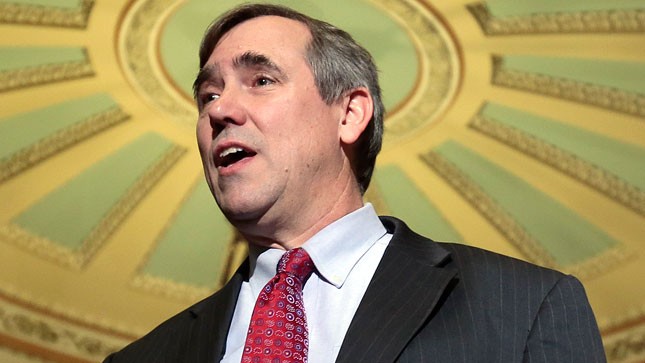
Jeff Merkley, D-OR, is one of the most partisan U.S. Senators, according to a just compiled Bipartisan Index that measures members of Congress. Of 100 Senators, Merkley ranked 93rd in bipartisanship.

Sen. Jeff Merkley, D-OR, a true blue partisan.

Sen. Jeff Merkley, D-OR, a true blue partisan.

A low score indicates that a legislator is viewing his or her duties through a partisan lens, rather than prioritizing problem solving and being open to working with the other party when possible, entertaining a wide range of ideas, and prioritizing governance over posturing.

The Lugar Center, a non-profit organization focusing on global policy issues, teamed up with the McCourt School of Public Policy at Georgetown University to develop a Bipartisan Index to measure members of Congress. The ranking of all senators, released for the first time on Tuesday, rates lawmakers by how their legislation does in attracting co-sponsors from the other party as well as how often they sponsor legislation proposed by members across the aisle.

“…sponsorship and co-sponsorship behavior is especially revealing of partisan tendencies,” said former Senator Richard G. Lugar, President of The Lugar Center. “Members’ voting decisions are often contextual and can be influenced by parliamentary circumstances. Sponsorships and co-sponsorships, in contrast, exist as very carefully considered declarations of where a legislator stands on an issue.”

Berkeley’s abysmal ranking in the Bipartisan Index suggests that he’s more interested in making political points than being an effective legislator. Partisan bills certainly have their place, but as Lugar said in his Introduction to the Bipartisan Index, “…at the beginning of the legislative process, when effective governance would argue for broadening a new bill’s appeal, too often the opposite is happening.  Bills are being written not to maximize their chances of passage, but to serve as legislative talking points.  Taking a position is not the same thing as governing.”

Facebook: swallowing the news

Facebook has officially launched its Instant Articles feature where full stories from media outlets are displayed, rather than links to the media sites. Media such as the New York Times, BuzzFeed and the Guardian are participating in the program.

The new function will not only avoid the problem of slow loading time for linked stories, but will prevent users from leaking from Facebook when leaving to view a full story. That will help Facebook in its goal to be a one-stop-shop.

You might not even notice the change, but it signals a transformative relationship between media outlets, Facebook and the public.

war-zone-2-journalist-cartoon

The collaboration will be far from benign. It will have a devastating impact, seriously eroding the brands of the media companies and, over time, the connections readers have with them.

In short, the seeds of your newspaper’s demise are being planted by Facebook. Read more.


The Oregon Convention Center Hotel: paying off the unions

Ask any informed person without a vested interest in the proposed Oregon Convention Center Hotel whether they think it will be a fiasco and you’re likely to get a loud and clear, “Yep!”

But public opinion has little to do with whether the hotel will get built. The fix is in, with Metro, liberal politicians and labor unions joined at the hip.

Metro Council President Tom Hughes, the hotel’s principal cheerleader, was first elected to Metro in 2010 with the strong support of labor organizations; they continued that support in his successful 2014 race.

“I want to build a hotel,” Hughes once told union workers. “I want it to be built by union workers, and I want union workers running it.”

unite here

Portland has just three union-operated hotels, all organized by Unite Here Local 8: the Benson; the Paramount; and the Portland Hilton Hotel and Executive Tower.

The unions got their first break on the Convention Center project when Metro mandated that the hotel be built by union building trades.

Prospective developers were also told to bid the privately-owned and operated project under union-supported prevailing wage guidelines where wages are set artificially high above the market.

Metro stacked the deck in favor of the unions again when the Council required that Hyatt sign a labor peace agreement with Unite Here before Metro would begin negotiating the details of the project. Hyatt, long a non-union hotel chain, subsequently agreed to a national labor peace agreement with Unite Here.

Metro also gave unions an edge in organizing the eventual hotel workers by requiring that they use a voting process despised by employers and many workers called card check. Under card check, instead of holding a federally-supervised secret ballot election, workers get to vote under the watchful eyes of union organizers, Lucky them.

Once a majority of employees have signed cards, the union is immediately recognized.

As the AFL-CIO’s Southeastern Oregon Central Labor Council put it, the hotel workers “…will come into a workplace where their management has promised to leave any decisions to the workers without wasting money on deceiving anti-union campaigns.”

Yep, folks, the fix is in.

Sure it’s ugly, but at least it’s expensive.

I passed an all-electric BMW i3 today and it’s the ugliest thing ever. It reminded me of the ungainly 2001-2005 Pontiac Aztec, one of the ugliest vehicles ever made, according to consumer polls. Even legendary GM executive, Bob Lutz, said it and other GM products looked like “angry kitchen appliances.”

BMW i3

BMW i3

What is it that drives people to buy the i3, with a MSRP up to $46,250, and other horrendously pricey, but ugly, products?

It’s the weirdness itself.

It’s not that people want an ugly car. What they want is to stand out, to express their identity.to have their friends, neighbors and even strangers see them in their distinct, peculiar, expensive car. If it’s an electric or hybrid car, so much the better because it crows, “I can afford this. Admire me and my environmental credentials.”

Same thing with a host of other products.

Want an expensive watch? You could spend tons on an exhorbitantly priced, but bland-looking one. But who will notice? Instead, try the Roger Dubuis Excalibur Quatuor, priced at 1 million Swiss francs (about US $1,125,000).

Roger Dubuis Excalibur Quatuor watch

Roger Dubuis Excalibur Quatuor watch

The maker says it’s worth it because its case is made entirely of silicon (according to the brand, the first such watch of its kind), a material with half the weight of titanium and four times the hardness. It’s big advantage? It’s really ugly, so people will notice.

How about shoes? Some women are apparently willing to spend $2495 on Giuseppe Zanotti white crystal-embellished peep-toe leather mid-calf booties. It can’t be because they are so elegant, but they certainly will be noticed.

Giuseppe Zanotti booties

Giuseppe Zanotti booties

Of course, some people will buy expensive things even if they aren’t ugly, so long as they carry status. Aspirational Americans keep buying Land Rovers, for example, even though they consistently get terrible reliability ratings.

Range Rover Evoque

Range Rover Evoque

When JD Power recently released the results of its newest Customer Service Index study, Land Rover finished right at the bottom, in the basement, dead last.

Typical of owner complaints is this from the owner of a Land Rover with 28,000 miles on it: “…after a year of owning it – the electronic park brake got stuck and was a huge expense to fix. Shortly after that the rear anti roll bar was leaking – another huge expense…After 50K miles front suspension arms have gone wheel bearings have gone and front anti roll bar has gone, another 4.5K to fix all. Just got the car back – and now the right side turbo has gone. Another 5K fix… Range rovers are nice to look at – but are built so poorly – its not worth owning this car.”

Oh well, at least people blowing all their money on overpriced things are keeping the people who make them employed. And that’s good for the economy, right?