Four Pinocchios – the gender pay gap

In an aggressive attempt to turn attention away from other issues less favorable to them as the midterm elections approach, Obama and the Democrats are yet again trying to generate some return from their “war on women” mantra. This time they’re highlighting with carefully choreographed actions what they insist is gender pay inequity.

On Wednesday, the Senate fell short on the number of yeas to move forward on the so-called “Paycheck Fairness Act”. Bluntly revealing the political nature of the entire effort, Democrats leaped at the opportunity to send out a fundraising solicitation bemoaning the loss within minutes of the vote.

Image

Obama routinely cites U.S. Census data showing that the average full-time female worker earned 77 cents for every dollar a man earns. (The U.S. Department of Labor says women in full-time jobs earn 81 cents for every dollar men earn.)

But the pay situation is not quite as simple as Obama and his Democratic colleagues say. Today the New York Times featured a story on the issue: Democrats Use Pay Issue in Bid for Women’s Vote, making that point.

The Bureau of Labor Statistics (BLS) makes the same point in its annual report, “Highlights of women’s earnings in 2012”: “In 2012, women who were full-time wage and salary workers had median usual weekly earnings of $691. On average in 2012, women made about 81% of the median earnings of male full-time wage and salary workers ($854).” That appears to support Obama’s assertions.

But every “full-time” worker, as the BLS notes, is not the same: Men were almost twice as likely as women to work more than 40 hours a week, and women almost twice as likely to work only 35 to 39 hours per week. Once that is taken into consideration, the pay gap begins to shrink. Women who worked a 40-hour week earned 88% of male earnings.

Then there is the issue of marriage and children. The BLS reports that single women who have never married earned 96% of men’s earnings in 2012.

The supposed pay gap appears when marriage and children enter the picture. Child care takes mothers out of the labor market, so when they return they have less work experience than similarly-aged males.

The reality is that multiple factors affect the earnings data, including the types of jobs worked by women, the number of hours they worked, their area of specialization/college major, hours worked and the career progression of some women.

One factor affecting the pay women receive is their work/home patterns. Women who leave the workforce to care for their children at home and later return to work often find that lower wages await them than if they had kept working. A Pew Research Center study released on April 8 revealed that the share of mothers who stay home with their children has steadily risen in recent years.

According to Pew, the share of mothers who don’t work outside the home rose to 29% in 2012, up from a modern-era low of 23% in 1999.

Image

Another Pew study in 2013 found that mothers are much more likely than fathers to have reduced work hours, take a significant amount of time off, quit a job or, by a small margin, turn down a promotion in order to care for a child or family member.

Pew said today’s young women are the first in modern history to start their work lives at near parity with men. Pew pointed out, however, that there’s no guarantee that today’s young women will sustain their near parity with men in earnings in the years to come. Recent cohorts of young women have fallen further behind their same-aged male counterparts as they have aged and dealt with the responsibilities of parenthood and family.

Still, it would be wise not to ignore that while the public sees greater workplace equality between men and women now than it did 20 to 30 years ago, most believe more change is needed, the Pew Research Center notes. Among Millennial women, 75% say this country needs to continue making changes to achieve gender equality in the workplace, compared with 57% of Millennial men.

So there’s still a lot of work to do.

Not all that glitters is gold; With crowdfunding it’s caveat emptor

Crowdfunding must be legit, right? After all, even Caroline Channing, the tall blonde in the TV show “2 Broke Girls,” went on a crowdfunding website, gofundyourself.com, to raise $1,500 for a new pair of pants.

But as millions of Americans jump on crowdfunding websites, some ugly truths are surfacing.

Some contributors are finding out the hard way that their munificence can enrich others at their expense.

In 2012, the Oculus Rift Project, developers of what they called “the first truly immersive virtual reality headset for video games”, brought in $2.4 million from 9,522 supporters across the country in a crowdfunding campaign on Kickstarter.

In March 2014, Facebook acquired the company, then called Oculus VR, for $2 billion. The venture capital investors in Oculus are expected to see a 2000 percent return on their money. The Kickstarter contributors’ return? Zero. Zip. Their money was a gift, not an investment.

A lot of Kickstarter donors were bitter. Some because they opposed the fledgling company selling out to a corporate behemoth, others because they felt cheated. Clearly they didn’t really understand the rules of the game when they pitched in.

Other crowdfunding supporters are finding that the whole process is more like the wild west, with little real oversight and no assurance that those seeking donations are legitimate.

wild_west


The GoFundMe crowdfunding website, for example, is pretty loose in its oversight. “With hundreds of thousands of campaigns, it’s not feasible for GoFundMe to investigate the claims stated by each campaign organizer,” the website says.

PandoDigest, issued by PandoDaily (http://pando.com), a web publication focusing on technology news, analysis, and commentary, recently wrote about a crowdfunding campaign run on Indiegogo for a device called the Healbe GoBe (http://bit.ly/1hAamf2), “the first and only wearable device that automatically measures the calories you consume and burn, through your skin.”  So far HealBe has raised $984,787.

PandoDigest questioned the legitimacy of the product. “…keen to be the first reporter to cover this marvelous piece of technology, I started asking questions,” James Robinson, a Pando reporter, wrote on March 20, 2014. “What I discovered was something far from the slick, bay area startup Healbe purported to be. Rather, I found a publicity shy company, operated remotely from Russia, promoting a device unsupported by any medical or scientific evidence whatsoever.”

“For someone looking to lose weight, it sounds like a wearable sent from heaven,” PandoDigest reported. “The only problem is, there’s no evidence that Healbe actually works. Worse than that, many medical experts have told our James Robinson that the device’s underlying technology has no way of doing what it claims to do. One doctor called it “some straight Ghostbusters, Peter Venkman bullshit.”
’

Questions about the device have led many contributors to ask for refunds.” I would like a refund of my pledge Dual Pack $325,” said Richard Torriani. “I am now skeptical of the claims made on your campaign page and have concerns about the legitimacy of the campaign itself. If the GoBe proves to be everything that is promised, I will gladly purchase one when they are released publicly.” Some commenters are also asking Healthbe to step in and sort out people’s concerns.

According to Indiegogo, it’s free to sign up, to create a campaign, and to contribute to a campaign. When a campaign raises funds, Indiegogo charges a 9.0% fee on the funds raised. If you reach your goal, you get 5.0% back, for an overall fee of 4.0%. the Healbe GoBe campaign’s original fundraising goal was $100,000, which has obviously surpassed. That means Indiegogo has earned almost $40,000 on the $987,592 of contributions to date, a nice haul, indeed.

caution-sign_shutterstock_62217049-300x199

Given all the questions and concerns, does Indiegogo have any responsibility to halt the campaign? “Our team of anti-fraud experts focuses on keeping our community safe,” it’s website says. “They’re responsible for developing new features to create a more secure and trustworthy environment for you. Our anti-fraud systems constantly monitor the performance of our product, helping us identify and eliminate fraudulent activity and scams.”


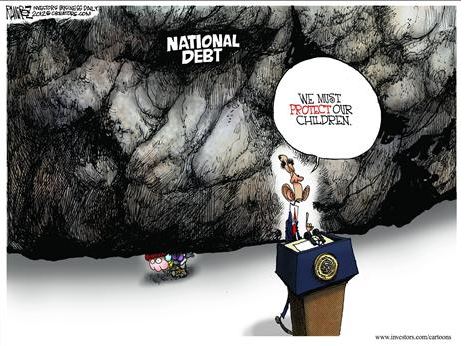
The real war is on our children

Democrats are again pulling out from their rhetorical basement accusations that Republicans are waging a “war on women”. Meanwhile, they’re ignoring another war that’s real, the “war on our children” that government spending addicts are prosecuting.

Our children are going to pay a heavy price for the fiscal insanity that has already led to national debt in excess of $17 billion.

Obama-National-DebtThe increase in our national debt over the past 25 years. years has been mind-boggling. In 1990, it was $3.2 billion, in 2000 $5.7 billion. By 2010 it was $13.6 billion. Now it has leaped to $17.5 billion.

But Democrats, in the spirit of “see no evil”, want to keep the issue under wraps and focus on other things. During a February 2014 House Financial Services Committee hearing, Rep. Maxine Waters (D-CA) and Rep. Keith Ellison (D-MN) even complained about two real-time running national debt clock displays in the hearing room. Ellison said it was just intended to send an ideological message.

Obama says his FY2015 budget proposal is an “opportunity agenda”. Yes, an opportunity for $564 billion more debt, an opportunity to increase total national debt to nearly $25 trillion over the next 10 years and an opportunity to pander to Americans who want it all without paying for it.

As Alabama Sen. Jeff Sessions, the top Republican on the Senate Budget Committee, said, Obama’s budget is a declaration that “deficits don’t matter, debt doesn’t matter, and that reality itself doesn’t matter.”

Some Democrats are arguing that annual deficits are dropping, so we can all back off worrying about the problem.

But the most recent Congressional Budget Office (CBO) budget forecast projects that after a few years of lower deficits they’ll climb again for an indefinite period. In addition, the national debt will increase annually by much more than the amount of the deficit because a considerable amount of federal borrowing is not counted in the budget.

As a result, the CBO projects $7.9 trillion will be added to the nation’s cumulative public debt over the next decade.

That’s because revenue will keep up with economic growth, but spending will grow even more. “Spending is boosted by the aging of the population, the expansion of federal subsidies for health insurance, rising health care costs per beneficiary, and mounting interest costs on federal debt,” the CBO said.

According to the CBO, interest payments will soon become the third largest item in the federal budget, after Social Security and Medicare. Right now, interest on the debt costs $233 billion. CBO projects that interest costs will reach $880 billion by 2024. As interest costs grow, they could crowd out investment in other priorities, including education, research and development, and other programs that could help our economy grow.

Large and growing federal debt that restrains economic growth will give policymakers less flexibility to respond to unexpected challenges, and eventually increase the risk of a fiscal crisis.

A Peter G. Peterson Foundation survey released on March 25, 2014 concluded that 67 percent of people say their concern about the national debt has increased over the past few years and 79 percent say that addressing the national debt should be among the President and Congress’ top 3 priorities.

And yet, Democrats continue to resist deficit-lowering efforts.

Deficit reduction surged as a policy priority during Obama’s first term: Between 2009 and 2013,  the share citing the deficit as a top priority rose 19 points, according to a January 2014 report from the Pew Research Center for the People & the Press. In the most recent 2014 survey, majorities of Republicans (80%) and independents (66%) continued to say reducing the budget deficit should be a top priority for the president and Congress, but just 49% of Democrats viewed it as a top priority, the lowest percentage since Obama took office. Going back 20 years, the gap between Republicans and Democrats on the issue has never been as large as it is today, Pew said.

Not exactly a hopeful sign for the emergence of bipartisan cooperation on the issue.


The Merkley Razzle-Dazzle: Both ways is the way I want it

Senator Jeff Merkley (D-OR) can’t seem to make up his mind.

In 2012, he voted for a bill to reform the federal flood insurance program, a bill everybody knew would mean higher insurance premiums for property owners to deal with a $24 billion debt the program had built up.

Now he’s portraying himself as a champion of the besieged middle class by lambasting those premium increases and voting to roll them back.

Merkley’s situation is captured perfectly in A.R. Ammons’ terse poem: One can’t have it both ways
 and both ways is the only way I
 want it.”

Merkley is obviously assuming that Oregonians just don’t know his voting record or have very short memories.

RazzleDazzle

In 2012, the National Flood Insurance Program (NFIP) was $24 billion in debt, partly because of big losses associated with damage from hurricanes Sandy and Katrina.The program was widely criticized for its below-market insurance rates and huge losses associated with multiple claims on homes and businesses that had flooded repeatedly.

Merkley voted for a bill designed to improve the program’s solvency by having property owners pay insurance rates that better reflected flood risks and reimbursement costs. The bill became law as PL 112-141 on July 6, 2012.

It was abundantly clear from the get-go that affected property owners were going to have to pay a lot more money for federal flood insurance. “The solvency and debt-reduction requirements imposed…by the 2012 reforms…virtually ensures that premiums will be going up across the board,” said an Association of State Floodplain Managers’ summary of the legislation.

But then Congress started hearing from constituents outraged that their flood insurance premiums were rising, some by hefty amounts.

Merkley responded by adopting the “Give ’em the old Razzle Dazzle approach, holding a September 2013 Senate hearing that gave him and others an opportunity to vent about problems with the flood insurance reform.

“The flood insurance bill, in combination with flood zone remapping, is delivering a massive financial blow to middle class families,” Merkley said. “This is unacceptable and substantial changes in the program are needed.”

In March 2014, Congress backtracked on the reform law, passing the Homeowner Flood Insurance Affordability Act that reversed some rate hikes and capped annual increases.

In a March 18, 2014 e-newsletter to his constituents, Merkley called the 2012 flood insurance reform law (that he had voted for) “misguided” and said he’d been hard at work to fix the huge rate increases resulting from it. Didn’t he understand what was in the 2012 legislation when he voted for it? If not, why did he vote for a bill he didn’t understand?

President Obama signed the rollback bill on March 21, 2014, even though his administration had argued in January that abandoning the 2012 reforms would “further erode the financial position of the NFIP.”

Members of Congress from both parties and around the country fell all over themselves in an effort to celebrate and take credit for the rollback of the 2012 reforms.

But negative reaction was also swift. “The new legislation will perpetuate a broken system by keeping premiums unrealistically low, encouraging coastal communities to continue to build — and rebuild — in high flood-risk areas, exposing them to growing risks and costs,” said Rachel Cleetus, an economist at the Union of Concerned Scientists. “It makes no sense for taxpayers to continue to subsidize flood insurance in high-risk areas that are only going to become riskier with rising seas and worsening storm surges.”

The rollback of the flood insurance hikes may take the heat off Congress for now, but it will have to tackle the issues again because the program’s debt problems have not been fixed. But, hey, that’s for another Congress to worry about.

If all you want is clicks, open a porn site

The Oregonian plans to tie reporter’s performance evaluations and pay to the number of online page views of their stories. The goal, according to a presentation made to reporters, is to increase both total unique page views and page views in particular sections, such as sports, entertainment and business.

If all a site is seeking is page views, it might as well just shift to porn. After all, that’s where the real traffic is.

Even though The Oregonian will be joining a growing list of news sites using content metrics to influence coverage, pay and performance, great peril lies ahead.

DangerWillRobinson

It used to be that a newspaper story’s readership and impact were hard to measure. The paper knew its paid circulation and where its subscribers lived, but whether the general audience, or specific key influencers, were reading particular stories and getting engaged in them was a mystery.

Digital journalism has changed all that. Now a news organization can measure precisely the web traffic a particular story generates, allowing the readership of individual reporters and the appeal of certain types of stories to be measured.

In the new dynamic, reporting is being evaluated following the principles of crowdfunding, where success is measured by how much money your online pitch attracts.

The problem, however, is that popularity at an online news site isn’t necessarily the equivalent of quality. A digital story on a celebrity, accompanied by an amusing picture and a reader quiz, might attract a lot of hits, or be great “click bait” as the online world says, but that doesn’t mean it was worth doing.

Equally, a well-written deeply researched story on damaging political chicanery might draw page views only from a small number of public policy aficionados, putting the reporter at a disadvantage in the pay and performance sweepstakes.

There’s no doubt that audience metrics are valuable, and are going to play an increasingly important role in helping traditional newspapers survive. The issue is whether they will be used wisely and to the public good.

As Raju Narisetti, senior vice president, strategy, for News Corp. said recently in a Poynter.org piece, Editors continue to have a key gatekeeper role to play even in this era of promiscuous audiences, even when they need to become gate-openers. Part of that is exercising good judgment. And if we didn’t do that, stories on Syria, the U.S. fiscal cliff and even the NSA wouldn’t continue to get the play they currently get on our home pages, especially if such decisions were purely based on following cues from reader-engagement metrics.”

Click-based news also doesn’t necessarily translate into public attention. Tony Haile the CEO of Chartbeat, a data analytics company, recently argued in Time.com that more sophisticated measurement of reader engagement is necessary. What’s critical to understand, he said, is a reader’s attention. “… writers living in the Attention Web are creating real stories and building an audience that comes back,” he said.


Merkley’s money: what a difference a term makes

HandsOut

Things are different now.

When Democrat Jeff Merkley first ran for the U.S. Senate in 2008, he raised a total of $6,512,231.

Now that he’s a Senator, he’s already reported raising $6,286,013 for his reelection and the 2014 race, in theory, hasn’t even begun. The Republicans haven’t even chosen who will run against him.

That means Merkley’s total haul is likely to go much higher as individuals, special interests and Democratic Party funds ramp up their donations to keep him in office.

The two parties are in a no-holds-barred struggle for control of the Senate, where pollsters and analysts think the Republicans have a shot at taking control with a good showing in the November 2014 elections. Merkley isn’t often mentioned as being in a high-risk race, but then former Senator Gordon Smith wasn’t thought to be vulnerable early on either.

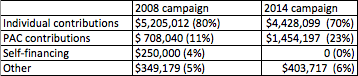
With 5 years as a U.S. Senator now behind him, the sources of Merkley’s donations are shifting. A smaller share is coming from individual contributors and twice as much from political action committees (PACs). Also, more unions are stepping up as big contributors, his big donors have less of an Oregon focus and Merkley isn’t having to dig into his own pocket.

merkleySenate

According to the Center for Responsive Politics, contributions to Merkley’s campaign committee for his 2008 campaign and for his 2014 campaign as of Dec. 31, 2013 break down as follows:

Screen Shot 2014-03-26 at 10.18.34 PM

For his 2008 Senate race, Merkley’s largest 10 contributors (individuals and PACs) to his campaign committee were:

JStreetPAC $78,180
Council for a Livable World $55,889
State of Oregon employees $35,050
Oregon Health & Science University $33,964
Moveon.org $26,731
Stoel, Rives et al $23,323
League of Conservation Voters $21,500
Intel Corporation $17,920
Newmark Knight Frank $17,300
Intl. Brotherhood of Electrical Workers $17,200

The largest contributor to his 2008 campaign, Washington, D.C-based JStreetPAC, makes contributions to candidates who support a two-state solution for Israel and Palestine and robust American military aid to Israel. “I am and will continue to be a staunch supporter of the special relationship between the U.S. and Israel,” Merkley said during his 2008 campaign.“I will always seek to ensure its strength and foster its growth.”

The second largest contributor to his 2008 campaign, Council for a Livable World, is a Washington, D.C.-based non-profit advocacy organization dedicated to reducing the danger of nuclear weapons. Merkley subsequently voted in 2010 for a new Strategic Arms Reduction Treaty (START) with Russia and in February 2014, Merkley and Senator Edward J. Markey (D-Mass.) introduced legislation that would cut $100 billion over the next decade from the U.S. nuclear weapons budget.

The bill, S. 2070, would shut down all U.S. missile defense activities, reduce from 12 to eight the number of SSBN(X) ballistic-missile submarines that are set to replace the retiring Ohio-class fleet and limit to eight the number of Ohio-class submarines that can currently be fielded. The bill has been referred to the Senate Committee on Armed Services where its languishing.

The largest 10 contributors (individuals and PACs) to Merkley’s campaign committee for his 2014 race as of the end of 2013 are significantly different, with much less of an Oregon focus:

Votesane PAC $31,250
Thornton & Naumes $25,000
Intel Corporation $22,050
Honeywell Intl. $20,000
Operating Engineers Union $20,000
Intl. Association of Firefighters $18,500
Blue Cross/Blue Shield $17,100
League of Conservation Voters $15,314
American Crystal Sugar $15,000
Communications Workers of America $15,000

Votesane PAC, a non-partisan channel for political donations, has funneled $1.6 million to candidates in the 2014 election cycle, with almost all of it going to Democrats.

The only union showing up in Merkley’s list of top 10 contributors for his 2008 race was the International Brotherhood of Electrical Workers at $17,200. Three unions show up as his biggest contributors for the 2014 race so far with a total of $53,500.

Also making their debut as major Merkley contributors are individuals from Thornton & Naumes, a Boston, Mass. law firm with class action expertise that has represented people claiming they were victims of asbestos and toxic exposure, defective products, financial fraud, and personal injury accidents.. Law firms and lawyers have been the top contributors to Merkley’s 2014 campaign as of Dec. 31, 2013, donating a total of $296,363.

This only reveals, of course, donations up the end of 2013. Expect a lot of shifts as the campaign progresses.

Merkley has already spent $3,045,241, or almost half, of the funds he’s raised since 2008. Recently, the largest single amount has gone to Mandate Media,a Portland-based internet strategy,services,and advertising firm specializing in progressive political candidates and advocacy organizations. Mandate is also associated with BlueOregon, a widely distributed progressive e-newsletter.

The top 5 recipients of the campaign’s recent expenditures were:

Mandate Media $200,485
CHS Mailing $141,305
Kauffman Group $125,163
Linemark Printing $ 71,639
Benenson Strategy Group $ 47,000

It’s important to recognize that much of the money now being spent on campaigns is so-called independent expenditures, spending by groups and individuals who claim they are not coordinating their activities with a candidate’s campaign committee.

In Merkley’s 2008 race, for example, according to FindTheBest, the following outside groups spent about $675,000 in support of his candidacy:

Committee Amount

Service Employees International
Union Committee on Political Education
(SEIU Cope) $430,238
League of Conservation Voters Inc. $145,317
Democratic Senatorial Committee $ 47,746
League of Conservation Voters
Action Fund $ 40,862
Moveon.org Political Action $ 7,026

It’s likely that similarly large amounts of independent expenditures will occur in the 2014 race.

Data sources: The Center for Responsive Politics (http://www.opensecrets.org), a non-profit, non-partisan research group based in Washington, D.C.; FindTheBest (www.findthebest.com; http://bit.ly/1nYKKSA),a network of for-profit websites connected to help consumers and businesses make informed decisions.

merkleySenate

Microagressions, microassaults, microinsults, microinvalidations : Macroinsanity

“Can we all get along?,” Rodney King said during the 1992 L.A. riots.

Apparently not.

As Voltaire said, “Common sense is not so common.” An increasing number of us seem determined to take offense at just about anything.

The New York times reported today (http://nyti.ms/1pmYMbO) that college students are seeing many slights as “Microaggressions”, the “social justice word du jour” for subtle offenses.

The Times raised the question of whether the issues raised in connection with the word are “a useful way of bringing to light often elusive slights in a world where overt prejudice is seldom tolerated, or a new form of divisive hypersensitivity, in which casual remarks are blown out of proportion.”

It all reminds me of a program a former employer of mine insisted all employees attend called “MicroInequities”. Stephen Young, former Senior Vice President and Chief Diversity Officer at JP Morgan Chase and Co-Founder of a management and consulting firm called Insight Education Systems, delivered the program, essentially telling all of us that dozens of things we said every day were offending somebody in the workplace.

To say the least there was a lot of eye rolling in the audience, with many commenting afterward that Young was taking things to an extreme, almost advocating that people take offense at the smallest perceived slights.

I’m with Harry Stein, at City Journal, who said that while most people feel unjustly treated at times, “most such supposed insults are slight or inadvertent, and even most of those that aren’t might be readily shrugged off.”

He also challenged the concept of “microaggressions”. Use of the term “suggests a more serious problem: the impulse to exaggerate the meaning of such encounters in the interest of perpetually seeing oneself as a victim,” he said.

bartSimpson

Is it two Oregons: Urban vs. Rural?

“The difference in this country is not red vs. blue,” Neil Levesque, director of the New Hampshire Institute of Politics at St. Anselm College, said in a Wall Street Journal article today. “It’s urban vs. rural.”

The Journal article went on to say:

“In many ways, the split between red Republican regions and blue Democratic ones-and their opposing views about the role of government-is an extension of the cultural divide between rural Americans and those living in cities and suburbs. As Democrats have come to dominate U.S. cities, it is Republican strength in rural areas that allows the party to hold control of the House and remain competitive in presidential elections. …”

A just released Oregon Values and Beliefs survey (http://oregonvaluesproject.org) makes it clear the urban vs. rural divide certainly holds true in Oregon.

Here’s a sampling of some key survey results broken down by regions in the state:

(1) Socially, Oregonians consider themselves:

Liberal
Portland Metro Area: 47%
Central Oregon: 29%
Eastern Oregon: 23%

Conservative
Portland Metro Area: 22%
Central Oregon: 37%
Eastern Oregon: 48%

(2) Oregon spends too much on public services and taxes should be reduced

Agree
Portland Metro Area: 28%
Central Oregon: 29%
Eastern Oregon: 46%

(3) Oregon should increase timber harvests in dense, over-crowded forest stands

Agree, that’s desirable
Portland Metro Area: 48%
Central Oregon: 66%
Eastern Oregon: 67%

Further evidence of the urban/rural split in Oregon is the results of the 2012 governor’s race between Kitzhaber and Dudley. A county-by-county review of the voting results illustrates the point. Kitzhaber carried only 6 counties, with big advantages coming particularly in Multnomah County (70.5% vs. 27.3%), Lane County (56.9% vs. 39.9%),and Benton County (59.4% vs. 38%). The Multnomah County vote was the kicker because of its large, concentrated population, which voted 198,157 for Kitzhaber and just 76,914 for Dudley.
FortRockSunsetByLarryGlothPortlandbridges

11 things Oregonians believe (or don’t know)

1. 50% of Oregonians don’t know Oregon has 2 U.S. Senators.
2. The things about Oregon that Oregonians value most are the state’s natural beauty, opportunities for outdoor recreation, open spaces, clean air and water, its sense of community, its climate.
3. 81% of Oregonians believe the most important public service provided in Oregon is K-12 education.
4. 57% of Oregonians believe environmental protection is more important than economic growth.
5. 63% of Oregonians don’t believe the state’s tax system is fair.
6. 64% of Oregonians believe the state government is wasteful and inefficient with our taxes and cannot be trusted to make good decisions.
7. Oregonians rate subsidies and tax breaks for business attraction or expansion the lowest of 20 different public priorities which necessitate tax support.
8. 70% of Oregonians believe all people should have equal access to a basic level of quality healthcare, but 72% believe people should be held accountable for high-risk behaviors such as smoking, drug use and lack of exercise, through higher insurance premiums.
9. Whether registered as a Republican, Democrat, Independent, Green, etc., a majority of Oregonians in all regions do not consider themselves strongly conservative or liberal on social or economic issues. The highest percentage of social liberals is in the Portland Metro Area (47%); the highest percentage of social conservatives is in Eastern Oregon (48%).
10. 78% of Oregonians are optimistic about their personal future over the next five years.
11. Just 42% of Oregonians believe Oregonians from diverse backgrounds will find common ground and work together to make progress addressing the critical issues facing the state.
TheWonders ofMcKenzieCreekbyShastaOrtwein

Source: 2013 Oregon Values & Beliefs Survey. Executed by DHM Research and PolicyInteractive Research. Sponsored by Oregon Health & Science University, The Oregon Community Foundation, Oregon Public Broadcasting and Oregon State University.

For more information visit http://www.truenorthoregon.org

The Supercalifragilisticexpialidocious Superhypothetical

Is Hillary going to run? Of course. But until she blurts it out officially, the media is having a field day writing speculative articles that seem to be written principally by adoring liberals to keep Hillary in the public eye.

 Image,

Mark Leibovich, author of the D.C dirt-dishing book “This Town”, wrote an unflattering  piece in the New York Times today about Scott Brown’s foray into New Hampshire politics,. He used him as a prime example of “a modern political breed known as the Superhypothetical — those professional non-candidates whose franchises depend largely on people speculating about what they might run for and their own willingness to engage in public indecision about it (all while assuring us, of course, that they are flattered and humbled by our interest).”

Leibovich even managed to comment on Brown’s move across the border from Wrentham, Mass., to his vacation home in Rye, N.H., in December as a reflection of  “a larger understanding of our politics” He points out that it matters not where a candidate actually comes from anymore. “More important, politics now are largely transacted in the nongeographic netherworlds of the media,” he said.

Somehow, however, Leibovich managed not to even mention Hillary, the all-around-best example of this new phenomenon.

If Brown is a Superhypothetical, Clinton is the Supercalifragilisticexpialidocious Superhypothetical, adored by the liberal media and promoted ad nauseum.

Not only that, but if Brown is to be castigated for his move to New Hampshire to run for the Senate again, Clinton was the carpet-bagger extraordinaire when she moved to New York to position herself for a run for the U.S. Senate. After all, Hillary, who grew up in a Chicago suburb, went to college in Massachusetts and Connecticut, then lived in Arkansas until Bill Clinton was elected president, had never even lived in New York. Still she won her New York race for the Senate.

Of course, neither Scott Brown nor Hillary Clinton have anything on James Shields, Oregon’s territorial governor during 1848-49. He subsequently became a senator from Illinois, Minnesota and Missouri, moving to a new state each time he wasn’t re-elected.