There they go again.Trump and guns.

Feigned Outrage

There they go again.

“If she (Hillary Clinton) gets to pick her judges, nothing you can do, folks,” Mr. Trump said at a rally in North Carolina today. “Although the Second Amendment people — maybe there is, I don’t know.”

His campaign maintained that he was referring to political activism.

But Mrs. Clinton’s campaign manager responded in high dudgeon: “What Trump is saying is dangerous.”

Clinton’s running mate, Senator Tim Kaine, erupted in disbelief. “Nobody who is seeking a leadership position, especially the presidency, the leadership of the country, should do anything to countenance violence, and that’s what he was saying,” Kaine said.

The ever low-key Elizabeth Warren followed up, saying Trump had made a “death threat.”

And of course a Democratic Congressman, Eric Swalwell, CA, followed up by calling on the Secret Service to investigate Donald Trump’s comments directed at Hillary Clinton, according to The Hill.

“Donald Trump suggested someone kill Sec. Clinton. We must take people at their word. @SecretService must investigate #TrumpThreat,” Swalwell Tweeted.

The fact that his tweet got him some media attention probably pleased Swalwell no end.

Dan Gross, the president of the Brady Campaign and Center to Prevent Gun Violence, which has endorsed Mrs. Clinton, said Mr. Trump’s statement was “repulsive — literally using the Second Amendment as cover to encourage people to kill someone with whom they disagree.”

The media loved it, seeing another opportunity for more over-the-top, twisted, contorted, coverage of the presidential campaign.

The New York Times reported that  Donald Trump seemed to suggest that gun rights backers could take matters into their own hands if Hillary Clinton nominated judges who favor gun control.

I heard the same kind of hand-wringing language on OPB this afternoon.

Similarly, The Hill reported: “Yet another Donald Trump reset has gone by the wayside as the GOP nominee appeared to joke that someone could shoot his Democratic rival, Hillary Clinton. His comment came just one day after a highly-touted economic speech meant to put Trump back on message.  After the comment gained steam on social media, the Trump campaign raced to clarify that Trump only meant political resource, not violence. But it’s the kind of diversion that drives on-the-fence Republicans crazy.”

Good grief. Come on folks. There are enough legitimate Trump issues to focus on without stooping to this kind of manufactured outrage.

Flint and Hillary Clinton’s race to the bottom

Flint, Michigan’s water is contaminated with lead. It’s an environmental, political and personal calamity. So where does Hillary Clinton go first? She casts it a racial issue.

“We’ve had a city in the United States of America where the population which is poor in many ways, and majority African-American has been drinking and bathing in lead contaminated water and the governor of that state acted as though he didn’t really care,” said a splenetic Clinton at a January 17 debate.

NBC News - Election Coverage - Season 2016

Hillary Clinton at the Jan. 17, 2016  Democratic Candidates Debate (Photo by: Virginia Sherwood)

And of course that liberal bastion, the New York Times, jumped on the bandwagon, noting that the majority of Flint’s residents are black and many are poor. “If Flint were rich and mostly white, would Michigan’s state government have responded more quickly and aggressively to complaints about its lead-polluted water?” the paper said.

It’s abundantly clear that Flint’s water situation is a result of failure at all levels of government, local, state and federal.

It’s equally clear that the economic catastrophe that is Flint, with its debt, high poverty rate, crime and depopulation, is the result of years of negligence by incompetent politicians.

But the left, by framing the current water controversy as a divisive civil rights issue instead, is embracing a long-standing pattern of exacerbating division to secure and maintain political power.

The mean-spirited racism charge makes reaching solutions harder while serving to distract the target audience from thinking about larger issues. As Christopher Lasch put it, if the commitment is to fomenting division, rather than to finding common ground, “…society dissolves into nothing more than contending factions, as the Founding Fathers of America understood so well–a war of all against all.”

America is being threatened from within by this conscious effort to carve up the electorate into antagonistic special interest groups every much as it is being threatened from without by religious zealots.

Enough.


Penn, El Chapo and Rolling Stone: throwing journalistic ethics to the wind

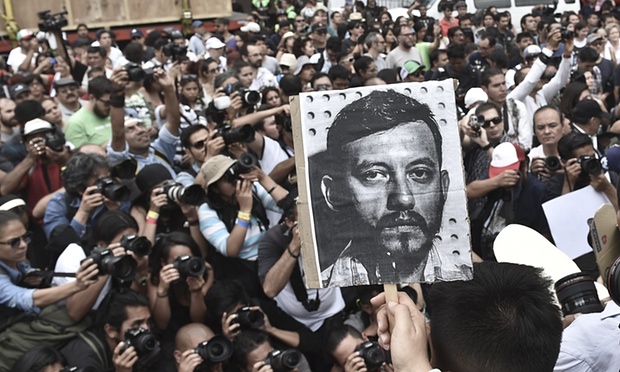
Mexican photojournalists hold pictures of their murdered colleague Rubén Espinoza during a demostration held at the Angel of Independence square in Mexico City. Photograph: Yuri Cortez/AFP/Getty Images

Mexican photojournalists hold pictures of their murdered colleague Rubén Espinoza during a demostration held at the Angel of Independence square in Mexico City. Photograph: Yuri Cortez/AFP/Getty Images

Rubén Espinosa, 31, a photographer for the Mexican investigative magazine Proceso, was killed in a Mexico City apartment in August, along with four women. Each had been beaten, tortured, and shot in the head.

Espinosa was the 13th journalist working in Veracruz to be killed since Governor Javier Duarte from the ruling Institutional Revolutionary party (PRI) came to power in 2011, according to Article 19, an international organization defending freedom of expression and information.

But what does Sean Penn care about that? His interest is in self-aggrandizement. Tossing humanity aside, he arranged to do a secret, exclusive interview of Joaquín Guzmán Loera, a murderous drug cartel leader known as El Chapo, that was published January 9 by Rolling Stone.

Sean Penn (L) greets El Chapo

Sean Penn (L) greets El Chapo

This is the same paragon of journalistic ethics that published the since discredited story of a gang rape of a student at a University of Virginia fraternity. A report by the Columbia Graduate School of Journalism reviewing Rolling Stone’s pursuit and coverage of that story said the publication didn’t follow “basic, even routine journalistic practice”.

The same criticism applies to Penn’s story, a stream of consciousness essay that reads like something written by a drug-addled Hunter S. Thompson, requiring the reader to suffer through over 4000 words about the derring-do involved in getting to El Chapo before Penn even meets him.

“I take no pride in keeping secrets that may be perceived as protecting criminals, nor do I have any gloating arrogance at posing for selfies with unknowing security men,” wrote Penn. “But I’m in my rhythm.” So why consider “…those beheaded, exploded, dismembered or bullet-riddled innocents, activists, courageous journalists and cartel enemies alike…” who’ve died at El Chapo’s hands? Journalistic glory awaits.

Besides, as Penn wrote, El Chapo doesn’t engage in “gratuitous kidnapping and murder”. He’s “…a businessman first, and only resorts to violence when he deems it advantageous to himself or his business interests.” Well, that explains it.

You might be surprised that, as a former reporter, I’m not too concerned about the ethics of Penn interviewing El Chapo, even though he’s clearly a drug lord who has committed murder and mayhem. Any good reporter would try to do the same.

I also don’t think Penn doing the interview and not advising law enforcement of his contact with Guzman, and where he could be found, is an ethical error.

My gripe is about something Rolling Stone admitted right up front, without any apparent shame: “Disclosure: … an understanding was brokered with the subject that this piece would be submitted for the subject’s approval before publication.”

Jann Wenner, Rolling Stone’s publisher, even told the New York Times. “I don’t think it was a meaningful thing in the first place.”

The problem is that’s a massive breach of journalistic principles.

It also raises legitimate questions about the contents of the article. Wenner said El Chapo didn’t ask for any changes, but how can the reader trust that? Admitting that the subject was given a pre-approval opportunity invites a lot of speculation about the truth.

Wenner compounded the problem by telling the Times, “We have let people in the past approve their quotes in interviews.”

That’s a bad move, too. It’s OK to go back to sources to clarify facts, to avoid making errors, but not to give them quote approval.

Politico argues that pre-approval was no big deal. “It was only common sense for El Chapo to demand story approval lest a geographically revealing detail get folded in and lead to his capture. In other words, the El Chapo story probably would not have been granted without the pre-publication concession—and without having a swaggering celebrity amateur to report and write it.”

Saying it’s OK to grant pre-approval if that’s the only way to get a story done is a cop out if there ever was one. That’s a slippery slope that can justify all sorts of ethical compromises to get a story.

And that’s where trust in journalism is lost.

Gun safety training: another feel-good solution to shooting deaths

Umpqua Community College candlelight vigil

Umpqua Community College candlelight vigil

After every shooting rampage, whether at Umpqua Community College, San Bernardino, or Sandy Hook, voices are raised across the country calling for “something to be done”.

The latest solution to escalating firearms deaths, put out there on Jan. 9 by the New York Times, is government-mandated gun safety training. The fact that it would have little impact on gun deaths, except, perhaps, to make suicides more efficient, is apparently irrelevant.

“…since we’re awash in firearms anyway, we’d be better off if people knew how to use them without hitting anything other than their target,” The New York Times argued in a Jan. 9 editorial.

Sounds good, but according to the U.S. Centers for Disease Control and Prevention, the majority of firearm deaths aren’t caused by bumbling undertrained shooters inadvertently blasting people. Instead, most gun deaths, roughly 6 of every 10, are suicides. This has been the case since at least 1981.

Training potentially suicidal people how to handle a gun better is unlikely to prevent them from blowing themselves away.

As homicides by firearms have been declining, the share of all gun deaths by suicide has been growing.

In 2010, for example, there were 31,672 deaths by firearms, including: 19,392 suicides (61%) compared with 11,078 homicides (35%).

In 2013, there were 33,636 deaths by firearms, including 21,175 suicides by firearm (63 %) compared with 8,454 homicides by firearms (25%).

Mandated safety training of potentially homicidal folks (including criminals, if they are so inclined) is also unlikely to sway them from their murderous intent. And if the New York Times’ objective in calling for required gun safety training is greater accuracy by shooters, does it make sense to insist on homicidal nutcases learning how to aim better?

I’m no gun-rights evangelist, but this push for government-mandated gun safety training to cut down on gun killings sounds to me like an attractive, but flawed and costly, tactic more symbolic than anything else.

If gun control proponents really want solutions, they should be realistic about what tactics will cost in time and money and whether they are capable of actually accomplishing anything meaningful.

Facebook: swallowing the news

Facebook has officially launched its Instant Articles feature where full stories from media outlets are displayed, rather than links to the media sites. Media such as the New York Times, BuzzFeed and the Guardian are participating in the program.

The new function will not only avoid the problem of slow loading time for linked stories, but will prevent users from leaking from Facebook when leaving to view a full story. That will help Facebook in its goal to be a one-stop-shop.

You might not even notice the change, but it signals a transformative relationship between media outlets, Facebook and the public.

war-zone-2-journalist-cartoon

The collaboration will be far from benign. It will have a devastating impact, seriously eroding the brands of the media companies and, over time, the connections readers have with them.

In short, the seeds of your newspaper’s demise are being planted by Facebook. Read more.


Ted Kennedy and Al Sharpton: no excuses

(Addendum: Al Sharpton is at it again. The New York Times reported on Nov. 19, 2014,  that Sharpton “has regularly sidestepped the sorts of obligations most people see as inevitable, like taxes, rent and other bills. Records reviewed by The New York Times show more than $4.5 million in current state and federal tax liens against him and his for-profit businesses.”

“Sidestepped” is too polite a word for how Sharpton has behaved. And this is a man President Obama turns to for guidance?)

Reading all about Al Sharpton’s emergence as a respectable political leader and go-to guy for President Obama, I’m reminded of Ted Kennedy.

Liberal Democrats loved Ted Kennedy.

He was the standard-bearer for the liberal wing of the Democratic Party. He was their beloved champion for his work on health care, education, immigration reform, civil rights, voting rights, workers’ rights and other causes.

TeddyKennedyMaryJo

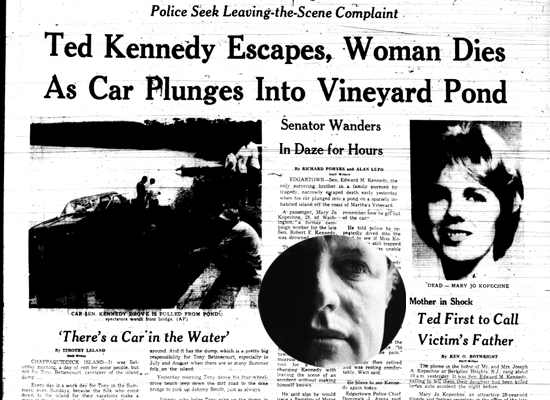
So what did Democrats do when faced with the news that Kennedy’s actions had caused the death of 28–year-old Mary Jo Kopechne when he drove an Oldsmobile 88 into a tidal channel on Chappaquiddick Island in 1969? They stuck with him.

What did they do when it was learned he had left the scene of the accident, consulted with a high-powered group of political and legal advisors, and didn’t notify the police for 10 hours after the accident. They stuck with him.

What did they do when State police detective-lieutenant George Killen said, “Senator Kennedy killed that girl the same as if he put a gun to her head and pulled the trigger?” They stuck with him.
They looked on without reproof when Kennedy’s only punishment was losing his driving license for a year and receiving a suspended two-month jail sentence.

All was forgiven. The liberal special interest groups that depended on his support in the contentious political arena, even the usually outspoken Liberal women’s rights groups, either stayed silent or defended him then and in the years to come. After all, he was one of them, a supporter of their agendas.

And Massachusetts voters continued sending Kennedy back to the Senate until his death on August 25, 2009, after which liberals eulogized him as a great American and a great senator.

“I can think of no one who engendered greater respect or affection from members of both sides of the aisle,” said President Obama in 2009 remarks on Kennedy’s death.

“I just hope we remember how he treated other people…,” said Vice President Biden, ignoring Kennedy’s reputation on the Hill as a “the rules don’t apply to me” boor whose appalling behavior was well documented.

Joyce Carol Oates suggested that even if Kennedy had caused the death of a young woman, he had redeemed himself by accomplishing so much good work thereafter, by his “…tireless advocacy of civil rights, rights for disabled Americans, health care, voting reform, his courageous vote against the Iraq war.”

Liberal’s willingness to excuse Ted Kennedy, even in the face of his clear guilt in the death of a young woman, reminds me of their tolerance for, and even promotion of, Al Sharpton’s ascension to political prominence.

Sharpton’s infamous rise in public notoriety has been well documented.

A 1987-1988 case that drew national attention revolved around Sharpton’s involvement with 15-year-old Tawana Brawley, a black woman from New York who accused six white men of raping her and leaving her in a garbage bag smeared with and covered with racist words written in charcoal.

Sharpton, who accused government officials of trying to cover up for the rapists because they were white, led the way in spurring a national uproar over the case.

brawley_sharpton_custom-1a3219e3e6986346b22e7fb0aea7ab0f3833f78e-s6-c30

He was later rebuked and fined after a grand jury concluded that Brawley had not been the victim of a forcible sexual assault and that she may herself have created the appearance of an attack.

In 1991, Sharpton stirred up black fury in the Crown Heights area of Brooklyn when a Jewish driver hit and killed a black boy, Gavin Cato, with his car.

At the boy’s funeral, Sharpton vilified Jewish “diamond merchants” who killed black children in Brooklyn.

Days of anti-Semitic riots culminated in the murder of Yankel Rosenbaum, an Australian Jew who had nothing to do with the incident, being stabbed to death in the midst of a mob of about 30.

The New York Post reported that after the driver of the car was cleared of charges and left for Israel, Sharpton flew to Tel Aviv to slap the driver with a civil suit. When a passer-by at Israel’s Ben Gurion Airport recognized Sharpton, she shouted, “Go to hell!”
“I am in hell already,” Sharpton replied. “I am in Israel.”

In December 1995, during a Harlem protest stirred up by Sharpton, a black man entered Freddy’s Fashion Mart, a Jewish-owned clothing store, took out a gun, ordered the black customers to leave and set a fire that killed himself and eight other people.

Sharpton was accused of having spurred the devastation by delivering and facilitating incendiary racist and anti-Semitic comments on black radio stations and at the protest.

In Sept. 2013, the New York Post reported that Robert F. Kennedy Jr. had written in a previously secret diary, “Al Sharpton has done more damage to the black cause than [segregationist Alabama Gov.] George Wallace. He has suffocated the decent black leaders in New York. His transparent venal blackmail and extortion schemes taint all black leadership.”

Sharpton, pitching himself as America’s leading advocate of social justice, shows up everywhere there’s a TV camera and a potential racial dispute to be exploited. Most recently, he made himself visible in Ferguson, Missouri.

Now Obama, the Democratic Party and other liberals are legitimizing Sharpton and giving him a highly visible chair at the table.

It’s an appalling comment on their willingness to embrace one of their own regardless of his contemptible actions.

Obama’s executive orders on immigration: A feast for special interests

“A government above the law is a menace to be defeated.”
Lord Scarman

“This is a nation of laws,” President Obama proclaimed on Tuesday during his plea for calm in Ferguson, MO.

Yes it is. And the President of the United States, who appears to be unable or unwilling to work with Congress on immigration, shouldn’t be focusing his energies on how to go around it.

obama-cnn

“America is a nation of laws, which means I, as the president, am obligated to enforce the law. I don’t have a choice about that. That’s part of my job,” Obama said in March 2011, at an event hosted by the Spanish-language television network Univision.

“There are enough laws on the books by Congress that are very clear in terms of how we have to enforce our immigration system that for me to simply through executive order ignore those congressional mandates would not conform with my appropriate role as president,” Obama added.

So there’s something very dispiriting about his administration’s current maneuvering, in collusion with an array of special interests, to bypass Congress and circumvent immigration law through executive orders.

It reminds me of my time as staff on a committee of the House of Representatives when an impatient constituent complained about House inaction on a piece of legislation. Rep. Edwin Forsythe (R-NJ), the ranking minority member of the committee, replied that the Founders intended Congress to be deliberate. “It keeps a lot of bad bills from passing,” he said.

Instead of letting that legislative process play out, there’s something odious about all the special interests sidling up to Obama and his advisors behind closed doors to plead their case. They haven’t succeeded in pushing Congress to pass an immigration bill to their liking, so they’re happy to win by going in the back door.

This is where special deals for special interests, many of which have likely contributed generously to Obama and Democrats, can get their rewards without public exposure.

In an interesting juxtaposition of stories in today’s New York Times, one story highlighted Obama’s disengagement with Congress. “…nearly six years into his term, with his popularity at the lowest of his presidency, Mr. Obama appears remarkably distant from his own party on Capitol Hill, with his long neglect of would-be allies catching up to him,” the story said.

Meanwhile,another story outlined Obama’s plans to use executive orders to make “potentially sweeping changes to the nation’s immigration system without Congress.”

”America cannot wait forever for them to act,” Obama said of Congressional Republicans.

But the unwillingness of Congress to act on a president’s priorities shouldn’t mean defaulting to unbridled executive action. Rather, it should lead to more aggressive effort to secure Congressional votes.

When faced with Congressional resistance to his civil rights proposals, President Johnson didn’t retreat to the oval office to invent spurious ways to bypass Congress. As Robert Caro has so ably documented, Johnson worked every angle, twisted every arm, and glad-handed every critic to secure passage of the 1964 Civil Rights Act.

According to Caro, when Johnson embarked on his campaign for a civil rights bill, his allies cautioned him about using up his political capitol on a important but doomed effort so soon after ascending to the presidency following Kennedy’s assassination.

Johnson’s reply? “Well, what the hell’s the presidency for?”

“Hard Choices” hype not paying off

Looks like Simon & Schuster made a bad choice in deciding to publish Hillary Clinton’s book.

Not that many people are buying it. That could say something about the depth of her appeal, beyond being a media celebrity and liberal icon.

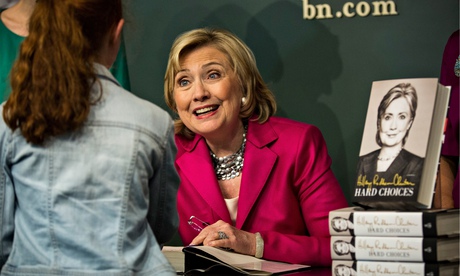
Hillary Clinton at a book signing for memoir in New York City

The New York Times reports (http://nyti.ms/1sGoHlL) that sales of Hillary’s book declined 43.5 percent to 48,000 copies in its second week on the shelves, according to Nielsen BookScan. That followed sales of about 85,000 copies in the first week the book hit bookstores.

Simon & Schuster is widely rumored to have paid paid Hillary a $14 million advance on “Hard Choices”, $6 million more than she was paid for her last book, “Living History”, and to have spent lavishly on promotion of the book. If that’s right, Simon & Schuster may be on the way to losing a lot of money on “Hard Choices”.

And all this doesn’t take into account that a lot of people buying the book are more collectors than readers.

So far, the only attention-grabbing things to come out from all the publicity about the book are embarrassing comments Hillary has made about her family’s financial situation.

“We came out of the White House not only dead broke, but in debt,” Clinton said ABC’s Diane Sawyer, referring to the hefty legal fees incurred during their White House years. “We had no money when we got there, and we struggled to, you know, piece together the resources for mortgages, for houses, for Chelsea’s education. You know, it was not easy.”

Commenters noted that Bill Clinton earned $200,000 a year as president and that the Clinton’s huge legal debts, largely an outgrowth of Bill Clinton’s misadventures, were paid off with public contributions. They also highlighted that Hillary and Bill immediately leaped into lucrative speaking engagements when Bill’s presidency ended.

Hillary is reported to have raked in $5 million in speaking fees since she left the State Department in early 2013, much of it from speeches billed at $200,000 a pop. Bill has been even more aggressive, pulling in $106 million from paid speeches since leaving the White House in January 2001.

Hillary found herself in more hot water when she told the Guardian  she’s not “truly well off” and insisted that she and Bill “pay ordinary income tax, unlike a lot of people who are truly well off, not to name names…”  Bloomberg News later reported, however, that the Clintons have played fast and loose to stave off hefty estate taxes on their own personal wealth. “…the two heads of the political dynasty have been seizing on legal but slippery loopholes to minimize taxes on inherited wealth…,” CBS News reported.