Obama’s executive orders on immigration: A feast for special interests

“A government above the law is a menace to be defeated.”
Lord Scarman

“This is a nation of laws,” President Obama proclaimed on Tuesday during his plea for calm in Ferguson, MO.

Yes it is. And the President of the United States, who appears to be unable or unwilling to work with Congress on immigration, shouldn’t be focusing his energies on how to go around it.

obama-cnn

“America is a nation of laws, which means I, as the president, am obligated to enforce the law. I don’t have a choice about that. That’s part of my job,” Obama said in March 2011, at an event hosted by the Spanish-language television network Univision.

“There are enough laws on the books by Congress that are very clear in terms of how we have to enforce our immigration system that for me to simply through executive order ignore those congressional mandates would not conform with my appropriate role as president,” Obama added.

So there’s something very dispiriting about his administration’s current maneuvering, in collusion with an array of special interests, to bypass Congress and circumvent immigration law through executive orders.

It reminds me of my time as staff on a committee of the House of Representatives when an impatient constituent complained about House inaction on a piece of legislation. Rep. Edwin Forsythe (R-NJ), the ranking minority member of the committee, replied that the Founders intended Congress to be deliberate. “It keeps a lot of bad bills from passing,” he said.

Instead of letting that legislative process play out, there’s something odious about all the special interests sidling up to Obama and his advisors behind closed doors to plead their case. They haven’t succeeded in pushing Congress to pass an immigration bill to their liking, so they’re happy to win by going in the back door.

This is where special deals for special interests, many of which have likely contributed generously to Obama and Democrats, can get their rewards without public exposure.

In an interesting juxtaposition of stories in today’s New York Times, one story highlighted Obama’s disengagement with Congress. “…nearly six years into his term, with his popularity at the lowest of his presidency, Mr. Obama appears remarkably distant from his own party on Capitol Hill, with his long neglect of would-be allies catching up to him,” the story said.

Meanwhile,another story outlined Obama’s plans to use executive orders to make “potentially sweeping changes to the nation’s immigration system without Congress.”

”America cannot wait forever for them to act,” Obama said of Congressional Republicans.

But the unwillingness of Congress to act on a president’s priorities shouldn’t mean defaulting to unbridled executive action. Rather, it should lead to more aggressive effort to secure Congressional votes.

When faced with Congressional resistance to his civil rights proposals, President Johnson didn’t retreat to the oval office to invent spurious ways to bypass Congress. As Robert Caro has so ably documented, Johnson worked every angle, twisted every arm, and glad-handed every critic to secure passage of the 1964 Civil Rights Act.

According to Caro, when Johnson embarked on his campaign for a civil rights bill, his allies cautioned him about using up his political capitol on a important but doomed effort so soon after ascending to the presidency following Kennedy’s assassination.

Johnson’s reply? “Well, what the hell’s the presidency for?”

Ferguson, MO: So many agendas, so little time

In 1989, when I was a reporter for The Oregonian, I happened to be in the vicinity of Homestead Air Force Base in Florida when Manuel Noriega, the former dictator of Panama, was flown in late at night after being captured by American troops in Operation Just Cause.

With my reporter credentials, I managed to secure access to an area near the base where a couple hundred demonstrators had gathered to denounce Noriega. The dynamics were fascinating.

The demonstrators would mill about calmly chatting, drinking cokes and smoking cigarettes until the TV crews yelled, “We’re going live” and turned on their lights. On cue, the demonstrators would quickly come together and erupt in ferocious anger, screaming slogans and raising protest signs. When the camera lights went out, the demonstrators would instantly resume their casual almost family picnic-like behavior.

To the TV viewers, Homestead Air Force base was overrun by a huge mob of anti-Noriega demonstrators demanding justice, but what was actually going on was a scripted, mutually beneficial tableau, with everybody playing their part.

Ferguson, MO feels like that.

Michael Brown

Michael Brown

From the moment Michael Brown was shot to death on Saturday afternoon, August 9, the story ceased to be about him.

For Obama critics, it has provided an opportunity to take him to task for not being more immediately engaged in the matter, for carousing on Martha’s Vineyard while Rome burned, or for injecting himself into the story in the first place.

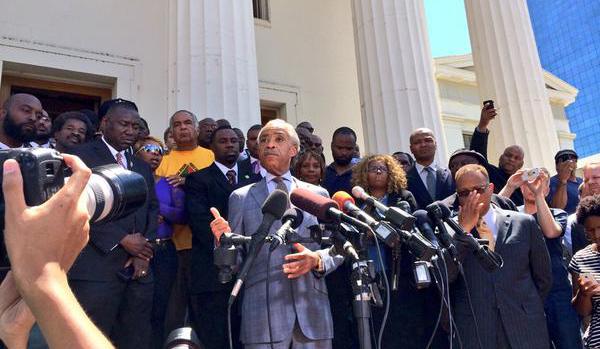
For Jesse Jackson, who arrived on the scene Friday night, it’s been a chance to remind people he’s still a player on the national stage. For the ever-present Al Sharpton, it has provided yet another chance to visibly insert himself in a controversy, hype it as a racial travesty and raise his public profile. On Aug. 12, Sharpton came to St. Louis to speak to Brown’s family and worked his way around the St. Louis area to demand justice in the shooting. That afternoon he managed to draw more attention by speaking on the steps of the Old Courthouse in St. Louis.

Al Sharpton speaks to a crowd at the St. Louis downtown courthouse

Al Sharpton speaks to a crowd at the St. Louis downtown courthouse

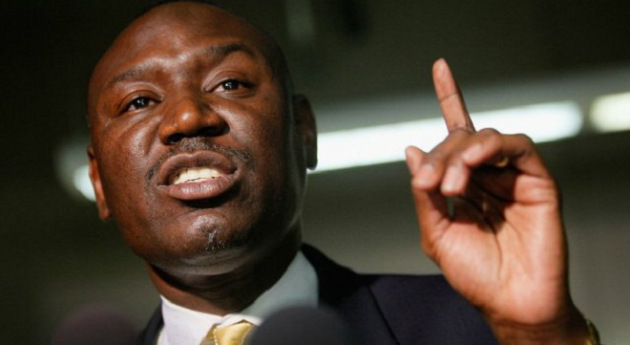
For Benjamin Crump, who represented the family of Trayvon Martin and has been hired by the Brown family as their counsel, it has provided a shot at a second dose of notoriety.

Benjamin Crump

Benjamin Crump

For the no-longer-as-influential NAACP, it has meant a chance to be a player, to hold a packed press conference at the local Murchison Tabernacle CME Church. So many people showed up, a lot of them had to stand outside and listen to speakers.

The NAACP press conference was overwhelmed with attendees

The NAACP press conference was overwhelmed with attendees

For some politicians, the whole affair has been a godsend for their exposure.

Missouri Democratic State Senator Maria Chappelle-Nadal went so far as to go on MSNBC and call Brown’s death an “execution-style” shooting. She also sent out expletive-laden tweets to Missouri Governor Jay Nixon, such as, “ You don’t know s..t bc you never communicate. F..K you, Governor!” and “F..K you, Governor. I’m calling your bullshit!”

Senator Elizabeth Warren (D-MA) weighed in with a tweet,too. “This is America, not a war zone.”

For critics of the distribution of surplus military equipment to police forces around the country, the use of such equipment in Ferguson has given them a chance to advance their messages.

Senator Rand Paul, R- KY, has put the responsibility for the militarization of police departments at the feet of big government, arguing that, “Washington has incentivized the militarization of local police precincts by using federal dollars to help municipal governments build what are essentially small armies…”

Senator Rand Paul, R-KY

Senator Rand Paul, R-KY

Rep. Hank Johnson, D-Ga., has announced his intention to introduce the “Stop Militarizing Law Enforcement Act,” which would further monitor, limit or eliminate such equipment sales. Johnson and Michael Shank, associate director for legislative affairs at the Friends Committee on National Legislation, took to USA Today on March 10 to proclaim of the military’s program, “Something potentially sinister is happening across America.”

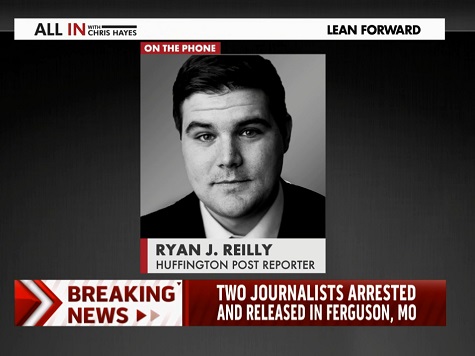
Even the media’s gotten into the act. After two reporters from the Washington Post and the Huffington Post were arrested on Aug. 13 while covering demonstrations in Ferguson, both media outlets and the reporters have gone public with descriptions of the incidents and anguished protests about the “assault on the freedom of the press.”

Ryan Reilly, a reporter for the Huffington Post, talked to MSNBC's Chris Hayes, anchor of “All In,” about his arrest .

Ryan Reilly, a reporter for the Huffington Post, talked to MSNBC’s Chris Hayes, anchor of “All In,” about his arrest .

Again, this reminds me of a time when I was at The Oregonian and a con man I was following in an exhausting and circuitous effort over several weeks threatened to kill me. I wanted to include all the details of my travails in researching the story when I wrote it, but a senior editor insisted I delete it. “The troubles you endured in getting the story don’t belong in the paper,” he said. ‘The story’s not about you.

Things fall apart

I was enjoying a coffee and pastry at a Starbucks this morning when a man sitting next to me checking his smartphone and reading the paper turned and said, “It looks like the rebels or the Russians might have shot down a Malaysian Airlines plane carrying 300 people. Do you get the feeling everything is just unraveling?”

Yes.

A plan to transport three busloads of Central American families through San Diego for processing at the Murrieta Border Patrol station took an unexpected turn when scores of protesters blocked the buses from entering.

A plan to transport three busloads of Central American families through San Diego for processing at the Murrieta Border Patrol station took an unexpected turn when scores of protesters blocked the buses from entering.

Tens of thousands of children of all ages, most unaccompanied by adults, are flowing across the U.S. Southwest border. Frustration and anger is bubbling up all over the country. Some people are arguing that President Obama has encouraged the stream of immigrants and that strong steps need to be taken to control the U.S. border and send the immigrants home. Others argue the immigrants need to be treated with compassion and welcomed to America with open arms in the spirit of “Give me your tired, your poor, your huddled masses yearning to breathe free…”

Whichever side you are on, and just about everybody seems to have taken sides, just 28% of the public approves of the way President Obama is handling the surge of children from Central America, according to a new poll by the Pew Research Center or the People & the Press.

Meanwhile, violence is spreading in Gaza and Israel after the kidnapping and killing of three Israeli teenagers in the West Bank set off a new cycle of violence in the region.

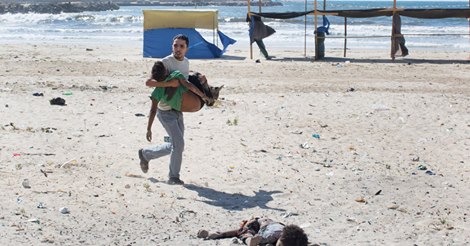
While Hamas militants and Israel exchange rocket fire, stories multiply of civilian deaths, including a story today reporting that four boys, ages 9 to 11, were killed on a beach west of Gaza City.

A boy on a Gaza beach killed in an Israeli attack is carried away.

A boy on a Gaza beach killed in an Israeli attack is carried away.

Of course, the only reason similar horrifying stories of civilian killings by the Hamas militants haven’t surfaced in Israel is because of its effective anti-rocket defenses.

In Ukraine, tension continues as Russia threatens the country, pro-Russian militants fight the government’s forces and, as noted earlier, rumors swirl that a Malaysian Airlines plane with 295 on board, including some Americans, that crashed in Ukraine near the Russian border was deliberately shot down. The Ukrainian Foreign Ministry in Kiev asserted that the “the airplane was shot down by the Russian Buk missile system.”

wreckage of Malaysia Airlines plane crash in Ukraine

wreckage of Malaysia Airlines plane crash in Ukraine

In Egypt, after a popular uprising resulted in the first democratically-elected Islamic president in Egypt’s history, forces led by Gen. Abdel Fattah el-Sisi overthrew the fledgling president and instigated an unforgiving campaign of retaliation against the Muslim Brotherhood and regime critics that continues to this day.

In Syria, after Obama insisted that use of chemical weapons by the the Assad regime would be “a red line for us,” Obama dithered and the civil war escalated, creating a country scarred with destruction and pushing out hundreds of thousands of refugees into neighboring counries.

obama-redlinespeech821

In Afghanistan, scene of what Obama called “the good war” that needed to be fought, chaos has ensued since the U.S. precipitously withdrew its troops.

In Iraq, after thousands of American soldiers gave their lives in an effort to create a sustainable peace, the U.S.-backed Shia-led government under Prime Minister Nouri al-Maliki initiated a cleansing of the Sunni minority. Now we have a violent struggle going on in Iraq with mostly Sunni militants from the radical Islamic State of Iraq and Syria.

A file image uploaded on June 14, 2014 on the jihadist website Welayat Salahuddin allegedly shows militants of the Islamic State of Iraq and the Levant (ISIL) executing dozens of captured Iraqi security forces members at an unknown location in the Salaheddin province (AFP Photo / HO)

A file image uploaded on June 14, 2014 on the jihadist website Welayat Salahuddin allegedly shows militants of the Islamic State of Iraq and the Levant (ISIL) executing dozens of captured Iraqi security forces members at an unknown location in the Salaheddin province (AFP Photo / HO)

Meanwhile, despite a roaring stock market, economic insecurity reigns. Just 19% of those surveyed by Pew say economic conditions in the U.S. are excellent or good while 81% rate conditions as only fair or poor. About six-in-ten (62%) still say jobs are difficult to find locally.

Detroit Area Economy Worsens As Big Three Automakers Face Dire Crisis

Obama’s rating for handling the economy also has stayed negative, with 56% disapproving of the way Obama is handling the economy, according to the Pew survey. In fact, Obama’s job rating on the economy has been around 40% for most of the past five years.

Meanwhile, Obama, “a restless president weary of the obligations of the White House,” as the New York Times puts it, jets around the world for fundraisers and dinners with celebrities and wealthy supporters, taking as many breaks as he can for golf.

Barack Obama

Unravelling? You bet.

Replenishing the Highway Trust Fund: more budget shenanigans

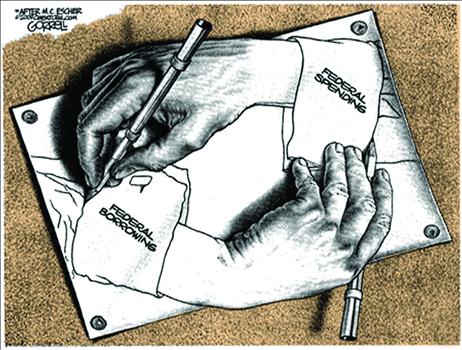
borrowing-spendingescher-hands

It’s not just a burst of illegal immigration and a screwed up Veterans Administration that motivates Congress to try budget slight-of-hand. Rebuilding a depleted Highway Trust Fund through dubious manipulations is being tried, too.

Facing depleted resources in the Highway Trust Fund that could hold up road and bridge construction across the country, and the jobs that would come with it, House Republicans and the Obama Administration are backing a bill that would inject up to $11 billion into the Fund by, among other things, making changes to corporate’ pension contributions.

So-called “pension smoothing” would allow companies to temporarily contribute less to their employees’ pension plans.

The theory behind this maneuver is that because pension contributions are tax-deductible, companies will pay higher federal taxes over the ten-year scoring period used by the Congressional Budget Office (CBO) if they put less money into their pension plans.

Senator Mr. Wyden (D – OR), Chairman of the Senate Finance Committee, already sees this as an opportunity to cleave off some of that new revenue. He’s proposing to use about $2.7 billion of the increased tax collections during that 10-year period to help out retired coal miners, who have underfunded pension and health benefits programs.

Senator Ron Wyden (D-OR)

Senator Ron Wyden (D-OR)

Wyden has expressed concern in the past about the potential burden on the Pension Benefit Guaranty Corporation from underfunded multi-employer pension plans, in which multiple employers in the same industry contribute to a single pension fund. Of particular concern are multi-employer plans established through union contracts in contracting industries, such as coal mining. Changes in the coal industry has meant fewer employers paying into pension funds on behalf of fewer employees.

But Congress’s “solution” to the Highway Trust Fund’s shortfall is a sham because the revenues that are supposedly increased because of the pension smoothing change would be largely offset in the years after the 10-year scoring period. That’s because corporations will pay less in taxes in years after the 10 year period. In other words, no real savings are realized in the long run. But because those reduced taxes wouldn’t happen until after 10 years, they don’t count in Congress’s method for calculating budget balance.

Wyden, of all people, ought to know that the whole method of producing revenue he wants to use to bulk up the coal miners’  underfunded pension plans is bogus. But why let reality intrude.

So bizarre.

Making it even more bizarre, Republicans vehemently opposed this very same “pension smoothing” policy back in March 2014 when the Democrats proposed using it to pay for the renewal of unemployment benefits.

“When they were seeking a spending offset to the five-month extension of unemployment insurance, Democrats were happy to use a budget gimmick,” the New Republic reported. “They would have preferred to use deficit spending, but a gimmick was the next best thing. If Republicans required a spending offset, better a fake one than one that cuts spending on the social safety net or other government programs.”

You have to watch them all like a hawk, don’t you.

Who lost Iraq? China Redux.

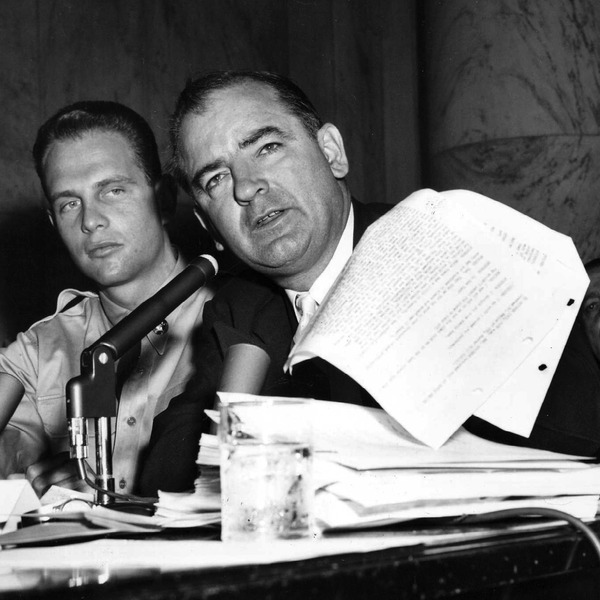
In the years following Chiang Kai-shek’s Nationalist regime’s loss to the Chinese Communists in 1949, when U.S. Senator Joseph McCarthy let loose his ill-founded accusations of communist infiltration in the United States, the country, eager to blame somebody, was wracked with questions about, “Who lost China”?

Senator Joseph McCarthy

Senator Joseph McCarthy

In the 1950’s, U.S. Senate committees studied what was seen as the failure of American foreign policy to prevent the Chinese Communist takeover.  McCarthyism is remembered today as a broad attack on presumed communists and sympathizers in the U.S., but it was also a targeted attack on the State Department’s experts on China, the so-called China Hands, who had told the truth as they saw it. A broad swath of these experts were either forced out the Foreign Service or had their careers completely derailed.

If Iraq falls to the Islamic State of Iraq and al-Sham, known as ISIS, after the loss of thousands of American lives and the expenditure of  billions of American dollars, there’s little doubt that a new rallying cry will arise, “Who lost Iraq?”

Sgt. Timothy Davis of San Diego places American flags before the gravestones of those buried at Arlington Cemetery.

Sgt. Timothy Davis of San Diego places American flags before the gravestones of those buried at Arlington Cemetery.

Potential targets are legion, which may well lead to a convulsive period in American domestic and foreign policy.

The blame game is, in fact, already underway.

On June 12, Fareed Zakaria wrote a column in the Washington Post titled, “Who lost Iraq? The Iraqis did, with an assist from George W. Bush”. The Iraqi government is “corrupt, inefficient and weak, unable to be inclusive (of the Sunnis) and unwilling to fight with the dedication of their opponents,” just like the Chinese nationalists were, Zakaria said.

So Prime Minister Nouri al-Maliki is the one who lost Iraq. But he came to power as a result of “a series of momentous decisions made by the Bush administration,” Zakaria said, so Bush lost Iraq.

But wait a minute. Things were much more settled in Iraq when Obama became president and his foreign policy team was hailing the country’s prosperity, embrace of democracy and relative quiet compared with earlier years. In 2010, Vice President Biden called Iraq one of Obama’s “great achievements”. In 2011, President Obama told troops at Fort Bragg, “We’re leaving behind a sovereign, stable and self-reliant Iraq.”

Wasn’t it the Obama Administration that made a precipitous withdrawal of U.S. troops from Iraq, encouraging adversaries and leaving the country’s elected government weaker in the face of continuing threats?

Or maybe it was the Obama Administration’s feckless foreign policy in dealing with Syria, with Obama insisting in 2012 that the use of chemical weapons by Syrian President Bashar Assad would cross a “red line for us” and might trigger a U.S. military response, followed by Obama’s failure to follow through.

Perhaps that emboldened not only Assad, but also ISIS, which is already perilously close to Baghdad.

The city of Mosul in Iraq, which ISIS soldiers have taken over.

The city of Mosul in Iraq, which ISIS soldiers have taken over.

Gary Alan Fine and Bin Xu, in “Honest Brokers: The Politics of Expertise in the “Who Lost China?” Debate”, note that much blame has been placed on the advice of a group of men and women labeled neoconservatives who got the U.S. embroiled in Iraq in the first place. “These policy experts have been targeted,” they say. “But more than just being wrong in their expectations, some critics, such as Seymour Hersh, suggest that these policy experts constituted a “cult,” and others allege that they were a group that placed the interests of the Bush administration, the Republican Party, or the state of Israel above that of the United States.”

Regardless of who made the decisions that have led to the current mess, hold on, because the atmosphere is going to get turbulent and all of America is going to feel it.

Berlin Redux: Those who cannot remember the past are condemned to repeat it

In July 2009, speaking at Moscow’s New Economic School, Obama said long-standing assumptions that the US and Russia were antagonists vying for spheres of influence were inaccurate.

“Given our interdependence, any world order that tries to elevate one value or people over another will inevitably fail,” he said. “That is why I have called for a ‘reset’ in relations between the United States and Russia. This must be more than a fresh start between the Kremlin and the White House, though that is important.”

“It must be a sustained effort among the American and Russian people to identify mutual interests, and to expand dialogue and co-operation that can pave the way to progress,” he added.

Obama calls for reset of U.S.-Russian relations in 2009

Obama calls for reset of U.S.-Russian relations in 2009

All this just 12 months after Bush’s hopes for better relations with Russia had been shattered by its war with Georgia.

Now, five years later, Russia has annexed the Crimean Peninsula of Ukraine and the United States is sitting by helplessly.

Obama has said that Russia, by its actions in Crimea, is on the wrong side of history.

Perhaps Obama is forgetting history.

In 1933, Adolph Hitler emphatically proclaimed Germany’s commitment to peace.

“The German government “…is…of the conviction that there can only be one great task in our time: securing peace in the world,” he declared to the Reichstag. “The German Government wishes to engage in peaceful discussions with the other nations on all difficult questions,” he added.

Hitler proclaims Germany's pursuit of peace

Hitler proclaims Germany’s pursuit of peace

That same year, however, Hitler laid the groundwork for what would become the pretext for forcefully absorbing other countries. “We have particularly at heart the fate of the Germans living beyond the frontiers of Germany who are allied with us in speech, culture, and customs and have to make a hard fight to retain these values,” he said in a policy statement submitted to the Reichstag on March 23, 1933. “The national Government is resolved to use all the means at its disposal to support the rights internationally guaranteed to the German minorities,” he said.

When Germany annexed Czechoslovakia’s Sudetenland in 1939, it was justified as an effort to “liberate” the predominantly German area and protect the abused ethnic German population . Foregoing action, Britain and France chose to negotiate a deal that preserved “peace in our time”.

Austria was next. In March 1938, a coup d’état was engineered by the Austrian Nazi Party of Austria’s state institutions in Vienna and Germany annexed Austria into the Third Reich that same month. The Nazis then held a plebiscite allowing the people to vote on the annexation and claimed that the vote in favor was 99.8 percent. (Sound familiar?)

The reaction from the Allies? Mostly words.

It wasn’t until Germany and the Soviets invaded Poland in 1939 that Britain and France declared war on Germany, too late to stop the Soviets and Nazis from slaughtering millions of Jews and Polish intelligentsia through starvation, forced labor and mass killings.

The Russian portion of Poland, by the way, was incorporated within Russia by Soviet “elections” and Russian citizenship was conferred on the Polish inhabitants. (Sound familiar?)

Allied action also came too late for Ukraine, which was overrun by the Nazis in 1941 after years of brutal killings under Stalin, during which millions of Ukrainians were murdered and millions more were sent to concentration camps.

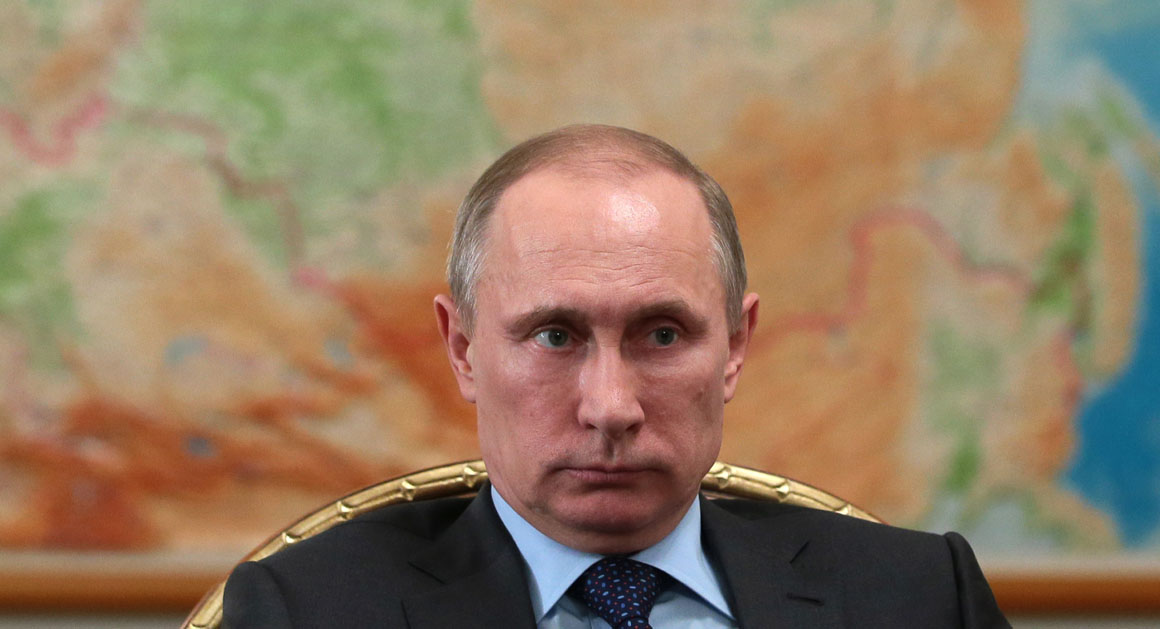
Now we have Putin talking about the need to “protect” ethic Russians in Eastern Ukraine.

“It’s all nonsense. There are no kinds of Russian units in eastern Ukraine. No special forces, no instructors. They are all local citizens.” Russia's President Vladimir Putin

“It’s all nonsense. There are no kinds of Russian units in eastern Ukraine. No special forces, no instructors. They are all local citizens.”
Russia’s President Vladimir Putin

On April 17, 2014, in a televised Q&A session with the Russian public, Putin observed that the Federation Council, the upper house of Russia’s Parliament, had granted him the right to use military force in Ukraine. “I really hope that I do not have to exercise this right and that we are able to solve all today’s pressing issues via political and diplomatic means,” he said.

And today, with Russian-connected demonstrators fomenting unrest in Eastern Ukraine, Russia had the gall to accuse the new Ukrainian government of flouting a just concluded agreement intended to diffuse the crisis. “The Geneva accord is not only not being fulfilled, but steps are being taken, primarily by those who seized power in Kiev, that are grossly breaching the agreements reached,” said Russian Foreign Minister Sergei Lavrov in a press conference in Moscow.

Here we go again?

Four Pinocchios – the gender pay gap

In an aggressive attempt to turn attention away from other issues less favorable to them as the midterm elections approach, Obama and the Democrats are yet again trying to generate some return from their “war on women” mantra. This time they’re highlighting with carefully choreographed actions what they insist is gender pay inequity.

On Wednesday, the Senate fell short on the number of yeas to move forward on the so-called “Paycheck Fairness Act”. Bluntly revealing the political nature of the entire effort, Democrats leaped at the opportunity to send out a fundraising solicitation bemoaning the loss within minutes of the vote.

Image

Obama routinely cites U.S. Census data showing that the average full-time female worker earned 77 cents for every dollar a man earns. (The U.S. Department of Labor says women in full-time jobs earn 81 cents for every dollar men earn.)

But the pay situation is not quite as simple as Obama and his Democratic colleagues say. Today the New York Times featured a story on the issue: Democrats Use Pay Issue in Bid for Women’s Vote, making that point.

The Bureau of Labor Statistics (BLS) makes the same point in its annual report, “Highlights of women’s earnings in 2012”: “In 2012, women who were full-time wage and salary workers had median usual weekly earnings of $691. On average in 2012, women made about 81% of the median earnings of male full-time wage and salary workers ($854).” That appears to support Obama’s assertions.

But every “full-time” worker, as the BLS notes, is not the same: Men were almost twice as likely as women to work more than 40 hours a week, and women almost twice as likely to work only 35 to 39 hours per week. Once that is taken into consideration, the pay gap begins to shrink. Women who worked a 40-hour week earned 88% of male earnings.

Then there is the issue of marriage and children. The BLS reports that single women who have never married earned 96% of men’s earnings in 2012.

The supposed pay gap appears when marriage and children enter the picture. Child care takes mothers out of the labor market, so when they return they have less work experience than similarly-aged males.

The reality is that multiple factors affect the earnings data, including the types of jobs worked by women, the number of hours they worked, their area of specialization/college major, hours worked and the career progression of some women.

One factor affecting the pay women receive is their work/home patterns. Women who leave the workforce to care for their children at home and later return to work often find that lower wages await them than if they had kept working. A Pew Research Center study released on April 8 revealed that the share of mothers who stay home with their children has steadily risen in recent years.

According to Pew, the share of mothers who don’t work outside the home rose to 29% in 2012, up from a modern-era low of 23% in 1999.

Image

Another Pew study in 2013 found that mothers are much more likely than fathers to have reduced work hours, take a significant amount of time off, quit a job or, by a small margin, turn down a promotion in order to care for a child or family member.

Pew said today’s young women are the first in modern history to start their work lives at near parity with men. Pew pointed out, however, that there’s no guarantee that today’s young women will sustain their near parity with men in earnings in the years to come. Recent cohorts of young women have fallen further behind their same-aged male counterparts as they have aged and dealt with the responsibilities of parenthood and family.

Still, it would be wise not to ignore that while the public sees greater workplace equality between men and women now than it did 20 to 30 years ago, most believe more change is needed, the Pew Research Center notes. Among Millennial women, 75% say this country needs to continue making changes to achieve gender equality in the workplace, compared with 57% of Millennial men.

So there’s still a lot of work to do.

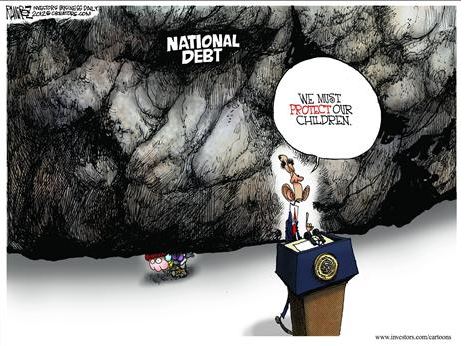
The real war is on our children

Democrats are again pulling out from their rhetorical basement accusations that Republicans are waging a “war on women”. Meanwhile, they’re ignoring another war that’s real, the “war on our children” that government spending addicts are prosecuting.

Our children are going to pay a heavy price for the fiscal insanity that has already led to national debt in excess of $17 billion.

Obama-National-DebtThe increase in our national debt over the past 25 years. years has been mind-boggling. In 1990, it was $3.2 billion, in 2000 $5.7 billion. By 2010 it was $13.6 billion. Now it has leaped to $17.5 billion.

But Democrats, in the spirit of “see no evil”, want to keep the issue under wraps and focus on other things. During a February 2014 House Financial Services Committee hearing, Rep. Maxine Waters (D-CA) and Rep. Keith Ellison (D-MN) even complained about two real-time running national debt clock displays in the hearing room. Ellison said it was just intended to send an ideological message.

Obama says his FY2015 budget proposal is an “opportunity agenda”. Yes, an opportunity for $564 billion more debt, an opportunity to increase total national debt to nearly $25 trillion over the next 10 years and an opportunity to pander to Americans who want it all without paying for it.

As Alabama Sen. Jeff Sessions, the top Republican on the Senate Budget Committee, said, Obama’s budget is a declaration that “deficits don’t matter, debt doesn’t matter, and that reality itself doesn’t matter.”

Some Democrats are arguing that annual deficits are dropping, so we can all back off worrying about the problem.

But the most recent Congressional Budget Office (CBO) budget forecast projects that after a few years of lower deficits they’ll climb again for an indefinite period. In addition, the national debt will increase annually by much more than the amount of the deficit because a considerable amount of federal borrowing is not counted in the budget.

As a result, the CBO projects $7.9 trillion will be added to the nation’s cumulative public debt over the next decade.

That’s because revenue will keep up with economic growth, but spending will grow even more. “Spending is boosted by the aging of the population, the expansion of federal subsidies for health insurance, rising health care costs per beneficiary, and mounting interest costs on federal debt,” the CBO said.

According to the CBO, interest payments will soon become the third largest item in the federal budget, after Social Security and Medicare. Right now, interest on the debt costs $233 billion. CBO projects that interest costs will reach $880 billion by 2024. As interest costs grow, they could crowd out investment in other priorities, including education, research and development, and other programs that could help our economy grow.

Large and growing federal debt that restrains economic growth will give policymakers less flexibility to respond to unexpected challenges, and eventually increase the risk of a fiscal crisis.

A Peter G. Peterson Foundation survey released on March 25, 2014 concluded that 67 percent of people say their concern about the national debt has increased over the past few years and 79 percent say that addressing the national debt should be among the President and Congress’ top 3 priorities.

And yet, Democrats continue to resist deficit-lowering efforts.

Deficit reduction surged as a policy priority during Obama’s first term: Between 2009 and 2013,  the share citing the deficit as a top priority rose 19 points, according to a January 2014 report from the Pew Research Center for the People & the Press. In the most recent 2014 survey, majorities of Republicans (80%) and independents (66%) continued to say reducing the budget deficit should be a top priority for the president and Congress, but just 49% of Democrats viewed it as a top priority, the lowest percentage since Obama took office. Going back 20 years, the gap between Republicans and Democrats on the issue has never been as large as it is today, Pew said.

Not exactly a hopeful sign for the emergence of bipartisan cooperation on the issue.