Why is Val Hoyle smiling?

moneyinpolitics

Like Hillary Clinton, Rep. Val Hoyle, D-Eugene, who’s running for Secretary of State,  wants to get the obscene amounts of money out of politics…..later.


That way, she can rake in bundles of money now while running for Oregon Secretary of State as a champion of fundraising reform.

hoyle-mobile

Val Hoyle (D-Eugene)

In the past, Hoyle has said she supports enacting a constitutional amendment to limit campaign contributions, so long as the limits aren’t “unreasonably low”.

She has also blamed Democratic losses outside Oregon on “fear and cynicism” among voters fostered by large political contributions “from a small handful of special interests”.

So much for worrying about special interests.

According to state records, Hoyle has raised $587,000 to date, putting her at the top of the fundraising pile among the Secretary of State candidates.

Val Hoyle (D)……………………..$592,728

Brad Avakian (D)…………………$387,482

Dennis Richardson (R)………….$297,413

Richard Devlin (D)……………. ..$172,315

Sid Leiken (R)……………………..$ 45,104

Hoyle’s biggest contributor is Michael Bloomberg, a New York businessman who supports aggressive gun control measures. On April 29, he gave Hoyle $250,000 in appreciation for her support of legislation that passed in the last session expanding background checks to almost all private firearm transfers.

“Mike is supporting Val Hoyle because her leadership in passing Oregon’s background check bill is truly notable,” Howard Wolfson, a spokesman for Bloomberg, told Willamette Week in an email. “No one in the country has worked harder —or more successfully—to take on the NRA than she has.”

Hoyle has also received $105,000 in contributions from Emily’s List, a Washington, D.C.-based political action committee that supports female candidates.

Without those two large contributions, both from out-of-state, Hoyle would have raised just $237,728, which would have put her behind both Brad Avakian and Dennis Richardson in fundraising totals.


P.S.: The other candidates aren’t exactly pure in their fundraising either, although they’re collecting nothing comparable to Hoyle from individual donors.

Brad Avakian’s larger contributions

  • $40,000 from United Food and Commercial Workers Local 555
  • $30,000 from Oregon School Employees Association – Voice of Involved Classified Employees (2307)
  • $10,000 from Pacific NW Regional Council of Carpenters, SSF
  • $10,000 from Oregon League of Conservation Voters PAC (2352)
  • $7,500 from Peter Goldman, a Seattle attorney
  • $6,000 from Naral Pro-Choice Oregon PAC (172)
  • $2,500 from Mt. & M Gaming, operator of The Last Frontier Casino in La Center, WA


Dennis Richardson’s larger contributions 

  • $25,000 from Sherman and Wanda Olsrud of Medford, OR
  • $15,000 from Larry Keith of Salem, OR
  • $15,000 from James Young of Lebanon, OR
  • $15,000 from Freres Timber, Inc. of Lyons, OR
  • $10,000 from Stephen M Greenleaf of Medford, OR
  • $10,000 from Richard E Uihlein of Lake Forest, IL
  • $10,000 from Murphy Co. of Eugene, OR
  • $5,000 from Zidelle Collin s of Shady Grove, OR
  • $5,000 from David A deVilleneuve of Central Point, OR

Sock it to ’em: Hales and the left long for more taxes

More taxes. That’s the left’s answer for everything. Usually, they try to spread out the tax increases so you won’t notice how the total is escalating. But this year, they’re going whole hog.

Funny Tax Picture 2

On Tuesday, Portland Mayor Charlie Hales proposed an $8.7 million increase in the Business License Fee. Now 2.2 percent of a business’ net profit, the fee would increase to 2.5 percent for 25,200 Portland businesses.

“We need to be responsible leaders by providing enough revenue to deliver basic City services and invest in making lasting progress on our challenges,” Hales said. “A slightly larger fee on business’ profits will have a far-reaching, positive impact on the city as a whole.”

Meanwhile, Our Oregon, a coalition of unions and progressive groups, is promoting Initiative Petition 28 for the November 2016 ballot.

The measure would raise the corporate minimum tax on Oregon sales of more than $25 million a year from the current minimum of $50,000 to $30,001 plus 2.5 percent of the excess over $25 million. The tax would be based solely on sales, not profit.

The Legislative Revenue Office estimates the corporate tax measure would raise $5.3 billion during the 2017-2019 biennium. Corporate taxes during that biennium under the current system are projected to reach about $1.1 billion.

In other words, the measure would increase corporate tax collections per biennium by a whopping 400 percent in one fell swoop.

“If that passes, we’ll have a lot of money to pay for stuff,” said Rep. Mitch Greenlick (D-Portland).

All this would be on top of Portland’s much-maligned Arts Tax, which a large swath of the city’s liberal population isn’t paying, and an additional 10 cents a gallon gas tax in Portland, the brainchild of Portland Commissioner Steve Novick, that would generate $64 million over the next four years if voters approve it on May 17.

Yesterday, May 3, an Oregon judge approved ballot language for another tax, a payroll tax that would support Portland State University. Supporters will now begin collecting signatures to get the tax on the ballot in November. The proposed one-tenth of 1 percent payroll tax on wages paid by Portland-area businesses would generate about $40 million annually for PSU.

And if all these new taxes aren’t enough, the increases in the minimum wage that the Democrats in the state Legislature just pushed through will start in July.

Meanwhile, Gov. Brown is meeting in Portland today with lawmakers and business executives to start the process of crafting a multi-billion dollar funding package for state roads. The package would likely involve higher gas taxes and vehicle registration and driver license fees.

Hold on  to your wallets, folks.


Marijuana: Oregon’s new lottery

Oregon government has found a new addiction – marijuana taxes.

marijuanapic

Oregon collected $3.48 million in marijuana taxes in January 2016, the first month of taxing legal recreational marijuana. Based on these returns, the future looks bright for Oregon’s budget.

Economics consulting firm ECONorthwest initially projected the state would see $38.5 million in marijuana tax revenue in 2016. The Oregon Liquor Control Commission, which regulates recreational marijuana, projected less. But if Oregon sales for the rest of the year stay on the current trajectory, Oregon will collect $41.76 million in 2016, the Bend Bulletin figures.

“While state officials were quick to caution that it will take time to get an accurate view of the money coming in through marijuana sales, the early estimate shows pot may be a bigger boon than initially thought for Oregon’s schools and police, which receive a portion of tax revenue,” the Bulletin said.

Under Ballot Measure 91, revenue after costs will be divided as follows: 40 percent to the Common School Fund; 20 percent to mental health, alcoholism and drug services; 15 percent to state police; 10 percent each to cities and counties; 5 percent to the Oregon Health Authority for alcohol and drug abuse prevention.

What a windfall is coming their way.

And soon enough, just as has happened with the State lottery, the Oregon Liquor Control Commission and the Legislature will find themselves looking for ways to generate more marijuana money.

Lottery money has already turned the state into an addict, as Oregon’s lottery take has gone from $87.8 million in FY86 to $1.12 billion for the fiscal year ended June 30, 2015, an increase of 6.1 percent over fiscal year 2014. The Lottery is a very big business.

Going forward, the Lottery is working hard to expand its audience and revenues with development of new games, platforms, and venues in order to attract more diverse demographic groups.

The lure of raking in lottery dollars without having to raise taxes has long been appealing to politicians anxious to satiate government’s insatiable thirst for revenue. In fact, the lottery is often referred to as a “voluntary tax”, though behavioral research calls the “voluntary” part into question.

Whatever it’s called, the state always wants more of it, just as it will with marijuana taxes. You can count on it.


Our Oregon: shooting Oregon in the foot – Dems and unions want more money to spend on more “stuff”


Tax big business. “Yeah.. that’s the ticket! Yeah, you betcha!,” SNL’s Tommy Flanagan would say.

bloated-government-cartoon

A Better Oregon, a campaign organization operating under the umbrella of Portland-based Our Oregon, a coalition of unions and progressive groups, agrees.

A Better Oregon is promoting Initiative Petition 28 for the November 2016 ballot. The measure would raise the corporate minimum tax on Oregon sales of more than $25 million a year from the current minimum of $50,000 to $30,001 plus 2.5 percent of the excess over $25 million. The tax would be based solely on sales, not profit.

The Legislative Revenue Office estimates the corporate tax measure would raise $5.3 billion during the 2017-2019 biennium. Corporate taxes during that biennium under the current system are projected to reach about $1.1 billion.

In other words, the measure would increase corporate tax collections per biennium by a whopping 400 percent in one fell swoop.

Rep. Mitch Greenlick (D-Portland), when endorsing the measure, said it would eliminate much of the constant need to choose between funding critical budget concerns each legislative session. “If that passes, we’ll have a lot of money to pay for stuff,” Greenlick said.

Otherwise, Greenlick said, most of the additional revenue in the economic forecast for the 2017-2019 budget would go to cover increased PERS liabilities and the state’s increased share of Medicaid funding, leaving little additional revenue for new stuff.

But not to worry, says Ben Unger, executive director of Our Oregon. The extra money won’t come out of your pocket. It will come mostly from large out-of-state corporations.

About 1,000 corporations doing business in Oregon, mostly multi-state corporations, would be affected by the higher taxes.

“This measure will make sure that large and out-of-state corporations do their part to fund the schools and services that will make Oregon thrive,” Our Oregon says on its website.

As long ago as I can remember advocates for higher taxes in Oregon have been making “out-of-state corporations” the bogeyman, the malignant beast that’s doing Oregonians wrong and needs to pay.

But as attractive a target as these corporations are, they’re not fools. They will find a way to avoid paying the taxes or they’ll pass on the added taxes to Oregon consumers as a stealth sales tax.

Moving a company’s headquarters to another state with a more congenial tax environment, as GE is doing with its recently announced shift from Connecticut to Massachusetts, won’t solve the problem, but there are always run-arounds.

Maybe some businesses will change their ownership form to get sales in Oregon under the $25 million trigger. Others may institute some special, higher regional pricing.

Some creative companies may become benefit corporations. Our Oregon thought it was being clever and supportive of the “good guys” when it inserted a provision in its initiative to exclude benefit companies under ORS 60.754 from the higher taxes. But this opened a loophole ripe for exploitation.

The liberal coalition behind Initiative petition 28, recalling their success in a tax increase battle in 2010, may be figuring they have a sure thing again with another measure targeting big business, but hopefully Oregonians in their wisdom will see this  proposal is a reach too far.


Benefit corporations: no sure thing

Lots of progressives in Oregon are big on public affirmations of goodness. That’s why they love the idea of benefit corporations, such as Neil Kelly, Rogue Creamery, Metropolitan Group, Medolac and Good Clean Love.

But before Oregonians conclude that benefit corporations are by their nature more socially responsible businesses, think again, and do some rigorous research. The fact is, in some cases the designation is being used as little more than a way to add a patina of respectability to otherwise questionable firms.

For a truly inauthentic attempt at sincerity and goodness, look no further than Laureate Education, Inc. It announced plans earlier this year its plans to do a $1 billion initial public offering (IPO) that would make it the first publicly traded benefit corporation.

If you’ve heard of Laureate, it may be because of its connection to former president Bill Clinton. In 2010, he signed on to become an “Honorary Chancellor”, or paid shill to be more accurate, for Laureate. In return for serving as a front man for the privately held for-profit education company, Clinton collected $16.5 million between 2010 and 2014. Laureate also has donated between $1 million and $5 million to the Clinton Foundation.

In its IPO prospectus, Laureate says, “we may take actions that we believe will benefit our students and the surrounding communities, even if those actions do not maximize our short- or medium-term financial results.” There’s little in its history, however, that suggests such an approach is part of the company’s DNA.

“We recognized the enormous importance that society places on education as a public good,” said Douglas L. Becker, Founder, Chairman and CEO of Laureate. “This inspired us to create a culture that combines the ‘head’ of a business enterprise with the ‘heart’ of a non-profit organization. “

With one million students studying online and on campuses at 88 institutions in 28 countries, Laureate is currently a private company, but it plans to go public. The company grew out of the K-12 tutoring company, Sylvan Learning Systems, in 2004 when Sylvan was spun off.

Laureate was taken private in a $3.8 billion deal in 2007. Investors included KKR & Co., Soros Fund Management, Paul Allen’s Vulcan Capital, Steve Cohen’s SAC Capital Advisors, Citi Private Equity, Sterling Capital and others, all investors whose commitment to corporate citizenship and the public good is unclear.

Registration as a public benefit corporation is also no guarantee that the governance of a company will be friendly to shareholders.

Steven Davidoff Solomon, a professor of law at the University of California, Berkeley, has pointed out that Laureate’s form of governance is especially unfriendly to shareholders. While Laureate is listing its stock as a public benefit corporation, it will also be going public with dual-class stock, which will maintain its current owners’ control over the company. This includes K.K.R. which will indirectly hold a greater than 10 percent interest in the company.

This doesn’t make sense, Solomon argues. K.K.R. is out to sell its stake at the highest price possible, not benefit other causes. So one has to wonder how strongly Laureate will even pay heed to the public benefit standard.

Then there’s the question of whether Laureate’s schools operate in the best interests of their students.

It’s 5 schools in the U.S. include: NewSchool of Architecture & Design, San Diego, CA; Santa Fe University of Art & Design, Santa Fe, NM; Kendall College, Chicago, Il; University of St. Augustine for Health Sciences, St. Augustine, FL; and the online-only Walden University, Minneapolis, MN.

newschool

Consider their records on the U.S. Department of Education’s College Scorecard, an online system designed to help students, parents and advisers make better college choices.

For example, according to the Scorecard:

  • The average annual net cost of attending NewSchool is about twice the national average, only 50 percent of students return after their first year and the graduation rate after six years is only 33 percent.
  • The average annual net cost of attending Kendall College is more than twice the national average, only 57 percent of students return after their first year and the graduation rate after six years is only 45 percent.
  • At the Santa Fe University of Art & Design, only 31 percent of the students graduate within six years and only about half of those graduates subsequently earned, on average, more than those with only a high school diploma.

Laureate also operated The National Hispanic University in East San Jose, CA, but it closed in August 23, 2015. The San Jose Mercury News attributed the closure to the U.S. Department of Education reducing financial aid and online opportunities for students enrolled in programs that did not offer good prospects for employment. Other media reported that the school also failed to meet its goals in enrollment for online coursework.

It will be interesting to see how this company, that has a history of questionable payments to Bill Clinton, is $4.7 billion in debt, is burdened with high interest payments, has lost money every year since 2010 and has a habit of saddling its students with debt and low graduation rates pulls off its public benefit corporation charade.

It may be a hard lesson for a lot of true believers in benefit corporations.

Flip or flop – resistance is futile

They should have known.

Tarek and Christina El Moussa, the hosts of HGTV’s show Flip or Flop, figured Portland would be a natural market for their traveling seminar on how to remodel and flip houses for a profit. So they scheduled four seminars in Portland to teach the tricks.

fliporflop1

And, of course, Portland’s lefties went ballistic.

“Stay out of Portland!!,” said a typical online post. “You’re preying on low income families and marketing to out of state buyers that are pushing locals out. You are not welcome!!”

But wait a minute. If you’ve ever watched Flip or Flop, you’d know that what the Moussas do is buy generally crummy houses, invest in substantial upgrades and sell them (hopefully for a profit), substantially enhancing the neighborhood. What’s wrong with that?

Would Portland’s lefties prefer that rundown houses just sit there as eyesores in nice neighborhoods? Would they prefer that dilapidated houses sit empty, attracting vandals and squatters?

Critics of the Moussa’s visit were likely motivated, in part, by their objection to so-called gentrification, upgrades of neighborhoods driven by economic and demographic changes.

What the objectors fear is a dislodging of the local culture and its replacement by higher income, higher educated, higher status residents of all racial and ethnic populations who patronize a more upscale mix of retailers.

But gentrification, for all its negative connotations to lefties (who, by the way, are often a key part of the gentrifying population) is what turns decaying areas of cities into neighborhoods of residents and businesses who pay taxes that lead to upgrades in infrastructure and government services across the board for everybody.

If you have children who recently graduated from college or are about to, they will likely be part of this process, too, as they look for good jobs and great places to live, push up the population and housing costs in already gentrified areas and put pressure on other not-quite-there-yet neighborhoods.

As they say in Star Trek, resistance is futile.


Still struggling: four Oregon areas still missing in action

The Great Recession is over. Right? Don’t tell that to the folks who live in four areas of Oregon designated among the most distressed communities in the state.

According to an exhaustive analysis just released by the Economic Innovation Group (EIG), a significant portion of Americans still feel like the recovery has left them behind. That translates into over 30 million Americans living in communities defined by slow job growth, vanishing businesses, and fewer opportunities to move up the economic ladder.

EIG used seven metrics to assess economic well-being:

  • Educational Attainment: Percent of population 25 years and over with a high school degree.
  • Housing Vacancy Rate: Percent of habitable housing that is unoccupied.
  • Unemployment Rate: Share of the labor force that is unemployed.
  • Poverty Level: Percent of population living under the poverty line.
  • Median Income Ratio: Ratio of the zip code’s median income to the state’s median income.
  • Change In Employment: Percent change in the number of individuals employed.
  • Change in Business Establishments: Percent change in the number of businesses.

Oregon compares relatively well overall to the rest of the country in terms of the economic health of its residents (EIG considers just 4% to be living in economic distress, http://bit.ly/1S2eoVR), but it’s not totally in the clear.

Based on the metrics above, the following Oregon zip codes earned the dubious distinction of being the state’s most economically distressed areas in four different population density categories:

Density Category Location Zip Code
Very High Portland 97209
High Portland 97204
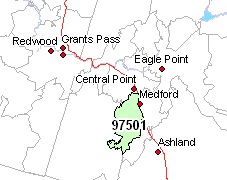
Medium Medford 97501
Low Christmas Valley 97641

Zip code 97209 in Portland is the most distressed area in the Very High Density category in Oregon.

Zip Code 97209

Zip Code 97209

Approximately 35.1% of 97209’s population lives in a low-income household with an annual income of less than $25,000 and another 20.7 percent live in a household earning an annual income between $25,000 and $50,000.

Portland zip code 97204 is the most distressed area in the High Density category.

Zip Code 97204

Zip Code 97204

Estimated annual median household income is just $13,350, significantly below the state average, and 91 percent of the households have an annual income of less than $30,000. Residents with a high school degree or less comprise 78 percent of the population.

Zip code 97501 in Medford is the most distressed area in the Medium Density category in Oregon.

Zip Code 97501

Zip Code 97501

Approximately 34.6% of 97501’s population lives in a household with an annual income of less than $25,000. Another 29.1% live in a household earning an annual income between $25,000 and $50,000. Annual median household income is $36,157. That puts 97501 363rd among all of Oregon’s zip codes.

As a side note, maybe tied to the local economy, 97501 has almost 8 bars per 10,000 residents, 32% more bars than average for Oregon and  95% more than the United States as a whole.

Zip code 97641, a sparsely populated area in Christmas Valley is the most distressed area in the low density category in Oregon.

Zip Code 97641

Zip Code 97641

Only 12 percent of the population has education beyond high school, connected, perhaps, to the fact that the median annual household income is 20,795 and 66% of the households have an annual income below $30,000.

In the coming weeks, EIG will be developing tools to enable people to easily compare communities and dive deeper into what is driving economic distress or prosperity. You will be able to see how well your community is doing, and then compare it to others across the country

Sen. Jeff Merkley: leading the way in partisanship

So much for working well across the aisle for the common good.

Jeff Merkley, D-OR, is one of the most partisan U.S. Senators, according to a just compiled Bipartisan Index that measures members of Congress. Of 100 Senators, Merkley ranked 93rd in bipartisanship.

Sen. Jeff Merkley, D-OR, a true blue partisan.

Sen. Jeff Merkley, D-OR, a true blue partisan.

A low score indicates that a legislator is viewing his or her duties through a partisan lens, rather than prioritizing problem solving and being open to working with the other party when possible, entertaining a wide range of ideas, and prioritizing governance over posturing.

The Lugar Center, a non-profit organization focusing on global policy issues, teamed up with the McCourt School of Public Policy at Georgetown University to develop a Bipartisan Index to measure members of Congress. The ranking of all senators, released for the first time on Tuesday, rates lawmakers by how their legislation does in attracting co-sponsors from the other party as well as how often they sponsor legislation proposed by members across the aisle.

“…sponsorship and co-sponsorship behavior is especially revealing of partisan tendencies,” said former Senator Richard G. Lugar, President of The Lugar Center. “Members’ voting decisions are often contextual and can be influenced by parliamentary circumstances. Sponsorships and co-sponsorships, in contrast, exist as very carefully considered declarations of where a legislator stands on an issue.”

Berkeley’s abysmal ranking in the Bipartisan Index suggests that he’s more interested in making political points than being an effective legislator. Partisan bills certainly have their place, but as Lugar said in his Introduction to the Bipartisan Index, “…at the beginning of the legislative process, when effective governance would argue for broadening a new bill’s appeal, too often the opposite is happening.  Bills are being written not to maximize their chances of passage, but to serve as legislative talking points.  Taking a position is not the same thing as governing.”

The Oregon Convention Center Hotel: paying off the unions

Ask any informed person without a vested interest in the proposed Oregon Convention Center Hotel whether they think it will be a fiasco and you’re likely to get a loud and clear, “Yep!”

But public opinion has little to do with whether the hotel will get built. The fix is in, with Metro, liberal politicians and labor unions joined at the hip.

Metro Council President Tom Hughes, the hotel’s principal cheerleader, was first elected to Metro in 2010 with the strong support of labor organizations; they continued that support in his successful 2014 race.

“I want to build a hotel,” Hughes once told union workers. “I want it to be built by union workers, and I want union workers running it.”

unite here

Portland has just three union-operated hotels, all organized by Unite Here Local 8: the Benson; the Paramount; and the Portland Hilton Hotel and Executive Tower.

The unions got their first break on the Convention Center project when Metro mandated that the hotel be built by union building trades.

Prospective developers were also told to bid the privately-owned and operated project under union-supported prevailing wage guidelines where wages are set artificially high above the market.

Metro stacked the deck in favor of the unions again when the Council required that Hyatt sign a labor peace agreement with Unite Here before Metro would begin negotiating the details of the project. Hyatt, long a non-union hotel chain, subsequently agreed to a national labor peace agreement with Unite Here.

Metro also gave unions an edge in organizing the eventual hotel workers by requiring that they use a voting process despised by employers and many workers called card check. Under card check, instead of holding a federally-supervised secret ballot election, workers get to vote under the watchful eyes of union organizers, Lucky them.

Once a majority of employees have signed cards, the union is immediately recognized.

As the AFL-CIO’s Southeastern Oregon Central Labor Council put it, the hotel workers “…will come into a workplace where their management has promised to leave any decisions to the workers without wasting money on deceiving anti-union campaigns.”

Yep, folks, the fix is in.

Subsidizing electric cars in Oregon: a shockingly bad idea

Batteries don’t charge up electric cars; government subsidies do. At least that’s what supporters of a bill now before the Oregon House seem to believe.

The bill, H.B. 2092, would establish an Incentive Fund to make rebates of up to $3000 to purchasers of alternative fuel vehicles, including those that are powered by batteries or hydrogen fuel and gasoline-electric vehicles. Rebates from the fund could total as much as $30 million per biennium and would be on top of the already absurd federal subsidy of up to $7500.

Just what we need, a $30 million government subsidy to purchasers of pricey cars, when Oregon is already one of the top states for EV market share and the state has many other more pressing concerns to address.

The House Energy and Environment Committee held a public heating on the bill on April 2 and has a work session on the bill scheduled for today, April 16.

Under the bill, state rebates would help affluent Oregonians buy vehicles such as the $43,000 BMW i3 and $135,000 i8, the $42,000 Mercedes B-Class, the $106,000 Tesla Model S P85D, and the $35,000 Chevy Volt.

The purchaser of a $135,000 BMW i8 would be eligible for a $3,000 rebate from the state under H.R. 2092

The purchaser of a $135,000 BMW i8 would be eligible for a $3,000 rebate from the state under H.R. 2092

To put things in perspective, $30 million is more than the TOTAL state income tax liability of all personal filers in 16 Oregon counties in 2013: Baker County ($13.1 million), Crook ($18.2 million), Curry ($19.6 million), Gilliam ($12.1 million), Grant ($5.9 million), Harney ($5.1 million), Jefferson ($15.5 million), Lake ($6.2 million), Malheur ($17.6 million), Morrow ($11.1 million), Sherman ($2.6 million), Tillamook ($23.6 million), Union ($24.7 million), Wallowa ($6.1 million), Wasco ($23.6 million) and Wheeler ($1.3 million).

If I lived in one of those counties I wouldn’t look kindly on all my personal state income tax payments going to this alternative fuel vehicle boondoggle.

Let’s be honest here, folks. There are a lot of other places $30 million could be invested more wisely in Oregon.

Seven Oregon counties have been losing population, Coos, Baker, Wallowa, Malheur, Grant, Wheeler, and Sherman.

If the Legislature can find another $30 million to spend, why not use the $30 million to help these struggling counties attract businesses?

Deserving young people around the state are dealing with the stresses and strains of trying to find the money to pay for post-secondary education.

Why not put the $30 million in Oregon Opportunity Grants, the state’s need based financial aid program.

The state invests in Employment Related Day Care in support of the Early Learning initiative, providing greater access to quality childcare for Oregon’s working families.

How about adding $30 million to the budget for that?

A potential decline in lottery revenues during the 2015-17 biennium is likely to present budget issues for the Oregon Parks and Recreation Department, Oregon Watershed Enhancement Board, Department of Agriculture, Department of Environmental Quality, Oregon Department of Fish and Wildlife, and the Oregon State Police Division of Fish and Wildlife. In addition, the Oregon Department of Fish and Wildlife is facing a significant budget shortfall.

The legislature could help out the Natural Resource Program area by adding $30 million to its budget.

The logical decision? Short-circuit this bill.