Bynum vs. Chavez-DeRemer/ Tis a Quandary

Chavez-DeRemer vs. Bynum

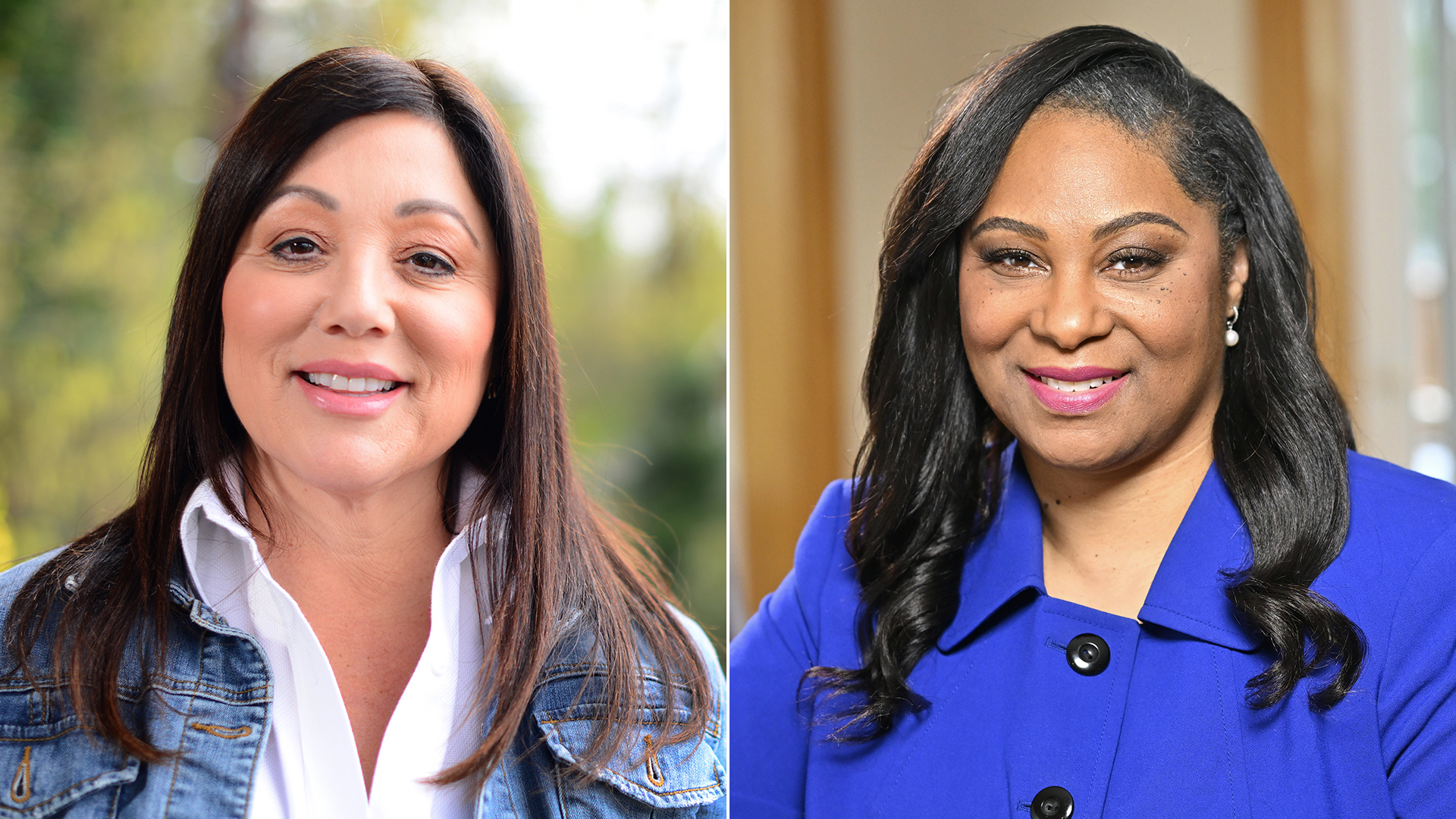
Republican incumbent Lori Chavez-DeRemer and Democratic challenger Janelle Bynum are at each other’s throats in Oregon’s 5th Congressional District race

At recent debates on KOIN TV in Portland and KTVZ in Bend, each candidate asserted that their opponent couldn’t be trusted. Bynum worked hard to tie Chavez-DeRemer to  Republican presidential candidate Donald Trump and the conservative Republicans in the House. Chavez-DeRemer, in turn, attacked Bynum for supporting Measure 110, the drug decriminalization measure later amended by House Bill 4002 in the face of public backlash against the measure. 

No question, Bynum is a flaming liberal. In September, House Minority Leader Hakeem Jeffries showed up in Portland to bolster her campaign. Par for the course, he accused Chavez-DeRemer of being aligned with extreme MAGA Republicans and Donald Trump., who Democrats portray as an imminent threat to democracy.

In contrast, Chavez-DeRemer works hard to portray herself as a moderate. She was ranked the 29th most bipartisan House member, and the most bipartisan Oregon member of the House, in an analysis released in May 2024 by the Lugar Center and the McCourt School of Public Policy at Georgetown University. But she has endorsed Trump’s return to the White House, has praised the Supreme Court ruling that overturned Roe v. Wade and has voted for a number of bills critics claim support the MAGA agenda.

The high-profile race is being run in a swing district created when the Legislature changed the district’s boundaries in 2021so it included a presumably more Democratic Bend. The race is now one of just a few that could decide who controls the U.S. House of Representatives.

So what to do if you are in the middle?

If Trump wins the White House, a vote for Chavez-DeRemer increases the likelihood that the House will stay in Republican hands. The Democrats now have a majority in the Senate but current thinking is that the Republicans have a high probability of retaking control with a net gain of two seats or by winning the presidential election along with a net gain of one seat. 

A particularly endangered Democrat is Senator Jon Tester of Montana, who trails his Republican challenger, Tim Sheehy, a wealthy Republican businessman. Polls suggest he’s toast because of the changing demographics of the state.  Republicans are also expected to flip West Virginia — where Joe Manchin is retiring- in the face of competition from Republican Governor Jim Justice . 

Of course, Democrats are still hopeful they can hold onto critical Senate seats in states like Ohio and Arizona and there are signs of weakness in Republican  Senator Ted Cruz’ s  race against Democratic challenger Colin Allred.

But if Trump wins, and the Republicans can hold on to the House and retake the Senate, that clean sweep would give Trump and his MAGA allies an opportunity to govern with impunity. If that’s not what you want, your best choice might be to vote for Bynum , even if you lean conservative, to increase the likelihood the Democrats will at least control the House and be in a position to block the more unpalatable elements of Trump’s MAGA agenda.

Tricky, isn’t it?

What’s Up with Rising CEO Pay at Northwest Natural?

Portland-based Northwest Natural is already grappling with efforts by climate activists to phase out natural gas use in Oregon homes in favor of electricity and a misguided Multnomah County lawsuit alleging the company is responsible for a ”substantial portion” of greenhouse gas pollution in Oregon. Now it has another problem –  concerns about ballooning CEO compensation.

With all the racket going on in the world and Oregon these days, it can be hard to focus on seemingly small things like this, but the soaring level of executive pay and the country’s increasing economic inequality are worth paying attention to.

Richard G. Reiten, President and Chief Operating Officer of Portland General Electric Company (PGE), was selected to run Northwest Natural In 1996.  I remember that appointment because I wrote about it as a reporter at The Oregonian. “The president of Portland General Electric is switching to gas” was the story lead on Nov. 6, 1995.

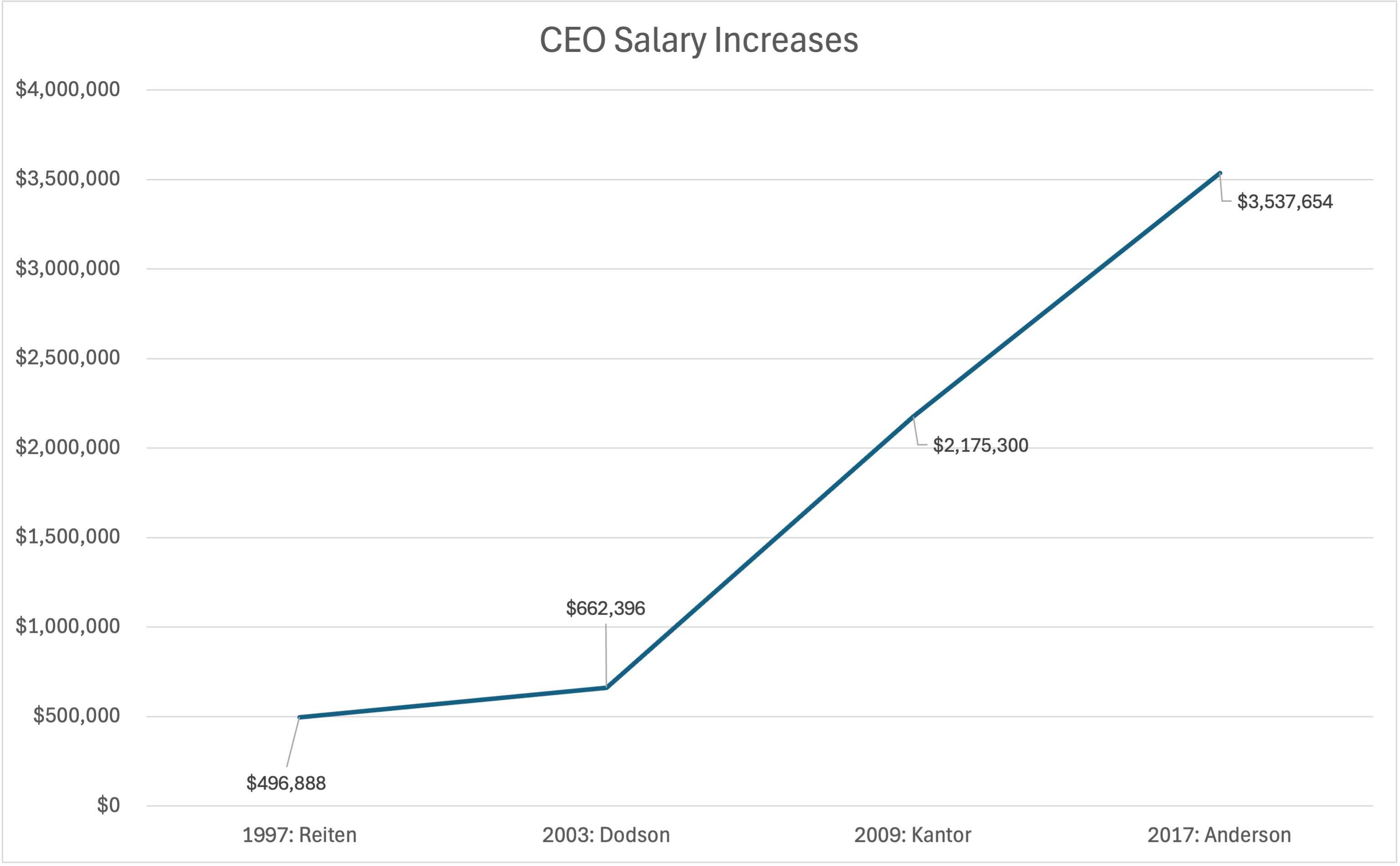
In 1997, Reiten’s first year as president and CEO of Northwest Natural, his compensation totaled $496,888 (Salary: $367,500; Bonus: $115,200; Other Compensation: $14,188).

Reiten, 63, was succeeded by Mark S. Dodson on January 1, 2003. His 2003 compensation totaled $662,396. (Salary: $390,000; Bonus: $250,000; Other Annual Compensation: $1,585; Other Compensation: $20,811).

Gregg S. Kantor succeeded Dodson as CEO on Jan. 1, 2009. His 2009 compensation leapt to $2,175,300 (Salary: $446,000; Bonus: $234,800; non-equity incentive plan: $330,200; Option Awards: $136,500; Change in pension value and nonqualified deferred compensation earnings: $994,400; Other compensation: $33,400).

Kantor was succeeded by David H. Anderson, who became CEO in August 2016. In 2017, his compensation totaled $3,537,654 (Salary: $641,700; Bonus: $173,300; Non-equity incentive plan: $437,700; Stock Awards: $834,900; Change in pension value and nonqualified deferred compensation earnings: $1,000,000; Other compensation: $58,300).

In 2023, Anderson’s compensation again totaled $3,537,654 (Salary: $830,000; Bonus: $328,145; Stock awards: $1,449,015; Non-equity incentive plan: $475,855; Change in pension value and nonqualified deferred compensation earnings: $404,515; All other compensation: $50,124. That’s $9692.20 a day.

All this despite the fact Northwest Natural, despite its local prominence, is actually a relatively small company, with just about 1200 employees and net income in 2023 of $93.9 million.

In May 2024, Northwest Natural announced that Anderson would retire on April 1, 2025. The Board of Directors designated Justin B. Palfreyman as the successor to Anderson. Palfreyman’s expected compensation was not disclosed. 

So how would you have done if you’d invested in Northwest Natural in 1997, when Richard Reiten became CEO?

Northwest Natural stock hit a peak price of $70.88 in 2019, but has since slipped to $38.88 on Oct. 7, 2024. If you had bought a block of shares at the start of 1997 and sold them almost 28 years later on Oct. 7, 2024, you would have realized a total gain of just $15.13 per share or 64%. 

If you invested $100 in the S&P 500 at the beginning of 1997 and reinvested all your dividends, you would now have about $1,173.11. This is a return on investment of 1,073.11%, or 9.40% per year. Even adjusted for inflation, the $1,173.11 nominal end value of the original $100 investment would have a real return of roughly $498.12 in 1997 dollars, or an inflation adjusted return of 498.12%.

It looks like Northwest Natural’s shareholders haven’t done quite as well as its CEO’s.

Portland’s Next Mayor? Who Cares?

Portland’s Next Mayor?

In all the turmoil and media attention focused on Portland’s new ranked choice voting election in November, much of the focus has been on the contest for mayor.[1]

Why?

The next mayor is going to be a eunuch. No, I don’t mean a castrated man. I mean the word metaphorically, in the sense an ineffectual or powerless person.

It’s the new 12-person City Council that will have the power to enact laws. The new mayor won’t even sit on the City Council or vote on council items (except to break a tie).  The mayor, and the new city administrator, who will be appointed by the mayor with council approval, will be in charge of carrying out City Council actions and crafting the city budget.

The mayor will also be tasked with appointing a city administrator, city attorney, and police chief, but that will also be only with the City Council’s approval. And to top it all off, the mayor won’t have veto power over council decisions. 

The mayor will serve more as a $175,463-a-year figurehead than a legislator, Tate White, a member of the city’s government transition team, told OPB earlier this year. “They’re going to be partnering with other jurisdictions, they’ll be standing at press conferences, they’re going to be the people meeting with representatives from sister cities when they come and visit, it will be far more ceremonial,” she said.

But don’t count on the new 12-person City Council, with three representatives per four new geographical districts and only one staff person for each City Council member, to be all that cooperative, efficient or effective. It might be more functional than New York City’s 51-member City Council, but likely not much. After all, a City Council member can be elected with as little as 25% + 1 votes, so their constituencies will be pretty damn small.[2] One consequence could be a Councilor able to remain in office by consistently satisfying just that smaller segment of eligible voters.

Jeff Jacoby, an award-winning columnist for the Boston Globe, calls the ranked choice voting process “democracy on the Rube Goldberg model”, where  ideas that supposedly simplify people’s lives wreak havoc instead.


[1] Mayoral candidates include three current members of Portland City Council: Rene Gonzalez, Mingus Mapps and Carmen Rubio. Others running are: Saadiq Ali, early childhood educator Shei’Meka As-Salaam, inventor James Atkinson IV, REAP youth advocate Durrell Kinsey Bey, financial advisor Nancy Congdon, Yao Jun He, advocate for the unhoused and community activist Michael O’Callaghan, artist and performer Liv Osthus, city hall veteran and green energy advocate Marshall Runkel, owner and president of TITAN Freight Systems Keith Wilson and maintenance supervisor Dustin Witherspoon. 

[2] Charter reform’s explanation of how “single transferable vote” (STV) will work: 

“Councilors of each district are elected using a proportional method of ranked choice voting known as single transferable vote. This method provides for the candidates to be elected on the basis of a threshold. The threshold is determined by the number of seats to be filled plus one, so that the threshold is the lowest number of votes a candidate must receive to win a seat such that no more candidates can win election than there are seats to be filled. In the initial round, the number of first rankings received by each candidate is the candidate’s vote count. Candidates whose vote counts are at least the threshold are declared elected. Votes that counted for elected candidates in excess of the threshold are called surplus. If fewer candidates are elected in the initial round than there are seats to be filled, the surplus percentage of all votes for the candidates who received a surplus are transferred to the next-highest ranked candidates in proportion to the total numbers of next-highest rankings they received on the ballots that counted for the elected candidate. If, after all surpluses have been counted in a round, no additional candidates have a vote count that is at least the threshold, the candidates with the lowest vote counts are successively eliminated in rounds and their votes are counted as votes for the candidates who are ranked next highest on the ballots that had been counted for the eliminated candidates, until another candidate has a vote count that is at least the threshold or until the number of candidates remaining equals the number of seats that have not yet been filled. The process of transferring surpluses of elected candidates and eliminating candidates continues until all positions are elected.”

Don’t Let Janelle Bynum Recast Herself as a Law-and-Order Candidate

Democrat Janelle Bynum, who is running against Rep. Lori Chavez-Deremer (R-OR) in the 5th Congressional District, knows the tide has turned so she’s trying to reposition herself as a law-and-order conservative. Don’t let her do it.

In a previous post, I wrote of how Bynum has the gall to say in her latest TV ad , “In Salem, I brought Republicans and Democrats together to re-criminalize fentanyl and other hard drugs. In Congress I’ll work with local law enforcement to get the officers and resources Oregon needs.”

She neglects to mention she supported decriminalization in Measure 110 before she opposed it. 

Specifically, she supported Measure 110, the 2020 ballot measure that decriminalized drugs.

That’s not all.

She says in her ad, “I won’t rest until our communities are safe”.  She undermined that pledge in 2017 when she voted to reduce voter-approved sentencings for ID Theft and Property Crimes in (HB 3078).  On the same day, she allowed car thieves to have short sentences and supported reduced sentencing for drug possession, cutting off court-ordered drug treatment for 2,500 addicts a year (HB 2355). 

As a Feb. 2024 report by the Oregon Criminal Justice System said, HB 3078 was enacted, primarily to reduce the number of persons incarcerated in Oregon’s prison system due to property offenses and identity theft. 

Section 5 of the bill changed sentences for Identity Theft and Theft in the First Degree for sentences imposed on or after January 1, 2018. These offenses were essentially removed from the sentencing structure created through the adoption of Measure 57 by Oregon voters in 2008 (creating statutory minimum sentences for certain property crimes). 

It worked.” “…prison usage remains at a lower trajectory than before, thanks in part to HB 3078,” the report said. 

 The Oregonian reported in 2018 the Dept. of Corrections was patting itself on the back for having 2500 less people in the system because of HB 3078. But some critics contended that meant cutting 2500 people a year on average from state sponsored treatment, and that spurred more homelessness and crime. 

Moreover, when crimes went from a felony to a misdemeanor and then in Measure 110 to a class E violation, all those with addictions were no longer precluded from gun ownership.

 On June 29, 2017, Steve Doell with Crime Victims United wrote in a guest column in The Oregonian that the bill “exemplifies the willingness of the legislature to sacrifice safety for savings.” 

In 2019, Bynum further muddied the waters when she voted to pass SB 1008, overturning much of voter-approved Measure 11, that required minimum-mandatory sentences for certain violent crimes and mandated that cases involving juveniles 15 years and older, accused of specific violent crimes, were to be to be handled in public in adult court. SB 1008 allowed a judge to see them in juvenile court in a non-public setting.

“Enough extremism” says one of Bynum’s ads. She should have thought that before she jumped on the social justice bandwagon.

Talk About a Flip-Flop: Janelle Bynum and Measure 110

Janelle Bynum, meet John Kerry.

Back in 2004, Sen.  John Kerry was the subject of a lot of ribbing when he said, in response to a question about his vote against an $87 billion supplemental appropriation for military operations in Iraq and Afghanistan, “I actually did vote for the $87 billion before I voted against it.” The George W. Bush campaign seized on the comment, using the footage in television ads to illustrate its charge that Kerry flip-flopped on issues, particularly the war in Iraq

Democrat Janelle Bynum, who is running against Rep. Lori Chavez-Deremer (R-OR) in the 5th Congressional District, has a lot in common with Kerry.

Sounding like a law-and order Republican, Bynum has the gall to say in her latest TV ad , “In Salem, I brought Republicans and Democrats together to re-criminalize fentanyl and other hard drugs. In Congress I’ll work with local law enforcement to get the officers and resources Oregon needs.”

She neglects to mention she voted for decriminalization before she voted against it.

Specifically, she supported Measure 110, the 2020 ballot measure that decriminalized drugs.

“It tells us a couple of things. No. 1, Oregonians are compassionate people,” Bynum said in response to a question about Measure 110 in a November 2023 interview. “Number two, it also tells the legislature that the people were hungry for a certain approach. And it’s not the legislature’s job to question the people; it’s the legislature’s job to implement the will of the people.”

On April 1, in response to a public outcry, Governor Tina Kotek signed HB 4002, recriminalizing hard drugs and rolling back some parts of measure 110. It was all so predictable.

Take responsibility, Janelle. You were one of the people who made that necessary.

The Oregon People’s Rebate: Another Misguided Idea from Wealthy California Progressives

It wasn’t Oregonians who financed the campaign for the ill-advised Measure 110. 

Out-of-state money financed the 2020 campaign for the measure that rashly decriminalized drug possession in the state. Of the nearly $6 million in cash and in-kind contributions received by the ballot measure committees, the New York City-based Drug Policy Alliance contributed over $5 million, one-third of its total revenue in 2020 according to its filing with the IRS.

Out-of-state money is also behind Initiative Petition 17, a 2024 ballot measure in support of a universal basic income (UBI) that would feature a $750 payment to every Oregonian, regardless of their income, every year, paid for by an increase in the minimum tax rate for high earning Oregon businesses.

The measure, called the Oregon People’s Rebate, would increase the tax on corporations making more than $25 million a year in revenue (not profit) in Oregon, increasing their minimum tax rate from less than 1% to 3%. According to the measure’s backers, the increase would generate about $3 billion a year. Oregon’s current population is 4,237,256. A $750 payment to each resident would total $3,177,942,000

“So your favorite local business won’t feel a thing,…other than every single one of their local customers, and employees, having an extra $750,” the backers say. “It’s that simple”.

‘Fact: The largest corporations pay less than 1% in Oregon tax,” the Oregon People’s website asserts. “We all pay between 5-10% in Oregon tax. Is that right? No! So we start to fix that.”

Oregon People’s Rebate was formed in Sept. 2022. It has received $425,696.50 in contributions to date in 2024, according to the Oregon Secretary of State. 

Following a long tradition Hollywood and Silicon Valley political activism, the biggest 2024 contributors are affiliated with investor and universal basic income proselytizer, Josh Jones of Los Angeles, CA. An early adopter of cryptocurrency, Jones says on his LinkedIn site, “I’m a programmer/entrepreneur/investor/retiree who likes Universal Basic Income, National Popular Vote, Groo the Wanderer, (aerial) Gondolas, basketball, lunch, programming, the internet, robots, space, movies, and starting up stuff!”

Jones Holding LLC, a corporation based in Los Angeles, has donated $425,000 in 2024 and Jones Parking Inc. has contributed nearly $95,000. The next largest 2024 contributors are the foundation (Gerald Huff Fund for Humanity) and the mother of Gerald Huff, a former software engineer from California who was an ardent proponent of Universal Basic Income before  he died in 2018. They have contributed a total of $90,000.

Calling the initiative a rebate is, of course, the first deception. Corporate taxes would cover the cost and the recipients of the largesse would be everyday Oregonians.

The assertion that Oregon corporations pay less than 1% in Oregon tax is dubious as well. According to the Tax Foundation,  Oregon C corporations face a 7.6 percent corporate income tax and a 0.57 percent gross receipts tax, and if they’re in the Portland area, they are subject to a 2.6 percent business license tax, a 2 percent business income tax, a 1 percent Supportive Housing Services Tax, and a 1 percent Clean Energy Surcharge, all of which are additional taxes on net income. 

The $750 payment might sound good,” the Tax Foundation says, “but if it raises the cost of goods, drives jobs and economic activity out of state, and puts Oregon-based businesses at a massive disadvantage with their out-of-state competitors, it’s likely to be an awful deal for Oregonians.”

Universal Basic Income is also far from a proven concept in addressing society’s ills.

“A UBI looks alluringly simple on the surface, since it provides cash unconditionally and with no targeting involved,” says a recent study by the staff of The World Bank.” But its implications are complex and largely unknown…It may affect, for instance, several labor market issues such as unemployment insurance, severance pay, unionization, contributory pensions, and minimum wages.”

“…hopes around a UBI as a societal revolution may be tempered by prosaic forces. After all, the ultimate generators of inequities may lie elsewhere, for example, in uneven access to education and health systems, low-paying and low-productivity jobs, poorly functioning markets, corruption, regressive tax codes, unequal pay, and social discrimination, among others.”

New York Times columnist Nicholas Kristof recently wrote a scathing critique of West Coast ideologues driving social policy. “…my take is that the West Coast’s central problem is not so much that it’s unserious as that it’s infected with an ideological purity that is focused more on intentions than on oversight and outcomes,” he wrote. It shows “indifference to the laws of economics.”

Oregonians would be wise to firmly reject the ham-fisted efforts of wealthy Californians to mess with our economy.  

Street of Dreams Rolls Over Neighbors

The NW Natural Street of Dreams has long been a showcase for over-the-top homes in the Portland area. Thousands of curious visitors descend on the sites to explore unique residences during the event and nearby homeowners and local media have generally enthusiastically welcome them. 

This year may be different as hordes of looky-loos descend on surprised nearby residents. 

Produced by the Home Building Association of Greater Portland, the 2024  NW Natural Street of Dreams will feature  more than 12 builders and 18  custom homes, luxury remodels, condominiums, and apartments scattered in and surrounding the Portland area, including including Portland itself, Hillsboro, Sherwood, Lake Oswego, and more. A ticket will provide entrance to all the locations to visit any time during the show hours.

The event, which will run from August 1 to August 18, 2024, will be open extended weekends only, Thursdays through Sundays, with varying hours and different open weekends.

Likely anticipating nearby homeowners and renters will be less than pleased with an invasion of their neighborhoods, the addresses for all homes on the tour are going to be a closely held secret until the eve of the event. They won’t be disclosed until emails are sent out the week before the show to all ticket holders.

Nan Binkley and Alec Holser of Lake Oswego have already sounded the alarm.

Four of the tour’s homes will be in established residential neighborhoods in Lake Oswego, they say, including one right next to their home. “We are sure our neighbors know next to nothing about this upcoming event,” they wrote in a June 19, 2024, Letter to the Editor published in the Lake Oswego Review. “Since when is it okay to let a commercial venture operate at such a large scale in small neighborhoods?” they wrote. “…it feels like the Home Builders Association is waiting until the last minute to apply for an event permit for something that will need shuttles, blocked roads and police oversight.”

Whose idea was this anyway? NW Natural and the Home Building Association of Greater Portland clearly didn’t think this through. As a result, they are likely in for a very public shellacking. 

Don’t Count On Allegations of Campaign Financing Foul Play In McLeod-Skinner’s Race Stirring Things Up

Jamie McLeod-Skinner

I’m a political junkie. Have been forever. When I was a kid, i went with my father to drop off Eisenhower/Nixon campaign material at homes in our neighborhood, in the 8th grade a local paper printed my first letter to the editor on a national policy dispute, and my career included serving on the staff of a committee of the House of Representatives. Even now, Lord knows how many political news sites I monitor.

But I’m a peculiar outlier. Face it, most folks could care less about politics most of the time. They ignore day-to-day political drama. A recent Gallup poll found that only 32% of Americans pay close attention to politics.  I think it’s less.

I bring this up because some may think the current dust-up over campaign contributions in the Jamie McLeod-Skinner/Janelle Bynum Democratic primary race in Oregon’s 5th District is going to influence a lot of voters. 

I doubt it.

The Democratic establishment, including the Democratic Congressional Campaign Committee and Gov. Tina Kotek (D) are backing Bynum. But now a new super PAC, Health Equity Now, has reserved about $352,000 in advertising with spots supporting McLeod-Skinner, according to the media tracking firm AdImpact. The ads began running in the Portland market on Wednesday. 

The PAC didn’t register with the Federal Election Commission (FEC) until May 3, allowing it to avoid filing information on its donors before the election occurs next Tuesday, May 21.

News media have jumped on the story. OPB said the whole affair is “raising questions about whether Republicans are trying to tilt the scales in the contest.” The Oregon Capital Chronicle Outside reported the outside money money “…spurred accusations from Democrats that Republicans are meddling to ensure incumbent GOP Rep. Lori Chavez-DeRemer faces a weaker opponent in November. “

ABC News reported a Bynum spokesperson said the ad buys “certainly looks like there are ties to Republicans.” 

“Let us be crystal clear, Jamie McLeod-Skinner is House Republicans’ dream opponent because they know they can beat her — making this shady GOP election meddling in a Democratic primary all the more alarming,” said Blakely Wall, a spokesperson for the Bynum campaign.

So why do I think this tempest won’t much matter?

Sure, there are incessant polls on political opinions, but that doesn’t mean people are constantly paying attention to politics in general or political shenanigans in particular. 

“We often talk about high-information voters versus low-information voters,” Larry Sabato, the director of the University of Virginia’s Center for Politics, told Columbia Journalism Review. ” What we leave out is the no-information voter. They’re the ones on social media or watching these crank news shows from the far right.… They actually know less than they would if they didn’t watch news at all. I’m very pessimistic.”

Most Americans think the country is in deeply polarized times, but sixty-five per cent of respondents to a Pew survey last year said that they were “exhausted”, not absorbed,  when thinking about politics. It’s probably worse now.

Even if some of our population have some interest in public policy, it’s hard to find it. A recent New Yorker article referred to when the late Neil Postman, an education scholar at New York University, wrote of the distinction between George Orwell and Alduous Huxley’s visions of the future. “Orwell feared that the truth would be concealed from us, Postman wrote. “Huxley feared the truth would be drowned in a sea of irrelevance.”

In the Internet/AI age, meaningful political information is “drowned in a sea of irrelevance.” And what does get through is more likely to be disinformation or to stir cynicism. A recent University of Michigan study shows that people regularly on social media were exposed to more political attacks and came away more cynical and distrustful of politic. Instead of becoming more involved, that can make them frustrated, disgruntled and disengaged. 

Then there’s the diminishing availability of real political news. Newspapers, once the main source of such news for everybody from business leaders to rural smalltown farmers, are a dying breed. And many of the ones that survive are on a resources diet. The Oregonian, once a powerful force with statewide coverage, is a shell of its former self. 

And if you are reading this, you are a tiny, and shrinking, part of politically engaged Oregonians.

So don’t be surprised if the hullabaloo about McLeod-Skinner’s fundraising causes barely a ripple in the general public’s views on the campaign. That’s just the way things go.

Is Portland’s Ranked Choice Voter Education Project Stumbling?

In its early years, the electric vehicle start-up Fisker tried to stimulate public interest by showing off a concept sports car, the EMotion, going down a desert road in a flashy 2017 marketing video. The problem, revealed by the Wall Street Journal,  – the car in the video didn’t have a motor or battery. It was propelled by people hiding inside who were pushing it forward with their feet through a hole in the floor.

To say the least, it was a deceptive start of a good idea, a worthy concept that stumbled in its execution. 

Portland’s voter education project on the city’s new ranked choice voting system to be utilized in the November 2024 election seems to be like that.

Request for Proposals on a voter education contract “…from qualified proposers with demonstrated experience in voter and community education and outreach” went out on April 7, 2023 asking that proposals be submitted by May 3, 2023. The intent was to post an intent to award the contract to a specific bidder on June 9, 2023.

The first slip-up occurred when a winning bidder wasn’t chosen until July 2023.

The winner of the $675,000 contract was United Way of the Columbia-Willamette in collaboration with Democracy Rising, Portland United for Change (a fiscally sponsored project of the United Way) and Brink Communications of Portland. United Way of the Columbia-Willamette was the sole legal entity awarded the contract and has oversight over it.

Portland United for Change was tasked with leading the day-to-day management of contract activities and to support subcontractor grant recipients working to implement the education and outreach effort for harder-to-reach voters. Samantha Gladu, Coalition Director at Portland United for Change, was expected to manage the overall project.

Democracy Rising was expected to apply its expertise in voter education efforts in five states on ranked choice voting.

Brink, which described itself as “…a queer woman-owned, BIPOC and LGBTQIA2S+-led marketing and communications agency united around justice, equity and solidarity”, was expected to provide four members of a six-person Project Team working on the voter education effort. 

A second slipup occurred two months later, however, when Brink, a 12-year-old 43-employee firm, unexpectedly ceased operations. “The disruptions of the pandemic, the recent economic downturn and upheavals in the marketing industry have been very difficult for our small business,” the company said in a LinkedIn post. 

Rather than switch to another bidder, the city left it to United Way to find a replacement firm for Brink. It took until January 2024 for United Way to accomplish that by selecting Hearts & Minds Communications LLC of Portland, a company founded in 2021 which describes itself as “…a growing collective of communicators, designers and strategists united by our approach to center racial justice in our work”.

Hearts & Minds has not responded to inquiries seeking information on who on its staff would replace the Brink employees serving on the Project Team, details on their roles and qualifications and specifics on their projected hourly rates.  

Then another problem. 

Two months later, on March 13, 2024, Samantha Gladu, Coalition Director at Portland United for Change, abruptly left the organization and transitioned to another employer. She had been expected to be the day-to-day contact with the city, helping to coordinate all the meetings and directing the appropriate people to meetings regarding various elements of the project. 

As of May 16, 2024, United Way had still not replaced Gladu and it’s not clear who’s running the show. “I think we can all agree that this is a very competitive market for employees, and we are not at all surprised that Samantha was poached away from her role at United Way. United Way is recruiting for this position,” said Shoshanah OppenheimCharter Transition Project Manager with the city.

All this turmoil occurred while the original timeline for the entire project had  envisioned that two key phases of the project would be underway.

First, Nov. 2023 – Feb. 2024 was supposed be spent identifying and engaging local voter education partners, building out infrastructure and collateral for different campaign focuses and working with election officials on ranked choice voting implementation.

Then, during Feb. 2024 – June 2024, the project team was expected to focus on outreach to coalition partners to extend capacity, the recruitment and training of organizational and volunteer leaders on voter education, and engagement of stakeholders and media to facilitate their understanding of the new election system.

The winning bidder was expected to use this time to offer sub-grants to “…local non-profit and community-based organizations who can assist in disseminating this vital information through trusted mediums to members of populations who traditionally lacked access to inclusive voter education and are most likely to benefit from focused, supplemental outreach.”

United Way’s original bid said the voter education effort aimed “to be operating on all cylinders” in June. The way things are going, it’s doubtful that will be the case. 

Mail-In-Voting Is On The Ballot in Oregon

In 2020, Donald Trump filed several lawsuits in an effort to stop vote-counting or force recounts after his campaign said post-Election Day increases in vote totals for President Joe Biden — many of which came from mail ballots, that were counted following the in-person votes — were evidence of fraud. 

None of the lawsuits succeeded. 

But Trump has continued to denigrate mail-in voting and promulgate theories that the 2020 election was contaminated by voter fraud, and his true believers are falling in behind him. (A humorous aside is that many Republican groups are also spending millions of dollars this year promoting voting by mail to spur turnout, particularly in competitive states)

Even though elections researchers have demonstrated that making it easier to vote by mail generates higher voter turnout for both parties, and incidences of fraud are rare, in December Trump called for an end to mail-in voting entirely. Following a “cutting off one’s nose to spite one’s face” strategy, he claimed in March that “any time the mail is involved, you’re going to have cheating”.  

Some election experts expect Trump to prematurely claim victory on the basis of early in-person votes in 2024 and to litigate the election going forward.

Now we have all three Republicans running to be Oregon Secretary of State, which oversees the state’s elections, hyping claims of voter fraud and affirming their desire to end Oregon’s long tradition of running elections by mail.

The three Republicans in the primary race are Beaverton real estate broker Brent Barker, state Sen. and rancher Dennis Linthicum and Salem business analyst Tim McCloud.

Brent Barker’s campaign website spells out his support for:

  • Statewide In-Person Voting
  • Limiting mail-in ballots to Military and Absentee Voters
  • Resetting all voter registration rolls to zero and requiring everybody to re-register
  • Hand counting tally results for all elections with observers

Linthicum, on his campaign website, pledges to:

  • Restore election integrity and promote diligent custodial ownership of election records
  • Advocate for in-person local precinct voting with ID
  • Safeguard the elections for the integrity of every Oregonian’s vote

Tim McCloud has not set up a website with campaign pledges. He was, however, a plaintiff in a lawsuit intended to end mail voting and electronic voting tabulation in Oregon.

A federal judge tossed the lawsuit, saying “generalized grievances” about the state’s elections aren’t enough to give a group of unsuccessful Republican candidates and other election deniers standing to sue.

McCloud has also commented on election issues in general. In responses to a questionnaire from KATU News, he said, “I will heavily fortify our election system against attacks, and implement fail-safe systems to prevent any disruption of our election system by bad actors. Additionally, I will advance all efforts for more access to Oregon’s public elections records, including more transparent processing of ballots, and conducting routine and thorough voter roll audits statewide.”

Whatever the merits, or failures, of mail-in voting, one thing remains true. As political analyst Larry J. Sabato, has said, “Every election is determined by the people who show up.”