Twin Tragedies: The travails of The Oregonian and the L.A. Times

newssanity

The Oregonian just announced it is laying off 11 more reporters, continuing what seems like a never-ending story.

You may recognize some of the names: Samantha Bakall, Jen Beyrle, Molly Blue, Allan Brettman, Jessica Floum, Susan Green, Anna Marum, Lynne Palombo, Mike Richman, Lynne Terry, Jerry Ulmer.

“Today, the positions of 11 of our colleagues in the newsroom are being eliminated,” the paper’s editor, Mark Katches, wrote in a memo to staff. “You’re probably asking yourself, when will these cuts end?,” the paper’s editor, Mark Katches, wrote in a memo to staff. “I wish I could answer that. Although we have made progress growing our digital audience while also producing award-winning, and important journalism, the revenue picture continues to pose challenges for our company—as is the case across the media landscape.”

Founded in 1850 as a four page weekly, iThe Oregonian’s first issue was printed in a log shack on SW First and Morrison, For many years after, it continued to build on its long and storied history.

But today it’s a mere shadow of its former self, and fading rapidly.

Unfortunately, The Oregonian’s not the only struggling news organization on the West Coast.

The Los Angeles Times is mired in turmoil and the people on its news staff are stunned with their predicament.

When Times workers voted on Jan. 4, 2018 to unionize, they figured it would bring a better deal and a more secure future.

“With a union, we can begin to address stagnant wages, pay disparities and declining benefits,” the union pronounced.

Don’t count on it.

Things struggling old-line newspapers are not doing these days are guaranteeing employment, handing out big annual raises and lowering healthcare premiums.

Union leaders said their goals include keeping the working conditions they like and getting a better deal on things they don’t like.

Demand all you want, folks, but it ain’t gonna happen.

Once massive influencers like the Los Angeles Times are on the decline, not the upswing. How the mighty have fallen.

About 20 years ago, the L.A. Times had an editorial staff of about 1,000 people. It’s now about 400, with more layoffs and buyouts expected.

As Nieman Lab, a website reporting on digital media innovation, put it this past week, ‘It’s a cut-of-the-month club, a gift that just keeps on giving.”

About 20 years ago, the L.A. Times had 22 foreign bureaus and 17 bureaus in the United States. By 2012, it had ten foreign “bureaus,” eight of them consisting of just one person, according to the Columbia Journalism Review. Today, the Times website lists just five staffed foreign bureaus (Beijing; Beirut; Johannesburg; Mexico City; Mumbai), with four of them staffed by just one person, plus a bureau in Sacramento and a bureau in Washington, D.C.

In Jan. 2003, the Times announced it planed to launch later that year its fifth regional edition, which would focus on the Inland Empire’s fast-growing Riverside and San Bernardino counties. “It’s a huge market, and parts of it have very strong affinities to Los Angeles,” John Puerner, then the Times’ CEO, publisher, and president, said in a statement to Editor & Publisher. “I think it could represent an important source of future, consistent, regular circulation growth.”

So much for that.

The regional editions are dead and gone.

About 20 years ago, the paper launched a National Edition. To the dismay of its supporters, it too expired.

So don’t get your hopes up all you folks in the L.A. Times newsroom. The union’s not going to save you.


Double dealing with PERS: enough of Gov. Brown’s shenanigans

kate-brown-10x8-d383f11824f1b171

What, me two-faced?

What one hand giveth, another taketh away.

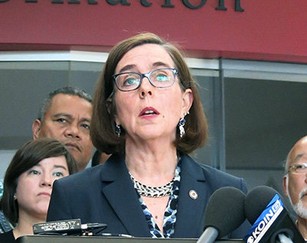
Gov. Kate Brown knows how it works.

Just as a task force she appointed puts out a report on how PERS’ massive unfunded actuarial liability (UAL) might be reduced, Brown appoints two legislators to jobs that will drain PERS of hundreds of thousands of dollars.

The Task Force, which Brown charged with identifying options to generate additional funding to reduce the PERS UAL by up to $5 billion over the next five years, issued its report yesterday (Nov. 1). Ideas put forward in the report to generate revenue for PERS , which would impact all Oregonians, include:

  • Privatize state universities
  • Sell surplus port and airport property
  • Sell additional Common School Fund land assets
  • Expand the types of gaming the Oregon Lottery offers and direct revenue from these new options toward PERS
  • Impose a charge for new water rights based on market prices.
  • Sell or do an IPO of SAIF
  • Institute more aggressive foreclosures on properties with property tax and other liens (“Cities could use their own discretion to use the streamlined process (in order to make sure they don’t evict 85-year old grandmothers,” the report notes.)
  • Increase OLCC’s flexibility to operate the spirits business to maximize profits; Increase alcohol licensing fees and excise taxes on beer and wine; impose a surcharge on all distilled spirit (liquor) sales in Oregon, calculated as a percentage of the retail sales price (e.g., 1%, 5%, or 10%).

While all this revenue-raising analysis is going on, Gov. Brown is proposing to undermine PERS’ financial health by conspiring with Sen. Richard Devlin (D-Tualatin) and Sen. Ted Ferrioli (R-John Day) to enrich the legislators, fleece PERS and drive up the costs of PERS payers, such as schools and local governments.

As I’ve pointed out previously, on Oct. 23, Brown nominated Devlin and Ferrioli to the Northwest Power & Conservation Council, a federally funded panel that provides policy and planning leadership on regional power, fish and wildlife issues. The Senate Rules Committee is scheduled to consider the nominations on Nov. 13.

The council positions come with a $120,000 annual salary, substantially more than Devlin and Ferrioli have been making from their legislative salaries.

Furthermore, as The Oregonian’s Ted Sickinger reported this past week, both men will likely end up raiding PERS for big payouts.

The jobs “…will allow both legislators to double dip, turbocharge their public pensions, or both,” Sickinger reported.

As Sickinger explained it:

“Ferrioli already draws a $33,083 annual pension from the Public Employees Retirement System. That benefit stems from 6½ years working for the Oregon Department of Veterans Affairs in the late ’70s and early ’80s…And because he is already at retirement age, he is allowed to double dip, continuing to collect it while working full time at the council.

Meanwhile, Ferrioli is eligible for a separate pension for his 20 years of legislative service. And if his Senate colleagues confirm him to the new position, that pension will be calculated using his new higher salary and the extra years of service he earns at the power council, according to PERS.

It’s unclear how much service credit Ferrioli earned during his years at the Legislature, given the part-time work. But assuming he sticks with the job for the first three-year term, the new salary could quintuple his legislative pension, which could translate to hundreds of thousands of dollars in extra benefits over the course of his retirement (emphasis mine). And he could start drawing that while continuing to work at the council.

Devlin, too, could see a similar multiplier in his legislative pension if confirmed. He, too, has 20 years of legislative service and is eligible to start drawing his pension. But if he holds off, the new salary and service at the power council would balloon those benefits after three years.”

This brazen attempt to exploit PERS when it is already suffering from billions in unfunded liabilities needs to be cut off at the pass.

If they want to maintain their reputations as public servants, Devlin and Ferrioli should either decline the Council appointments or they should refuse any additional PERS benefits that may arise because of them.

And Gov. Brown and the Legislature need to put a stop to this practice of raiding PERS to enrich former Legislators. It’s time to stop taking Oregonians for rubes.


Abuse of Power: Gov. Kate Brown’s PERS Payoff

Kate Brown

Why is Gov. Kate Brown laughing?

Co-conspirators Gov. Kate Brown (D), Sen. Richard Devlin (D-Tualatin) and Sen. Ted Ferrioli (R-John Day) have concocted a bipartisan scheme to enrich the legislators and fleece the Public Employees Retirement System (PERS).

This while a task force appointed by Gov. Brown has been trying to determine the best ways to slash the the crushing PERS debt by $5 billion. The task Force’s report is expected to be submitted on Nov. 1. The PERS Board has predicted that if solutions aren’t found, PERS costs could rise from 17 percent of state and local government annual payrolls to 34 percent in 2021. That would be likely to force worker layoffs.

And you thought Oregon was a corruption-free state.

On Oct. 23, Brown nominated Devlin and Ferrioli to the Northwest Power & Conservation Council, a federally funded panel that provides policy and planning leadership on regional power, fish and wildlife issues. The Senate Rules Committee is scheduled to consider the nominations on Nov. 13.

Neither legislator will bring any expertise in regional power, fish and wildlife issues to the Council. Devlin, 65, is a retired corrections officer and private investigator. Ferrioli, 66, is a retired public relations executive.

But their lack of expertise is not the most egregious issue. It’s their exploitation of the public purse.

First, the council positions come with a $120,000 annual salary, substantially more than Devlin and Ferrioli have been making from their legislative salaries.

Second, as The Oregonian’s Ted Sickinger reported this past week, both men will be raiding PERS for big payouts.

The jobs “…will allow both legislators to double dip, turbocharge their public pensions, or both,” Sickinger reported.

This is how Sickinger put it:

“Ferrioli already draws a $33,083 annual pension from the Public Employees Retirement System. That benefit stems from 6½ years working for the Oregon Department of Veterans Affairs in the late ’70s and early ’80s…And because he is already at retirement age, he is allowed to double dip, continuing to collect it while working full time at the council.

Meanwhile, Ferrioli is eligible for a separate pension for his 20 years of legislative service. And if his Senate colleagues confirm him to the new position, that pension will be calculated using his new higher salary and the extra years of service he earns at the power council, according to PERS.

It’s unclear how much service credit Ferrioli earned during his years at the Legislature, given the part-time work. But assuming he sticks with the job for the first three-year term, the new salary could quintuple his legislative pension, which could translate to hundreds of thousands of dollars in extra benefits over the course of his retirement (emphasis mine). And he could start drawing that while continuing to work at the council.

Devlin, too, could see a similar multiplier in his legislative pension if confirmed. He, too, has 20 years of legislative service and is eligible to start drawing his pension. But if he holds off, the new salary and service at the power council would balloon those benefits after three years.”

This brazen attempt to exploit PERS, which Brown, Devlin and Ferrioli know is already in deep trouble, needs to be cut off at the pass.

If they want to maintain their reputations as public servants, Devlin and Ferrioli should either decline the Council appointments or they should refuse any additional PERS benefits that may arise because of them.

Gov. Brown needs to stop taking Oregonians for rubes. It’s time to put a stop to this abuse of the system.


The #Oregonian: the disintegration of a once great American print newspaper

“Three centuries after the appearance of (James and Benjamin) Franklin’s ‘Courant’, it no longer requires a dystopic imagination to wonder who will have the dubious distinction of publishing America’s last genuine newspaper.”    Eric Alterman

TheOregonian

Contents of print edition of The Oregonian, Wednesday, July 5, 2017

Stories on front page: 2

Front page stories written by Oregonian reporters: 1

Total number of stories by Oregonian reporters: 11

Stories from Associated Press and wire reports: 13

Stories from the Washington Post: 1

Stories from the Tribune News Service: 1

Stories from The Marshall Project: 1

Oregonian staff editorials: 0

Food insert:

    Stories by the Tribune News Service – 1

         Stories by the Washington Post – 2

         Stories by Oregonian reporters – 0

Oregon Craft Beer Month Official Guide:

         Stories by marketing personnel – 4

       Stories by Oregonian reporters – 0


WES: going off the rails

stagecoach

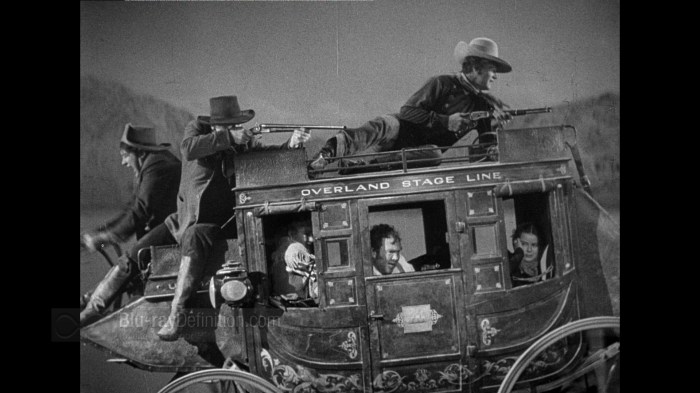
“We’re in a fine fix, my friends.”  Stagecoach. 1939.

TriMet is buying 2 more train cars for WES, the Westside Express Service train that runs a 14.7-mile limited schedule between Wilsonville and Beaverton.

Hey, why not? When things are going downhill, double down.

On May 25, after just six minutes of consideration, TriMet’s Board of Directors voted unanimously to approve bidding on the purchase of two used Budd RDC passenger diesel railcars from Dallas Area Rapid Transit (DART) for a total of up to $1.5 million. An additional $550,000 is expected to be needed for retrofit work to make the cars service-ready.

“We need to plan for ridership growth,” TriMet spokeswoman Mary Fetsch told The Oregonian. “Staff believes that these cars would meet the expected demands for the growing WES service for at least the next ten years…,” Neil McFarlane, TriMet’s general manager, said to the Board in a May 25 memo.

Oh sure, plan for massive ridership growth.

In early 2009, TriMet predicted WES would have 2,400 daily riders its first year of operations and 3000 by 2020.

But things started to go south quickly. WES began operating in February 2009. By Dec. 2009, weekday boardings averaged 1,140. By June 2010, the last month of Fiscal Year (FY) 2010, weekday boardings for the year averaged 1,200, less than half the number TriMet had predicted.

TriMet General Manager Fred Hansen told The Oregonian it was way too early to say if the agency’s heavy-rail gambit was a mistake.

He was wrong.

In FY15, weekday boardings averaged just 1869. Equally disturbing, operating costs per boarding on WES are stubbornly high at $13.50, versus $2.83 on busses and $2.14 on MAX.

Operating cost per boarding ride measures the direct cost of providing each ride. Operating costs are expenses for labor, energy and expendable supplies to provide transit service and to maintain vehicles and plant facilities. It does not include general andf administrative costs, interest or depreciation.

WESgraphwithkey

Here we are in 2016 and the situation is still appalling.

As of April 2016, the most recent month for which I was able to obtain data from TriMet, average daily boardings in FY16 are just 1,779. Operating costs per boarding ride are also still substantially imbalanced, at $2.67 for busses, $2.01 for MAX and $12.56 for WES.

The WES figure translates into a fare recovery ratio of operating costs of just 8.1 percent. Operations costs are expenses for labor, energy and expendable supplies to provide transit service and to maintain vehicles and plant facilities.

And these figures don’t even take into account the $161.2 million spent to build WES.

Even if WES reaches 3000 average daily boardings, operating costs per boarding ride will remain much higher than for busses and MAX.

The fact is, WES is a train wreck.

The minimum wage mess: what hath we wrought?

brownminimumwage

Governor Kate Brown signs the bill to raise Oregon’s minimum wage, March 2, 2016

If you listen just to Democrats in the Oregon Legislature, the just-signed law upping the minimum wage is an unalloyed victory for all.

Tell that to Oregon universities that are faced with big pay increases and to the students who aren’t going to get a job because their school can’t afford to pay them.

According to The Oregonian, Oregon’s new minimum is likely to lead to cutbacks in student hiring or in the number of hours they’re allowed to work, and possibly higher tuition to cover added costs.

At the University of Oregon, the annual wage increases will translate into an estimated $2.3 million in additional wages

In the 2017-19 biennium, $3.4 million in the next funding cycle and $6.1 million by the 2021-23 biennium.

With similar impacts expected at Oregon State University, the school could be looking at reducing the number of student jobs by 650 to 700 positions by FY2019 to cut costs, said OSU spokesman, Steve Clark.

Small businesses across the state are agonizing over the minimum wage increases, too. They’re not going to be talking about ‘What do we do to expand? What do we do to hire more people?’,” said Anthony K. Smith, Oregon state director for the National Federation of Independent Business.

“They’re going to be making some very difficult decisions, none of which are going to help them grow. They have to decide whether to reduce hours for employees, raise prices on customers, make a reduction in their workforce, relocate their business, or maybe even close their doors.

Then, of course, Oregon’s minimum wage changes will contribute to the increased hodgepodge of pay rates in the Pacific Northwest.

If you are an employer in the Pacific Northwest, the minimum wage you will have to pay your employees early next year could, depending on the type and specific location of your business, the age of the employee, and other factors, be any one of the following: $8.05, $9.25, $9.47, $10.15, $10.50, $12.00, $12.50, $13.00, $15.24, $10.35, $11.15, $14.50, $15.00, or $15.24.

If you have to pay prevailing wage rates, your minimum wage rate will be even more expansive. In Oregon, for example, if an employer chooses to include the fringe rate with the basic hourly rate, the minimum hourly wage will be $57.26 for a boilermaker, $52.36 for a dredger and $34.31 for a Highway & Parking Striper.

Clearly, the plethora of minimum wages is going to generate maximum confusion for employers and employees alike. What a mess.

Want to know the whole bewildering picture? See below.

FEDERAL

2016 Federal hourly minimum wage: $7.25 an hour

Federal (sub) Contractors hourly minimum wage

Rate: $10.15. Calculated annually based upon cost of living and rounded to the nearest multiple of $0.05

WASHINGTON

2016 Washington hourly minimum wage outside Seattle, SeaTac and Tacoma: $9.47

  • 14- and 15-year-olds may be paid 85% of the minimum wage ($8.05).
  • Businesses may not use tips as credit toward minimum wages owed to a worker.
  • Under Initiative 688, approved by Washington voters in 1998, the state makes a cost-of-living adjustment to its minimum wage each year based on the federal Consumer Price Index for Urban Wage Earners and Clerical Workers (CPI-W) (www.ssa.gov). The state’s minimum wage is recalculated each year in September. Th4 new wage takes effect the following year on January 1.

2016 Seattle hourly minimum wage

A wage includes salary, hourly pay, commissions, piece-rate, and non-discretionary bonuses. Wages do not include tips or payments towards medical benefits. However, payment toward medical benefits can reduce employers’ minimum wage requirements temporarily until 2018.

Small Employers – 500 or fewer employees

 To calculate employer size, count the employer’s total number of individual employees worldwide. For franchises, count all employees in the franchise network.

All small employers are required to pay minimum compensation. Small employers can meet this requirement in two ways:

  • Pay hourly minimum compensation rate; or
  • Pay hourly minimum wage and make up the balance with employee tips reported to the IRS and/or payments toward an employee’s medical benefits plan. For an employee’s medical benefits to qualify toward the minimum wage, the plan must be the equivalent of a “silver” level or higher as defined in the federal Affordable Care Act. An employer cannot pay a reduced minimum wage if the employee declines medical benefits or is not eligible for medical benefits.
  1. Hourly Rate

Small employers pay hourly minimum compensation rate based on the following schedule:

  Minimum Compensation
2016 (January 1) $12.00/hour
2017 (January 1) $13.00/hour
2018 (January 1) $14.00/hour
2019 (January 1) $15.00/hour
  1. Tips and/or Medical Benefits

Small employers pay an hourly minimum wage and reach the minimum compensation rate through employee tips reported to the IRS and/or payments toward an employee’s medical benefits plan. If the tips and/or payments toward medical benefits do not add-up to the minimum compensation rate, the small employer makes up the difference.

  Minimum Compensation Minimum Wage
2016 (January 1) $12.00/hour $10.50/hour
2017 (January 1) $13.00/hour $11.00/hour
2018 (January 1) $14.00/hour $11.50/hour
2019 (January 1) $15.00/hour $12.00/hour
2020 (January 1) $15.75 $13.50/hour
2021 (January 1) $16.49 $15.00/hour

In 2025, small employers will pay the same minimum wage rate as large employers and will no longer count employee tips and/or payments toward an employee’s medical benefit plan toward minimum compensation. The City of Seattle will calculate percentage changes to the minimum wage based on the Consumer Price Index (CPI).

Large Employers: 501 or more employees

To calculate employer size, count the employer’s total number of individual employees worldwide. For franchises, count all employees in the franchise network.

Large employers can meet Seattle’s minimum wage requirements in two ways:

  • Pay hourly minimum wage; or
  • Pay reduced hourly minimum wage if the employer makes payments toward an employee’s silver level medical benefits plan. For an employee’s medical benefits to qualify toward the minimum wage, the plan must be the equivalent of a “silver” level or higher as defined in the federal Affordable Care Act. An employer cannot pay a reduced minimum wage if the employee declines medical benefits or is not eligible for medical benefits.
  1. Hourly Rate

Large employers who do not pay towards an employee’s medical benefits plan pay hourly minimum wage based on the following schedule:

  Minimum Wage
2016 (January 1) $13.00/hour
2017 (January 1) $15.00/hour
  1. Medical Benefits

Large employers who do make payments toward an employee’s medical benefits plan pay a reduced minimum wage based on the following schedule:

  Minimum Wage
2016 (January 1) $12.50/hour
2017 (January 1) $13.50/hour
2018 (January 1) $15.00/hour

Once Seattle’s minimum wage reaches $15.00/hour, payments toward medical benefits no longer impact employees’ minimum wage. In subsequent years, the City of Seattle will calculate percentage changes to the minimum wage based on the Consumer Price Index (CPI).

SeaTac Minimum Wage 

Rate: $15.24 for workers in and near Seattle-Tacoma International Airport.

 Tacoma, WA hourly minimum wage

11/04/15 – Tacoma, WA voters approved a $12 city minimum wage phased in over two years. The new minimum wage will apply to most employees who work 80+ hours per year within Tacoma city limits and begins with an increase to $10.35 an hour on February 1, 2016, Jan.1, 2017: $11.15; Jan. 1, 2018: $12.


OREGON

Current:  $9.25

 Tier 1 (the Portland urban growth boundary)

July 1, 2016: $9.75

July 1, 2017: $11.25

July 1, 2018: $12

July 1, 2019: $12.50

July 1, 2020: $13.25

July 1, 2021: $14

July 1, 2022: $14.75


Tier 2 (Benton, Clackamas, Clatsop, Columbia, Deschutes, Hood River, Jackson, Josephine, Lane, Lincoln, Linn, Marion, Multnomah, Polk, Tillamook, Wasco, Washington and Yamhill counties)


July 1, 2016: $9.75

July 1, 2017: $10.25

July 1, 2018: $10.75.

July 1, 2019: $11.25

July 1, 2020: $12

July 1, 2021: $12.75

July 1, 2022: $13.50


Tier 3 (Malheur, Lake, Harney, Wheeler, Sherman, Gilliam, Wallowa, Grant, Jefferson, Baker, Union, Crook, Klamath, Douglas, Coos, Curry, Umatilla and Morrow counties)


July 1, 2016: $9.50

July 1, 2017: $10

July 1, 2018: $10.50

July 1, 2019: $11

July 1, 2020: $11.50

July 1, 2021: $12

July 1, 2022: $12.50


Milwaukie hourly Minimum Wage for city employees

10/22/15 – The Milwaukie City Council adopted a $15 minimum wage for all city employees. The resolution passed unanimously, putting in place a $15 minimum wage for not only full-time employees of the city of Milwaukie, but also part-time and seasonal workers, as well as interns.

Prevailing Wage Rates

In January and July of each year, Oregon’s Bureau of Labor and Industries publishes the prevailing wage rates that are required to be paid to workers on non-residential public works projects in the state of Oregon. Quarterly updates are published in April and October.

REGION #2

Clackamas, Multnomah and Washington Counties

Under the Davis-Bacon Act, employers can either choose to pay the fringe benefits as additional cash wages (which would result in an effective hourly wage of $38) or provide a “bona fide” benefit plan. Benefits that might be included in such a plan are retirement accounts (401(k) or pensions), medical insurance, vision insurance, dental insurance and life insurance.


Basic hourly rate             Fringe rate

Boilermaker               $33.92                           $23.34

Dredger                       $39.08                           $13.28

Fence constructor

(non-metal)               $24.10                         $10.12

(Metal)                          $20.50                         $ 5.09

Highway & Parking

Striper                            $26.11                          $ 8.20
An abuse of power: Oregon Democrats and the short session

When Governor Brown signed the new minimum wage law on March 2 she hailed it as an example of Oregon’s collaborative spirit. Far from it.

The Democrats have been using this year’s short session to run the Legislature like an authoritarian one-party state. That’s what happens when one party is in control for so long.

2013-congress

In one case, the Democrats steamrolled Republicans and rammed a minimum wage bill, SB 1532, through the Legislature in just one month.

The Senate passed the bill 16-12, with the vote going strictly along party lines. The House vote was 32-26, with every Republican again voting no.

Under this major law that will impact workers and employers across the state, the base state minimum wage will rise to $9.75 on July 1. Wages will then rise at different rates in in three geographic areas, with the Portland area reaching $14.75 in 2022.

Then there’s what The Oregonian has called “one of the most far-reaching pieces of energy legislation the state has ever seen.”

On March 1, the Democrats rammed through the House on almost a strict party-line vote, the latest version of a controversial bill that would end the use of coal to provide power to Oregonians within two decades and expand the use of renewables to 50% of the power supply by 2040. Republicans then repeatedly failed to derail the legislation, after which all but one Democrat voted to pass the bill, overwhelming the no votes of 12 Republicans (one didn’t vote).

In this case, it wasn’t only the Republicans that were shut out of the process; so was the Oregon Public Utility Commission. The Oregonian reported that state utility regulators say they were shut out when it came time to craft the legislation and when members of the Commission tried to voice their concerns publicly, the governor’s office muzzled them.

To top it off, Democrats have abused the short Legislative session itself.

When voters approved Measure 71, providing for annual legislative sessions, in 2010, there was a general expectation that the short sessions would deal with emergencies and lower-impact bills, leaving the longer sessions for comprehensive and high-impact bills where deliberation and public input would be required.

Democrats have cast that approach aside this short session and run amok with major partisan legislation.

Apparently its true, to slightly rephrase Mark Twain’s observation, that “No man’s life, liberty, or property are safe while the Oregon Legislature is in session.”


The long, slow, agonizing death of The Oregonian

newspaperdeath 

Top veteran reporters leaving. Circulation shrinking. Local bureaus closing. Regional papers consolidating. Daily print editions disappearing. Morale sinking.

It’s come to this at our once-proud and prominent newspaper, The Oregonian.

Founded in 1850 as a four page weekly, its first issue printed in a log shack on SW First and Morrison, The Oregonian has a long and storied history.

The headquarters of The Oregonian from 1892 to 1948.

The headquarters of The Oregonian from 1892 to 1948.

In June 1948, The newspaper moved to a new building on Southwest Broadway.

In June 1948, The newspaper moved to a new building on Southwest Broadway.

Daily newspapers like The Oregonian were once pervasive throughout the United States, with many communities having both a morning and evening paper, and sometimes a weekly local paper as well.

When Advance Publications bought The Oregonian in 1950 for $5.6 million, its daily circulation was 214,916. The Portland Metro Area’s population that year totaled 704,829.

Coincidentally, a significant challenge to the newspaper industry’s business model, dependent on print advertising, also began about this time. Although there’s a tendency today to attribute the decline of newspapers to the Internet, it might better be tied to the advent of television, which sucked away advertising dollars that covered costs and generated profits.

In 1950, five years after the advent of commercial television in the United States, television penetration of U.S. households was only 9.0%. By 1955 it was up to 64.5% and by 1960 87.1 percent. As TV penetration grew, newspapers’ share of ad revenue shrank.

Newspapers commanded 37 percent of all U.S. advertising revenues in 1950. By 1960, that share had shrunk to 31 percent, the first downward shift in newspaper advertising since the depression. During that same 10-year period, TV’s share of total advertising rose from 3 to 30 percent.

I joined The Oregonian as a business reporter in 1987. It was a robust, well-respected paper then, with a proud past and a much-anticipated future. Daily Monday-Friday circulation was 319,624; Sunday circulation 375,914.

When I left the paper 10 years later in 1997 to take a corporate communications job, Daily Monday-Friday circulation was 360,000, Sunday circulation 450,000. We were on a roll.

Much of that success has been attributed to Sandra Mims Rowe, who came on as editor in 1993 and tried to energize the newsroom with a hiring spree, bringing on reporters and editors from around the country. Under her leadership, the newsroom grew from about 280 to more than 400 and distinguished itself by winning five Pulitzers.

But the paper wasn’t able to escape the tumult of the newspaper business during her tenure. By the time she retired from The Oregonian in Dec. 2009, she had to cut staff, salaries and benefits as circulation and revenue declined.

In 2009, The Oregonian’s daily circulation sat at 268,572 and Sunday circulation at 344,950, causing the paper to lose its position as one of the top 25 Sunday circulation papers in the country. That same year, the paper announced a long-term policy that protected full-time employees from layoffs for economic or technological reasons would end.

By 2012, daily circulation sank to 228,599, only slightly higher than circulation in 1950, and the declines have continued.

The Oregonian’s footprint will shrink further later this month when three of its Washington County weeklies, the 143-year-old Hillsboro Argus, the 4-year-old Forest Grove Leader and the 3-year-old Beaverton Leader, will meld into one publication, the Washington County Argus. Their consolidation will mean even less local media coverage and impact.

Meanwhile, talented reporters have been fleeing in droves, some pushed out, others motivated by buy-outs. Some have decamped to other papers, others to corporate and government communications jobs. At the same time the once powerful paper has seen its clout diminish as it has abandoned rural Oregon and 7-day-a-week print distribution.

The Oregonian’s enhanced focus on digital news delivery is showing real signs of life, but it’s not maintaining the paper’s prestige and power. Digital numbers on OregonLive.com are up impressively (6,339,000 unique visitors in Jan. 2015). But with the average visitor to a newspaper website only staying on the site for three minutes per visit, many digital visitors to OregonLive.com are short-termers and aren’t loyal Oregonian readers.

In addition, new digital advertising revenue at newspapers across the country is substantially less than the print revenue that is being lost. In 2005, U.S. newspaper ad revenue totaled $49.4 billion, $47.4 billion from print and $2 billion from digital. By 2014, print ad revenue had shrunk by about two-thirds to $16.4 billion, but digital ad revenue had only grown to $3.5 billion, according to the Pew Research Center.

So here we are. A once mighty paper hollowed out and  humbled. A growing population served by a smaller paper. A weakened paper that no longer drives the daily discussion at the proverbial water cooler (or over a latte). A diminished, editorially impotent presence with a dwindling ability to hold powerful interests accountable.

None of this is good news if you want an educated, informed public in a position to make wise judgments about public policy.

“The way to prevent irregular interpositions of the people is to give them full information of their affairs through the channel of the public papers, and to contrive that those papers should penetrate the whole mass of the people,” wrote Thomas Jefferson in 1787.

That is as true today.

If it matters to Oregonians, it’s in (The Washington Post) Willamette Week

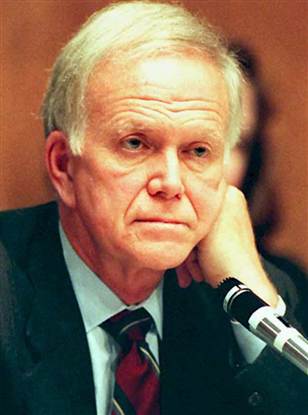
For those of you who don’t remember, Bob Packwood was the first.

Former Senator Bob Packwood (R-Ore)

Former Senator Bob Packwood (R-Ore)

On Nov. 22, 1992, the Washington Post reported that 10 women had accused Sen. Bob Packwood of sexual harassment. Even though one of The Oregonian’s own reporters was among the 10, and the paper had gotten tips about Packwood’s behavior, incredibly it had failed to aggressively pursue the matter. The Oregonian’s failure to break the story was mortifying for the entire paper.

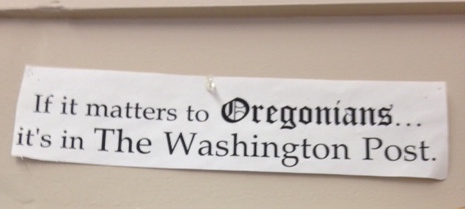
Adding to the shame was a bumper sticker that began appearing around Portland:

washPoststicker

Oregonian editor, Bill Hilliard, later told the Washington Post, in a massive understatement, that his paper “should have been a little more aggressive… We were worried about ruining a man’s career.”

Neil Goldschmidt was second.

Neil Goldschmidt

Neil Goldschmidt

Nigel Jaquiss, a reporter at Willamette Week, was researching the role of former Oregon Governor, and later power player, Neil Goldschmidt, in efforts to take over Portland General Electric. He was making good progress on the story, but got hints there was more.

“It was shaping up to be a pretty good story,” Jaquiss told the American Journalism Review, “but I kept getting pushed by people… ‘There’s more you ought to be looking at… There’s a girl..'”

Jaquiss’ aggressive digging eventually revealed that Goldschmidt, when he was the married Mayor of Portland, had begun raping a neighbor’s 14-year-old daughter on a regular basis over a three-year period. Sources said Goldschmidt often took the girl to her parents’ basement, to hotels and other private spots for sex.

When Willamette week posted a summary of the story on its website, it spread like wildfire. The Oregonian had been beaten again.

Not only had The Oregonian been beaten again, this time by a local alternative weekly, but The Oregonian made things even worse. When it ran the Goldschmidt story it appeared to many readers to soft-pedal Goldschmidt’s actions as “an affair” with “a high school student”. Oregonians went ballistic.

A memo of a staff meeting at the Oregonian revealed that there was a lot of internal angst, too. The memo noted: “Steve Duin felt strongly that our coverage today was too reverential. We are dealing with a child molester. He made a very impassioned plea for doing the who knew what when story — lots of people became rich riding Goldschmidt’s coat tails — and why they kept it secret. He suggested that readers might think we’d learned nothing from Packwood and that we are hands off people in power.”

And now the Kitzhaber-Cylvia Hayes scandal.

John Kitzhaber and Cylvia Hayes

John Kitzhaber and Cylvia Hayes

Again, it was Nigel Jaquiss and Willamette Week that broke the story and followed up with bombshell after bombshell.

The Oregonian followed up with some revelations, but it was late to the party. It’s most significant role in the evolving saga was to run an editorial on Feb. 4, 2015 calling on Kitzhaber to resign, arguing, “…it should be clear by now to Kitzhaber that his credibility has evaporated to such a degree that he can no longer serve effectively as governor.”

What’s happening to The Oregonian, once the state’s dominant paper of record, now a mere shadow of its former self?

It may sound hackneyed, but great newspapers like the Oregonian were once the indispensable guardians of our freedom. Seasoned reporters have served as watchdogs to ensure good government and reinforce good citizenship. The Oregonian has been a key ingredient of  civic dialogue and discourse in the state.

David Simon, a former Baltimore Sun reporter who created the award-winning HBO series The Wire, warned at a U.S. Senate hearing on the “Future of Journalism”, that “high-end journalism is dying in America.”  Oregon can’t afford for The Oregonian to be among those at death’s door.


Disclosure: I worked as a reporter at The Oregonian during the 80s and 90s.