Will The Oregonian survive?

Local news coverage is dying.

dyingnewspapers

The latest casualty — the entire staff of the New Orleans Times-Picayune. All 161 of them, , including reporters and editors, are losing their jobs.

On May 2, the Times-Picayune’s rival, the New Orleans Advocate, bought the Times-Picayune and plans to merge the papers under a single masthead and website. The seller — Advance Local Media LLC, the parent of Oregonian Media Group.  Even winning  two Pulitzers for its coverage of Hurricane Katrina didn’t serve the Times-Picayune.

Randy Siegel, CEO of Advance Local, assured the New York Post’s Keith J. Kelly that the sale of the Times-Picayune was a one-time thing. But what if it’s not? Is The Oregonian/OregonLive at risk, too?

Daily newspapers like the Times-Picayune and The Oregonian were once pervasive throughout the United States, with many communities having both a morning and evening paper, and sometimes a weekly local paper as well. But daily local newspapers are now in decline, dealing with cratering circulation, a reduction in print editions and drastic staff cuts.

According to the Wall St. Journal, nearly 1,800 US newspapers shut down between 2004 and 2018, including more than 60 dailies and 1,700 weeklies. Hundreds of communities have lost their local newspapers. Between 1,300 and 1,400 communities that had newspapers of their own in 2004 now have no news coverage at all, according to the UNC Center for Innovation and Sustainability in Local Media.

It was once unthinkable that papers such as the Cincinnati Post, the Albuquerque Tribune, the New York Sun, the Rocky Mountain News, and the Tampa Tribune would close, but they are all gone now. Nicco Mele, former director of Harvard’s Shorenstein Center, predicts that half of remaining titles will disappear within the next two years.

Newspaper consumption in Oregon is already dropping precipitously, with daily and weekly circulation combined falling from 1.4 million in 2004 to 796,000 in 2019, the UNC Center says.

Some of the remaining Oregon papers are what the UNC Center calls “ghosts”  because their newsroom staffing has been so dramatically pared back, often by more than half,  that the remaining journalists cannot adequately cover their communities.

In January 2018, when Willamette Week broke that The Oregonian was laying off another 11 newsroom staffers, the Portland Mercury observed, “After repeated rounds of layoffs, it’s hard to imagine The Oregonian having anywhere else to cut. But the news business’s grim prognosis marches on, so the cuts continue.”

“For those inclined to point fingers at The Oregonian or our parent company Advanced Publications: Ad revenue across our industry continues to plummet precipitously. Layoffs in local newsrooms are happening everywhere. And it fucking sucks,” Oregonian reporter Shane D. Kavanaugh tweeted.

Compared with its breadth and depth in the 1990s, The Oregonian/OregonLive has become a ghost. When I was a business reporter at The Oregonian in the 1980s and 1990s, the business team of reporters and editors was a robust 8-10 individuals covering a panoply of topics from energy and healthcare to labor and retail. OregonLive’s list of staff today includes just one reporter, Mike Rogoway, specifically devoted to business coverage , unless you also count Jeff Manning, who is listed as a reporter covering Health Care Business, OHSU.

Sports coverage is still robust, with 12 reporters and editors, but just one reporter, Gordon Friedman, is specifically assigned to covering everything going on at Portland City Hall.

When the Jan. 2018 layoffs were announced, The Oregonian/OregonLive’s editor and vice president of content, Mark Katches, said to the paper’s staff, “You’re probably asking yourself, when will these cuts end? I wish I could answer that. Although we have made progress growing our digital audience while also producing award-winning, and important journalism, the revenue picture continues to pose challenges for our company – as is the case across the media landscape.”

In August 2018, Katches abandoned ship himself to take a new job as executive editor of the Tampa Bay Times, another paper that has had its own struggles both before and since it acquired its competitor,  the Tampa Tribune, in 2016 .

With all the strife in the newspaper business, is The Oregonian/OregonLive ripe for the same fate as the Times-Picayune.

Don’t think it can’t happen.


2020: Will the mainstream media make a difference?

trumpandreporters

There’s a lot of tortured handwringing going on among the mainstream media about how they covered the 2016 presidential race and what they need to do to fix things for 2020.

“…we have a chance to do things differently than we did the last time around – to redeem ourselves,” columnist Frank Bruni opined in The New York Times on Jan. 13, 2018. “Our success or failure will affect our stature at a time of rickety public trust in us.”

Bruni’s column focused on the role of the “mainstream, establishment media” and its responsibility to clean up its act, to avoid writing about the spectacle and cover, instead, substance, fitness for office and competing visions of government.

Sounds all very serious and high-minded. But Bruni’s angst is too late.

The fact is, what the mainstream, establishment print and television media have to say about politics simply doesn’t matter as much anymore because people are going elsewhere to find out what’s going on and what people think about it.

“The conversation that should concern everyone, in both media and politics, is not about what gets covered,” Peter Hamby recently wrote in Vanity Fair.  “It’s about what gets attention.”

“At a time when technology is transforming voter behavior at unprecedented speed, this is a problem that the mainstream media, even on its best behavior, cannot possibly solve without a drastic reimagining of what journalism is and how it reaches contemporary audiences.”

Diminishing influence

newspaperreaders1950

In 1950, almost every American household read a daily newspaper

In 1950, almost every American household read a daily newspaper. By 2000, only 50 percent of Americans read a printed newspaper on a daily basis.

As I write this in Jan. 2019, I’m sitting at a large, bustling coffee shop. A couple dozen people of all ages are busily engaged at their laptops. Not a single person is reading a newspaper.

The fact is fewer Americans read a daily newspaper today than in 1950, while the U.S. population has more than doubled. And the prognosis isn’t good. With just 2 percent of teenagers reading a newspaper on a regular basis, few are developing a newspaper reading habit.

Unlike the individualized, algorithm-determined, constantly updated news delivered to consumers online, print newspapers offer identical mass communications to their customers. And by the time the news in print newspapers reaches the intended audience, not only is it stale, but it has been superceded by newer news.

During the 2016 election, a survey of U.S. adults by the Pew Research Center revealed  that print versions of both local and national newspapers were named as key sources for election news and information by only 3% and 2% of respondents respectively. Late night comedy shows did just as well as sources at 3%.  (Maybe that explains why Sen. Kirsten Gillibrand (D-NY) announced she was forming a presidential exploratory committee during a Jan. 15 appearance on “The Late Show with Stephen Colbert”)

pewresearch2016electiontable

And even if you did read print newspapers during the election, policy issues — what the nominees would do if elected—got little press coverage in print outlets. In the 2016 general election, policy issues accounted for just 10 percent of the news coverage—less than a fourth the space given to the horserace between the candidates, according to a Shorenstein Center study.

And even if you did read print newspapers during the election, policy issues — what the nominees would do if elected—got little press coverage in print outlets. In the 2016 general election, policy issues accounted for just 10 percent of the news coverage—less than a fourth the space given to the horserace between the candidates, according to a Shorenstein Center study.

All this has translated into a drastic reduction in the influence of newspaper editorial endorsements.

“Once upon a time, a newspaper endorsement for a political candidate was about as good as it got,” Philip Bump wrote in the Washington Post  a couple weeks before the 2016 election. “In the era before the internet…big, important newspapers could shift the fortunes of people seeking the presidency. Nowadays, that’s … less of the case.”

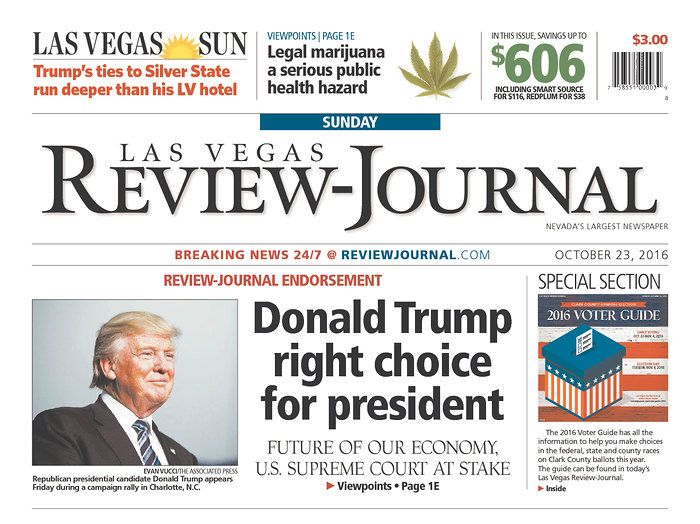
Of the 269 U.S. newspapers that dispensed their wisdom by endorsing a presidential candidate in 2016, 240 endorsed Hillary Clinton and just 18 endorsed Donald Trump. Libertarian Gary Johnson secured nine endorsements and independent conservative Evan McMullin got one.
trumpendorsement

Of the top 100 largest newspapers in America with the largest circulations, just two endorsed Trump,

As Politico media reporter Hadas Gold tweeted when Trump’s stunning victory became clear, “… newspaper endorsements DO NOT MATTER.”

That may be partly due to slipping public respect for the mainstream media.  In a Pew Research Center survey taken shortly after the November 2016 balloting, only one in five respondents gave the press a grade of “B” or higher for its performance. Four of five graded its performance as a “C” or lower, with half of them giving it an “F.”

Declining newspaper circulation

Much of the waning influence of print newspapers can also be attributed to circulation declines (or the reverse).
newspapercirculationpercentofhouseholds

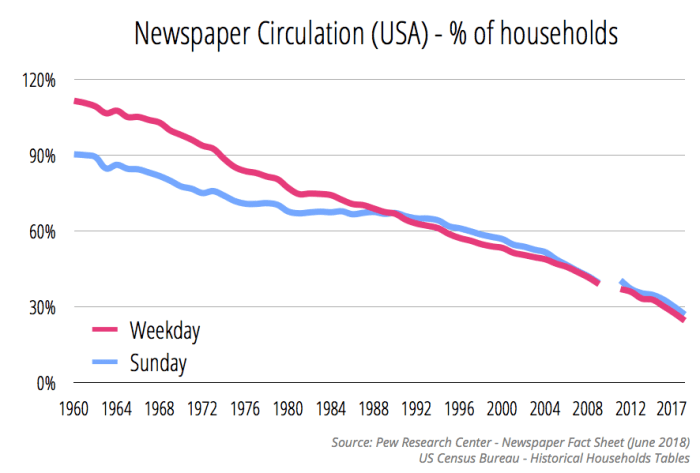
In 1960, nearly 120 percent of households bought a daily newspaper (i.e. there were 1.2 papers sold per household). By 2017, fewer than 30 percent of households bought a daily newspaper.

In 1990, circulation of U.S. daily newspapers totaled 62.3 million weekday and 62.6 million Sunday. By 2009, circulation had sunk to 55.8 million daily and 59.4 million Sunday.

According to the Pew Research Center, in 2016, despite the excitement and turmoil of the national elections, weekday and Sunday circulation for U.S. daily newspapers – both print and digital – fell 8%, marking the 28th consecutive year of declines. Weekday circulation fell to 35 million and Sunday circulation to 38 million – the lowest levels since 1945.

The following year, the first of Tump’s term, was equally discouraging. Estimated total U.S. daily newspaper circulation (print and digital combined) in 2017 was 31 million for weekday and 34 million for Sunday, down 11% and 10%, respectively, from 2016.

Some of that decline is because the United States has lost almost 1,800 papers since 2004, including more than 60 dailies and 1,700 weeklies, leaving 7,112 in the country, according to The School of Media and Journalism at UNC.

California lost the most dailies of any state. In one case, the 140-year-old, 500-circulation Gridley Herald used to serve Gridley (population 6,000) in the central California county of Butte, 60 miles from Sacramento. On Aug. 29, 2018, the paper’s staff and the community were notified by the paper’s owner, GateHouse Media, that the final issue of the twice-weekly paper would be published the next day.

Daily newspaper circulation in California totaled about 5.7 million 15 years ago. In 2018, that was cut in half to 2.8 million.

If print circulation continues to drop at current rates, as many as one-half of the nation’s surviving dailies will no longer be in print by 2021, predicts Nicco Mele, director of the Shorenstein Center for Media, Politics and Public Policy at Harvard University..

One of the most striking examples of decline is in Silicon Valley. The San Jose Mercury News, rebranded as The Mercury News in 2016, was once an influential publication with about 400 reporters, editors, photographers, and artists.

According to The Columbia Journalism Review, the Mercury News was one of the first daily newspapers in the U.S. with an online presence, the first to put all its content on that site, the first to use the site to break news, and one of the first to migrate its growing online content to the web.

Its commitment to innovation and hard news led to daily circulation of 200,258 in 2009 making it the fifth largest daily newspaper in the United States.

But subsequent years of bad business decisions, declining classified advertising (including job listings), layoffs, McClatchy’s purchase of the paper’s owner, Knight Ridder, in 2006, and the subsequent sale of the Mercury News to the MediaNews Group caused the paper to slip. “…sadly the San Jose Merc is a mere shadow of its former self,” commented one online reviewer.

Not that long ago, the San Jose paper proclaimed itself “The Newspaper of Silicon Valley,” media business analyst Ken Doctor wrote in Newsonomics. “Silicon Valley has done quite well, becoming the global economic engine and driving great regional affluence. But the economically fecund region has become — in less than a decade — a news desert.”

Here at home, The Oregonian, a paper with a long and storied history, is a story of decline, too.
oregonianbuildingold

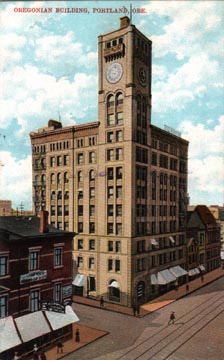
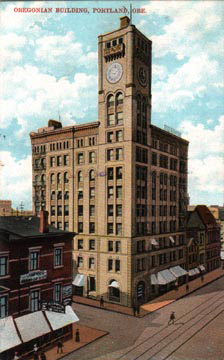
The Oregonian Building, at the corner at the intersection of S.W. Sixth and Alder, occupied by the paper during 1892-1948.

In 1950, when Advance Publications bought the paper, its daily circulation was 214,916. For quite a while, things looked promising.

I joined The Oregonian as a business and politics reporter in 1987. It was a robust, well-respected paper, with a proud past and a much-anticipated future. Daily circulation was 319,624; Sunday circulation 375,914.

When I left the paper 10 years later in 1997 to take a corporate communications job, daily circulation was 360,000, Sunday circulation 450,000. It looked like the paper was on a roll.

But good times were not ahead. By 2012, daily circulation had sunk to 228,599, only slightly higher than in 1950. In subsequent years, daily circulation continued to slump, despite robust population growth in the Portland Metro Area.

Meanwhile, talented reporters have fled in droves, some pushed out, others motivated by buy-outs. At the same time the once powerful paper’s clout has diminished as it has abandoned rural Oregon and 7-day-a-week print distribution.

By 2018, The Oregonian had a print circulation of just 158,000 and distributed  to 15 fewer counties in Oregon and Washington than it did in 2004, when it had a circulation of 338,000, according to a UNC report on The Expanding News Desert.

A few smaller local Oregon papers are thriving, but most are suffering, too. And all of them have a tough time covering state and national politics consistently and with any depth.

Oregon Public Broadcasting OPB recently reported that Western Communications, which owns seven newspapers across the West, including the Bulletin in Bend, the Baker City Herald and the La Grande Observer, “is on the brink of foreclosure.” The company hasn’t paid nearly $1 million owed in local property taxes and interest and is between three and five years behind on taxes in counties across Oregon, OPB reported.

Comprehensive political coverage by the Eugene Register Guard is threatened, too. On March 1, 2018, GateHouse Media, the same company that closed the Gridley Herald, acquired the Register Guard, which had survived more than 90 years of independent, family ownership.

GateHouse publishes 130 daily newspapers. It has a reputation for tightfisted financial management accompanied by staff layoffs. It’s impact on the Register Guard has fit that pattern. In Dec. 2017, before the GateHouse takeover, the editorial and news staff at The Register-Guard totaled 42, according to the paper’s staff directory. Today the directory lists 27, of which just 12 are identified as reporters..

Not only has the Register Guard staff shrunk; so has its daily circulation, dropping from 54,325 in 2011 to 41,280 today.

“What’s happening with the Guard isn’t unique to the Guard,” Tim Gleason,professor and former dean at the University of Oregon School of Journalism and Communication, told the Eugene Weekly. “It’s what’s happening all over the country as these venture capital firms buy newspapers and then largely gut them.”

Of course, newspapers are being gutted whether or not they are investment targets.

In early January 2019, the Dallas Morning News eliminated 43 jobs, according to the Columbia Journalism Review, half of them in the newsroom, with the cuts  hitting reporters covering immigration, transportation, the environment, and the courts.

On Friday, February 1, The McClatchy Company, which owns properties such as the Miami Herald and the Kansas City Star, emailed staffers to announce that 450 employees would be offered voluntary buyouts as part of a “functional realignment,” essentially signaling that the jobs have been marked out of the budget. The news was first reported by the Miami New Times.

If print newspaper circulation across the board continues to drop at current rates, as many as one-half of the nation’s surviving dailies will no longer be in print by 2021, predicts Nicco Mele, director of the Shorenstein Center for Media, Politics and Public Policy at Harvard.

None of this is good news if you want an educated, informed public in a position to make wise judgments about public policy.

“The way to prevent irregular interpositions of the people is to give them full information of their affairs through the channel of the public papers, and to contrive that those papers should penetrate the whole mass of the people,” wrote Thomas Jefferson in 1787.

That is as true today.

How about network television news?

Given the decline of local print media, local network TV news is one of the few remaining sources of locally-focused journalism covering political issues, but local TV news has been experiencing declines as well.

Just from 2016 to 2017, the portion of Americans who often rely on local TV for their news fell 9 percentage points, from 46% to 37%, according to the Pew Research Center. Still, local tv news shows have multiple opportunities to cover educate their audience. The problem is that covering public policy is rarely their forte and it’s not what their audience is seeking.

Instead, local TV news is the outlet of choice by adults for weather, breaking news and traffic reports, although young adults are more likely to turn to the Internet, according to Pew Research.

Public policy and politics coverage is also suffering with a decline in the audiences for the national network news shows of NBC, ABC and CBS, although some scholars believe television news viewing has little effect on issue learning. In other words,  watching increasing quantities of television news will not lead to greater knowledge about political issues because of the paucity of real issue information. You may know more about polls and personalities, but not so much about political issues that affect your life.

Remember when the family used to gather in the living room every night for the evening news, either the Huntley-Brinkley Report, CBS Evening News with Walter Cronkite or ABC Evening News with Frank Reynolds and Howard K. Smith? That was so long ago.

family-gathered-around-tv-500x214

All three network evening news shows have been losing audience steadily since then. By 1998, the three network evening newscasts reached a combined average of only about 30.4 million viewers in a country with a population of 276 million.

In 2016, even with a turbulent presidential campaign, the average viewership for the ABC, CBS and NBC evening newscasts was 24 million, according to a Pew Research Center  analysis.

Compare that to the ratings of a single showing of 2016’s number one primetime TV show, The Big Bang Theory, which averaged 19.9 million viewers, or with Super Bowl 50 on Feb. 7, 2016, which got 112.6 million average viewers, according to Nielsen.

By the 2017-18 television season, ABC’s evening news had an average of 8.6 million viewers, NBC Nightly News 8.15 million and CBS Evening News 6.2 million. That’s a total of 22.95 million.


lonesomerhodes

Lonesome Rhodes, a master manipulator.

In Elia Kazan’s classic movie “A Face in the Crowd,” Lonesome Rhodes, played brilliantly by Andy Griffiths, rises from an itinerant Ozark guitar picker to a local media rabble-rouser to TV superstar and a political power. “I’m not just an entertainer. I’m an influence, a wielder of opinion, a force… a force!”, he exclaimed at one point.

Newspaper publishers and TV news anchors may once have felt the same way, but their days are numbered.

This doesn’t mean, however, that the demand for news is going to collapse. It just means there’s going to be a need for more imagination in formatting and delivering it in ways that grab an audience and rewards them for their attention.

Vanity Fair’s Peter Hamby cited a twice-daily news show produced by NBC that runs on Snapchat. According to Digiday, the brief show, Stay Tuned, was created specifically for the vertical-screen mobile experience. In 2018, Stay Tuned averaged 25 – 35 million unique viewers per month on Snapchat, according to data provided to NBC News by Snap. Only one-third of that audience also watches, reads or listens to NBC News content on other platforms, so two-thirds are a new NBC audience.

To top it off, about 75 percent of the “Stay Tuned” audience is under 25 and 90 percent is under 34, according to Snapchat, a significant accomplishment given that reaching younger audiences has provers to be a challenge for traditional print and network TV.

So the future isn’t all grim. It will just be different.


Twin Tragedies: The travails of The Oregonian and the L.A. Times

newssanity

The Oregonian just announced it is laying off 11 more reporters, continuing what seems like a never-ending story.

You may recognize some of the names: Samantha Bakall, Jen Beyrle, Molly Blue, Allan Brettman, Jessica Floum, Susan Green, Anna Marum, Lynne Palombo, Mike Richman, Lynne Terry, Jerry Ulmer.

“Today, the positions of 11 of our colleagues in the newsroom are being eliminated,” the paper’s editor, Mark Katches, wrote in a memo to staff. “You’re probably asking yourself, when will these cuts end?,” the paper’s editor, Mark Katches, wrote in a memo to staff. “I wish I could answer that. Although we have made progress growing our digital audience while also producing award-winning, and important journalism, the revenue picture continues to pose challenges for our company—as is the case across the media landscape.”

Founded in 1850 as a four page weekly, iThe Oregonian’s first issue was printed in a log shack on SW First and Morrison, For many years after, it continued to build on its long and storied history.

But today it’s a mere shadow of its former self, and fading rapidly.

Unfortunately, The Oregonian’s not the only struggling news organization on the West Coast.

The Los Angeles Times is mired in turmoil and the people on its news staff are stunned with their predicament.

When Times workers voted on Jan. 4, 2018 to unionize, they figured it would bring a better deal and a more secure future.

“With a union, we can begin to address stagnant wages, pay disparities and declining benefits,” the union pronounced.

Don’t count on it.

Things struggling old-line newspapers are not doing these days are guaranteeing employment, handing out big annual raises and lowering healthcare premiums.

Union leaders said their goals include keeping the working conditions they like and getting a better deal on things they don’t like.

Demand all you want, folks, but it ain’t gonna happen.

Once massive influencers like the Los Angeles Times are on the decline, not the upswing. How the mighty have fallen.

About 20 years ago, the L.A. Times had an editorial staff of about 1,000 people. It’s now about 400, with more layoffs and buyouts expected.

As Nieman Lab, a website reporting on digital media innovation, put it this past week, ‘It’s a cut-of-the-month club, a gift that just keeps on giving.”

About 20 years ago, the L.A. Times had 22 foreign bureaus and 17 bureaus in the United States. By 2012, it had ten foreign “bureaus,” eight of them consisting of just one person, according to the Columbia Journalism Review. Today, the Times website lists just five staffed foreign bureaus (Beijing; Beirut; Johannesburg; Mexico City; Mumbai), with four of them staffed by just one person, plus a bureau in Sacramento and a bureau in Washington, D.C.

In Jan. 2003, the Times announced it planed to launch later that year its fifth regional edition, which would focus on the Inland Empire’s fast-growing Riverside and San Bernardino counties. “It’s a huge market, and parts of it have very strong affinities to Los Angeles,” John Puerner, then the Times’ CEO, publisher, and president, said in a statement to Editor & Publisher. “I think it could represent an important source of future, consistent, regular circulation growth.”

So much for that.

The regional editions are dead and gone.

About 20 years ago, the paper launched a National Edition. To the dismay of its supporters, it too expired.

So don’t get your hopes up all you folks in the L.A. Times newsroom. The union’s not going to save you.


Double dealing with PERS: enough of Gov. Brown’s shenanigans

kate-brown-10x8-d383f11824f1b171

What, me two-faced?

What one hand giveth, another taketh away.

Gov. Kate Brown knows how it works.

Just as a task force she appointed puts out a report on how PERS’ massive unfunded actuarial liability (UAL) might be reduced, Brown appoints two legislators to jobs that will drain PERS of hundreds of thousands of dollars.

The Task Force, which Brown charged with identifying options to generate additional funding to reduce the PERS UAL by up to $5 billion over the next five years, issued its report yesterday (Nov. 1). Ideas put forward in the report to generate revenue for PERS , which would impact all Oregonians, include:

  • Privatize state universities
  • Sell surplus port and airport property
  • Sell additional Common School Fund land assets
  • Expand the types of gaming the Oregon Lottery offers and direct revenue from these new options toward PERS
  • Impose a charge for new water rights based on market prices.
  • Sell or do an IPO of SAIF
  • Institute more aggressive foreclosures on properties with property tax and other liens (“Cities could use their own discretion to use the streamlined process (in order to make sure they don’t evict 85-year old grandmothers,” the report notes.)
  • Increase OLCC’s flexibility to operate the spirits business to maximize profits; Increase alcohol licensing fees and excise taxes on beer and wine; impose a surcharge on all distilled spirit (liquor) sales in Oregon, calculated as a percentage of the retail sales price (e.g., 1%, 5%, or 10%).

While all this revenue-raising analysis is going on, Gov. Brown is proposing to undermine PERS’ financial health by conspiring with Sen. Richard Devlin (D-Tualatin) and Sen. Ted Ferrioli (R-John Day) to enrich the legislators, fleece PERS and drive up the costs of PERS payers, such as schools and local governments.

As I’ve pointed out previously, on Oct. 23, Brown nominated Devlin and Ferrioli to the Northwest Power & Conservation Council, a federally funded panel that provides policy and planning leadership on regional power, fish and wildlife issues. The Senate Rules Committee is scheduled to consider the nominations on Nov. 13.

The council positions come with a $120,000 annual salary, substantially more than Devlin and Ferrioli have been making from their legislative salaries.

Furthermore, as The Oregonian’s Ted Sickinger reported this past week, both men will likely end up raiding PERS for big payouts.

The jobs “…will allow both legislators to double dip, turbocharge their public pensions, or both,” Sickinger reported.

As Sickinger explained it:

“Ferrioli already draws a $33,083 annual pension from the Public Employees Retirement System. That benefit stems from 6½ years working for the Oregon Department of Veterans Affairs in the late ’70s and early ’80s…And because he is already at retirement age, he is allowed to double dip, continuing to collect it while working full time at the council.

Meanwhile, Ferrioli is eligible for a separate pension for his 20 years of legislative service. And if his Senate colleagues confirm him to the new position, that pension will be calculated using his new higher salary and the extra years of service he earns at the power council, according to PERS.

It’s unclear how much service credit Ferrioli earned during his years at the Legislature, given the part-time work. But assuming he sticks with the job for the first three-year term, the new salary could quintuple his legislative pension, which could translate to hundreds of thousands of dollars in extra benefits over the course of his retirement (emphasis mine). And he could start drawing that while continuing to work at the council.

Devlin, too, could see a similar multiplier in his legislative pension if confirmed. He, too, has 20 years of legislative service and is eligible to start drawing his pension. But if he holds off, the new salary and service at the power council would balloon those benefits after three years.”

This brazen attempt to exploit PERS when it is already suffering from billions in unfunded liabilities needs to be cut off at the pass.

If they want to maintain their reputations as public servants, Devlin and Ferrioli should either decline the Council appointments or they should refuse any additional PERS benefits that may arise because of them.

And Gov. Brown and the Legislature need to put a stop to this practice of raiding PERS to enrich former Legislators. It’s time to stop taking Oregonians for rubes.


Abuse of Power: Gov. Kate Brown’s PERS Payoff

Kate Brown

Why is Gov. Kate Brown laughing?

Co-conspirators Gov. Kate Brown (D), Sen. Richard Devlin (D-Tualatin) and Sen. Ted Ferrioli (R-John Day) have concocted a bipartisan scheme to enrich the legislators and fleece the Public Employees Retirement System (PERS).

This while a task force appointed by Gov. Brown has been trying to determine the best ways to slash the the crushing PERS debt by $5 billion. The task Force’s report is expected to be submitted on Nov. 1. The PERS Board has predicted that if solutions aren’t found, PERS costs could rise from 17 percent of state and local government annual payrolls to 34 percent in 2021. That would be likely to force worker layoffs.

And you thought Oregon was a corruption-free state.

On Oct. 23, Brown nominated Devlin and Ferrioli to the Northwest Power & Conservation Council, a federally funded panel that provides policy and planning leadership on regional power, fish and wildlife issues. The Senate Rules Committee is scheduled to consider the nominations on Nov. 13.

Neither legislator will bring any expertise in regional power, fish and wildlife issues to the Council. Devlin, 65, is a retired corrections officer and private investigator. Ferrioli, 66, is a retired public relations executive.

But their lack of expertise is not the most egregious issue. It’s their exploitation of the public purse.

First, the council positions come with a $120,000 annual salary, substantially more than Devlin and Ferrioli have been making from their legislative salaries.

Second, as The Oregonian’s Ted Sickinger reported this past week, both men will be raiding PERS for big payouts.

The jobs “…will allow both legislators to double dip, turbocharge their public pensions, or both,” Sickinger reported.

This is how Sickinger put it:

“Ferrioli already draws a $33,083 annual pension from the Public Employees Retirement System. That benefit stems from 6½ years working for the Oregon Department of Veterans Affairs in the late ’70s and early ’80s…And because he is already at retirement age, he is allowed to double dip, continuing to collect it while working full time at the council.

Meanwhile, Ferrioli is eligible for a separate pension for his 20 years of legislative service. And if his Senate colleagues confirm him to the new position, that pension will be calculated using his new higher salary and the extra years of service he earns at the power council, according to PERS.

It’s unclear how much service credit Ferrioli earned during his years at the Legislature, given the part-time work. But assuming he sticks with the job for the first three-year term, the new salary could quintuple his legislative pension, which could translate to hundreds of thousands of dollars in extra benefits over the course of his retirement (emphasis mine). And he could start drawing that while continuing to work at the council.

Devlin, too, could see a similar multiplier in his legislative pension if confirmed. He, too, has 20 years of legislative service and is eligible to start drawing his pension. But if he holds off, the new salary and service at the power council would balloon those benefits after three years.”

This brazen attempt to exploit PERS, which Brown, Devlin and Ferrioli know is already in deep trouble, needs to be cut off at the pass.

If they want to maintain their reputations as public servants, Devlin and Ferrioli should either decline the Council appointments or they should refuse any additional PERS benefits that may arise because of them.

Gov. Brown needs to stop taking Oregonians for rubes. It’s time to put a stop to this abuse of the system.


The #Oregonian: the disintegration of a once great American print newspaper

“Three centuries after the appearance of (James and Benjamin) Franklin’s ‘Courant’, it no longer requires a dystopic imagination to wonder who will have the dubious distinction of publishing America’s last genuine newspaper.”    Eric Alterman

TheOregonian

Contents of print edition of The Oregonian, Wednesday, July 5, 2017

Stories on front page: 2

Front page stories written by Oregonian reporters: 1

Total number of stories by Oregonian reporters: 11

Stories from Associated Press and wire reports: 13

Stories from the Washington Post: 1

Stories from the Tribune News Service: 1

Stories from The Marshall Project: 1

Oregonian staff editorials: 0

Food insert:

    Stories by the Tribune News Service – 1

         Stories by the Washington Post – 2

         Stories by Oregonian reporters – 0

Oregon Craft Beer Month Official Guide:

         Stories by marketing personnel – 4

       Stories by Oregonian reporters – 0


WES: going off the rails

stagecoach

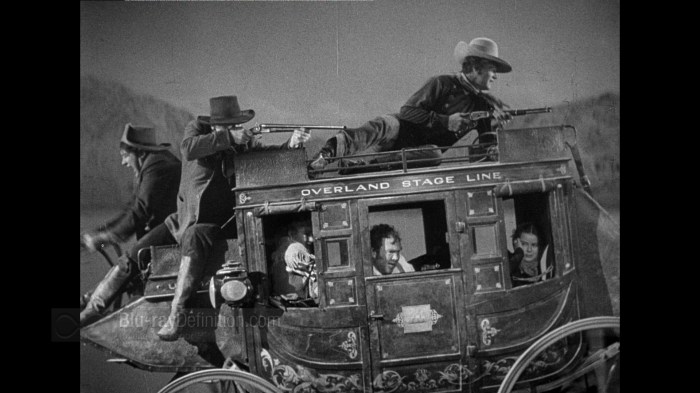
“We’re in a fine fix, my friends.”  Stagecoach. 1939.

TriMet is buying 2 more train cars for WES, the Westside Express Service train that runs a 14.7-mile limited schedule between Wilsonville and Beaverton.

Hey, why not? When things are going downhill, double down.

On May 25, after just six minutes of consideration, TriMet’s Board of Directors voted unanimously to approve bidding on the purchase of two used Budd RDC passenger diesel railcars from Dallas Area Rapid Transit (DART) for a total of up to $1.5 million. An additional $550,000 is expected to be needed for retrofit work to make the cars service-ready.

“We need to plan for ridership growth,” TriMet spokeswoman Mary Fetsch told The Oregonian. “Staff believes that these cars would meet the expected demands for the growing WES service for at least the next ten years…,” Neil McFarlane, TriMet’s general manager, said to the Board in a May 25 memo.

Oh sure, plan for massive ridership growth.

In early 2009, TriMet predicted WES would have 2,400 daily riders its first year of operations and 3000 by 2020.

But things started to go south quickly. WES began operating in February 2009. By Dec. 2009, weekday boardings averaged 1,140. By June 2010, the last month of Fiscal Year (FY) 2010, weekday boardings for the year averaged 1,200, less than half the number TriMet had predicted.

TriMet General Manager Fred Hansen told The Oregonian it was way too early to say if the agency’s heavy-rail gambit was a mistake.

He was wrong.

In FY15, weekday boardings averaged just 1869. Equally disturbing, operating costs per boarding on WES are stubbornly high at $13.50, versus $2.83 on busses and $2.14 on MAX.

Operating cost per boarding ride measures the direct cost of providing each ride. Operating costs are expenses for labor, energy and expendable supplies to provide transit service and to maintain vehicles and plant facilities. It does not include general andf administrative costs, interest or depreciation.

WESgraphwithkey

Here we are in 2016 and the situation is still appalling.

As of April 2016, the most recent month for which I was able to obtain data from TriMet, average daily boardings in FY16 are just 1,779. Operating costs per boarding ride are also still substantially imbalanced, at $2.67 for busses, $2.01 for MAX and $12.56 for WES.

The WES figure translates into a fare recovery ratio of operating costs of just 8.1 percent. Operations costs are expenses for labor, energy and expendable supplies to provide transit service and to maintain vehicles and plant facilities.

And these figures don’t even take into account the $161.2 million spent to build WES.

Even if WES reaches 3000 average daily boardings, operating costs per boarding ride will remain much higher than for busses and MAX.

The fact is, WES is a train wreck.

The minimum wage mess: what hath we wrought?

brownminimumwage

Governor Kate Brown signs the bill to raise Oregon’s minimum wage, March 2, 2016

If you listen just to Democrats in the Oregon Legislature, the just-signed law upping the minimum wage is an unalloyed victory for all.

Tell that to Oregon universities that are faced with big pay increases and to the students who aren’t going to get a job because their school can’t afford to pay them.

According to The Oregonian, Oregon’s new minimum is likely to lead to cutbacks in student hiring or in the number of hours they’re allowed to work, and possibly higher tuition to cover added costs.

At the University of Oregon, the annual wage increases will translate into an estimated $2.3 million in additional wages

In the 2017-19 biennium, $3.4 million in the next funding cycle and $6.1 million by the 2021-23 biennium.

With similar impacts expected at Oregon State University, the school could be looking at reducing the number of student jobs by 650 to 700 positions by FY2019 to cut costs, said OSU spokesman, Steve Clark.

Small businesses across the state are agonizing over the minimum wage increases, too. They’re not going to be talking about ‘What do we do to expand? What do we do to hire more people?’,” said Anthony K. Smith, Oregon state director for the National Federation of Independent Business.

“They’re going to be making some very difficult decisions, none of which are going to help them grow. They have to decide whether to reduce hours for employees, raise prices on customers, make a reduction in their workforce, relocate their business, or maybe even close their doors.

Then, of course, Oregon’s minimum wage changes will contribute to the increased hodgepodge of pay rates in the Pacific Northwest.

If you are an employer in the Pacific Northwest, the minimum wage you will have to pay your employees early next year could, depending on the type and specific location of your business, the age of the employee, and other factors, be any one of the following: $8.05, $9.25, $9.47, $10.15, $10.50, $12.00, $12.50, $13.00, $15.24, $10.35, $11.15, $14.50, $15.00, or $15.24.

If you have to pay prevailing wage rates, your minimum wage rate will be even more expansive. In Oregon, for example, if an employer chooses to include the fringe rate with the basic hourly rate, the minimum hourly wage will be $57.26 for a boilermaker, $52.36 for a dredger and $34.31 for a Highway & Parking Striper.

Clearly, the plethora of minimum wages is going to generate maximum confusion for employers and employees alike. What a mess.

Want to know the whole bewildering picture? See below.

FEDERAL

2016 Federal hourly minimum wage: $7.25 an hour

Federal (sub) Contractors hourly minimum wage

Rate: $10.15. Calculated annually based upon cost of living and rounded to the nearest multiple of $0.05

WASHINGTON

2016 Washington hourly minimum wage outside Seattle, SeaTac and Tacoma: $9.47

  • 14- and 15-year-olds may be paid 85% of the minimum wage ($8.05).
  • Businesses may not use tips as credit toward minimum wages owed to a worker.
  • Under Initiative 688, approved by Washington voters in 1998, the state makes a cost-of-living adjustment to its minimum wage each year based on the federal Consumer Price Index for Urban Wage Earners and Clerical Workers (CPI-W) (www.ssa.gov). The state’s minimum wage is recalculated each year in September. Th4 new wage takes effect the following year on January 1.

2016 Seattle hourly minimum wage

A wage includes salary, hourly pay, commissions, piece-rate, and non-discretionary bonuses. Wages do not include tips or payments towards medical benefits. However, payment toward medical benefits can reduce employers’ minimum wage requirements temporarily until 2018.

Small Employers – 500 or fewer employees

 To calculate employer size, count the employer’s total number of individual employees worldwide. For franchises, count all employees in the franchise network.

All small employers are required to pay minimum compensation. Small employers can meet this requirement in two ways:

  • Pay hourly minimum compensation rate; or
  • Pay hourly minimum wage and make up the balance with employee tips reported to the IRS and/or payments toward an employee’s medical benefits plan. For an employee’s medical benefits to qualify toward the minimum wage, the plan must be the equivalent of a “silver” level or higher as defined in the federal Affordable Care Act. An employer cannot pay a reduced minimum wage if the employee declines medical benefits or is not eligible for medical benefits.
  1. Hourly Rate

Small employers pay hourly minimum compensation rate based on the following schedule:

  Minimum Compensation
2016 (January 1) $12.00/hour
2017 (January 1) $13.00/hour
2018 (January 1) $14.00/hour
2019 (January 1) $15.00/hour
  1. Tips and/or Medical Benefits

Small employers pay an hourly minimum wage and reach the minimum compensation rate through employee tips reported to the IRS and/or payments toward an employee’s medical benefits plan. If the tips and/or payments toward medical benefits do not add-up to the minimum compensation rate, the small employer makes up the difference.

  Minimum Compensation Minimum Wage
2016 (January 1) $12.00/hour $10.50/hour
2017 (January 1) $13.00/hour $11.00/hour
2018 (January 1) $14.00/hour $11.50/hour
2019 (January 1) $15.00/hour $12.00/hour
2020 (January 1) $15.75 $13.50/hour
2021 (January 1) $16.49 $15.00/hour

In 2025, small employers will pay the same minimum wage rate as large employers and will no longer count employee tips and/or payments toward an employee’s medical benefit plan toward minimum compensation. The City of Seattle will calculate percentage changes to the minimum wage based on the Consumer Price Index (CPI).

Large Employers: 501 or more employees

To calculate employer size, count the employer’s total number of individual employees worldwide. For franchises, count all employees in the franchise network.

Large employers can meet Seattle’s minimum wage requirements in two ways:

  • Pay hourly minimum wage; or
  • Pay reduced hourly minimum wage if the employer makes payments toward an employee’s silver level medical benefits plan. For an employee’s medical benefits to qualify toward the minimum wage, the plan must be the equivalent of a “silver” level or higher as defined in the federal Affordable Care Act. An employer cannot pay a reduced minimum wage if the employee declines medical benefits or is not eligible for medical benefits.
  1. Hourly Rate

Large employers who do not pay towards an employee’s medical benefits plan pay hourly minimum wage based on the following schedule:

  Minimum Wage
2016 (January 1) $13.00/hour
2017 (January 1) $15.00/hour
  1. Medical Benefits

Large employers who do make payments toward an employee’s medical benefits plan pay a reduced minimum wage based on the following schedule:

  Minimum Wage
2016 (January 1) $12.50/hour
2017 (January 1) $13.50/hour
2018 (January 1) $15.00/hour

Once Seattle’s minimum wage reaches $15.00/hour, payments toward medical benefits no longer impact employees’ minimum wage. In subsequent years, the City of Seattle will calculate percentage changes to the minimum wage based on the Consumer Price Index (CPI).

SeaTac Minimum Wage 

Rate: $15.24 for workers in and near Seattle-Tacoma International Airport.

 Tacoma, WA hourly minimum wage

11/04/15 – Tacoma, WA voters approved a $12 city minimum wage phased in over two years. The new minimum wage will apply to most employees who work 80+ hours per year within Tacoma city limits and begins with an increase to $10.35 an hour on February 1, 2016, Jan.1, 2017: $11.15; Jan. 1, 2018: $12.


OREGON

Current:  $9.25

 Tier 1 (the Portland urban growth boundary)

July 1, 2016: $9.75

July 1, 2017: $11.25

July 1, 2018: $12

July 1, 2019: $12.50

July 1, 2020: $13.25

July 1, 2021: $14

July 1, 2022: $14.75


Tier 2 (Benton, Clackamas, Clatsop, Columbia, Deschutes, Hood River, Jackson, Josephine, Lane, Lincoln, Linn, Marion, Multnomah, Polk, Tillamook, Wasco, Washington and Yamhill counties)


July 1, 2016: $9.75

July 1, 2017: $10.25

July 1, 2018: $10.75.

July 1, 2019: $11.25

July 1, 2020: $12

July 1, 2021: $12.75

July 1, 2022: $13.50


Tier 3 (Malheur, Lake, Harney, Wheeler, Sherman, Gilliam, Wallowa, Grant, Jefferson, Baker, Union, Crook, Klamath, Douglas, Coos, Curry, Umatilla and Morrow counties)


July 1, 2016: $9.50

July 1, 2017: $10

July 1, 2018: $10.50

July 1, 2019: $11

July 1, 2020: $11.50

July 1, 2021: $12

July 1, 2022: $12.50


Milwaukie hourly Minimum Wage for city employees

10/22/15 – The Milwaukie City Council adopted a $15 minimum wage for all city employees. The resolution passed unanimously, putting in place a $15 minimum wage for not only full-time employees of the city of Milwaukie, but also part-time and seasonal workers, as well as interns.

Prevailing Wage Rates

In January and July of each year, Oregon’s Bureau of Labor and Industries publishes the prevailing wage rates that are required to be paid to workers on non-residential public works projects in the state of Oregon. Quarterly updates are published in April and October.

REGION #2

Clackamas, Multnomah and Washington Counties

Under the Davis-Bacon Act, employers can either choose to pay the fringe benefits as additional cash wages (which would result in an effective hourly wage of $38) or provide a “bona fide” benefit plan. Benefits that might be included in such a plan are retirement accounts (401(k) or pensions), medical insurance, vision insurance, dental insurance and life insurance.


Basic hourly rate             Fringe rate

Boilermaker               $33.92                           $23.34

Dredger                       $39.08                           $13.28

Fence constructor

(non-metal)               $24.10                         $10.12

(Metal)                          $20.50                         $ 5.09

Highway & Parking

Striper                            $26.11                          $ 8.20

An abuse of power: Oregon Democrats and the short session

When Governor Brown signed the new minimum wage law on March 2 she hailed it as an example of Oregon’s collaborative spirit. Far from it.

The Democrats have been using this year’s short session to run the Legislature like an authoritarian one-party state. That’s what happens when one party is in control for so long.

2013-congress

In one case, the Democrats steamrolled Republicans and rammed a minimum wage bill, SB 1532, through the Legislature in just one month.

The Senate passed the bill 16-12, with the vote going strictly along party lines. The House vote was 32-26, with every Republican again voting no.

Under this major law that will impact workers and employers across the state, the base state minimum wage will rise to $9.75 on July 1. Wages will then rise at different rates in in three geographic areas, with the Portland area reaching $14.75 in 2022.

Then there’s what The Oregonian has called “one of the most far-reaching pieces of energy legislation the state has ever seen.”

On March 1, the Democrats rammed through the House on almost a strict party-line vote, the latest version of a controversial bill that would end the use of coal to provide power to Oregonians within two decades and expand the use of renewables to 50% of the power supply by 2040. Republicans then repeatedly failed to derail the legislation, after which all but one Democrat voted to pass the bill, overwhelming the no votes of 12 Republicans (one didn’t vote).

In this case, it wasn’t only the Republicans that were shut out of the process; so was the Oregon Public Utility Commission. The Oregonian reported that state utility regulators say they were shut out when it came time to craft the legislation and when members of the Commission tried to voice their concerns publicly, the governor’s office muzzled them.

To top it off, Democrats have abused the short Legislative session itself.

When voters approved Measure 71, providing for annual legislative sessions, in 2010, there was a general expectation that the short sessions would deal with emergencies and lower-impact bills, leaving the longer sessions for comprehensive and high-impact bills where deliberation and public input would be required.

Democrats have cast that approach aside this short session and run amok with major partisan legislation.

Apparently its true, to slightly rephrase Mark Twain’s observation, that “No man’s life, liberty, or property are safe while the Oregon Legislature is in session.”


The long, slow, agonizing death of The Oregonian

newspaperdeath 

Top veteran reporters leaving. Circulation shrinking. Local bureaus closing. Regional papers consolidating. Daily print editions disappearing. Morale sinking.

It’s come to this at our once-proud and prominent newspaper, The Oregonian.

Founded in 1850 as a four page weekly, its first issue printed in a log shack on SW First and Morrison, The Oregonian has a long and storied history.

The headquarters of The Oregonian from 1892 to 1948.

The headquarters of The Oregonian from 1892 to 1948.

In June 1948, The newspaper moved to a new building on Southwest Broadway.

In June 1948, The newspaper moved to a new building on Southwest Broadway.

Daily newspapers like The Oregonian were once pervasive throughout the United States, with many communities having both a morning and evening paper, and sometimes a weekly local paper as well.

When Advance Publications bought The Oregonian in 1950 for $5.6 million, its daily circulation was 214,916. The Portland Metro Area’s population that year totaled 704,829.

Coincidentally, a significant challenge to the newspaper industry’s business model, dependent on print advertising, also began about this time. Although there’s a tendency today to attribute the decline of newspapers to the Internet, it might better be tied to the advent of television, which sucked away advertising dollars that covered costs and generated profits.

In 1950, five years after the advent of commercial television in the United States, television penetration of U.S. households was only 9.0%. By 1955 it was up to 64.5% and by 1960 87.1 percent. As TV penetration grew, newspapers’ share of ad revenue shrank.

Newspapers commanded 37 percent of all U.S. advertising revenues in 1950. By 1960, that share had shrunk to 31 percent, the first downward shift in newspaper advertising since the depression. During that same 10-year period, TV’s share of total advertising rose from 3 to 30 percent.

I joined The Oregonian as a business reporter in 1987. It was a robust, well-respected paper then, with a proud past and a much-anticipated future. Daily Monday-Friday circulation was 319,624; Sunday circulation 375,914.

When I left the paper 10 years later in 1997 to take a corporate communications job, Daily Monday-Friday circulation was 360,000, Sunday circulation 450,000. We were on a roll.

Much of that success has been attributed to Sandra Mims Rowe, who came on as editor in 1993 and tried to energize the newsroom with a hiring spree, bringing on reporters and editors from around the country. Under her leadership, the newsroom grew from about 280 to more than 400 and distinguished itself by winning five Pulitzers.

But the paper wasn’t able to escape the tumult of the newspaper business during her tenure. By the time she retired from The Oregonian in Dec. 2009, she had to cut staff, salaries and benefits as circulation and revenue declined.

In 2009, The Oregonian’s daily circulation sat at 268,572 and Sunday circulation at 344,950, causing the paper to lose its position as one of the top 25 Sunday circulation papers in the country. That same year, the paper announced a long-term policy that protected full-time employees from layoffs for economic or technological reasons would end.

By 2012, daily circulation sank to 228,599, only slightly higher than circulation in 1950, and the declines have continued.

The Oregonian’s footprint will shrink further later this month when three of its Washington County weeklies, the 143-year-old Hillsboro Argus, the 4-year-old Forest Grove Leader and the 3-year-old Beaverton Leader, will meld into one publication, the Washington County Argus. Their consolidation will mean even less local media coverage and impact.

Meanwhile, talented reporters have been fleeing in droves, some pushed out, others motivated by buy-outs. Some have decamped to other papers, others to corporate and government communications jobs. At the same time the once powerful paper has seen its clout diminish as it has abandoned rural Oregon and 7-day-a-week print distribution.

The Oregonian’s enhanced focus on digital news delivery is showing real signs of life, but it’s not maintaining the paper’s prestige and power. Digital numbers on OregonLive.com are up impressively (6,339,000 unique visitors in Jan. 2015). But with the average visitor to a newspaper website only staying on the site for three minutes per visit, many digital visitors to OregonLive.com are short-termers and aren’t loyal Oregonian readers.

In addition, new digital advertising revenue at newspapers across the country is substantially less than the print revenue that is being lost. In 2005, U.S. newspaper ad revenue totaled $49.4 billion, $47.4 billion from print and $2 billion from digital. By 2014, print ad revenue had shrunk by about two-thirds to $16.4 billion, but digital ad revenue had only grown to $3.5 billion, according to the Pew Research Center.

So here we are. A once mighty paper hollowed out and  humbled. A growing population served by a smaller paper. A weakened paper that no longer drives the daily discussion at the proverbial water cooler (or over a latte). A diminished, editorially impotent presence with a dwindling ability to hold powerful interests accountable.

None of this is good news if you want an educated, informed public in a position to make wise judgments about public policy.

“The way to prevent irregular interpositions of the people is to give them full information of their affairs through the channel of the public papers, and to contrive that those papers should penetrate the whole mass of the people,” wrote Thomas Jefferson in 1787.

That is as true today.