On the Cusp of Chaos: Trump’s Deportation Purge

“The American people have given Donald Trump ultimate power,” says Paul Glastris, editor in chief of the Washington Monthly, “They’re going to get the Trump agenda, good and hard.”

America’s “immigration crisis” is a “massive invasion” spreading “misery, crime, poverty, disease and destruction to communities all across our land” and the nation’s cities are being “flooded” by the “greatest invasion in history” of undesirables from “every corner of the earth, not just from South America, but from Africa, Asia, Middle East,” Donald Trump bellowed at the Republican National Convention in July 2024. “They’re coming from prisons. They’re coming from jails. They’re coming from mental institutions and insane asylums. We have to stop the invasion into our country that’s killing hundreds of thousands of people a year.”

Did you miss Trump describing migrants as “vermin” who would “poison the blood of the country”? How about when he said in 2023 that some South American countries were deliberately emptying their “insane asylums” and “mental institutions” to send the patients to the United States as migrants.

You likely didn’t miss Trump’s solution? “Carry out the largest deportation operation in American history” the Republican platform said in “one of a series of bold promises that we will swiftly implement” Trump promised.  Huddled masses, yearning to breathe free? Not in Trump country. Deport ’em all.

Easier said than done.

First, let’s talk about numbers.

In 2021, when Joe Biden took office, the figures thrown around for the number of undocumented/illegal/unauthorized/ (whatever word you choose) immigrants in the United States varied by a million or so. The Migration Policy Institute (MPI) put the number at 11.2 million. The Center for Migration Studies said there were approximately 10.3 million.

Curiously, much of the media coverage of the immigration situation today continues to use the 11 million figure, despite the upsurge in border crossings. That may be a sign of lazy reporting, purposefully misleading numbers for ideological reasons, different collections methods or confusion over how to count migrants.

Trump’s numbers have been all over the map. In March 2024, he said 15 million migrants had crossed into the United States border over just the past two years. In August, he said 10 million had come across the border since Biden took office. In later election rallies, he cited a 20 million crossings figure during Biden’s tenure as president. .And in his one televised debate with Kamala Harris he claimed 21 million migrants were crossing the border every single month.

One number often used to track migrants is “encounters” with migrants, including people who tried to cross into the US illegally and people who tried to enter legally but were deemed inadmissible.  According to the Border Patrol, since Biden became president in January 2021, there have been more than 10 million encounters, about 8 million of those at the southwest land border with Mexico, up from 2.4 million encounters during the Trump administration. The number is not, however, a reliable count of people who stay in the US. Some are sent back and some are counted multiple times from multiple attempts to cross the border. The encounters number also, obviously, do not count those who manage to slip across the border and escape undetected.

Compounding the numbers problem, the Wall Street Journal reports that Trump wants to “revoke deportation protections from millions of immigrants, including tens of thousands of Afghans evacuated after the fall of Kabul and hundreds of thousands of Ukrainians allowed in after the Russian invasion.”

Whatever the accurate number, it’s one hell of a lot of people, about equal to the entire population of Georgia.

How exactly does Trump plan to deport them all?

Is he going to demand that the military, the FBI, the Border Patrol, local police, the whole shebang of law enforcement, round them up and put them in detention centers?

On Nov. 18, The New York Times reported Trump had confirmed that he intended to declare a national emergency and use the U.S. military in some form to assist in his plans for mass deportations of undocumented immigrants.

The Times said Trump used his social media platform, Truth Social, to respond to a post made earlier in November by Tom Fitton, who runs the conservative group Judicial Watch, and who wrote that Mr. Trump’s administration would “declare a national emergency and will use military assets” to address illegal immigration “through a mass deportation program.” At around 4 a.m. on the 18th, Mr. Trump reposted Mr. Fitton’s post with the comment, “TRUE!!!”

Trump’s top immigration policy adviser, Stephen Miller, told the Times earlier in 2024 said that military funds would be used to build “vast holding facilities that would function as staging centers” for immigrants as their cases progressed and they waited to be flown to other countries. The Homeland Security Department would run the facilities, Miller said.

Is he going to commandeer railroad lines, planes and riverboats to ferry them to the Mexican border?

How’s Trump going to pay for this massive deportation program? The American Immigration Council, an admittedly pro- immigrant group, says the cost of deporting 13 million immigrants in the U.S. illegally could cost $968 billion over a little more than a decade.

Then there are the courts. Do Trump’ and his henchmen expect the American Civil Liberties Union and immigrant advocacy groups to forego court battles if Trump again tests the bounds of his legal authority. The ACLU’s website already promises, “Starting on day one, we’re ready to fight for our civil liberties and civil rights in the courts, in Congress, and in our communities. We did it during his first term – filing 434 legal actions against Trump while he was in office – and we’ll do it again.”

Of course, no matter what Trump wants to do, not all countries will be willing to accept the return of their citizens. Trump faced that problem in his first term.

In a 2016 speech in Phoenix, Trump said, “There are at least 23 countries that refuse to take their people back after they’ve been ordered to leave the United States, including large numbers of violent criminals. They won’t take them back. So we say, ‘Okay, we’ll keep them.’ “Not going to happen with me, not going to happen with me.”

Not so fast, Mr. Trump. U.S. Immigration and Customs Enforcement (ICE) defines any country that fails to cooperate with the U.S. immigration removal process as “recalcitrant”. According to ICE, “Uncooperative countries significantly exacerbate the challenges presented to ICE by the U.S. Supreme Court’s decision in Zadvydas v. Davis, 533 U.S. 678 (2001). In this case, the Supreme Court ruled that: With narrow exceptions, noncitizens with final orders of removal — including noncitizens determined to pose threats to the community or considered flight risks — may not be detained by ICE beyond a presumptively reasonable period of six months if there is no “significant likelihood of removal in the reasonably foreseeable future”.

The Trump administration may also encounter enforcement resistance from so-called “sanctuary” jurisdictions across the country, which include: Alameda, Berkeley, Fremont, Los Angeles, Oakland, San Francisco (county and city), San Mateo County, Santa Ana, Santa Clara County, and Watsonville in California; Boulder and Denver in Colorado; King County, Seattle, and Walla Walla County in Washington; Portland in Oregon; and even Washington, D.C. The Los Angeles City Council has already voted to prohibit city resources from being used for federal immigration enforcement.

“Americans are being squeezed out of the labor force and their jobs are taken,” Trump said at the Republican Convention. “By the way, you know who’s taking the jobs, the jobs that are created? One hundred and seven percent of those jobs are taken by illegal aliens.” But not all employers will likely be cooperative in immigrant sweeps. The Pew Research Center estimated that unauthorized immigrants represented about 4.8% of the U.S. workforce in 2022.  About two-thirds of U.S. crop-farm workers are foreign-born, for example, and 42% aren’t legally authorized to work in the country,  About two-thirds of U.S. crop-farm workers are foreign-born, and 42% aren’t legally authorized to work in the country, according to a Labor Department report.

“Implementing Trump’s (deportation) plan would be a logistical nightmare and social tragedy, with consequences reverberating beyond the deportees and into the lives of over 20 million people living in mixed-status households, including 5.5 million U.S.-born children suddenly missing one or both parents,” the Center asserts.

Then, no matter how individuals voted, there’s the question of how Americans across the board are going to respond to Trump’s draconian deportation program once it hits their neighborhood. I expect there will be a backlash. I couldn’t put it better than Yascha Benjamin Mounk, Associate Professor of the Practice of International Affairs at Johns Hopkins University’s School of Advanced International Studies. In a post-election podcast conversation with American political scientist Francis Fukuyama, Mounk said:

“When you have very lax policies and high levels of illegal immigration, people say, “clamp down, we want to close the border,” and the moment you start doing the things you actually need to do to clamp down, they start to say, “well, hang on a second, I didn’t want this kid to die. I didn’t want those kids to be separated from their parents. I didn’t want this particular member of the community, who’s been here for 25 years and who seems like a very good and reasonable person, to suddenly be taken and sent back to where they came from.” And so I think even on that issue, which was a winning issue of Trump’s and which he clearly has a popular mandate…he may quite quickly lose public support, nevertheless.”

Well put.

Bynum vs. Chavez-DeRemer/ Tis a Quandary

Chavez-DeRemer vs. Bynum

Republican incumbent Lori Chavez-DeRemer and Democratic challenger Janelle Bynum are at each other’s throats in Oregon’s 5th Congressional District race

At recent debates on KOIN TV in Portland and KTVZ in Bend, each candidate asserted that their opponent couldn’t be trusted. Bynum worked hard to tie Chavez-DeRemer to  Republican presidential candidate Donald Trump and the conservative Republicans in the House. Chavez-DeRemer, in turn, attacked Bynum for supporting Measure 110, the drug decriminalization measure later amended by House Bill 4002 in the face of public backlash against the measure. 

No question, Bynum is a flaming liberal. In September, House Minority Leader Hakeem Jeffries showed up in Portland to bolster her campaign. Par for the course, he accused Chavez-DeRemer of being aligned with extreme MAGA Republicans and Donald Trump., who Democrats portray as an imminent threat to democracy.

In contrast, Chavez-DeRemer works hard to portray herself as a moderate. She was ranked the 29th most bipartisan House member, and the most bipartisan Oregon member of the House, in an analysis released in May 2024 by the Lugar Center and the McCourt School of Public Policy at Georgetown University. But she has endorsed Trump’s return to the White House, has praised the Supreme Court ruling that overturned Roe v. Wade and has voted for a number of bills critics claim support the MAGA agenda.

The high-profile race is being run in a swing district created when the Legislature changed the district’s boundaries in 2021so it included a presumably more Democratic Bend. The race is now one of just a few that could decide who controls the U.S. House of Representatives.

So what to do if you are in the middle?

If Trump wins the White House, a vote for Chavez-DeRemer increases the likelihood that the House will stay in Republican hands. The Democrats now have a majority in the Senate but current thinking is that the Republicans have a high probability of retaking control with a net gain of two seats or by winning the presidential election along with a net gain of one seat. 

A particularly endangered Democrat is Senator Jon Tester of Montana, who trails his Republican challenger, Tim Sheehy, a wealthy Republican businessman. Polls suggest he’s toast because of the changing demographics of the state.  Republicans are also expected to flip West Virginia — where Joe Manchin is retiring- in the face of competition from Republican Governor Jim Justice . 

Of course, Democrats are still hopeful they can hold onto critical Senate seats in states like Ohio and Arizona and there are signs of weakness in Republican  Senator Ted Cruz’ s  race against Democratic challenger Colin Allred.

But if Trump wins, and the Republicans can hold on to the House and retake the Senate, that clean sweep would give Trump and his MAGA allies an opportunity to govern with impunity. If that’s not what you want, your best choice might be to vote for Bynum , even if you lean conservative, to increase the likelihood the Democrats will at least control the House and be in a position to block the more unpalatable elements of Trump’s MAGA agenda.

Tricky, isn’t it?

Donald Trump. Meet Lonesome Rhodes.

Andy Griffith in “A Face in the Crowd”

The blistering movie A Face in the Crowd deliciously exposes how Americans are seduced by people who swindle us. “This parable about a small-town con man who attains the power to sway the nation to his whims is America: our fanaticism, whimsy, and desire for elusive authenticity at the expense of our souls,” April Wolfe wrote in a spot-on review of the 1957 movie.

Andy Griffith, in his first film role, long before he played Andy Taylor, the low-key widowed sheriff of Mayberry, plays a charismatic hayseed who rises to popularity in a television show and, with an exaggerated sense of his new persuasive power, goes berserk. 

Russ Buettner and Susanne Craig, investigative reporters for The New York Times, recently wrote a lengthy, perceptive and revealing inside story of how the producers of “The Apprentice” crafted a TV version of Donald Trump — measured, thoughtful and endlessly wealthy — that ultimately fueled his path to the White House.

The story meticulously exposed how the producers of The Apprentice turned Trump from a slightly garish, smug New York real estate schmuck with a history of business failures who worked out of a musty, messy office into business royalty, an astute, self-made billionaire.

“The facts never really mattered,” the New York Times story noted. “Drama mattered. Comedy mattered. Entertainment value mattered. Mr. (Mark) Burnett (the show’s executive producer) liked to call it “dramality.” And Mr. Trump was dramatic, occasionally funny, and always entertaining.”

So when he came down the escalator in June 2015, staging the announcement of his candidacy for president, he was a new man, remade by reality television.

Since producing The Apprentice, Burnett has made other successful shows, including “Shark Tank” and “The Voice”, but as Patrick Radden Keefe  wrote in The New Yorker in 2018, “…his chief legacy is to have cast a serially bankrupt carnival barker in the role of a man who might plausibly become the leader of the free world. “I don’t think any of us could have known what this would become,” Katherine Walker, a producer on the first five seasons of “The Apprentice,” told Keefe. “But Donald would not be President had it not been for that show.”

The New York Times story agreed. 

But Burnett and his associates kept their opinion of Trump to themselves, giving him free reign to elevate his prominence based on lies.

Commenters on the Times story savaged Burnett and his associates for foisting Trump on the American public. 

“Mark Burnett created this mess the country is in,” one commenter posted in the paper’s online comments section. “The dumbing-down of America is from all reality TV and especially this egocentric reality “star” turned president. It’s all a complete disgrace that has ruined the fabric of our country.”

“You couldn’t print what I think of these garbage people,” another commented. ”Between Burnett’s greed… and all these enablers, they tipped over the first Domino to end what is left of our Democracy.” 

“He was always a 2-bit husband, father and criminal,” wrote another. “Then, the megalomaniac and pathological narcissist gets a gig on probably one of the most scripted and controlled shows ever produced and becomes a 2-bit actor. Ratings and fakery will take you a long way in TV.” 

“He’s a phony who starred in a show that presented him as a wildly successful businessman while his real business “empire” was failing with numerous bankruptcies despite his $400 million inheritance,” said another. “His political success is also a product of the same fake narrative coupled with a vast army of low information voters who enjoy his racist tinged insult comic act.”

But Burnett and his cronies weren’t the only ones willing to hide the reality of Trump from the public.  Hangers-on who rode Trump’s coattails to the White House and then stayed on in Trump’s administration were guilty, too.

They were perfectly willing to advance an empty vessel of a man created by television, just like the admirers of Chance, a simple gardener whose TV-informed utterances are mistaken for profundity in Peter Sellers’ 1979 movie, Being There.

The essential difference between Chance and Trump is in their relative naïveté.. Chance is a picture of childlike innocence thrown out among vultures. Trump is no innocent. Nor are the hangers-on who have attached themselves to his star like remora, fishes noted for attaching themselves to sharks for food and locomotion.

The remora men (they are mostly men) who have attached themselves to Trump, likely knowing full well of his destructive narcissism, includes key campaign advisors Roger Stone, Corey Lewandowski, Paul Manafort, Steve Bannon, Brad Parscale, and Hope Hicks, his Chiefs of Staff, Reince Priebus, John Kelly and Mark Meadows, as well as cabinet members including Secretary of State Mike Pompeo, Secretary of Defense Jim Mattis, Attorney General Jeff Sessions, Secretary of Transportation Elaine Chao and Ambassador to the United Nations, Nikki Haley.

Then, of course, there were the Republican members of Congress who derided Trump and his incendiary rhetoric in private and gave him rapturous praise in public. I recall reading a story about how, after Trump left a private meeting with key members of Congress when he was president, they could be heard laughing at him.

They have all been in a position to tell the truth to the American people, to the mob Trump has spawned, but they have chosen not to. They are as guilty as Burnett, more-so because they had an obligation to the country.

They all have displayed the same self-serving weakness as the men and women who were well aware of President Biden’s declining mental and physical state, kept it from the public and still backed him in his ego-driven selfish run for another term. “Taken together, this is all a troubling portrait — of unelected staffers trying to shield the public from Biden’s declining mental health so they can preserve their access to power and ability to make policy,” Philip Klein wrote in the National Review.  

We deserve better. 

Trump/Vance Threaten The Competence of the Federal Civil Service

Donald Trump has made it clear he wants to overhaul the federal civil service and erode merit system principles. Sen. J.D. Vance, R-Ohio, Trump’s pick for vice president, has said that if Trump wins re-election, he should “…fire every single mid-level bureaucrat” and “replace them with our people.”

At campaign events, Trump has promised to “obliterate the deep state,” what he believes is a network of non-elected government employees working under cover to bypass elected officials and further their own contrary agenda.

I’m sure it sounds straightforward, simple and appealing to Trump’s ideological followers who think career civil servants would work to stymie Trump’s conservative policies if he’s re-elected.

But firing all the federal government’s mid-level bureaucrats and replacing them with political appointees would be a disaster for America.

I know that because I’m a former mid-level federal bureaucrat. I know that much of the work in multiple government agencies by U.S. civil servants is highly specialized, complex, and essential for an efficient government that serves the people. 

Under the U.S. General Service (GS) pay scale, the GS-1 through GS-7 range generally marks entry-level positions, mid-level positions are in the GS-8 to GS-12 range and top-level positions (senior managers, high-level technical specialists, or physicians) are in the GS-13 to GS-15 range.

I served in that mid-level band. As a Foreign Affairs Officer with the National Marine Fisheries Service during part of my professional career, I worked with the Department of State on international fisheries negotiations, principally with Russia, Canada and Asian nations. In preparing for that job, I earned a bachelor’s degree in International Relations, a master’s degree in Political Science and a master’s degree in Marine Affairs. I had also written a proposal for the United Nations Conference on the Law of the Sea and worked for an international marine conservation non-profit in Canada.

Many others on my team had similar backgrounds. During my time in government I worked with a wide range of exceptional people with broad experience and academic backgrounds doing specialized work that advanced American interests. 

“Almost all Western democracies have a professional civil service that does not answer to whatever political party happens to be in power, but is immune from those sorts of partisan wranglings,” says Kenneth Baer, who served as a senior Office of Management and Budget (OMB) official. “They bring… a technical expertise, a sense of long history and perspective to the work that the government needs to do.”

Gutting the civil service and replacing experienced workers with political hacks, as Trump and Vance advocate, would be irresponsible.

Don’t let it happen.

President Biden: Stay or Go?

Option 1: Everybody just throw up their hands in dismay and let the fur fly.

Option 2: Adopt a “Stand by your man” attitude. Treat the current controversy as much ado about nothing, just “one bad night”. It wouldn’t be the first time the party ignored obvious personal failures by prominent members. Regardless of the current sturm and drang over Biden’s well-being and mental stability, just hang in there and hope the furor will dissipate, relying on the American public’s inability to focus on anything for more than a few days (or minutes). Count on spineless, wishy-washy electeds, such as Rep. Jerry Nadler (D-NY), to back off their calls for Biden to step aside. Ignore the fact that Biden, even if he hangs on, may not be well enough to lead for another four years even if he wins. 

Option 3: Keep up the practiced deception, despite the evidence. The Wall Street Journal reported today that aides, in order to protect the president from scrutiny (and keep their jobs and influence), kept a tight rein on his travel plans, news conferences, public appearances and meetings with donors. Ignore the fact that hordes of aides and elected Democrats have deceived the public and that most voters think Joe is just too damn old. Oliver Wiseman wrote today in The Free Press, “As Biden geared up for a second run, it was clear that any young, ambitious Democrat who dared to challenge him would be all but disowned by their party… In poll after poll, Democratic voters told the party they wanted someone other than Biden at the top of the ticket. But the party apparatus ignored them. Now look where we are.”

Option 4:  Convince Biden to step down before the convention, making Kamala Harris President. Anoint Harris as the nominee at the party’s convention, in the midst of riotous pro-Palestinian demonstrations  (Shades of the riots at the 1968 Democratic convention in Chicago, which lead to Hubert Humphrey’s loss to Richard Nixon in the general election) On June 27, the day of President Biden’s debate, Harris’ approval rating was 39.4 percent, while her disapproval rating was 49.4 percent.. ignore the fact that her approval numbers have actually fallen since the first presidential debate sparked calls for Biden to quit the race. According to FiveThirtyEight’s average, on June 27, the day of the debate, Harris’ approval rating was 39.4 percent, while her disapproval rating was 49.4  percent. On July 5, Harris’ approval rating stood at 37.1 percent and her disapproval rating was 51.2 percent, not a hopeful sign if she runs against Trump, whose approval numbers have actually been rising.

Option 5: Convince Biden to withdraw as the party’s nominee at the Democratic Convention and initiate an open convention, releasing the pledged delegates he has accumulated to date (3,894 of 3,937 committed so far). All those delegates could then vote for whomever they chose. That might, of course, run the risk of alienating minority voters who would resent the party automatically not elevating Kamala Harris (she wouldn’t even be assured of keeping the No. 2 job),  setting off chaos on the convention floor and leaving the party’s eventual nominee just weeks to make his/her case to voters before the Nov. 5 election.  

Option 6: Back to Option 1.

Executives Warming to Trump Are Making a Mistake

In the 1930s, fashion entrepreneur Hugo Boss saw opportunity in Hitler’s rise. A German businessman and an early member of the Nazi Party, his clothing company used forced labor in German-occupied territories and prisoner-of-war camps to manufacture uniforms for the SS and the Wehrmacht.

The willingness of business interests to align themselves with dubious political leaders has a long history.

Some of America’s top business executives are carrying on the tradition today with their apparent willingness to reconnect with Donald Trump.

At a June 13 Business Roundtable meeting in Washington, D.C., about 80 CEOs met with Trump, including Apple’s Tim Cook, JP Morgan’s Jamie Dimon, Citigroup’s Jane Fraser, Bank of America’s Brian Moynihan and  Xerox CEO Steven Bandrowczak. 

The executives told the Wall Street Journal their willingness to listen to Trump stems from frustration with President Biden, a growing sense that Trump could win the presidency again and a desire to shape the Republican’s agenda before the election. 

This warming to Trump comes despite his legacy of inflammatory and divisive rhetoric, his role in the chaos of Jan. 6 and his relentless effort to undermine the 2020 election and overturn the legitimate results. This is also a man who  admired the Tiananmen Square massacre in China and told Xi Jinping that he had no problem with Xi putting ethnic/religious minorities into detention camps. 

Larry Diamond, an expert on democratic governance at the Hoover Institution, told CNN that Trump, clearly a damaged man, “has massive responsibility for creating the normative atmosphere in which extremism, hatred, racial bigotry and violent imagery have prospered and metastasized.”

“Looking back at it now, the most surprising thing about the Donald Trump presidency is that we survived it at all: the lies, the chaos, the ignorance, ugliness, recklessness and lawlessness,” Bill Press, a senior political contributor on CNN, wrote in The Hill. Press noted not only “how bad the Trump presidency was, but how dangerous, operating without any limits, a repeat Trump performance would be.”

Too many American business leaders seem ready to ignore that ominous warning. They are doing so at great risk to themselves and America.

Messages of Doom Aren’t Reaching Trumpers

A friend recently praised the The Atlantic’s January/February 2024 edition for turning over an entire issue to 24 writers offering dystopian warnings about a second Trump presidency. 

“In his first term, Trump’s corruption and brutality were mitigated by his ignorance and laziness, “ wrote David Frum. “In a second, Trump would arrive with a much better understanding of the system’s vulnerabilities, more willing enablers in tow, and a much more focused agenda of retaliation against his adversaries and impunity for himself.”

“Trump’s bullying of military leaders, journalists, and judges was never merely the ranting of an attention seeker, and that behavior—backed by the credible threat of violence from radicalized supporters—will likely become even more central to his governing style,” wrote Juliette Kayyem.

That should have a real impact on public discourse about Trump, my friend said.

Not likely.

The Atlantic, The New York Times, The Washington Post, The New Yorker, Vanity Fair, The Washington Monthly and multiple other elite liberal/progressive/left-leaning publications are preaching to the choir in covering politics and so much more of the cultural landscape. Far too often, their attention is on things the vast majority of Americans are simply not focusing on. 

As former New York Times editor James Bennet wrote in The Economist, “The reality is that the Times is becoming the publication through which America’s progressive elite talks to itself about an America that does not really exist.”

The New York Times illusions are reflected in its coverage of the HBO show “Succession”, described by one critic as “an amoral look at the stupidity of capitalism”. The paper droned on about the show interminably after its debut in June 2018. 

“…time has hardly dulled the beige sheen of “Succession”, New York Times reporter Alexis Soloski effused in the paper’s Dec. 3, 2024 edition. “In January it will likely dominate the Emmy Awards — all of the main cast received nominations and Armstrong earned two, for writing and as an executive producer — and no other show has come to replace it in the cultural consciousness.”

But the fact is Succession was a niche show, not even on the radar of most Americans. Succession’s May 2023 finale drew 2.9 million viewers, a series high. Even counting delayed viewing, “Succession” averaged just 8.7 million viewers per episode in its fourth and final season.

That’s with a total U.S. population of 341 million, with just about every household having a television or computer screen for streaming.

That’s how it is with the New York Times. Even though it now has about 10 million subscribers, and still claims it runs “All the News That’s Fit to Print”, it’s not really talking to America. 

According to the paper’s readership demographics, 91% of its readers identify as Democrats, only 7% of the readership doesn’t have a higher education degree and most of its readers are white and well-off. 

In other words, most people who read the New York Times and other liberal-leaning publications do so because they already share the political sensibilities of these publications.

And frankly, there’s not much incentive for pundits to go off the beaten track. As Osita Nwaney put it in a Columbia Journalism Review article about political writing, “…What’s worth writing about and how? The morsels of rage and misery we offer might not have much political effect, but they do feed an online writing economy that rewards speed, quantity, and deference to algorithms designed for the profit of three or four tech companies—an economy that offers few incentives to generate writing that lingers in the mind longer than half a day or half an hour…The whole system is one of the bleakest forms of entertainment imaginable.”

Similar limiting factors are present with most “elite” news outlets in the United States. 

Even television news and opinion shows reach a narrow audience. The days when Walter Cronkite dominated the scene,  reaching an estimated 27-29 million viewers per night, when the nation’s population was just over 200 million, are long gone. 

ABC World News Tonight with David Muir finished the week of November 27 at No. 1 in the evening news ratings race with an average of just 8.45 million viewers. That same week, NBC Nightly News with Lester Holt averaged 7.075 million viewers and The CBS Evening News with Norah O’Donnell averaged 5.05 million total viewers. In other words, the combined viewership of all three top evening network news shows totaled 20.56 million, about one third fewer viewers than Cronkite alone reeled in more than 40 years ago when America’s population was much smaller.

The proliferation of liberal political comment on social media  and in reams of political punditry also likely has less of an impact on the broad public than is often assumed. 

This is likely one big reason why all the hand-wringing about Trump in progressive publications and network news shows, isn’t denting Trump’s support. He’s still crushing his GOP presidential primary opponents and surpassing President Biden in the polls, even in a poll pitting Trump against Biden, Kennedy, West and Stein. 

Put simply, Trump’s supporters just aren’t listening. 

Bloomberg’s money: now what?

bloombergmoney2

Democrats, eager to position themselves as the good guys in the campaign finance debate, weren’t real happy about all that Bloomberg money flowing into the primary campaign.

Bloomberg spent an estimated $500 million in just 100 days on slick TV ads, mailers, about 2400 staff spread around the country and for political-data and polling. Critics, including his Democratic primary opponents, accused him of trying to buy the nomination.

But now that Bloomberg has abandoned his campaign, will the Democrats become more accepting of his pledge to keep spending millions to help Democrats win the presidency and other races in the general election?

Bernie Sanders has said he wants to win with small dollar individual contributions. He’s also said he wouldn’t welcome Bloomberg’s big money help. Joe Biden, who has a history of decrying the role of wealthy people and special interests in elections, has been considerably more flexible in practice.

According to the Federal Election Commission (FEC) and Open Secrets, a nonpartisan website by the Center for Responsive Politics that tracks the effects of money and lobbying on elections and public policy, Sanders has raised $134,069,993, about one-third of that in large contributions.

In contrast, the Biden for President committee has raised $68,281,49, about two-thirds of that in large contributions:

A pro-Biden SuperPAC, Unite the Country, has raised an additional $7,919,417 from just 163 donors, with employees of the top three donors (Masimo Corp; Blum Capital Partners; Marcus & Millichap) giving $1 million each. A Leadership PAC, American Possibilities, has donated $432,948 more.

If Bloomberg decides to follow through on his pledge to spend millions to defeat Trump, there are no limits on what he can spend. Since he’s worth an estimated $60 billion, he could be a very big player.

He would be prohibited from coordinating his spending decisions with the eventual Democratic nominee, but that is honored more in the breach than the observance. .

Biden says on his presidential campaign website that he will “reduce the corrupting influence of money in politics.”

“Biden strongly believes that we could improve our politics overnight if we flushed big money from the system and had public financing of our elections,” his website says. “Democracy works best when a big bank account or a large donor list are not prerequisites for office, and elected representatives come from all backgrounds, regardless of resources. But for too long, special interests and corporations have skewed the policy process in their favor with political contributions.”

So much for empty rhetoric.

If Biden wins the Democratic nomination, neither he nor the Democratic Party will try to stop Bloomberg from pouring his money into the campaign to defeat Trump. You can bet on it.

Presidential pardons have a long, sad history

trumpturkeypardon

Presidents have long been pardoning more than just turkeys.

“The clemency orders that Mr. Trump issued this week were the result of a process that bypassed the formal procedures used by past presidents and was driven instead by friendship, fame and a shared sense of persecution.” That was the New York Times’ take this morning.

In singling out Trump, the paper seems to have forgotten recent history. As contemptible and unwise as Trump’s actions are to many, he is hardly the first president to take questionable actions in this arena.

President Obama issued 212 pardons and 1,715 commutations, including one of a 35-year prison sentence given to former U.S. Army soldier Bradley/Chelsea Manning for the largest leak of classified data in U.S. history to WikiLeaks.

President Clinton, never one to be embarrassed by his actions, pardoned his brother Roger Clinton after Roger served a year in prison after pleading guilty to cocaine distribution charges.

In August 1999, Clinton also commuted the sentences of 16 members of FALN, a Puerto Rican paramilitary organization that had set off 120 bombs in the United States, mostly in New York City and Chicago. The commutation was opposed by the U.S. Attorney’s Office, the FBI, and the Federal Bureau of Prisons and Congress condemned Clinton’s action by votes of 95–2 in the Senate and 311–41 in the House.

One pundit recently commented that at least Trump didn’t pull a fast one on his last day in office. That was when Clinton’s did his most egregious pardon. On January 20, 2001, against the advice of White House aides ,he pardoned Marc Rich, a former hedge-fund manager. Rich had fled the U.S. during his prosecution and was living in Switzerland at the time. Rich owed $48 million in taxes and had been charged with 51 counts of tax fraud.

At the time of the pardon, Rich was No. 6 on the government’s list of most wanted fugitives and had been on the lam, albeit a luxurious one, for 16 years, ever since his 1983 indictment by a grand jury.

Rich’s ex-wife had donated to the Democratic National Committee, the Clinton Presidential Library and Hillary Clinton’s New York Senate campaign, raising considerable suspicion about the pardon and leading former President Jimmy Carter to call the pardon “disgraceful.”

A New York Times editorial called the pardon “a shocking abuse of presidential power.” The liberal New Republic said it “is often mentioned as Exhibit A of Clintonian sliminess.” Not that such allegations ever seemed to bother the Clintons.

And the Clintons reaped benefits from the pardon even after Rich’s death in 2013, as Rich’s former business partners, lawyers, advisers and friends continued to shower millions of dollars on the Clintons.

Of course, Clinton isn’t the only “last day in office” pardoner. Remember Peter, Paul and Mary? In 1970, Peter Yarrow was convicted of taking “improper liberties” with a 14-year-old fan, for which he spent three months in jail. On his last day in office, President Jimmy Carter granted Yarrow a pardon.

President George H.W. Bush was roundly condemned for pardoning, commuting the sentences and rescinding the convictions of six people convicted in the Iran-Contra arms-for-hostages scandal during Reagan’s presidency,

Reagan stepped up, too, pardoning New York Yankees owner George Steinbrenner after he pleaded guilty to illegally contributing to Nixon’s campaign.

Then there’s Nixon. In 1974, President Gerald Ford granted a “full, free and absolute pardon” to his predecessor Richard Nixon “for all offenses against the United States.” This broadly unpopular action was the only time a president has received a pardon. It caused a huge firestorm because Nixon was so unpopular and because there was suspicion that Ford secretly promised to pardon Nixon in exchange for him resigning and allowing Vice President Ford to succeed him.

So much for punishing bad behavior.

Galling presidential pardons: a bipartisan thing

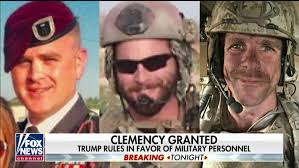
On Nov. 15, President Trump intervened in the cases of three U.S. service members accused of war crimes.

pardons

Trump signed an Executive Grant of Clemency (Full Pardon) for Army First Lieutenant Clint Lorance, an Executive Grant of Clemency (Full Pardon) for Army Major Mathew Golsteyn, both of whom were accused of murder in Afghanistan, and an order directing the promotion of Special Warfare Operator First Class Edward R. Gallagher to the grade of E-7, the rank he held before he was tried and found not guilty of nearly all of the charges against him.

In taking this action, Trump incurred the wrath of politicians, pundits and many in the general public.

A U.S. defense official told CNN that there’s concern among the department’s leadership that Trump’s pardons could undermine the military’s justice system. CNN and the New York Times also reported that senior Pentagon leadership, including Defense Secretary Mark Esper, urged Trump not to intervene in the three cases.

According to Task & Purpose,  a news site covering the military, several former military leaders echoed the same concerns.

“As President Trump intervenes in war crimes cases on behalf of individuals accused or convicted of war crimes, he … undermines decades of precedent in American military justice that has contributed to making our country’s fighting forces the envy of the world,” Gen. Charles Krulak, former commandant of the Marine Corps, said in a statement.

“I can honestly say I have not talked to a single military officer who would be in favor of pardoning any one of these three,” Gary Solis, a combat veteran and former military attorney who now teaches the laws of war at the Georgetown University Law Center and the George Washington University Law School, told Military.com.

But as contemptible and unwise as Trump’s actions are to many, he is hardly the first president to take such questionable actions.

Barack Obama issued 212 pardons and 1,715 commutations, including one of a 35-year prison sentence given to former U.S. Army soldier Bradley/Chelsea Manning for the largest leak of classified data in U.S. history to WikiLeaks.

President Bill Clinton, never one to be embarrassed by his actions, pardoned his brother Roger Clinton after Roger served a year in prison after pleading guilty to cocaine distribution charges.

In August 1999, President Bill Clinton also commuted the sentences of 16 members of FALN, a Puerto Rican paramilitary organization that had set off 120 bombs in the United States, mostly in New York City and Chicago. The commutation was opposed by the U.S. Attorney’s Office, the FBI, and the Federal Bureau of Prisons and  Congress condemned Clinton’s action by votes of 95–2 in the Senate and 311–41 in the House.

But Clinton’s most egregious pardon was one he issued on his last day in office, January 20, 2001, when, against the advice of White House aides he pardoned Marc Rich, a former hedge-fund manager. Rich had fled the U.S. during his prosecution and was living in Switzerland at the time. Rich owed $48 million in taxes and had been charged with 51 counts of tax fraud.

ThatsRich

Marc Rich

At the time of the pardon, Rich was No. 6 on the government’s list of most wanted fugitives and had been on the lam, albeit a luxurious one, for 16 years, ever since his 1983 indictment by a grand jury.

Rich’s ex-wife had donated to the Democratic National Committee, the Clinton Presidential Library and Hillary Clinton’s New York Senate campaign, raising considerable suspicion about the pardon and leading former President Jimmy Carter to call the pardon “disgraceful.”

A New York Times editorial called the pardon “a shocking abuse of presidential power.” The liberal New Republic said it “is often mentioned as Exhibit A of Clintonian sliminess.” Not that such allegations ever seemed to bother the Clintons.

And the Clintons reaped benefits from the pardon even after Rich’s death in 2013, as Rich’s former business partners, lawyers, advisers and friends continued to shower millions of dollars on the Clintons.

Of course, Clinton isn’t the only “last day in office” pardoner. Remember Peter, Paul and Mary? In 1970, Peter Yarrow was convicted of taking “improper liberties” with a 14-year-old fan, for which he spent three months in jail. On his last day in office, President Jimmy Carter granted Yarrow a pardon.

President George H.W. Bush was roundly condemned for pardoning, commuting the sentences and rescinding the convictions of six people convicted in the Iran-Contra arms-for-hostages scandal during Reagan’s presidency,

Reagan stepped up, too, pardoning New York Yankees owner George Steinbrenner after he pleaded guilty to illegally contributing to Nixon’s campaign.

Then there’s Nixon. In 1974, President Gerald Ford granted a “full, free and absolute pardon” to his predecessor Richard Nixon “for all offenses against the United States.” This broadly unpopular action was the only time a president has received a pardon. It caused a huge firestorm because Nixon was so unpopular and because there was suspicion that Ford secretly promised to pardon Nixon in exchange for him resigning and allowing Vice President Ford to succeed him.

So much for punishing bad behavior.