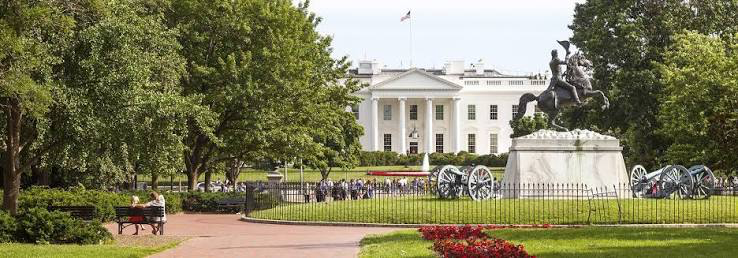
Lafayette Park north of the White House is one of the most prominent hubs for political protests in the country and a beacon for the first amendment.
So, of course, President Trump, not content with destroying the Rose Garden and the West Wing, is continuing his rampage through Washington’s landmarks with a move to permanently surround the park with an 8-9 ft. fence. That would allow the park to be closed at Trump’s discretion.
On Thursday, July 16, the Commission of Fine Arts, a federal design panel stuffed with Trump supplicants, indicated support for the plan.
“This is definitely the president’s park, but also the people’s park, and it’s to be made open, but also closeable, so that it can be made safe,” James C. McCrery II, the vice chair of the Commission, told the New York Times.
Safe for whom? Safe from whom?
The park has long been the site of multiple political protests, including picketing by suffragists demanding voting rights, protests for women’s rights and the Equal Rights Amendment (ERA), demonstrations by civil rights and anti-war activists, LGBTQ activists, anti-nuclear war encampments, and Black Lives Matter demonstrations.
In 2021, the National Park Service and the White House Historical Association added three wayside markers on the north side of the park that tell the story of protest in the park, the construction of the White House by free and enslaved laborers, and the influence of First Lady Jacqueline Kennedy in preserving the character of the park.
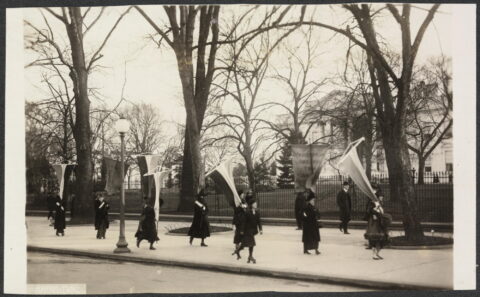
In this Library of Congress photo from 1917, suffragists march with banners, picketing outside on the sidewalk in front of the White House.
The Secret Service, the Executive Office of the President and the Department of the Interior claim they want to install the permanent fence so the park can be closed during “heightened conditions.”
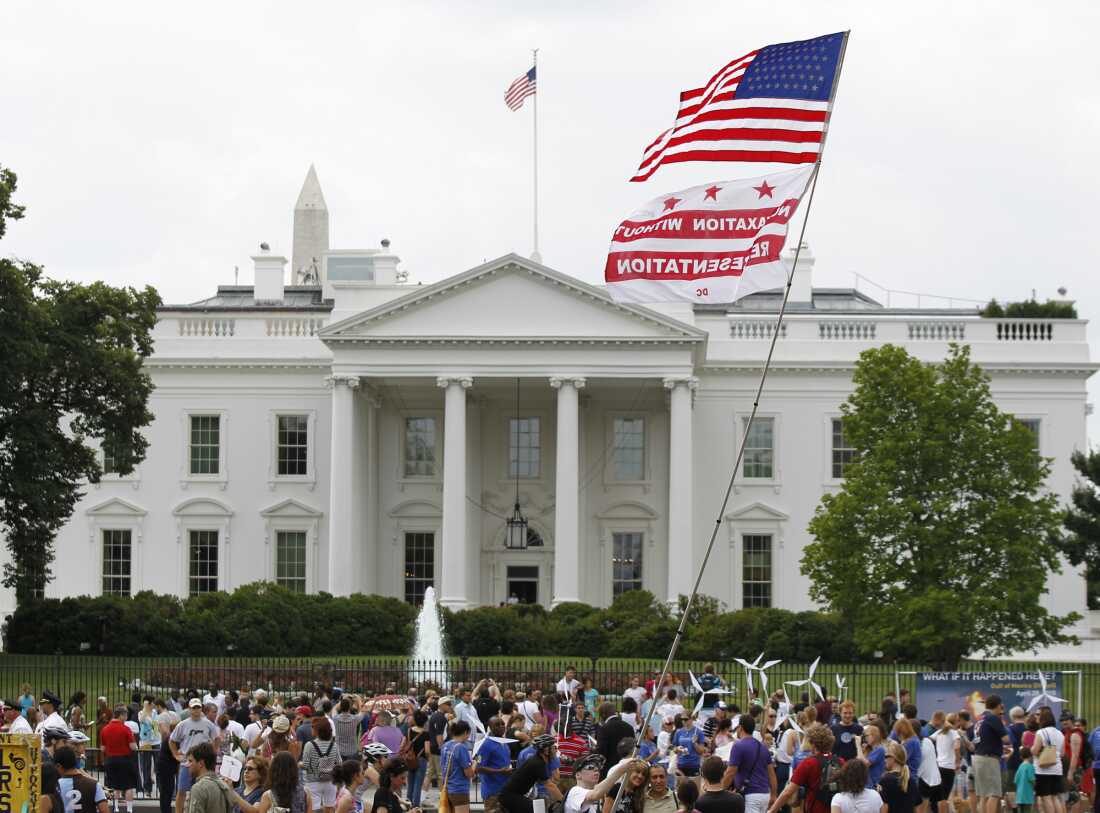
NPR ran the AP photo above by Luis Alvarez of a rally in Lafayette Park to show how close protesters were able to get to the White House without barriers in 2011. Trump wants to push them back, way back.
“What this fencing represents, to me, is the worst of what the new attitude toward politics represents,” Marty Pearl, 83, who brought a “Hate Won’t Make America Great” sign to the area, told NPR. “And that is imperialism, fascism, dictatorship, because what dictators do is isolate themselves from the people they rule. That is not, for me, the way democracies can possibly work.”
He’s right. Putting our political leaders more and more behind barriers and keeping them more and more distant from the people they serve diminishes our democracy.
And Trump doesn’t want to stop with the fence.
In June, the Washington Post disclosed that Trump is secretly planting a monument to himself in Lafayette Square in the form of 47 maple trees as a nod to being the 47th president.
Enough!
Postcript:
Clay Pearce · on Facebook
J͏u͏l͏y͏ ͏3͏0͏ ͏a͏t͏ ͏5͏:͏5͏6͏ ͏A͏M͏ ·
I felt a profound sense of sorrow as our plane descended into Washington, D.C., last Thursday. I hadn’t been to our nation’s capital since 2008.
As we drove to our hotel, a deep heaviness settled over me. We passed National Guard troops stationed on street corners and around monuments. It was deeply unsettling to see armed American soldiers patrolling the streets of our nation’s capital.
Passing the Labor Department, I saw two enormous, Stalin-esque banners of Trump and Teddy Roosevelt hanging from the building. I couldn’t help but wonder how we had reached a point where the president of the United States was being glorified on government buildings in a way that felt more like a personality cult than a democracy.
The next morning, we walked toward Dupont Circle and saw more armed troops, ICE agents, and Secret Service personnel patrolling the streets. When we headed toward the White House, police and military vehicles blocked the usual road.
We were directed to a small viewing area where we could barely see the White House through a sixteen-foot fence surrounding Lafayette Park.
Americans, Australians, Colombians, and people from around the world were gathered there, straining to catch a glimpse of the people’s house through the massive barrier.
I was horrified.
The White House belongs to the American people. Lafayette Square belongs to the American people. These are symbols of our democracy—not private property to be barricaded and hidden from the public.
 ThinkingOregon