Wyden and Merkley: Out of Bounds

Senators Ron Wyden and Jeff Merkley (D-OR) should be ashamed of themselves.

wydenmerkley

The misguided duo: Sen. Ron Wyden (L) and Sen. Jeff Merkley (D-OR)

In their effort to defeat the nomination of Oregon federal prosecutor Ryan Bounds for the 9th U.S. Circuit Court of Appeals, Wyden and Merkley misrepresented the facts, relied on questionable accusations by a left-leaning judicial advocacy group, engaged in the kind of character assassination that is sadly predictable in Washington and obscured their motivations.

In September 2017, President Trump nominated Bounds, who grew up in Hermiston, OR, to fill a vacancy on the markedly liberal 9thCircuit.

That the nomination was made without the advice and consent of Wyden and Merkley hinted at a difficult road ahead. But it was a “Snapshot” report issued in February 2018 by the Alliance for Justice that provided fuel for the arguments used by Oregon’s senators. Without hesitation, they weaponized the report.

But the Alliance was no neutral observer. The Alliance is a group of 130 organizations focused on legal issues to advance progressive causes. In the 1980s, it mounted campaigns against President Ronald Reagan’s appointees to the federal courts and was a key player in a successful scorched-earth attack against D.C. Circuit Court of Appeals Judge Robert Bork, who was nominated to the Supreme Court by Reagan. The Alliance is currently a player in the fight against Trump’s nomination of Judge Brett Kavanaugh to the Supreme Court.

The Alliance’s report was a vehement broadside against Bounds, with particular criticism of some of his writings. “…while Bounds has few public writings, those he does have are deeply disturbing,” the report said. “Particularly noteworthy are several articles Bounds wrote for The Stanford Review while a college student. He expressed hostility toward multiculturalism and diversity, often using derogatory language. Throughout these writings, Bounds displayed a strong intolerance for issues or positions he deemed liberal or progressive.”

Merkley and Wyden jumped on the opportunity to use the Alliance report against Bounds in a barrage of allegations full of sound and fury, but blissfully free of substance. In a joint statement, they asserted, “…Ryan Bounds failed to disclose inflammatory writings revealing his archaic and alarming views about sexual assault, the rights of workers, people of color, and the LGBTQ community.”

The media and liberal organizations embraced the ensuing conflict, highlighting the Alliance’s report, but not its biases, and rarely offering the public online links to the report itself. The Oregonian, the New York Times and other publications and organizations referred repeatedly to Bounds’ “inflammatory” writings.

Asserting that Bounds had “expressed his disdain for multicultural values and organizations” while at Stanford University, the report cited excerpts from Stanford Review articles Bounds had written taking to task some aspects of of multiculturalism for undermining social cohesion.

“During my years in our Multicultural Garden of Eden, I have often marveled at the odd strategies that some of the more strident racial factions of the student body employ in their attempts to ‘heighten consciousness,’ ‘build tolerance,’ ‘promote diversity,’ and otherwise convince us to partake of that fruit which promises to open our eyes to a PC version of the knowledge of good and evil,” an excerpt from a February 1995 article by  Bounds read.

Bounds expressed the opinion that  groups organized around racial identity exhibit “the fundamental behaviors of group think,” have no tolerance for individualism and are too fixated on their “sensitivity”, that  “threatens to corrupt our scholastic experience and tear our student community asunder.”

Bounds may have expressed himself clumsily (he was, after all, a brash undergraduate student at the time), but his opinions then are widely shared today, particularly among conservatives. Today’s critics argue that an overemphasis on multiculturalism undermines national unity, encourages separatism over assimilation and isolates ethnic groups within the body politic.

Kenan Malik, a contributing opinion writer for The International New York Times, addressed the issue in a Foreign Affairs article, “The Failure of Multiculturalism.” Multiculturalists “seek to institutionalize diversity by putting people into ethnic and cultural boxes – into a singular, homogeneous Muslim community, for example – and defining their needs and rights accordingly,” he wrote. “Such policies, in other words, have helped create the very divisions they were meant to manage.”

Similarly, Victor Davis Hanson,a senior fellow at the Hoover Institution, recently argued in the National Review  that an overemphasis on multiculturalism is “dividing up the country according to tribal grievances,” rather than making the nation stronger by encouraging a common culture.

Claire Fagin, former President of the University of Pennsylvania, elaborated. “We are moving into a very, very hyphenated world: It’s Asian-American, African-American . . . it’s so contrary to everything I grew up with . . . when everyone fought to just be American. For many of us who stress pluralism, these are not easy times.”

The Alliance report also took Bounds to task for writing a Commentary  in the Oct. 1994 Stanford Review  “… arguing that campus sexual assault and rape victims should have to satisfy the stringent “beyond reasonable doubt” standard. The report twisted this to mean Bounds “…supports making it more difficult to hold perpetrators of campus sexual assault accountable.”

Merkley jumped on this allegation. “Is the person fit (to serve on the Circuit Court) who says that there’s nothing wrong with a university failing to properly punish an alleged rapist?” he said on the Senate floor.

In fact, what Bounds argued against was a relaxation of the burden of proof required in prosecuting alleged violations of the University’s Fundamental Standard, especially in cases of sexual assault. In making his case, he expressed the views of many legal scholars who today argue that campus tribunals operating under university procedures do not adequately protect student rights, resulting in students losing their right to due process.

In other words, Bounds’ views 24 years ago were ahead of his time and hardly worthy of condemnation today.

Even worse, in a particularly egregious overreach, Wyden suggested a connection between Bounds and the Nazis.

Bounds  “…essentially compared tolerance and diversity to Nazi practices” in his writings, Wyden said to Willamette Week.  “…my late great Uncle Max was one of the last to be gassed in Auschwitz, and the idea that comparing tolerance to the Nazis is just so offensive that this is somebody who was not fit to be on an important court. A judge ought to be held to a higher standard.”

Nazis! Auschwitz! This crossed the dividing line between civil discourse and hysterical vitriol.

Wyden was presumably castigating Bounds for writing, “I am mystified because these tactics (by racial factions at Stanford) seem always to contribute more to restricting consciousness, aggravating intolerance, and pigeonholing cultural identities than many a Nazi bookburning.”

Merkley piled on, asking in remarks on the Senate floor, “Is the individual fit when the individual says that promoting diversity contributes more to restricting consciousness and aggravating intolerance than a Nazi bookburning?”

But that’s not really what Bounds said. Bounds was saying that some of the divisive tactics adopted by campus groups were more harmful to the school’s sense of community than the censoring of beliefs and ideas represented by the hateful burning of works decreed by propaganda minister Joseph Goebbels to be “un-German”.

Bounds was most certainly not equating tolerance with Nazism. Accusations that he was were a political cheap shot that illustrate the depths to which politicians will sink in this hyper-partisan time.

Wyden and Merkley celebrated when Senate Majority Leader Mitch McConnell abruptly withdrew Bounds’ name on July 19, 2018 after a Republican Senator, Tim Scott (R-NC), indicated he wouldn’t vote for Bounds.

Though Wyden and Merkley tried to sound high-minded in their victory, their real elation was that they had set the stage for possibly delaying a vote on Brett Kavanaugh’s nomination to  a seat on the Supreme Court until after the midterms (when the Democrats hope to take control) or defeating the nomination based on some as yet undiscovered material.

Sen. Dianne Feinstein (D-CA), Chair of the Senate Judiciary Committee, has already said Bounds withdrawal makes it clear the Senate should have access to all the records associated with Kavanaugh’s lengthy career in Washington before voting on his nomination.

“If Republicans agreed that Bounds is not qualified because of what he wrote in college, how could they possibly argue that material from Brett Kavanaugh’s time in the White House and as a political operative aren’t relevant?” Feinstein said in a statement        released the same day as McConnell’s announcement.

Before Bounds’ withdrawal, Wyden told Willamette Week  that Senators are honorable people. “We don’t reward people who mislead,” he said.

Apparently they do.


Don’t bet on public support for Oregon’s sanctuary law

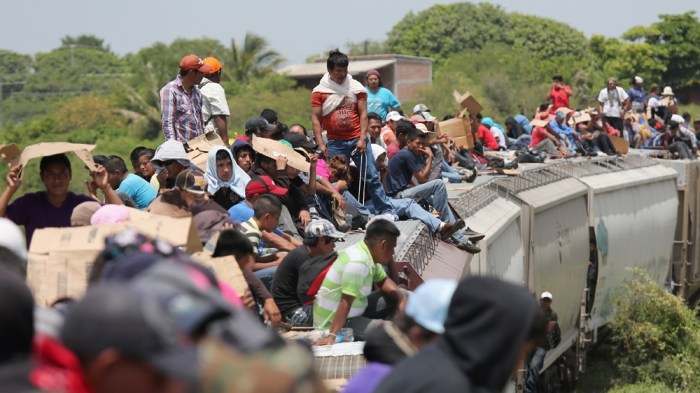
illegalimmigrantstrain

Ballot Measure 105, which would throw out Oregon’s Sanctuary law, doesn’t have a prayer in November, right?

Certainly not in Democrat-led Oregon with its progressive bastions of Multnomah, Lane and Benton Counties and the large overwhelmingly liberal population of Portland.

Don’t be so sure.

Beneath the surface of highly visible and noisy liberal activism there’s considerable concern among the general public about illegal immigration and its ties to a breakdown in respect for the law.

Even many diehard liberals, though supportive of legal immigration, are showing frustration with illegal immigration and with those advocating open borders and the abolition of ICE.

Many are becoming not just uncomfortable with illegal immigration, but hostile to it, seeing as as inimical to an ordered society.

If there was ever a consensus among liberals that welcoming all immigrants, legal and illegal, was the right and moral thing to do, that consensus has shattered.

In a March 2018 Gallup poll, for example, 58 percent of respondents, including 48 percent of Democrats, said they were worried about illegal immigration. This level of concern is typical of what Gallup has measured over the past 18 years, apart from a window between 2006 and 2011 when roughly two-thirds of Americans expressed worry.

That may be one reason why Measure 105’s opponents have come together as Oregonians United Against Profiling, avoiding any reference to illegal immigrants, undocumented immigrants or illegal aliens.

An early sign of public discomfort with illegal immigrants in Oregon came in 2014. That was when, despite a slew of organizations and public figures urging a yes vote, voters overwhelmingly overturned a state lawthat would have given state issued photo ID in the form of driver cards“without requiring a person to provide proof of legal presence in the United States.”

Public impatience with the ICE protest camp adjacent to the U.S. Immigration and Customs Enforcement offices in South Waterfront was also a sign of liberal weariness with immigration activists.

ICEprotest

While Portland liberals might once have been expected to embrace the protesters, it became clear as the protest continued that support for the camp was dwindling, particularly among residents and business owners in the South Waterfront area. Liberals there didn’t want their upscale neighborhood trashed by hostile, obscenity-spewing, pathway-blocking, unruly protesters either. Even Mayor Wheeler, who initially took a hands-off stance, buckled to public pressure to close down the camp.

Liberal tolerance in Oregon, particularly in Portland, is also being tested by problems associated with escalating homelessness.

When Officer Daryl Turner, president of the Portland Police Association, wrote in a July 16 Facebook post, “Our city has become a cesspool,”the public response was largely supportive.

turnercesspool

In a KGW News poll asking if viewers agreed with Turner, 94 percent of respondents said yes. Even many online commenters on Portland media sites agreed. “I am a liberal, but am with police on this one,” said a Willamette Week commenter. “Undermining their hard work is counterproductive and hurts us all.”

Awareness if shifting public attitudes on illegal immigrants may have contributed to today’s statement by Knute Buehler, Republican candidate for governor, that he supports Measure 105.

“I see it as way to remove barriers between local and state law enforcement communicating and cooperating with federal officials to keep Oregonians safe. It’s regrettable that this measure is even needed.”

All this tells me the defeat of Measure 105 is far from a sure thing.


United States Olympic Committee: rotten at the top

Sexual abuse isn’t the only scandal under the United States Olympic Committee (USOC).

While most of Oregon’s Olympic hopefuls and those from around the country have had to scramble to pay the bills for their training, employees of the non-profit USOC have been wallowing in exorbitant salaries.

USOClogo

“The road to Pyeongchang is paved with blood, sweat, tears, and a whole lot of money,”  the Aspen Times wrote before the 2018 Winter Olympics. But not every aspiring Olympic athlete has a big bank account.

“Many of them had to crowdfund to get (to PyeongChang),” wrote Washington Post reporter Sally Jenkins. “They bartended, cleaned houses and begged their local police to hold bake sales to help them pay for training and plane tickets.” More than 1,000 campaigns were up on crowdfunding site GoFundMe when you searched “2018 Olympics.” And only a handful of Olympians actually reap big payoffs from their victories.

Meanwhile, USOC executives and staff rake in the dough.

According to the USOC’s Form 990 tax return to the IRS, USOC staff took home $52,949,974 in salaries, other compensation and employee benefits in 2016. At least 13 of the non-profit’s 375 employees collected over $300,000 each and 129 individuals collected over $100,000 each.

And the compensation numbers are just as distressing at some of 47 national governing bodies under the USOC umbrella.

USA Swimming, for example, is responsible for selecting and training teams for international competition including the Olympic Games. In 2016, when the USA Swimming Board of Directors extended the contract of USA Swimming Executive Director Chuck Wielgus through Dec. 31, 2020 , it agreed to pay him just short of $1 million a year.

This despite serious questions about sexual abuse claims by swimmers and a 2014 story, Unprotected, in Outdoors Magazine that blew the lid on swimmers’ complaints.”There’s a horror in the shadows of American competitive swimming: a continuing legacy of sexual abuse, usually involving male coaches who prey on young women—and a governing body that looks the other way,” Outdoor writer  Rachel Sturtz reported. Wielgus died of complications from colon cancer in April 2017.

Another national governing body, the U.S. Ski and Snowboard Association (USSA), compensated both a former and current CEO in the year ending April 30, 2017, according to its Form 990 .  William Marolt, who led the USSA as CEO for 18 years before retiring in March 2014, received $741,696 in compensation while his successor, Tiger Shaw, pulled in $510,683.

Then there was Dan Flynn, CEO of U.S. Soccer, whose compensation for the year ending April 30, 2017 totaled $832,655. The U.S. men failed to even qualify for the 2016 Olympics soccer tournament; the American women lost to Sweden in the earliest exit the team had ever made in a major tournament.

The USOC revels in pushing out heartwarming stories about the noble Olympics and the athletes who sacrifice to achieve their dreams for America’s greater glory, but it doesn’t talk much about the loot its executives and staff pull in.

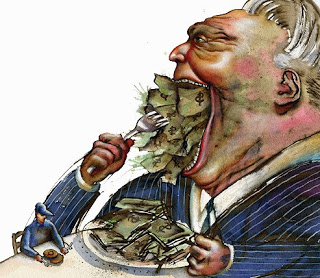
money_pigs2

“A house built on greed cannot long endure.” Edward Abbey

In 2016, the most recent year for which compensation data is available, high earners at the USOC included:

CEO Scott A. Blackmun: $1,075,604

Chief Financial Officer Morane Kerek: $301,586

General Counsel Christopher McCleary: $417,416

Chief of Paralympics/NGB Richard W. Adams: $371,550

Chief of Sport Performance Alan R. Ashley: $498,252

Chief Marketing Officer Lisa P. Baird: $592,934

Chief Development Officer Jon M. Denney: $579,027

Chief of Communications Patrick D. Sandusky: $434,622

Managing Director Info Technology Trevor E. Miller: $359,750

Managing Director Marketing Richard Poll: $340,015

Mng. Director, Govt. Relations, Desiree Filippone: $327,529

Mng. Dir. Marketing Peter Zeytoonjian: $301,695

Former Chief Paralympic Russell C. Huebner: $336,754

CEO Blackmun resigned in March 2017, ostensibly because of health problems, but also likely because of sex abuse scandals and oft-criticized excessive salaries at the USOC.

The outrageous compensation payments in 2016 were part of a pattern of steadily escalating compensation in recent years. The 2016 payments were 13 percent higher than payments in 2014 ($47,026,640) and 2014 payments were 7 percent higher than payments in 2012 ($43,939,962).

“To many Olympic athletes, those USOC executives still look like the 1 percent,” wrote Philip Hersh, a former Olympic Specialist for the Chicago Tribune. “That is not an image they should want.”


P.S.: The just-completed World Cup reminds us that it’s not just the Olympics that’s over the top in handing out money. The 36 members of scandal plagued FIFA are scheduled to meet just three times this year, but each will be paid $250,000  for their participation.

worldcup


KGW and CBD: A failure to inform

CBDfromplant

It wasn’t exactly fake news, but it wasn’t the whole story either.

On Monday, July 9, KGW-TV ran a story about how CBD-infused products are gaining popularity.

 CBD is one of many compounds, known as cannabinoids, that are found in the cannabis plant. Unlike THC, CBD is not psychoactive. It does not change the state of mind of the person who uses it, although it does appear to produce significant changes in the body.

The KGW story came across more as breathless cheerleading than a news report.

It began with a folksy item about a brewer infusing his beer with CBD for flavor.

“But it also has some other benefits,” said reporter, Keely Chalmers. “Many health experts believe CBD helps with things like pain, anxiety, seizures, even some cancers.”

That might be why business at a Portland CBD Hemp Store, where you can get CBD-infused candy, dog treats, oils and more, has been so good, she continued.

The story also featured a massage therapist who began offering CBD-infused massages and “within weeks the calls from satisfied customers started pouring in.”

Chalmers even threw in a segment featuring Dr. Nephi Stella, Co Director
of the University of Washington – Center for Cannabis Research, who she said asserts that CBD “has proven therapeutic qualities and is safe.”

Cannabinoids have a very good safety profile,” the researcher said in an interview. ‘It all depends on dosage and how much you take and how often.”

Sounds good, huh?

But there’s an unmentioned problem. There are still very little long-term safety data available and there is “no scientific evidence” that most CBD products can be effectively used to treat or cure serious diseases, according to the U.S. Food and Drug Administration (FDA).

The only product the FDA has approved, based on well-controlled clinical trials, is a purified form of CBD to treat seizures associated with two rare, severe forms of epilepsy in patients two years of age and older.

Not only is there no scientific evidence that other CBD products are safe or effective, but the FDA has taken recent actions against companies distributing unapproved CBD products marketed in a variety of formulations, such as oil drops, capsules, syrups, teas, and topical lotions and creams.

…we remain concerned about the proliferation and illegal marketing of unapproved CBD-containing products with unproven medical claims,” FDA Commissioner Scott Gottlieb said on June 25, 2018. “The promotion and use of these unapproved products may keep some patients from accessing appropriate, recognized therapies to treat serious and even fatal diseases.”

The KGW report also failed to disclose that CBD products are being produced in a no man’s land in terms of regulation. “CBD is being produced without any regulation, resulting in products that vary widely in quality,” said Marcel Bonn-Miller at the University of Pennsylvania School of Medicine. “It really is the Wild West. Joe Bob who starts up a CBD company could say whatever the hell he wants on a label and sell it to people.”

And even where people have used CBD in some form and claimed it had a positive effect, that’s hardly scientific proof of efficacy. “There’s no control, so it’s basically how do you know if we’re dealing with the true effect of the drug or just simply a placebo effect because somebody thinks they’ve been given a drug that will be beneficial?” said Timothy Welty, chair of the department of clinical sciences at Drake University’s College of Pharmacy and Health Sciences, in Des Moines, Iowa.

KGW’s story wasn’t false information designed to masquerade as news, the definition the Columbia Journalism Review says is favored by most white papers and news reports about the problem. Instead, as in so many other media failures, the error was one of omission.

And that undermines trust in the media.


Starbucks: Another nice mess

starbucksprotestinPhilly

Starbucks is in a mess of its own making, and it’s going to get worse.

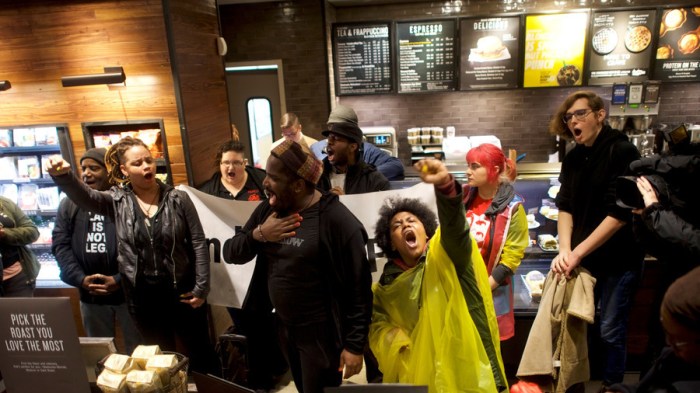
On Monday, July 2, a report  prepared at Starbucks’ request came out advising the company on its diversity efforts. The report followed an incident in April when a store manager in Philadelphia called the police after two black men who hadn’t bought anything didn’t leave the store when asked.

The report’s extensive list of recommendations, if adopted, would reach deep into Starbucks’ operations with a litany of actions high on the liberal agenda. Now, if Starbucks fails to embrace the recommendations it will surely be subject to more accusations of racial bias and bad faith.

But the list shouldn’t have come as a surprise to Starbucks. After all, in a bid to placate the left, Starbucks gave the report assignment to the NAACP Legal Defense and Educational Fund and Heather McGhee, former president and now senior fellow of Demos.

The NAACP is hardly a neutral observer on racial issues and Demos is a left-wing think tank launched in 2000 by a group of liberal activists, journalists and politicians, including then-state Senator Barack Obama. To top it off, Demos’ Board Chair is progressive Senator Elizabeth Warren’s daughter, Amelia Warren Tyagi.

Reading the report’s recommendations is like listening to a panel composed of Al Sharpton, Rachel Maddow, Cornell West, George Soros and Jon Stewart:

  • Encourage unionization of Starbucks’ workforce. “…we recommend that the company recognize, respect and encourage the fundamental civil right that is collective bargaining.”
  • Make worker pay transparent. Let all workers know what other workers are making.
  • Do a Civil Rights Audit.“…conduct…a comprehensive and independent review of the company’s processes, policies and outcomes across a range of metrics, including racial diversity of staff at all levels and contractors throughout the supply chain.”
  • Change how staff are evaluated and promoted. “Bluntly, some managers and even corporate leadership may not have a future with the company under the new standards. “
  • Pay a $15 an hour starting wage.“Economic security is a racial equity issue.” (According to Glassdoor, a typical Starbucks Barista salary is $9 an hour)
  • Provide support to police departments. Offer financial and in-kind support to assist with anti-bias training by police departments and in-kind rewards to departments that complete initial trainings.
  • Eliminate arbitration requirements. “Mandatory arbitration agreements prevent employees from bringing individual claims in federal courts, essentially privatizing civil rights employment claims.”
  • Give money for education. Commit financial resources towards supporting college readiness and SAT preparation programs in Philadelphia high schools.

And as if that isn’t enough interference in Starbucks’ business, the report says Starbucks should, “Appoint an independent consultant…to monitor the effectiveness of these measures, and to regularly report back to civil rights organizations.”

You can be sure that the left will assiduously follow Starbuck’s follow-up on the report’s recommendations and call out the company publicly for any perceived sluggishness in implementing change.

And the media will breathlessly jump on every allegation, presenting a constant management and public relations nightmare.

Listen carefully and you can almost hear the company’s employees and shareholders muttering the Laurel and Hardy line— “Well , here’s another nice mess you’ve gotten me into!”

Another fine mess

What now after Janus? More union decertifications.

decertification1

The Supreme Court decided on Wednesday that public sector unions cannot require that workers who choose not to join help pay for collective bargaining. The decision will likely cause thousands of workers to opt out of paying ”agency” or “fair share” fees to public unions.

The National Education Association (NEA), for example, is expecting a nearly 14 percent membership loss and a $50 million budget reduction over the next two years.

Oregon, which has about 145,000 government employees covered by union contracts, is one of 22 states that require workers to pay such fees. That haul is now at risk, too.

Justice Samuel A. Alito Jr. wrote that requiring all workers to finance union activity violated the First Amendment. “We conclude that this arrangement violates the free speech rights of nonmembers by compelling them to subsidize private speech on matters of substantial public concern.”

Now there’s one more action that’s likely — efforts to enhance worker awareness of the union decertification process and the initiation of more decertification elections.

Decertification is the process where the National Labor Relations Board (NLRB) allows employees to call for a special election to eliminate their union as their “exclusive representative.”  It takes away the union’s authority to act as the workers’ bargaining representative.Employees can file for a decertification election if they believe support for their union has diminished and they have gathered signatures from at least 30 percent of workers.

Decertification actions often occur when members conclude their union is undemocratic, corrupt, inept or has simply overstayed its welcome. Decertification efforts also become more attractive when union membership was decided years before by a substantially different workforce or in situations where there is high workforce turnover. In both cases, questions arise as to whether union representation decided by others should continue in perpetuity.

“Democratic elections are a hallmark of a free society, and for good reason,” says the Freedom Foundation, a non-profit working to minimize the power of unions. “Holding regular elections for our leaders helps keep them accountable and responsive to the people. It encourages healthy debate about the direction of our society and prevents power from becoming entrenched and abusive. The same principles should apply to labor unions for the same reasons.”

In 2012, employees of St. Charles Hospital in Bend voted 334-212 to end their representation by the Service Employees International Union.

A prime candidate for a decertification vote down the road In Oregon is likely to be Burgerville because of its high employee turnover.

“High-employee turnover rates are the root of many decertification votes,” according to Eric Fink, an associate law professor at N.C.’s Elon University. “Typically, newer workers who did not fight for union representation in the first place are less loyal to the union than older workers.” Fink’s made his comment in connection with a July 2017 vote by FedEx Freight drivers in Charlotte, N.C. to decertify the International Brotherhood of Teamsters Local 71.

In April 2018, workers at a Burgerville at Southeast 92nd Avenue and Powell Boulevard in Southeast Portland voted 18-4 in favor of forming a union, requiring that Burgerville negotiate with the workers. Workers at a Burgerville on Southeast McLoughlin Boulevard followed with a 17-5 vote in favor of forming a union. The Burgerville chain owned by Holland Inc.

But the success of workers at these two Burgerville sites and any others down the line may be short-lived. That’s because Burgerville and the entire fast food industry have exceedingly high turnover rates, often in the 150 percent range. That means a restaurant with 20 workers has to hire 30 new people every year, many of whom might not support the union. Turnover is particularly high when a significant number of jobs are entry level and filled by young people in school or focused on enhancing their low income through job switching.

Fast Companyrecently reported that the fast-food industry is currently grappling with record employee turnover, much of that because of new technologies. It’s not burger-flipping robots affecting things so much as things like mobile apps, delivery, and self-order kiosks that are easy for customers to use, but have a learning curve for employees.

With the Janus ruling, aggressive pushes for decertification may be the next priority for individuals and organizations seeking to lessen the influence of unions.


Sports Betting: The Mississippi Choctaws may be first; will Oregon tribes be next?

The Mississippi Band of Choctaw Indians is expecting to be the first Native American tribe in the U.S. to offer sports betting in the wake of the U.S. Supreme Court’s May 14, 2017 decision striking down a federal law that prohibited sports gambling.

The Choctaw Tribal Council has started the ball rolling by approving professional and collegiate sports bettingat the Choctaw’s Silver Star Casino and the Golden Moon Casino at the Pearl River Resort near Philadelphia, MS and the Bok Homa Casino in Choctaw, MS.

GoldenMoonHotelandCasino

The Golden Moon Hotel and Casino, one of the planned sports betting sites in Mississippi.

Nine Native American tribes own and operate Indian casinos in Oregon, a small fraction of the 238 tribes in 28 states that offer some form of gaming, according to the National Indian Gaming Commission.You can bet all the tribes are going to go after a piece of the sports betting action.

The only casinos currently allowed in Oregon have to be owned and operated by Native American tribes. It’s not clear how the legalization of sports betting will play out in that circumstance.

One thing that’s for sure is that the tribes aren’t going to be alone in wanting to capture sports betting revenue.

Professional sports leagues have already said they want a cut. Leagues would receive 1 percent of the total wagered on their sporting events under a proposal presented in May by NBA Senior Vice President Dan Spillane. “Without our games and fans, there could be no sports betting,” Spillane testified at a legislative panel studying the prospect of legalized sports gambling in New York.

The NBA and MLB have already drafted model legislation that would enshrine a 1 percent “integrity fee” in law and they have sent forth a phalanx of expensive lobbyists to statehouses to advance their agenda.

The LEAD1 Association, which represents athletic directors at 130 colleges, including directors at the University of Oregon and Oregon State University, has said colleges deserve integrity fees as well.

Let the games begin.

Send Oregon’s sports betting revenue to PERS.

You know Oregon’s going to do it?

Jump into legalized sports betting, that is.

sportsbetting

According to the American Gaming Association, Americans already illegally bet $150 billion on sports every year. With the May 14, 2018 Supreme Court decision overturning the Professional and Amateur Sports Protection Act (PASPA) and allowing states to legalize sports betting, Oregon’s going to want to cash in.

A political consultant working with California card clubs, online and out-of-state gambling firms and sports leagues has already proposed for the November 2020 ballot an initiative to legalize sports betting in the state. The consultant submitted a formal request on June 11 to the state attorney general’s office to prepare a title and summary for a possible initiative.

Professional sports leagues are getting ready, too. They’ve have already made it clear they want a cut of the action.

Leagues would receive 1 percent of the total wagered on their sporting events under a proposal presented in May by NBA Senior Vice President Dan Spillane. “Without our games and fans, there could be no sports betting,” Spillane testified at a legislative panel studying the prospect of legalized sports gambling in New York.

The NBA and MLB have already drafted model legislation that would enshrine the 1 percent “integrity fee” in law and they have sent forth a phalanx of expensive lobbyists to statehouses to advance their agenda.  The Professional Golfers’ Associationhas endorsed the integrity fee concept and the LEAD1 Association, which represents athletic directors at 130 colleges, including directors at the University of Oregon and Oregon State University, has said colleges deserve integrity fees as well.

“Our athletic directors are concerned not only about the vulnerability of young student-athletes to inducements of point shaving, but by the increased compliance costs to keep their programs clean,” LEAD1 said in a May 15, 2018 press release. “We have seen these cost increases in athletic programs in Nevada (for example, University of Nevada, Las Vegas (UNLV)) where sports betting is legalized, and these compliance costs can run into the hundreds of thousands of dollars. It is crucially important that states help athletic departments secure the extra resources to ensure that student-athletes stay out of trouble. A point shaving scandal would be catastrophic to an athletic department and university.”

Then, of course, there are the athletes. On April 12, 2018, before the Supreme Court decision, four players’ unions, the MLBPA, NBPA, NFLPA and NHLPA, issued a media release  saying their members should get a cut of sports betting revenue, too. “Betting on sports may become widely legal, but we cannot allow those who have lobbied the hardest for sports gambling to be the only ones controlling how it would be ushered into our businesses,” the release said. “The athletes must also have a seat at the table to ensure that players’ rights and the integrity of our games are protected.”

Just as Oregon’s legislators have welcomed the influx of marijuana tax money, the prospect of sports gambling tax revenue probably has some of them salivating. Current recipients of state lottery revenues, including the seven public universities in the state whose athletic departments receive a cut, are anxiously awaiting sports betting money, too.

But dividing up sports betting revenue the way the state spreads around lottery and marijuana tax revenue would be a mistake. Instead, the one program that needs the money the most, PERS, should get ALL of it.o

Reducing PERS’ estimated $25 billion unfunded liability (UAL) with sports betting revenue has the advantage of not requiring any changes to future benefits of public employees, something their unions have vigorously resisted.

In Nov. 2017, a PERS UAL Task Force appointed by Governor Brown to review and propose options for making payments toward the PERS UAL listed increased lottery revenue from the expansion of different game platforms or new types of games or retailers as a possible source of funds to help rescue PERS.

The Task Force did not specifically address the use of potential revenue from sports betting. It did, however, say that using lottery revenue to reduce the UAL for schools would likely be permissible under the state constitution as “financing public education.”

So just do it.


Commissioner Fritz spills the beans: Portland’s CEO pay ratio tax isn’t about addressing inequality

taxes-2

Every once in a while politicians let the truth slip out.

The Portland City Council said it wanted to send a message about income inequality when it voted in Dec. 2016 to impose a surtax on CEO compensation. The misguided surtax, based on an arbitrary statistic, was to be added to the city’s business tax on publicly traded companies whose chief executives earn more than 100 times the median pay of their employees. No limits would apply to privately-held companies.

The city figured the surtax would generate about $2.5 million per year. Then-Commissioner Steve Novick, the sponsor of the measure, said he hoped it “would prod corporate America back to equitable pay scales.”

The surtax and the pending hike of the city’s business license tax are a part of an effort to create a “more equitable” tax structure, Commissioner Amanda Fritz said. “Taxing the rich is something people in Portland have been asking us to do.”

But Fritz’ explanation was a ruse. She didn’t vote for the tax because it would address income inequality. She just wanted the city to collect more money. That’s it. Plain and simple.

I know this because I posted a story last week about the whole CEO pay ratio issue and Portland’s adoption of the pay ratio tax. I argued that the whole pay ratio concept was flawed, misleading and meaningless.

The real motive of the pay ratio advocates, I said, was to give the left a tool to propel its inequality agenda, to promote envy and class warfare, and to argue that the once-great America as a land of opportunity is vanishing and that more aggressive government intervention guided by left wing principles is necessary.

Fritz responded to me directly, writing that the real reason for the pay ratio tax was just one word, “revenue.”  “… to expand on that, taxes pay for services,” Fritz said. “The $3 million annually collected via the CEO tax will help pay for many vital public services.”

amandafritz

More money. That’s what I want. Commissioner Amanda Fritz

In other words, forget about all this fighting inequality blather. The city wanted more revenue and the CEO pay ratio tax was one way to get it.

It’s just another example of the City of Portland nickel and diming taxpayers.


One Word for the SEC’s Pay Ratio Rule and Portland’s Pay Ratio Tax: Hogwash.


doesntaddup

The pay ratio idea just doesn’t add up.

The May 27, 2018 print edition of The Oregonian devoted 1600 words to a story about an SEC requirement that companies report on the pay ratios of their CEO and other workers and on a new Portland tax tied to CEO pay ratios. The New York Times, the Wall Street Journal and other media have played the SEC rule story prominently as well.

Why so much attention to such foolishness?

The Dodd-Frank Act required that the Securities and Exchange Commission (SEC) enact a rule requiring that about 3,800 publicly traded companies disclose the ratio between how much they pay their CEO and how much they pay their median worker.

Passed in 2010 during the Obama administration, and set to take effect in 2017, the requirement was ostensibly to ensure that the devastating 2008 financial crisis won’t be repeated, to increase the transparency of executive compensation and to provide investors with another piece of information to consider when determining whether the compensation of their CEO is appropriate.

Sen. Robert Menendez (D-NJ), who introduced the pay ratio provisionin the Dodd-Frank Act., said ,“This simple benchmark will help investors monitor both how a company treats its average workers and whether its executive pay is reasonable.”

The AFL-CIO said the law was needed to enable corporate boards and the public to evaluate the reasonableness of CEO pay and to show which companies are investing in their workforce to create high-wage jobs.

But as a former business colleague who worked for a U.S. Senator used to tell me, “In politics, nothing is about what it’s about.”

The real motive of the pay ratio advocates was to give the left a tool to propel its inequality agenda, to promote envy and  class warfare, and to argue that the once-great America as a land of opportunity is vanishing and that more aggressive government intervention guided by liberal principles is necessary.

But as the media have been rolling out breathless stories on how flabbergasted, appalled and outraged they are by a lot of the pay ratio disclosures, they are ignoring the fact that the ratios are, by and large, both misleading and meaningless. The SEC is mandating that flawed methodologies be used by companies to report meaningless data in order to advance a political narrative.

As SEC Commissioner Michael S. Piwowar said in a dissenting statement on the pay ratio rule, “Today’s rulemaking implements a provision of the highly partisan Dodd-Frank Act that pandered to politically-connected special interest groups and, independent of the Act, could not stand on its own merits. “

“The bottom line is that this is one of the sillier and more pointless disclosures that I have ever seen,” David Yermack, a professor of finance at NYU’s Stern School of Business, told The Atlantic.

As noted in the Texas A&M Law Review, “The pay ratio disclosure will likely do nothing to further any aspect of the SEC’s mandate to protect investors, maintain fair, orderly, and efficient markets, and facilitate capital formation.”

One reason the SEC rule is pointless is because every company calculates the pay ratio differently, partly because it gives companies wide leeway in identifying median workers. To illustrate, companies don’t have to account for independent contractors if they don’t set their pay. So a company with a highly paid CEO and loads of low-paid independent contractors can massage its numbers to look better.

Companies can also manipulate the numbers by identifying their median worker in a variety of ways. One could use cash compensation alone, another salary, equity grants and other types of pay. Companies have to disclose which components they used to determine the median worker, but that can be buried in the fine print.

The pay ratio numbers also can fluctuate because of different types of businesses. To illustrate, at Goldman Sachs, an investment banking, securities and investment management firm where most employees are highly educated and highly paid professionals, the pay ratio figure will obviously be lower that at McDonalds and other fast food outlets where most employees are less educated and earn modest wages.

Businesses that employ a lot of part-time or seasonal workers, or that employ a lot of foreign workers in countries with comparatively lower wages, will also have high ratios.

To top it all off, the disclosures required by the SEC rule do little to help investors make decisions on trades. Not only is the pay ratio calculation based on wildly different data used by different companies, but CEO-worker pay ratios are not especially reliable indicators of how a company will perform.

It’s not that reporters and editorial writers don’t know the pay ratio numbers are pretty much worthless and politically motivated. It’s just that a story that gives them a chance to rail about inequality is too much to miss.

As Stanford University Professor Joseph Grundfest said when the SEC rule was finalized in 2015, “Ultimately, the ratios that companies will disclose in their SEC filings will not be grist for meaningful debate so much as fodder for shocking headlines. Individually, factoids about executive compensation can be truly, deeply bananas, and some media outlets capitalize on that.”

Portland’s pay ratio surcharge is foolish, too

greedygovernment

Government greed at work.

Given the unreliability of the pay ratio numbers, Portland’s pay ratio tax is a farce, too, just another tool to raise revenue.

And a clear message to businesses considering locating in Portland: fuhgedaboudit!

In December 2016, the Portland City Council voted to impose a surtax on CEO compensation that would be added to the city’s business tax on publicly traded companies whose chief executives earn more than 100 times the median pay of their employees.

The surcharge was set at an additional 10 percent in taxes if their CEO’s compensation is greater than 100 times the median pay of all their employees and 25 percent if the pay ratio is greater than 250 times the median.

The city figures the surtax will generate about $2.5 to $3.5 million per year.

Only Commissioner Dan Saltzman showed wisdom in voting against the proposal by then-Commissioner Steve Novick.

The fact is Portland’s tax is based on unreliable data and will fail miserably in meeting Novick’s hope that it “would prod corporate America back to equitable pay scales.”

First, as noted above, the pay ratio numbers on which the tax is based are inconsistent and unreliable. The leeway given to companies in determining the pay-ratios is so great that the numbers are meaningless.

Second, the tax on Portland companies will be irritating, but probably not burdensome to the affected companies, so it’s not likely to change their compensation practices.

Third, even if some shamed companies reduce their CEO’s pay and spread around the cut, it won’t mean much to other employees.

For example, Kroger, which owns Fred Meyer, reported its CEO’s pay as $11,534,860, which Kroger said is 547 times its median worker’s pay of $21,075.

Even if Kroger reduced its CEO’s pay to $2 million, and distributed the rest equally to Kroger’s 400,000 employees, they would each see an annual raise of just $23.84.

In other words, the Novick surcharge is just another way to pad the city’s coffers.