United States Olympic Committee: rotten at the top

Sexual abuse isn’t the only scandal under the United States Olympic Committee (USOC).

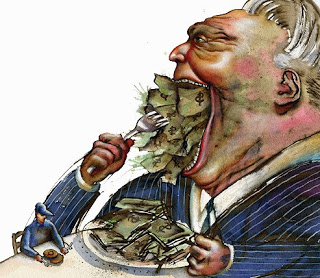
While most of Oregon’s Olympic hopefuls and those from around the country have had to scramble to pay the bills for their training, employees of the non-profit USOC have been wallowing in exorbitant salaries.
USOClogo

“The road to Pyeongchang is paved with blood, sweat, tears, and a whole lot of money,”  the Aspen Times wrote before the 2018 Winter Olympics. But not every aspiring Olympic athlete has a big bank account.

“Many of them had to crowdfund to get (to PyeongChang),” wrote Washington Post reporter Sally Jenkins. “They bartended, cleaned houses and begged their local police to hold bake sales to help them pay for training and plane tickets.” More than 1,000 campaigns were up on crowdfunding site GoFundMe when you searched “2018 Olympics.” And only a handful of Olympians actually reap big payoffs from their victories.

Meanwhile, USOC executives and staff rake in the dough.

According to the USOC’s Form 990 tax return to the IRS, USOC staff took home $52,949,974 in salaries, other compensation and employee benefits in 2016. At least 13 of the non-profit’s 375 employees collected over $300,000 each and 129 individuals collected over $100,000 each.

And the compensation numbers are just as distressing at some of 47 national governing bodies under the USOC umbrella.

USA Swimming, for example, is responsible for selecting and training teams for international competition including the Olympic Games. In 2016, when the USA Swimming Board of Directors extended the contract of USA Swimming Executive Director Chuck Wielgus through Dec. 31, 2020 , it agreed to pay him just short of $1 million a year.

This despite serious questions about sexual abuse claims by swimmers and a 2014 story, Unprotected, in Outdoors Magazine that blew the lid on swimmers’ complaints.”There’s a horror in the shadows of American competitive swimming: a continuing legacy of sexual abuse, usually involving male coaches who prey on young women—and a governing body that looks the other way,” Outdoor writer  Rachel Sturtz reported. Wielgus died of complications from colon cancer in April 2017.

Another national governing body, the U.S. Ski and Snowboard Association (USSA), compensated both a former and current CEO in the year ending April 30, 2017, according to its Form 990 .  William Marolt, who led the USSA as CEO for 18 years before retiring in March 2014, received $741,696 in compensation while his successor, Tiger Shaw, pulled in $510,683.

Then there was Dan Flynn, CEO of U.S. Soccer, whose compensation for the year ending April 30, 2017 totaled $832,655. The U.S. men failed to even qualify for the 2016 Olympics soccer tournament; the American women lost to Sweden in the earliest exit the team had ever made in a major tournament.

The USOC revels in pushing out heartwarming stories about the noble Olympics and the athletes who sacrifice to achieve their dreams for America’s greater glory, but it doesn’t talk much about the loot its executives and staff pull in.

money_pigs2

“A house built on greed cannot long endure.” Edward Abbey

In 2016, the most recent year for which compensation data is available, high earners at the USOC included:

CEO Scott A. Blackmun: $1,075,604

Chief Financial Officer Morane Kerek: $301,586

General Counsel Christopher McCleary: $417,416

Chief of Paralympics/NGB Richard W. Adams: $371,550

Chief of Sport Performance Alan R. Ashley: $498,252

Chief Marketing Officer Lisa P. Baird: $592,934

Chief Development Officer Jon M. Denney: $579,027

Chief of Communications Patrick D. Sandusky: $434,622

Managing Director Info Technology Trevor E. Miller: $359,750

Managing Director Marketing Richard Poll: $340,015

Mng. Director, Govt. Relations, Desiree Filippone: $327,529

Mng. Dir. Marketing Peter Zeytoonjian: $301,695

Former Chief Paralympic Russell C. Huebner: $336,754

CEO Blackmun resigned in March 2017, ostensibly because of health problems, but also likely because of sex abuse scandals and oft-criticized excessive salaries at the USOC.

The outrageous compensation payments in 2016 were part of a pattern of steadily escalating compensation in recent years. The 2016 payments were 13 percent higher than payments in 2014 ($47,026,640) and 2014 payments were 7 percent higher than payments in 2012 ($43,939,962).

“To many Olympic athletes, those USOC executives still look like the 1 percent,” wrote Philip Hersh, a former Olympic Specialist for the Chicago Tribune. “That is not an image they should want.”


P.S.: The just-completed World Cup reminds us that it’s not just the Olympics that’s over the top in handing out money. The 36 members of scandal plagued FIFA are scheduled to meet just three times this year, but each will be paid $250,000  for their participation.

worldcup


KGW and CBD: A failure to inform

CBDfromplant

It wasn’t exactly fake news, but it wasn’t the whole story either.

On Monday, July 9, KGW-TV ran a story about how CBD-infused products are gaining popularity.

 CBD is one of many compounds, known as cannabinoids, that are found in the cannabis plant. Unlike THC, CBD is not psychoactive. It does not change the state of mind of the person who uses it, although it does appear to produce significant changes in the body.

The KGW story came across more as breathless cheerleading than a news report.

It began with a folksy item about a brewer infusing his beer with CBD for flavor.

“But it also has some other benefits,” said reporter, Keely Chalmers. “Many health experts believe CBD helps with things like pain, anxiety, seizures, even some cancers.”

That might be why business at a Portland CBD Hemp Store, where you can get CBD-infused candy, dog treats, oils and more, has been so good, she continued.

The story also featured a massage therapist who began offering CBD-infused massages and “within weeks the calls from satisfied customers started pouring in.”

Chalmers even threw in a segment featuring Dr. Nephi Stella, Co Director
of the University of Washington – Center for Cannabis Research, who she said asserts that CBD “has proven therapeutic qualities and is safe.”

Cannabinoids have a very good safety profile,” the researcher said in an interview. ‘It all depends on dosage and how much you take and how often.”

Sounds good, huh?

But there’s an unmentioned problem. There are still very little long-term safety data available and there is “no scientific evidence” that most CBD products can be effectively used to treat or cure serious diseases, according to the U.S. Food and Drug Administration (FDA).

The only product the FDA has approved, based on well-controlled clinical trials, is a purified form of CBD to treat seizures associated with two rare, severe forms of epilepsy in patients two years of age and older.

Not only is there no scientific evidence that other CBD products are safe or effective, but the FDA has taken recent actions against companies distributing unapproved CBD products marketed in a variety of formulations, such as oil drops, capsules, syrups, teas, and topical lotions and creams.

…we remain concerned about the proliferation and illegal marketing of unapproved CBD-containing products with unproven medical claims,” FDA Commissioner Scott Gottlieb said on June 25, 2018. “The promotion and use of these unapproved products may keep some patients from accessing appropriate, recognized therapies to treat serious and even fatal diseases.”

The KGW report also failed to disclose that CBD products are being produced in a no man’s land in terms of regulation. “CBD is being produced without any regulation, resulting in products that vary widely in quality,” said Marcel Bonn-Miller at the University of Pennsylvania School of Medicine. “It really is the Wild West. Joe Bob who starts up a CBD company could say whatever the hell he wants on a label and sell it to people.”

And even where people have used CBD in some form and claimed it had a positive effect, that’s hardly scientific proof of efficacy. “There’s no control, so it’s basically how do you know if we’re dealing with the true effect of the drug or just simply a placebo effect because somebody thinks they’ve been given a drug that will be beneficial?” said Timothy Welty, chair of the department of clinical sciences at Drake University’s College of Pharmacy and Health Sciences, in Des Moines, Iowa.

KGW’s story wasn’t false information designed to masquerade as news, the definition the Columbia Journalism Review says is favored by most white papers and news reports about the problem. Instead, as in so many other media failures, the error was one of omission.

And that undermines trust in the media.


Starbucks: Another nice mess

starbucksprotestinPhilly

Starbucks is in a mess of its own making, and it’s going to get worse.

On Monday, July 2, a report  prepared at Starbucks’ request came out advising the company on its diversity efforts. The report followed an incident in April when a store manager in Philadelphia called the police after two black men who hadn’t bought anything didn’t leave the store when asked.

The report’s extensive list of recommendations, if adopted, would reach deep into Starbucks’ operations with a litany of actions high on the liberal agenda. Now, if Starbucks fails to embrace the recommendations it will surely be subject to more accusations of racial bias and bad faith.

But the list shouldn’t have come as a surprise to Starbucks. After all, in a bid to placate the left, Starbucks gave the report assignment to the NAACP Legal Defense and Educational Fund and Heather McGhee, former president and now senior fellow of Demos.

The NAACP is hardly a neutral observer on racial issues and Demos is a left-wing think tank launched in 2000 by a group of liberal activists, journalists and politicians, including then-state Senator Barack Obama. To top it off, Demos’ Board Chair is progressive Senator Elizabeth Warren’s daughter, Amelia Warren Tyagi.

Reading the report’s recommendations is like listening to a panel composed of Al Sharpton, Rachel Maddow, Cornell West, George Soros and Jon Stewart:

  • Encourage unionization of Starbucks’ workforce. “…we recommend that the company recognize, respect and encourage the fundamental civil right that is collective bargaining.”
  • Make worker pay transparent. Let all workers know what other workers are making.
  • Do a Civil Rights Audit.“…conduct…a comprehensive and independent review of the company’s processes, policies and outcomes across a range of metrics, including racial diversity of staff at all levels and contractors throughout the supply chain.”
  • Change how staff are evaluated and promoted. “Bluntly, some managers and even corporate leadership may not have a future with the company under the new standards. “
  • Pay a $15 an hour starting wage.“Economic security is a racial equity issue.” (According to Glassdoor, a typical Starbucks Barista salary is $9 an hour)
  • Provide support to police departments. Offer financial and in-kind support to assist with anti-bias training by police departments and in-kind rewards to departments that complete initial trainings.
  • Eliminate arbitration requirements. “Mandatory arbitration agreements prevent employees from bringing individual claims in federal courts, essentially privatizing civil rights employment claims.”
  • Give money for education. Commit financial resources towards supporting college readiness and SAT preparation programs in Philadelphia high schools.

And as if that isn’t enough interference in Starbucks’ business, the report says Starbucks should, “Appoint an independent consultant…to monitor the effectiveness of these measures, and to regularly report back to civil rights organizations.”

You can be sure that the left will assiduously follow Starbuck’s follow-up on the report’s recommendations and call out the company publicly for any perceived sluggishness in implementing change.

And the media will breathlessly jump on every allegation, presenting a constant management and public relations nightmare.

Listen carefully and you can almost hear the company’s employees and shareholders muttering the Laurel and Hardy line— “Well , here’s another nice mess you’ve gotten me into!”

Another fine mess

What now after Janus? More union decertifications.

decertification1

The Supreme Court decided on Wednesday that public sector unions cannot require that workers who choose not to join help pay for collective bargaining. The decision will likely cause thousands of workers to opt out of paying ”agency” or “fair share” fees to public unions.

The National Education Association (NEA), for example, is expecting a nearly 14 percent membership loss and a $50 million budget reduction over the next two years.

Oregon, which has about 145,000 government employees covered by union contracts, is one of 22 states that require workers to pay such fees. That haul is now at risk, too.

Justice Samuel A. Alito Jr. wrote that requiring all workers to finance union activity violated the First Amendment. “We conclude that this arrangement violates the free speech rights of nonmembers by compelling them to subsidize private speech on matters of substantial public concern.”

Now there’s one more action that’s likely — efforts to enhance worker awareness of the union decertification process and the initiation of more decertification elections.

Decertification is the process where the National Labor Relations Board (NLRB) allows employees to call for a special election to eliminate their union as their “exclusive representative.”  It takes away the union’s authority to act as the workers’ bargaining representative.Employees can file for a decertification election if they believe support for their union has diminished and they have gathered signatures from at least 30 percent of workers.

Decertification actions often occur when members conclude their union is undemocratic, corrupt, inept or has simply overstayed its welcome. Decertification efforts also become more attractive when union membership was decided years before by a substantially different workforce or in situations where there is high workforce turnover. In both cases, questions arise as to whether union representation decided by others should continue in perpetuity.

“Democratic elections are a hallmark of a free society, and for good reason,” says the Freedom Foundation, a non-profit working to minimize the power of unions. “Holding regular elections for our leaders helps keep them accountable and responsive to the people. It encourages healthy debate about the direction of our society and prevents power from becoming entrenched and abusive. The same principles should apply to labor unions for the same reasons.”

In 2012, employees of St. Charles Hospital in Bend voted 334-212 to end their representation by the Service Employees International Union.

A prime candidate for a decertification vote down the road In Oregon is likely to be Burgerville because of its high employee turnover.

“High-employee turnover rates are the root of many decertification votes,” according to Eric Fink, an associate law professor at N.C.’s Elon University. “Typically, newer workers who did not fight for union representation in the first place are less loyal to the union than older workers.” Fink’s made his comment in connection with a July 2017 vote by FedEx Freight drivers in Charlotte, N.C. to decertify the International Brotherhood of Teamsters Local 71.

In April 2018, workers at a Burgerville at Southeast 92nd Avenue and Powell Boulevard in Southeast Portland voted 18-4 in favor of forming a union, requiring that Burgerville negotiate with the workers. Workers at a Burgerville on Southeast McLoughlin Boulevard followed with a 17-5 vote in favor of forming a union. The Burgerville chain owned by Holland Inc.

But the success of workers at these two Burgerville sites and any others down the line may be short-lived. That’s because Burgerville and the entire fast food industry have exceedingly high turnover rates, often in the 150 percent range. That means a restaurant with 20 workers has to hire 30 new people every year, many of whom might not support the union. Turnover is particularly high when a significant number of jobs are entry level and filled by young people in school or focused on enhancing their low income through job switching.

Fast Companyrecently reported that the fast-food industry is currently grappling with record employee turnover, much of that because of new technologies. It’s not burger-flipping robots affecting things so much as things like mobile apps, delivery, and self-order kiosks that are easy for customers to use, but have a learning curve for employees.

With the Janus ruling, aggressive pushes for decertification may be the next priority for individuals and organizations seeking to lessen the influence of unions.


Sports Betting: The Mississippi Choctaws may be first; will Oregon tribes be next?

The Mississippi Band of Choctaw Indians is expecting to be the first Native American tribe in the U.S. to offer sports betting in the wake of the U.S. Supreme Court’s May 14, 2017 decision striking down a federal law that prohibited sports gambling.

The Choctaw Tribal Council has started the ball rolling by approving professional and collegiate sports bettingat the Choctaw’s Silver Star Casino and the Golden Moon Casino at the Pearl River Resort near Philadelphia, MS and the Bok Homa Casino in Choctaw, MS.

GoldenMoonHotelandCasino

The Golden Moon Hotel and Casino, one of the planned sports betting sites in Mississippi.

Nine Native American tribes own and operate Indian casinos in Oregon, a small fraction of the 238 tribes in 28 states that offer some form of gaming, according to the National Indian Gaming Commission.You can bet all the tribes are going to go after a piece of the sports betting action.

The only casinos currently allowed in Oregon have to be owned and operated by Native American tribes. It’s not clear how the legalization of sports betting will play out in that circumstance.

One thing that’s for sure is that the tribes aren’t going to be alone in wanting to capture sports betting revenue.

Professional sports leagues have already said they want a cut. Leagues would receive 1 percent of the total wagered on their sporting events under a proposal presented in May by NBA Senior Vice President Dan Spillane. “Without our games and fans, there could be no sports betting,” Spillane testified at a legislative panel studying the prospect of legalized sports gambling in New York.

The NBA and MLB have already drafted model legislation that would enshrine a 1 percent “integrity fee” in law and they have sent forth a phalanx of expensive lobbyists to statehouses to advance their agenda.

The LEAD1 Association, which represents athletic directors at 130 colleges, including directors at the University of Oregon and Oregon State University, has said colleges deserve integrity fees as well.

Let the games begin.

Send Oregon’s sports betting revenue to PERS.

You know Oregon’s going to do it?

Jump into legalized sports betting, that is.

sportsbetting

According to the American Gaming Association, Americans already illegally bet $150 billion on sports every year. With the May 14, 2018 Supreme Court decision overturning the Professional and Amateur Sports Protection Act (PASPA) and allowing states to legalize sports betting, Oregon’s going to want to cash in.

A political consultant working with California card clubs, online and out-of-state gambling firms and sports leagues has already proposed for the November 2020 ballot an initiative to legalize sports betting in the state. The consultant submitted a formal request on June 11 to the state attorney general’s office to prepare a title and summary for a possible initiative.

Professional sports leagues are getting ready, too. They’ve have already made it clear they want a cut of the action.

Leagues would receive 1 percent of the total wagered on their sporting events under a proposal presented in May by NBA Senior Vice President Dan Spillane. “Without our games and fans, there could be no sports betting,” Spillane testified at a legislative panel studying the prospect of legalized sports gambling in New York.

The NBA and MLB have already drafted model legislation that would enshrine the 1 percent “integrity fee” in law and they have sent forth a phalanx of expensive lobbyists to statehouses to advance their agenda.  The Professional Golfers’ Associationhas endorsed the integrity fee concept and the LEAD1 Association, which represents athletic directors at 130 colleges, including directors at the University of Oregon and Oregon State University, has said colleges deserve integrity fees as well.

“Our athletic directors are concerned not only about the vulnerability of young student-athletes to inducements of point shaving, but by the increased compliance costs to keep their programs clean,” LEAD1 said in a May 15, 2018 press release. “We have seen these cost increases in athletic programs in Nevada (for example, University of Nevada, Las Vegas (UNLV)) where sports betting is legalized, and these compliance costs can run into the hundreds of thousands of dollars. It is crucially important that states help athletic departments secure the extra resources to ensure that student-athletes stay out of trouble. A point shaving scandal would be catastrophic to an athletic department and university.”

Then, of course, there are the athletes. On April 12, 2018, before the Supreme Court decision, four players’ unions, the MLBPA, NBPA, NFLPA and NHLPA, issued a media release  saying their members should get a cut of sports betting revenue, too. “Betting on sports may become widely legal, but we cannot allow those who have lobbied the hardest for sports gambling to be the only ones controlling how it would be ushered into our businesses,” the release said. “The athletes must also have a seat at the table to ensure that players’ rights and the integrity of our games are protected.”

Just as Oregon’s legislators have welcomed the influx of marijuana tax money, the prospect of sports gambling tax revenue probably has some of them salivating. Current recipients of state lottery revenues, including the seven public universities in the state whose athletic departments receive a cut, are anxiously awaiting sports betting money, too.

But dividing up sports betting revenue the way the state spreads around lottery and marijuana tax revenue would be a mistake. Instead, the one program that needs the money the most, PERS, should get ALL of it.o

Reducing PERS’ estimated $25 billion unfunded liability (UAL) with sports betting revenue has the advantage of not requiring any changes to future benefits of public employees, something their unions have vigorously resisted.

In Nov. 2017, a PERS UAL Task Force appointed by Governor Brown to review and propose options for making payments toward the PERS UAL listed increased lottery revenue from the expansion of different game platforms or new types of games or retailers as a possible source of funds to help rescue PERS.

The Task Force did not specifically address the use of potential revenue from sports betting. It did, however, say that using lottery revenue to reduce the UAL for schools would likely be permissible under the state constitution as “financing public education.”

So just do it.


Commissioner Fritz spills the beans: Portland’s CEO pay ratio tax isn’t about addressing inequality

taxes-2

Every once in a while politicians let the truth slip out.

The Portland City Council said it wanted to send a message about income inequality when it voted in Dec. 2016 to impose a surtax on CEO compensation. The misguided surtax, based on an arbitrary statistic, was to be added to the city’s business tax on publicly traded companies whose chief executives earn more than 100 times the median pay of their employees. No limits would apply to privately-held companies.

The city figured the surtax would generate about $2.5 million per year. Then-Commissioner Steve Novick, the sponsor of the measure, said he hoped it “would prod corporate America back to equitable pay scales.”

The surtax and the pending hike of the city’s business license tax are a part of an effort to create a “more equitable” tax structure, Commissioner Amanda Fritz said. “Taxing the rich is something people in Portland have been asking us to do.”

But Fritz’ explanation was a ruse. She didn’t vote for the tax because it would address income inequality. She just wanted the city to collect more money. That’s it. Plain and simple.

I know this because I posted a story last week about the whole CEO pay ratio issue and Portland’s adoption of the pay ratio tax. I argued that the whole pay ratio concept was flawed, misleading and meaningless.

The real motive of the pay ratio advocates, I said, was to give the left a tool to propel its inequality agenda, to promote envy and class warfare, and to argue that the once-great America as a land of opportunity is vanishing and that more aggressive government intervention guided by left wing principles is necessary.

Fritz responded to me directly, writing that the real reason for the pay ratio tax was just one word, “revenue.”  “… to expand on that, taxes pay for services,” Fritz said. “The $3 million annually collected via the CEO tax will help pay for many vital public services.”

amandafritz

More money. That’s what I want. Commissioner Amanda Fritz

In other words, forget about all this fighting inequality blather. The city wanted more revenue and the CEO pay ratio tax was one way to get it.

It’s just another example of the City of Portland nickel and diming taxpayers.


One Word for the SEC’s Pay Ratio Rule and Portland’s Pay Ratio Tax: Hogwash.


doesntaddup

The pay ratio idea just doesn’t add up.

The May 27, 2018 print edition of The Oregonian devoted 1600 words to a story about an SEC requirement that companies report on the pay ratios of their CEO and other workers and on a new Portland tax tied to CEO pay ratios. The New York Times, the Wall Street Journal and other media have played the SEC rule story prominently as well.

Why so much attention to such foolishness?

The Dodd-Frank Act required that the Securities and Exchange Commission (SEC) enact a rule requiring that about 3,800 publicly traded companies disclose the ratio between how much they pay their CEO and how much they pay their median worker.

Passed in 2010 during the Obama administration, and set to take effect in 2017, the requirement was ostensibly to ensure that the devastating 2008 financial crisis won’t be repeated, to increase the transparency of executive compensation and to provide investors with another piece of information to consider when determining whether the compensation of their CEO is appropriate.

Sen. Robert Menendez (D-NJ), who introduced the pay ratio provisionin the Dodd-Frank Act., said ,“This simple benchmark will help investors monitor both how a company treats its average workers and whether its executive pay is reasonable.”

The AFL-CIO said the law was needed to enable corporate boards and the public to evaluate the reasonableness of CEO pay and to show which companies are investing in their workforce to create high-wage jobs.

But as a former business colleague who worked for a U.S. Senator used to tell me, “In politics, nothing is about what it’s about.”

The real motive of the pay ratio advocates was to give the left a tool to propel its inequality agenda, to promote envy and  class warfare, and to argue that the once-great America as a land of opportunity is vanishing and that more aggressive government intervention guided by liberal principles is necessary.

But as the media have been rolling out breathless stories on how flabbergasted, appalled and outraged they are by a lot of the pay ratio disclosures, they are ignoring the fact that the ratios are, by and large, both misleading and meaningless. The SEC is mandating that flawed methodologies be used by companies to report meaningless data in order to advance a political narrative.

As SEC Commissioner Michael S. Piwowar said in a dissenting statement on the pay ratio rule, “Today’s rulemaking implements a provision of the highly partisan Dodd-Frank Act that pandered to politically-connected special interest groups and, independent of the Act, could not stand on its own merits. “

“The bottom line is that this is one of the sillier and more pointless disclosures that I have ever seen,” David Yermack, a professor of finance at NYU’s Stern School of Business, told The Atlantic.

As noted in the Texas A&M Law Review, “The pay ratio disclosure will likely do nothing to further any aspect of the SEC’s mandate to protect investors, maintain fair, orderly, and efficient markets, and facilitate capital formation.”

One reason the SEC rule is pointless is because every company calculates the pay ratio differently, partly because it gives companies wide leeway in identifying median workers. To illustrate, companies don’t have to account for independent contractors if they don’t set their pay. So a company with a highly paid CEO and loads of low-paid independent contractors can massage its numbers to look better.

Companies can also manipulate the numbers by identifying their median worker in a variety of ways. One could use cash compensation alone, another salary, equity grants and other types of pay. Companies have to disclose which components they used to determine the median worker, but that can be buried in the fine print.

The pay ratio numbers also can fluctuate because of different types of businesses. To illustrate, at Goldman Sachs, an investment banking, securities and investment management firm where most employees are highly educated and highly paid professionals, the pay ratio figure will obviously be lower that at McDonalds and other fast food outlets where most employees are less educated and earn modest wages.

Businesses that employ a lot of part-time or seasonal workers, or that employ a lot of foreign workers in countries with comparatively lower wages, will also have high ratios.

To top it all off, the disclosures required by the SEC rule do little to help investors make decisions on trades. Not only is the pay ratio calculation based on wildly different data used by different companies, but CEO-worker pay ratios are not especially reliable indicators of how a company will perform.

It’s not that reporters and editorial writers don’t know the pay ratio numbers are pretty much worthless and politically motivated. It’s just that a story that gives them a chance to rail about inequality is too much to miss.

As Stanford University Professor Joseph Grundfest said when the SEC rule was finalized in 2015, “Ultimately, the ratios that companies will disclose in their SEC filings will not be grist for meaningful debate so much as fodder for shocking headlines. Individually, factoids about executive compensation can be truly, deeply bananas, and some media outlets capitalize on that.”

Portland’s pay ratio surcharge is foolish, too

greedygovernment

Government greed at work.

Given the unreliability of the pay ratio numbers, Portland’s pay ratio tax is a farce, too, just another tool to raise revenue.

And a clear message to businesses considering locating in Portland: fuhgedaboudit!

In December 2016, the Portland City Council voted to impose a surtax on CEO compensation that would be added to the city’s business tax on publicly traded companies whose chief executives earn more than 100 times the median pay of their employees.

The surcharge was set at an additional 10 percent in taxes if their CEO’s compensation is greater than 100 times the median pay of all their employees and 25 percent if the pay ratio is greater than 250 times the median.

The city figures the surtax will generate about $2.5 to $3.5 million per year.

Only Commissioner Dan Saltzman showed wisdom in voting against the proposal by then-Commissioner Steve Novick.

The fact is Portland’s tax is based on unreliable data and will fail miserably in meeting Novick’s hope that it “would prod corporate America back to equitable pay scales.”

First, as noted above, the pay ratio numbers on which the tax is based are inconsistent and unreliable. The leeway given to companies in determining the pay-ratios is so great that the numbers are meaningless.

Second, the tax on Portland companies will be irritating, but probably not burdensome to the affected companies, so it’s not likely to change their compensation practices.

Third, even if some shamed companies reduce their CEO’s pay and spread around the cut, it won’t mean much to other employees.

For example, Kroger, which owns Fred Meyer, reported its CEO’s pay as $11,534,860, which Kroger said is 547 times its median worker’s pay of $21,075.

Even if Kroger reduced its CEO’s pay to $2 million, and distributed the rest equally to Kroger’s 400,000 employees, they would each see an annual raise of just $23.84.

In other words, the Novick surcharge is just another way to pad the city’s coffers.


Oregon Connections Academy/Oregon Charter Academy: still a virtual calamity

connectionsacademy.com-large.1486544046

Real learning? Not so much.

They’re back!

The slick television commercials extolling the virtues of Oregon Connections Academy (ORCA), Oregon’s largest online public charter school, are popping up on local TV again. But don’t be fooled. ORCA, renamed Oregon Charter Academy in the 2020-2021 school  year, which draws in kids from across the state, is still failing its students and undermining Oregon’s commitment to a quality education for every child.

“Parents gave high marks for our academic rigor, program flexibility, the high quality of our teachers, and for delivering high levels of student achievement,” ORCA Principal Allison Galvin said in her most report to students and parents.

I don’t know why the parents are so thrilled. Perhaps intoxicated by ORCA’s technical, non-traditional approach, they overlook ORCA’s academic numbers, which have been getting worse in recent years, not better.

Or itmay be because the debate about online charter schools is more about people’s values than academic performance. To a lot of parents and students, online charters are really about independence, bonding with like-minded parents, having the option of choice, and escaping from what are perceived as stifling, monopolistic government bureaucracies.

Living in a cocoon of misinformation, they’re not interested in contrary data. And as neuroscientist Tali Sharot observed in her book, “The Influential Mind,” it’s hard to convince people with just data. When presented with hard evidence that contradicts their deeply held beliefs, people often work overtime to find reasons to defend those beliefs rather than modify them.

Charter schools in Oregon, including online charters, are publicly funded, so parents don’t pay tuition. Instead, the Oregon Department of Education distributes State School Fund money to each school district that sponsors a charter school.

ORCA’s sponsor is Santiam Canyon School District 129-J, which serves the communities of Mill City, Gates, Detroit and Idanha.

For the past three school years Oregon K-12 schools have assessed their performance in English Language Arts, Mathematics and Science.

ORCA’s numbers tell a dreadful story of failure, and it’s going from bad to worse.gett

The numbers below show the declining percentage of ORCA students meeting the state’s standard for school and district accountability in every category over the past three school years.

English Language Arts

2014-15   61.3 %

2015-16    61.5%

2016-17    54.2%


Math

2014-15     37.6%

2015-16     30.6%

2016-17     27.5%


Science

2014-15    62.7%

2015-16     59.3%

2016-17     56.2%

ORCA officials have blamed the academic problems of their students on the fact that ORCA takes on many students who stumbled at their former traditional brick-and-mortar public schools.

But research reveals that it’s the struggling learners who are least likely to be well served by online coursework. In other words, while struggling students are the ones most in need of traditional in-person courses, they are often shuttled off to online schools, which is exactly what they don’t need.

Because they are public schools, online charters are required to meet the same diploma requirements as Oregon’s traditional brick-and-mortar Oregon public schools.

Graduation rates at all Oregon public schools, including online charters, are calculated the same way by the Oregon Department of Education (ODE) as an “adjusted cohort graduation rate.” That rate is the percentage of all students who graduate from high school with a diploma within a four-year cohort period after they start 9th grade.

The graduation rate of all Oregon public schools in 2017 was 77 percent. ORCA’s graduation rate that year was just 64 percent.

Making things worse, the transfer of many struggling students to ORCA may, in a perverse sort of way, have helped the traditional public schools they came from. That’s because it removed academically challenged students from the rolls, improving graduation rates.

Encouraging struggling students to transfer from their brick-and-mortar school to an online school also can make their former schools appear more successful:

“When low achieving students leave, for instance, average school test scores increase,” concluded a report rom the California Legislative Analysts’ Office raising concerns about alternative schools. “This gives the appearance that the school is improving, and it allows the school to focus on the education needs of the more motivated students that remain. In addition, when students marked as ‘problems’ or ‘trouble makers’ drop out, they relieve educators of administrative headaches. As a result, inattention to the needs of these types of students can actually make schools appear more successful.”

Research suggests this is a national problem.

 “School officials nationwide dodge accountability ratings by steering low achievers to alternative programs,” ProPublica, an independent, nonprofit newsroom, reported in February 2017.

 If education is a public good—one whose results bear powerfully on our prosperity, our safety, our culture, our governance, and our civic life—you have to recognize that voters and taxpayers have a compelling interest in whether kids are learning what they should, at least in schools that call themselves public, Chester Finn Jr., President Emeritus at the Fordham Institute said in June 2017.

Oregon’s governor and legislators should recognize their compelling interest in taking ORCA and other failing online public schools to task.


Earl Blumenauer: from man of the people to multi-millionaire

NOTE: Also published on Oregon Catalyst

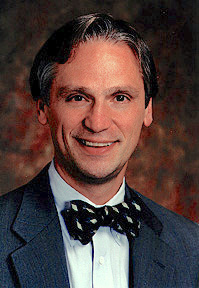
It looks like a career in elective office has been very good to Earl Blumenauer.

When Blumenauer went to Congress as a Democrat representing Oregon’s 3rd District in 1996, he was a man of modest means.

Earl_Blumenauer_1997

Rep. Earl Blumenauer (D-OR) in 1997, his first full year in office.

Now the Congressman’s a multi-millionaire.

He’s achieved his wealth while, other than a stint at Portland State University, his work history consists entirely of holding elective office.

earl_v2

Source: Derived from calculations of estimated net worth* by the Center for Responsive Politics, OpenSecrets.org

Blumenauer was sort of a wunderkind, first elected to office when he was barely out of college.

His first job after graduating from Lewis and Clark College in 1970 was assistant to the president of PSU. During his eight-year tenure there he was elected to the Oregon Legislature in 1972 and earned a law degree from Lewis and Clark in 1976.

He was elected to the Multnomah County Commission in 1978, where he worked until 1985. He was elected to the Portland City Commission in 1986, where he served until 1996. His annual salary as Commissioner in his last year was $70,610.

Blumenauer was elected to the U.S. House of Representatives in May 1996 in a special election to fill the vacancy caused by the election of then-Rep. Ron Wyden to the Senate. He was elected to a full term that November.

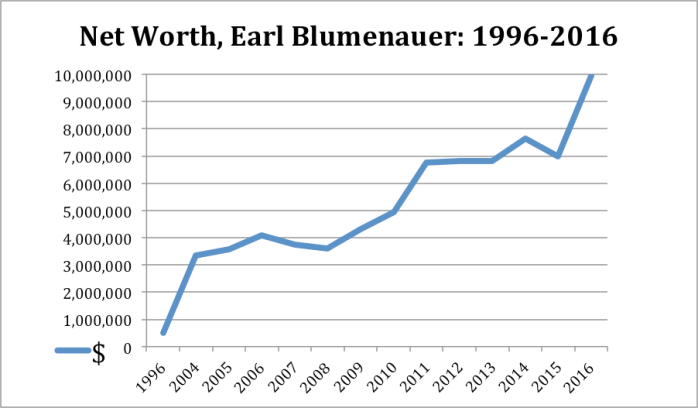
Based on the Financial Disclosure Report**  Blumenauer filed with the Clerk of the House for 1996, and using the Center for Responsive Politics’ formula for analyzing lawmakers’ finances, Blumenauer’s estimated net worth in 1996 when he took office in Congress was $504,009.

His assets included investments in a number of mutual funds, Nike stock, deposits in money market funds, Bank of America and Portland Teachers Credit Union, and investments in real estate in Portland, OR and Washington, D.C.

His Washington, D.C. property was a duplex at 510 6th St. SE he purchased on Sept. 6, 1996 for $169,000 to use as his residence. His other real estate investments were principally in Portland apartment buildings, some through Limited Liability Companies (LLCs).

Blumenauer’s potential retirement benefits from his employment in Congress and his potential PERS benefits are not required to be reported in Financial Disclosure Reports. He did, however, list his PERS account among his assets in his filing for 1999, putting its value at $250,001 – $500,000. Most Members of Congress also receive an annual salary, currently $174,000. They are not required to disclose this information either.

The numbers indicate that Blumenauer wasn’t a pauper, but neither was he filthy rich.

To say the least, he’s done quite well for himself since then.

By 2016, the most recent year for which Financial Disclosure Reports have been filed, Blumenauer, who tries to position himself as a bow-tied everyman on a bike, was, by any measure, a very wealthy man. The Center for Responsive Politics estimated his net worth at almost $10 million ($9,950,020).

Some of that increase in wealth may be related to his 2004 marriage to Margaret D. Kirkpatrick, who served as Senior Vice President of Environmental Policy and Affairs at Northwest Natural Gas Company from January 1, 2015 until January 19, 2016. Financial Disclosure Reports do not break out the individual sources of a member’s wealth.

The Center figured that Blumenauer’s net worth in 2016 made him the 20th wealthiest member of the House, up considerably from 81st in 2004, the oldest year for which ranking data has been published.

In comparison, during 2005-2015, the median net worth of all House members went from $629,250 to $888,510.

The Center for Responsive Politics reports that the top industries in which Blumenauer invested in 2016 were oil and gas (estimated investments: $3,175,000) and real estate (estimated investments: $1,475,000).

His 2016 assets included his D.C. residence, with an assessed value of $821,650 (Current estimated market value is $950,690), an investment in the Joinery Holding Co. with a value of at least $250,00 and a vacation house in Deer Isle, ME.

He included the vacation house for the first time in his Financial Disclosure Report for 2004. At that time he said he had a one-half interest in the home valued at $100,001 – $250,000. In the ensuing 14 years, he has continued to report his share of the house’s value in the same range.

Although Congressional rules require that he report all financial transactions, including purchases, sales and exchanges of assets that amount to more than $1,000 in the calendar year, Blumenauer has never reported on the purchase of the house or its address, preventing a search of Deer Isle tax records to determine the property’s current value.

Blumenauer’s 2016 assets also included over $1 million in Northwest Natural Gas stock, investments in a number of mutual funds, deposits in a Schwab Money Market Fund, the Portland Teachers Credit Union and the Congressional Federal Credit Union, and investments in Portland real estate.

In his Financial Disclosure Report for 2016, Blumenauer reported other real estate investments in four properties:

  1. The Pettygrove House, 1400 N.W. 23rd

PettygroveHouse

  1. 1701 N.W. Glisan

GlisanHouse2

  1. 2441 N.E. Weidler St.

weidlerHouse

4. 530 N.W. 23rd, Campbell Apts.

NW23rd


Multnomah County records  and a title report show that Blumenauer and his wife, Margaret D. Kirkpatrick, also jointly own residential property at 2241 N.E 30th Ave. in Portland, but neither the purchase transaction nor the value of the asset have ever been noted in Blumenauer’s Financial Disclosure Reports to Congress.

County records show that Isaak Regenstreif, a Portland consultant who describes himself on his website as “a connector and a problem solver,” purchased the property on May 1, 1989 for $182,500. He then sold it to Margaret Kirkpatrick on March 22, 2002 for $82,627.  The recorded title for the property also shows a $270,000 conventional loan.

If Blumenauer included this property, which has a current market value of $1,262,840, in his list of assets on his Financial Disclosure Report to Congress, that would further increase the estimate of his net worth by the Center for Responsive Politics.


30thHouseblumenauer

2241 N.E 30th Ave., Portland

Blumenauer’s next Financial Disclosure Report, which will cover 2017, is due to be submitted on or before May 15, 2018.

He is next up for re-election in Nov. 2018.

EarlBlumenauerCreditGettyImages

Earl Blumenauer. Credit: Getty Images

Blumenauer’s Financial Disclosure Report for 2010 shows he began investing that year in a mutual fund listed as T Rowe Price Retirement 2020, putting in between $100,001 –  $250,000. In 2012, he made a number of investments in Blackrock 2020 Retirement. Both are target-date funds designed to meet the investment objectives of people planning to retire in 2020.

Perhaps that’s a clue that Blumenauer, 69, expects to make his next term his last. If it is, he’ll likely retire a rich man.

___________________________

*Rep. Blumenauer’s estimated net worth was calculated by the Center for Responsive Politics, a non-partisan, non-profit that tracks money in U.S. politics, on OpenSecrets.org. Net worth was calculated by summing the filer’s assets and then subtracting any listed liabilities. Filers report the amount of each of their assets, transactions and liabilities as falling within one of several ranges. The minimum possible values for each asset were added together as were the maximum possible values. Likewise, minimum and maximum liability amounts were summed. The maximum debt figure was then subtracted from the minimum asset figure and the minimum debt figure was subtracted from the maximum asset figure. The resulting range represents the extremes of how much a filer could be worth, and his or her actual net worth should fall somewhere within that range. The midpoint or average of the two limits was also calculated and used for purposes of ranking the filers by wealth. Retirement accounts from employment with the federal government are not reported in Financial Disclosure Reports. Most Members of Congress also receive an annual salary, currently $174,000. They are not required to disclose this information.

Rep. Earl Blumenauer’s Estimated Net Worth/House Wealth Rank

2016: Net worth: $9,950,020; House rank: 20th

2015: Net worth: $6,997,519; House rank: 59th

 2014: Net worth: $7,632,520; House rank: 46th

2013: Net worth: $6,828,015; House rank: 58th

2012: Net worth: $6,809,015; House rank: 48th

2011: Net worth: $6,057,014; House rank: 47th

2010: Net worth: $4,924,520; House rank: 64th

2009: Net worth: $4,302,516; House rank: 76th

2008: Net worth: $3,615,019; House rank: 75th

2007: Net worth:  $3,739,518; House rank: 81st

2006: Net worth: $4,077,518; House rank: 82nd

2005: Net worth: $3,569,016; House rank: 88th

2004: Net worth: $3,357,511; House rank: 81st

1996: Net worth: $504,009; House rank: NA

**Financial Disclosure Reports include information about the source, type, amount, or value of the incomes of Members, officers, certain employees of the U.S. House of Representatives and related offices, and candidates for the U.S. House of Representatives. The reports are filed with the Clerk of the House as required by Title I of the Ethics in Government Act of 1978, as amended (5 U.S.C. app. § 101 et seq.)