Get Smart – It’s time to tighten the screws on for-profit schools

Too many for-profit schools have no good reason to exist and lots of reasons not to.

Corinthian Colleges, a for-profit chain of schools with about 72,000 students, took in $1.4 billion in federal student loans and grants last year, almost 90 percent of its total revenue. The money kept afloat the 107 campuses of Corinthian’s schools across the country, operated under the names Heald, Everest and WyoTech.

corinthiancolleges

But now the entire system is collapsing under the weight of lawsuits and government action alleging fraud, excessive student debt, low completion rates, lies about student success in finding employment in their fields, and other malfeasance.

For-profit schools in the United States have become a largely government program, sucking up federal loans and grants, costing taxpayers billions and failing to deliver for students. The government should be coming down hard on a network that delivers so little value for all the federal money pouring into it.

But Congress, particularly heavily lobbied Republicans swamped in campaign contributions from the for-profit colleges industry, refuses to rein in the abuse.

Minnesota Republican Rep. John Klein tops the list of members receiving contributions from the for-profit schools industry, taking in $117,650 in the 2014 cycle. Klein just happens to be Chairman of the House Committee on Education and the Workforce.
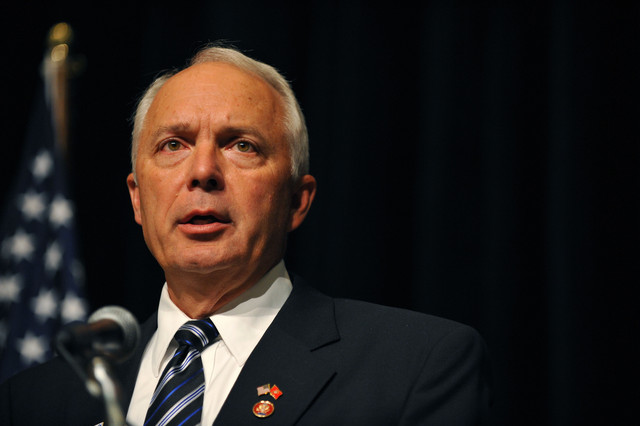
Republican Rep. John Klein is a big beneficiary of contributions from the for-profit schools industry

Republican Rep. John Klein is a big beneficiary of contributions from the for-profit schools industry

This isn’t to say the Democrats are all on the side of the angels. Cory Booker, a New Jersey Democrat, pulled in $11,100 from for-profit schools and Senator Patty Murray, a Washington Democrat, collected $21,70 in the 2014 cycle, according to the Center for Responsive Politics.

A typical concern raised by Democrats is that cracking down on the for-profit schools will hurt minorities, a cynical explanation given that minorities tend to be the ones hit the worst by for-profit schools’ abuse.

Prominent companies heavily invested in for-profit colleges include ITT Technical Institute, DeVry, Kaplan, Apollo Group / University of Phoenix, Career Education Corp. (CEC), Education Management Corp. (EDMC), and Globe University.

Just in the first three months of 2014, for-profit education companies spent at least $1.9 million on lobbying expenses, according to an Inside Higher Ed analysis. Apollo Education Group, the Association for Private Sector Colleges and Universities, Bridgepoint Education, Herzing University and Corinthian Colleges (which operates under the school names Everest, Heald, and Wyotech) were among the biggest spenders.

The Association of Private Sector Colleges and Universities, the trade group representing for-profit schools, argues on its Higher Education For All website, that “all students should be afforded the opportunity to pursue a postsecondary education regardless of their location, socioeconomic status or career choice… Government should not be in the business of restricting individual’s opportunities…”

Agreed, but that doesn’t mean the government, and taxpayers, should be subsidizing a failing system.

According to the Institute for College Access and Success, more than 600,000 federal student loan borrowers who entered repayment in 2010 defaulted on their loans by 2012. The largest share of these students – 46 percent –attended for-profit colleges, even though they enrolled just 13 percent of students nationally.

Apollo Group says it’s “Playing a vital role in educating the world”, but in 2013, the Washington Post reported that the University of Phoenix had an overall graduation rate — meaning first-time undergraduates who get a degree in six years — of about 16 percent, and the graduation rate for students in online programs was just one-fourth of that.

phoenix-university

Particularly hard hit are veterans. According to the Center for Investigative Reporting, over the past five years, the University of Phoenix campus in San Diego reaped $95 million in post 9/11 GI Bill money, more than the entire University of California system. Meanwhile, the overall graduation rate at the San Diego campus is less than 15 percent and more than 25 percent of students default on their loans within three years of leaving school.

The for-profit college industry has been battling for years to block regulations that could shut off federal dollars flowing to programs that too often leave graduates and drop-outs with excessive debt and no good-paying job.

On Feb. 26, 2014, when Consumer Financial Protection Bureau Director, Richard Cordray, filed a lawsuit against for-profit chain ITT Educational Services for misleading students, he cited the failure of for-profit schools to serve their students well.

According to the National Center for Education Statistics, he said, for bachelor’s degree students starting a four-year program in 2004, just 28 percent of students attending for-profit institutions graduated within six years. This was half the rate for students at four-year public institutions.

“This is truly an American tragedy,” said Cordray, in announcing the suit against ITT. “Students may think they are climbing a ladder to success when instead they are getting knocked down, crushed by student debt that does not help them gain a better job or a better life.”

It’s time for Congress to act.

Forget about freedom in Ukraine; there’s money to be made

Crass. Imbecilic. Disgraceful.

It’s hard to pick a word that works when American businesses take to the Wall Street Journal today to run a full page ad arguing that confronting Russia over its invasion of Crimea in Ukraine is not in America’s best interests.

“America’s interests are at stake in Russia and Ukraine,”  the ad, placed by the National Association of Manufacturers and the U.S. Chamber of Commerce, blares in bold print.  “Sanctions hurt American interests…We are concerned about actions that would harm American manufacturers and cost American jobs…It’s time to put American jobs and growth first.”

First before what? Before respect for human dignity? Before the right of a nation’s people to choose their own government?  Before support for the principle of territorial integrity as stated in the United Nations Charter?

ukraine

“Democracy and respect for human rights have long been central components of U.S. foreign policy,” the U. S. Department of State says. “Supporting democracy not only promotes such fundamental American values as religious freedom and worker rights, but also helps create a more secure, stable, and prosperous global arena in which the United States can advance its national interests.”

America has been promoting democracy around the world since its founding under both Republican and Democratic presidents. Now we shouldn’t care about the rights of the Ukrainians if there are profits at stake?

How low can we go?

“Hard Choices” hype not paying off

Looks like Simon & Schuster made a bad choice in deciding to publish Hillary Clinton’s book.

Not that many people are buying it. That could say something about the depth of her appeal, beyond being a media celebrity and liberal icon.

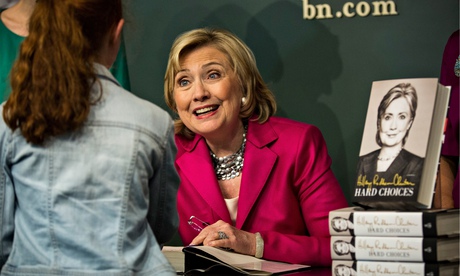
Hillary Clinton at a book signing for memoir in New York City

The New York Times reports (http://nyti.ms/1sGoHlL) that sales of Hillary’s book declined 43.5 percent to 48,000 copies in its second week on the shelves, according to Nielsen BookScan. That followed sales of about 85,000 copies in the first week the book hit bookstores.

Simon & Schuster is widely rumored to have paid paid Hillary a $14 million advance on “Hard Choices”, $6 million more than she was paid for her last book, “Living History”, and to have spent lavishly on promotion of the book. If that’s right, Simon & Schuster may be on the way to losing a lot of money on “Hard Choices”.

And all this doesn’t take into account that a lot of people buying the book are more collectors than readers.

So far, the only attention-grabbing things to come out from all the publicity about the book are embarrassing comments Hillary has made about her family’s financial situation.

“We came out of the White House not only dead broke, but in debt,” Clinton said ABC’s Diane Sawyer, referring to the hefty legal fees incurred during their White House years. “We had no money when we got there, and we struggled to, you know, piece together the resources for mortgages, for houses, for Chelsea’s education. You know, it was not easy.”

Commenters noted that Bill Clinton earned $200,000 a year as president and that the Clinton’s huge legal debts, largely an outgrowth of Bill Clinton’s misadventures, were paid off with public contributions. They also highlighted that Hillary and Bill immediately leaped into lucrative speaking engagements when Bill’s presidency ended.

Hillary is reported to have raked in $5 million in speaking fees since she left the State Department in early 2013, much of it from speeches billed at $200,000 a pop. Bill has been even more aggressive, pulling in $106 million from paid speeches since leaving the White House in January 2001.

Hillary found herself in more hot water when she told the Guardian  she’s not “truly well off” and insisted that she and Bill “pay ordinary income tax, unlike a lot of people who are truly well off, not to name names…”  Bloomberg News later reported, however, that the Clintons have played fast and loose to stave off hefty estate taxes on their own personal wealth. “…the two heads of the political dynasty have been seizing on legal but slippery loopholes to minimize taxes on inherited wealth…,” CBS News reported.


Moving to the suburbs: addiction and poverty

Linda knows poverty in the midst of plenty.

Her family was desperately poor during her childhood, but they lived in a tony Portland suburb, attending school there with kids who were much more affluent.

Her home environment growing up, however, was far from idyllic. Linda and her siblings were exposed throughout her childhood to drug and alcohol abuse as well as domestic violence.

That led Linda (not her real name) to reckless behavior, including her own drug and alcohol addiction, followed by brief trips to jail. She tried to straighten out on several occasions, but slipped back, returning poverty to the forefront.

In his heart-wrenching novel, “There are No Children Here”, Alex Kotlowitz followed the lives of two young boys growing up in the projects of the near West Side of Chicago. There they were in the midst of ruinous poverty, rampant drug use, run-ins with the police and dysfunctional families.

The book resonated partly because poverty and associated ills are often seen as synonymous with big cities.

But times are changing. Linda now lives in suburban Tigard, not a rundown area of Chicago or inner city Portland.

A012-BlightCourt001-1107y_11-12-2007_O7NEO0E.jpg

As in her youth, she’s experiencing hardship, but this time she’s getting help through collaborative social service programs that promote self-sufficiency for homeless individuals and families. And she’s making real progress toward getting back on her feet. A big break came recently when she got a job.

The suburbs are struggling with an increasing number of residents living in poverty, including Tigard’s home, Washington County, which has a well-deserved reputation as the economic engine of Oregon with thousands of well-paying jobs.

The shift of poverty to the suburbs occurred around 2001, when data showed that more poor people lived in suburbs than in cities. The trend sped up with the Great Recession, which devastated many families.

One-fourth of poor people living in extremely poor neighborhoods in the nation’s 100 largest metro areas are in the suburbs, according to research at the Brookings Institution in Washington, D.C. And suburbs account for four in ten poor individuals in those regions who live in areas of high poverty—a neighborhood poverty rate exceeding 20 percent.

Alan Berube, a Senior Fellow at Brookings, argues that contemporary anti-poverty strategies must recognize the different needs of poor families in both cities and suburbs. The suburbs, for example, often lack the density to deliver services in a distinct area, he says.

Poor families often spread over greater distances in the suburbs, and they face different barriers (transportation, for example) than city dwellers do. Moreover, as poverty spreads to the suburbs, it becomes less a neighborhood problem and more of a regional or sub-regional problem.

Berube and Elizabeth Kneebone, a fellow at the Metropolitan Policy Program at Brookings, say we need to recognize that growing jobs and fighting poverty are not separate initiatives. As U.S. Senator Barbara Mikulski put it, the best social program is a job. In addition, we need to engage more partners, particularly the private sector, in efforts to improve outcomes for low-income people and places.

A few years into the painfully slow recovery from the Great Recession, the need remains high.


Grab them by the throat, Jeff, and don’t let go.

I’m standing with you, Jeff.

How could I not after getting your letters pleading for money and using every poll-tested word in the book to convince me to make my check payable to Jeff Merkley for Oregon.

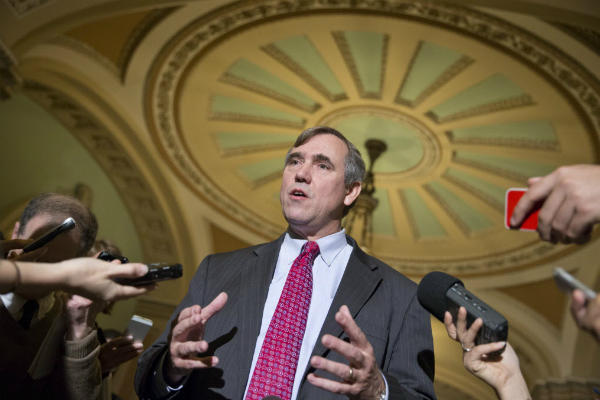
merkleySenate

You tried to capture me with the first line, hitting me over the head by asking me if I’m “fed up with Koch-style special interests always getting their way in Washington.”

“Koch-style special interests.” Ah, yes. Always lead with a reference to the Koch brothers, the favorite bogeymen of the Democrats, denounced by MoveOn “for using your vast wealth — more than the combined wealth of the bottom 40 percent of Americans — to corrupt our democracy” and assailed by Senate Majority Leader, Harry Reid for being “un-American” and leading the way to a dystopian America run by moneyed interests.

Forget about the fact the Democrats have their own moneyed interests. According to OpenSecrets.org, from 1989 to 2014 rich donors gave Democrats $1.15 billion — $416 million more than the $736 million given to the GOP. Among the top 10 donors to both parties, Democrat supporters outspent Republican supporters 2-to-1.

 Then you asked if I’ve “…had it with the Republicans shilling for the wealthy and powerful.”

“Shilling.” What a great word. A shill supports something with the pretense of sincerity, when in fact he’s being paid for his services. So I guess while the Republicans shill for their wealthy patrons, the Democrats shill for theirs. In your case, principal contributors to your campaign during 2009 -2014 have been:


Industry    Total raised       From Individuals From PACS
lawyers/law firms $337,313 $259,615 $77,698
Leadership PACs $166,500 0 $166,500
Real estate interests $146,868 $74,358 $72,510
Building trade unions $117,000 0 $117,000

Oh, and I just loved your appealing for my money “because the Republicans and their special interests cronies are hell bent on defeating me in 2014.”

“Cronies.” Another loaded word. The Republicans don’t have supporters, backers or enthusiasts. They have despicable, contemptible, loathsome “cronies”, part of a corrupt system of trading favors.

Then you said your race against Republican Monica Wehby is “going to be an uphill battle” because you “refuse to play ball with the Washington insiders…”

Ah yes, those dreaded “Washington insiders.” But wait a minute. You’ve been back there in D.C. for almost six years now. Aren’t you an “insider”, too. Or, with all the anti-Washington sentiment going on, are you trying to make voters forget that you’re an incumbent?

You also warned me that your record “…will be twisted into as many smears as special interest Super PACS can jam into a 30-second TV ad.”

So the TV ad you have up now asserting that Wehby will vote in favor of measures to “gut the middle class”, isn’t a smear? I mean, you know that the growth in Medicare costs, for example, jus unsustainable. And when a researcher hired by the Democratic Party of Oregon got ahold of a police report on Wehby’s alleged harassment of an ex-suitor and it somehow became public, wasn’t that a smear?

All candidates rely on catchphrases to define themselves and their opponents, as well as establish the framework of the campaign. Part of the reason is because, even though candidates sometimes talk about issues, “The unspoken reality…is that the vast majority of Americans don’t vote based on particular issues at all,” Dr. Frank Luntz wrote in Words that Work. “The fabled issue voter is a rare specimen indeed. ‘Agrees with me on the issues’ is inevitably one of the least important candidate attributes in determining public support.”

Instead, Americans decide who to vote for more on a candidate’s image or vibe, Luntz says.

You know that. You know most voters don’t really know that much about the substance behind issues and don’t deal well with complexity or intricacy. So you’re trying to poison the well with negative sounding buzzwords about the opposition. Smart.


Want to skip out on paying back all your student loans?

Now that you’re out of college, want to skip out on making those pesky student loan payments until all your debts are paid off? No problem.

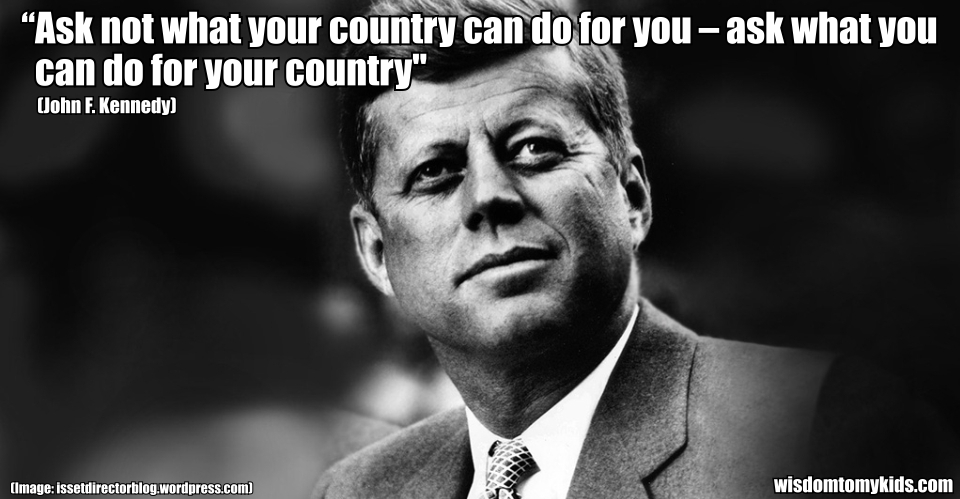
Under a program that reverses John F. Kennedy’s “Ask not what your country can do for you, ask what you can do for your country”, loan forgiveness is available under the Public Service Loan Forgiveness (PSLF) program created by Congress in 2007. Under this law, signed by President George W. Bush, once people holding full-time public jobs have completed 120 payments on their federal direct loans, the remaining balance can be forgiven, with no cap.

No longer in vogue?

No longer in vogue?

The list of qualifying public sector jobs is longer than my arm.

That’s because qualifying employment is “any employment with a federal, state, or local government agency, entity, or organization…”, including work for a qualifying not-for-profit employer  “if it provides certain public services, such as emergency management, military service, public safety, or law enforcement services; public health services; public education or public library services; school library and other school-based services; public interest law services; early childhood education; public service for individuals with disabilities and the elderly.”

Good grief. Who isn’t qualified?

What supporters of loan forgiveness conveniently forget is that forgiving loans costs money, something that can’t be ignored when the the national debt exceeds $17 trillion.

Forgiving college loans also likely makes students less sensitive to tuition costs and schools more likely  to encourage students to borrow for increasing college costs national debt, rather than pushing schools to figure out how to become more affordable.

The rationale for the creation of the program was that people in public service jobs make less money than those in the private sector, so government needs to add perks to make public service jobs more appealing to the well-educated.

The problem is that government salaries are not all necessarily lower than those in the private sector for comparable jobs, people in the public sector tend to have more generous retirement benefits and attempting to drive educated people to public sector jobs may not be the best use of American talent. At its root, the loan forgiveness program assumes that public sector jobs are inherently more valuable to the country, justifying foisting the unpaid portion of student loans on the American taxpayer.

Another argument made for this loan forgiveness program is that it stimulates the economy because it puts more money in American’s pockets instead of in loan repayment.

A Freakonomics post made hash of that argument, noting:

  1. If we are going to give money away, why on earth would we give it to college grads? This is the one group who we know typically have high incomes, and who have enjoyed income growth over the past four decades.  The group who has been hurt over the past few decades is high school dropouts.
  2. If you want stimulus, you get more bang-for-your-buck if you give extra dollars to folks who are most likely to spend each dollar, like poor people.
  3. People who support this are a bunch of kids who don’t want to pay their loans back. And worse: Do this once, and what will happen in the next recession? More lobbying for free money…?
  4. Much of the rhetoric in support of loan forgiveness is,Give free money to us, rather than corporations, millionaires and billionaires.”  Why give money to college grads rather than the 15% of the population in poverty?

Finally, a good case can be made that we have too many people in the public sector and that the last thing we need to do is incentivize adding more.

Congress should abolish this loan forgiveness program, not expand it.


Who lost Iraq? China Redux.

In the years following Chiang Kai-shek’s Nationalist regime’s loss to the Chinese Communists in 1949, when U.S. Senator Joseph McCarthy let loose his ill-founded accusations of communist infiltration in the United States, the country, eager to blame somebody, was wracked with questions about, “Who lost China”?

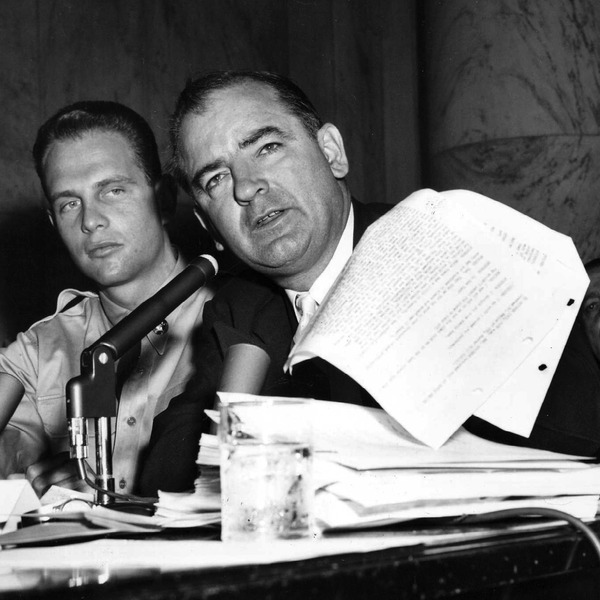
Senator Joseph McCarthy

Senator Joseph McCarthy

In the 1950’s, U.S. Senate committees studied what was seen as the failure of American foreign policy to prevent the Chinese Communist takeover.  McCarthyism is remembered today as a broad attack on presumed communists and sympathizers in the U.S., but it was also a targeted attack on the State Department’s experts on China, the so-called China Hands, who had told the truth as they saw it. A broad swath of these experts were either forced out the Foreign Service or had their careers completely derailed.

If Iraq falls to the Islamic State of Iraq and al-Sham, known as ISIS, after the loss of thousands of American lives and the expenditure of  billions of American dollars, there’s little doubt that a new rallying cry will arise, “Who lost Iraq?”

Sgt. Timothy Davis of San Diego places American flags before the gravestones of those buried at Arlington Cemetery.

Sgt. Timothy Davis of San Diego places American flags before the gravestones of those buried at Arlington Cemetery.

Potential targets are legion, which may well lead to a convulsive period in American domestic and foreign policy.

The blame game is, in fact, already underway.

On June 12, Fareed Zakaria wrote a column in the Washington Post titled, “Who lost Iraq? The Iraqis did, with an assist from George W. Bush”. The Iraqi government is “corrupt, inefficient and weak, unable to be inclusive (of the Sunnis) and unwilling to fight with the dedication of their opponents,” just like the Chinese nationalists were, Zakaria said.

So Prime Minister Nouri al-Maliki is the one who lost Iraq. But he came to power as a result of “a series of momentous decisions made by the Bush administration,” Zakaria said, so Bush lost Iraq.

But wait a minute. Things were much more settled in Iraq when Obama became president and his foreign policy team was hailing the country’s prosperity, embrace of democracy and relative quiet compared with earlier years. In 2010, Vice President Biden called Iraq one of Obama’s “great achievements”. In 2011, President Obama told troops at Fort Bragg, “We’re leaving behind a sovereign, stable and self-reliant Iraq.”

Wasn’t it the Obama Administration that made a precipitous withdrawal of U.S. troops from Iraq, encouraging adversaries and leaving the country’s elected government weaker in the face of continuing threats?

Or maybe it was the Obama Administration’s feckless foreign policy in dealing with Syria, with Obama insisting in 2012 that the use of chemical weapons by Syrian President Bashar Assad would cross a “red line for us” and might trigger a U.S. military response, followed by Obama’s failure to follow through.

Perhaps that emboldened not only Assad, but also ISIS, which is already perilously close to Baghdad.

The city of Mosul in Iraq, which ISIS soldiers have taken over.

The city of Mosul in Iraq, which ISIS soldiers have taken over.

Gary Alan Fine and Bin Xu, in “Honest Brokers: The Politics of Expertise in the “Who Lost China?” Debate”, note that much blame has been placed on the advice of a group of men and women labeled neoconservatives who got the U.S. embroiled in Iraq in the first place. “These policy experts have been targeted,” they say. “But more than just being wrong in their expectations, some critics, such as Seymour Hersh, suggest that these policy experts constituted a “cult,” and others allege that they were a group that placed the interests of the Bush administration, the Republican Party, or the state of Israel above that of the United States.”

Regardless of who made the decisions that have led to the current mess, hold on, because the atmosphere is going to get turbulent and all of America is going to feel it.

“Hard Choices”: Don’t read this book

dontread

Haven’t had time to read Hillary’s book, “Hard Choices”? Not to worry. Hardly anybody else will either.

In any case, it’s not meant to be read, but to serve as another way station in Hillary’s inexorable march to a presidential campaign.

Despite the likelihood that it will be a bestseller, it’s a pretty good bet that few people will actually read it cover to cover. Like Thomas Piketty’s 700 page book, “Capital in the Twenty-First Century,” it will be a hit mostly as an empty vessel into which people of all stripes will pour their biases and preconceptions.

The pundits, editorial writers and political junkies will read it, or parts of it, so they can pontificate about it. Politicians will only look in the index to see if they’re mentioned. Curious people will then read the musings of influencers who hold their same world view, reinforcing what they are inclined to believe anyway.

Hillary’s admirers will heap praise on the book and on commentary that treats it with awe, such as Michiko Kakutani’s New York times review that said the book is a “subtle, finely calibrated work.” Her detractors will disparage the book and nod their heads in agreement when reading critical comments, such as Slate’s John Dickerson who called the book ‘low-salt, low-fat, low-calorie … with vanilla pudding as the dessert.”

So if you like Hillary, go ahead and buy the book or go to one of Hillary’s over-hyped book tour events, but don’t bother to read the book. If there’s anything really attention grabbing in it, somebody else will tell you about it.

So far, the only attention-grabbing thing to come out isn’t even in the book, but something Hillary said in an interview with ABC’s Diane Sawyer ahead of the release of “Hard Choices.”

“We came out of the White House not only dead broke, but in debt,” Clinton said to Sawyer, referring to the hefty legal fees incurred during their White House years. “We had no money when we got there, and we struggled to, you know, piece together the resources for mortgages, for houses, for Chelsea’s education. You know, it was not easy.”

The social media lines lit up in fury after that comment became public.

Commenters noted that Bill Clinton earned $200,000 a year as president, for a total of $1.6 million in the previous eight years. They pointed out that the Clinton’s huge legal debts, largely an outgrowth of Bill Clinton’s misadventures, were paid off with public contributions. And they highlighted that Hillary and Bill immediately leaped into lucrative speaking engagements when Bill’s presidency ended.

Hillary is reported to have raked in $5 million in speaking fees since she left the State Department in early 2013, much of it from speeches billed at $200,000 a pop. Bill has been even more aggressive.

CNN research of Bill Clinton’s financial records in 2013 showed he pulled in $106 million from paid speeches since leaving the White House in January 2001, including $17 million just in 2012. In November 2011, he was paid $750,000 for a single speech to executives and employees of telecom firm Ericsson in Hong Kong and in one Sept. 2006 weekend in the U.K., he collected more than $1,000,0000 for three speeches.

But you didn’t need to read Hillary’s book to learn about all this. So, as Chuck Palahniuk, author of the award-winning novel Fight Club, said in the opening lines of another one of his books, Choke, “If you’re going to read this, don’t bother.”


Honey, our paychecks are shrinking

It was a lofty goal.

One of the principal goals of the Oregon Business Plan when it launched in 2002 was to raise Oregon’s per capita personal income above the national average by 2020.

DREAM-JOB

So much for that dream.

Oregon’s per capita personal income in 2013, total personal income divided by total population, was 90.3 percent of the U.S. average, which was actually down from 2001, when it was 94.6 percent.*

Oregon’s per capita income has grown for the past three years, and that’s reason for optimism, but so has the per capita income in other states, so Oregon is still lagging behind.

Eric Fruits, a faculty member at Portland State University, warns against braking out the bubbly over Oregon’s income growth, even though it put Oregon 15th in personal income growth among the United States and the District of Columbia. That’s because, he argues, over the long run Oregon’s per capita income growth has lagged the rest of the U.S. by two to four tenths of a percentage point and the difference compounds over time.

“Even the tiniest drags on the economy can compound over time such that a state that begins almost nine percent richer than the rest of the country can end up decades later being nine percent poorer than the rest of the country,” Fruits wrote recently.

Equally troubling is that behind the per capita income numbers are some discouraging data on Oregon’s and the nation’s changing workforce.

Oregon’s job growth in 2013, during which its job base grew by 2.4 percent and it added about 39,000 jobs, was one of the fastest in the country. It was exceeded only by North Dakota and Florida.  If the pace continues this year, Oregon could recover all the jobs lost in the recession before 2014 ends.

Already, the country as a whole has regained all the jobs lost during the Great Recession, though it took six and one-half years. But consider that the country’s population has grown by about 15 million since the Great Recession began and the potential workforce has grown as well.

Also, consider the types of jobs that are being created.

At the start of 2008, a private-sector worker earned $818.31 a week. In April 2014, almost six and one-half years later, that figure had grown to $838.70, just $20 a week more.

While the economy has been adding jobs, the new jobs are not enough to keep up with population growth and too often aren’t the solid middle class jobs we need for the overall economy to thrive.

“Although employers added jobs in a broad range of industries, the bulk of new jobs added are found in a handful of industries known for low wages—accommodation and food services, temporary help services, retail trade, and long-term health care, ” the left-leaning Center for American Progress notes.

Image

If Oregon really wants to advance relative to other states, we need more firms selling lots of products, hiring lots of people, and paying high wages to generate the gains that are needed across the state, the Oregon Business Plan recently noted.. That means we need to start more, grow more, recruit more and retain more highly productive companies in a variety of sectors across the state.


_______

*Per capita personal income

National        Oregon

2002       $31,481         $29,400

2003       $32,295         $30,144

2004       $33,909         $31,597

2005       $35,452         $32,542

2006       $37,725         $34,644

2007       $39,506         $35,796

2008       $40,947         $36,772

2009       $38,637         $35,621

2010       $39,791         $35,869

2011       $41,560         $37,744

2012       $42,693         $39,166

2013       $44,543         $40,233


*Source: U.S. Department of Commerce, Bureau of Economic Analysis; Oregon Employment Department, WorkSource Oregon