There they go again.Trump and guns.

Feigned Outrage

There they go again.

“If she (Hillary Clinton) gets to pick her judges, nothing you can do, folks,” Mr. Trump said at a rally in North Carolina today. “Although the Second Amendment people — maybe there is, I don’t know.”

His campaign maintained that he was referring to political activism.

But Mrs. Clinton’s campaign manager responded in high dudgeon: “What Trump is saying is dangerous.”

Clinton’s running mate, Senator Tim Kaine, erupted in disbelief. “Nobody who is seeking a leadership position, especially the presidency, the leadership of the country, should do anything to countenance violence, and that’s what he was saying,” Kaine said.

The ever low-key Elizabeth Warren followed up, saying Trump had made a “death threat.”

And of course a Democratic Congressman, Eric Swalwell, CA, followed up by calling on the Secret Service to investigate Donald Trump’s comments directed at Hillary Clinton, according to The Hill.

“Donald Trump suggested someone kill Sec. Clinton. We must take people at their word. @SecretService must investigate #TrumpThreat,” Swalwell Tweeted.

The fact that his tweet got him some media attention probably pleased Swalwell no end.

Dan Gross, the president of the Brady Campaign and Center to Prevent Gun Violence, which has endorsed Mrs. Clinton, said Mr. Trump’s statement was “repulsive — literally using the Second Amendment as cover to encourage people to kill someone with whom they disagree.”

The media loved it, seeing another opportunity for more over-the-top, twisted, contorted, coverage of the presidential campaign.

The New York Times reported that  Donald Trump seemed to suggest that gun rights backers could take matters into their own hands if Hillary Clinton nominated judges who favor gun control.

I heard the same kind of hand-wringing language on OPB this afternoon.

Similarly, The Hill reported: “Yet another Donald Trump reset has gone by the wayside as the GOP nominee appeared to joke that someone could shoot his Democratic rival, Hillary Clinton. His comment came just one day after a highly-touted economic speech meant to put Trump back on message.  After the comment gained steam on social media, the Trump campaign raced to clarify that Trump only meant political resource, not violence. But it’s the kind of diversion that drives on-the-fence Republicans crazy.”

Good grief. Come on folks. There are enough legitimate Trump issues to focus on without stooping to this kind of manufactured outrage.

Think third party: your vote will not be wasted

hillaryEvilQueen2Trumpclown1

It doesn’t have to be a choice between an evil queen and a bombastic clown, two toxic, fatally flawed candidates.

About two-thirds of prospective voters consider both Donald Trump and Hillary Clinton dishonest and untrustworthy. That’s millions of Americans who hold both candidates in high disregard, but appear ready to just hold their noses and vote for one of them, unwittingly helping to preserve the status quo. That’s insanity.

The idea that a third party candidate can’t win will then become a self-fulfilling prophecy.

But there is another option in this presidential race. Support, and then vote for, a candidate from another party, such as  Libertarian candidate Gary Johnson or Green Party candidate Jill Stein. Your vote won’t be wasted and America will be the better for it.

As Eugene V. Debs, five-time presidential candidate of the Socialist Party of America, observed, “It is better to vote for what you want and not get it than to vote for what you don’t want and get it.”

The potential receptivity of Oregonians to a third party is reflected in the fact that about a third of Oregon’s three million registered voters don’t belong to the Democratic or Republican Party.

Some of that is surely a clear decision by voters refusing to align themselves with one of the major parties. Some may be tied to Oregon’s new policy of automatically registering voters when they visit a Department of Motor Vehicles. Under that process, voters are automatically registered as “unaffiliated” and later given the option of picking a party choice, but most do nothing.

Nationally, the nonpartisan Pew Research Center recently reported that the share of independents in the public, which long ago surpassed the percentages of either Democrats or Republicans, continues to increase. In a 2016 report, based on 2014 data, 39% identify as independents, 32% as Democrats and 23% as Republicans. This is the highest percentage of independents in more than 75 years of public opinion polling, according to Pew.

In a 2014 Gallup poll, 58 percent of U.S. adults also favored having a third party because the Republican and Democratic parties “do such a poor job” representing the American people. Only 35 percent said the two existing major parties do an adequate job of this.

Your willingness to express support for a third party candidate will have one immediate impact. In 2000, the Commission on Presidential Debates (CPD), a private company, approved rules stipulating that, besides being on enough state ballots to win an Electoral College majority, debate participants must clear 15% in pre-debate opinion polls.

At a minimum, if you express your support for another party’s candidate, that person will have a better chance of joining the presidential debates, making Americans more aware of their positions and enhancing the possibility that they will emerge as a serious contender.

Don’t cop out by endorsing write-ins instead. If you agree that voting is about expressing a political preference, write-ins only signal a defection from the two-party system, not support for another person and agenda. Voting for a third party conveys endorsement of a recognizable set of principles, a public platform.

Even if your third party candidate doesn’t win, your vote will have an impact. Willie Sutton reputedly replied to a reporter’s inquiry as to why he robbed banks by saying “because that’s where the money is.” Politicians follow a similar principle. They go where the votes are. If voters reject the history, values and solutions of Clinton and Trump, other politicians will become more open to alternatives.

Americans will not be throwing away or wasting their votes by casting them for people and policies they support, rather than for the lesser of two evils.

As John Quincy Adams said, “Always vote for principle, though you may vote alone, and you may cherish the sweetest reflection that your vote is never lost.”

The only wasted vote is one that’s not cast at all.

(Postscript: The Chicago Tribune agrees: Editorial: Let Libertarian Gary Johnson debate Clinton and Trump, http://trib.in/2b6FGv4)


Clinton, Trump and the housing crisis: a different perspective

Hillary Clinton and her surrogates think they have found something to damage Donald Trump, statements he has made about opportunities to profit from a housing market crash.

But have they? A deeper look suggests Trump was prescient in his analysis of the housing market.

Ten years ago Trump was recorded saying, “I sort of hope that (a housing market crash) happens because then, people like me would go in and buy” and “If there is a bubble burst, as they call it, you know you can make a lot of money.”

foreclosure

At a campaign rally on Tuesday, Clinton jumped on the quotes, accusing Trump of wishing for a financial crash so he could “make some money for himself.”

The Democratic National Committee (DNC) piled on, saying in a press release that Trump “cheered on” the collapse of the housing market. The DNC also observed that the housing crash devastated minorities such as Hispanics and African-Americans (who happen to be a key part of Hillary’s base).

“Donald Trump’s lack of concern for the economic well-being of hard-working families shows that he doesn’t have the judgment and temperament to occupy the Oval Office,” wrote DNC spokesperson Luis Miranda.

But another way to look at it is Trump was being pretty smart and perceptive—and if the Clintons had been smart, they could have made some money, too (not that they needed any more).

The 2008 financial crisis was triggered to a significant degree by subprime mortgages, loans made to people with poor credit or with little documentation to back up their financial fitness. These mortgages were transformed into toxic financial products by investment specialists who made a bundle when the products were sold.

The danger these subprime mortgage products posed wasn’t foreseen by Janet Yellen, Chair of the Board of Governors of the Federal Reserve System.

“While a tightening of credit to the subprime sector and foreclosures on existing properties have the potential to deepen the housing downturn, I do not consider it very likely that such developments will have a big effect on overall U.S. economic performance,” Yellen said well into the foreclosure crisis. ” I say this, in part, because these mortgages represent only a small part of the overall outstanding mortgage stock.”

Yellen went on to misread the economy, saying, “I think that the current stance of policy is likely to foster sustainable growth with a gradual ebbing of inflation over time.”

The danger these subprime mortgage products posed also wasn’t foreseen “by the chief executives of America’s premier banks,” said a New York Times book review of the best-selling book, The Big Short. “It was not foreseen by government regulators, by Treasury officials or by the Fed. It was foreseen, however, by a handful of investors, who were aghast at the madness they saw on the Street and who used their prescience to make a fortune off the financial system’s calamitous meltdown.”   

the-big-short1-1080x607

Trump should fire back at Hillary by pointing out that she’s made some contentious allegations her supporters might resent. For example, she laid some of the blame for the housing crisis on greedy, dishonest homeowners.

“…certainly borrowers share responsibility as well,” Clinton said in a speech at NASDAQ headquarters. “Homebuyers who paid extra fees to avoid documenting their income should have known they were getting in over their heads” and people across the country “…who were busy buying two, three, four houses to sell for a quick buck don’t deserve our sympathy.”

Nothing’s simple, is it?

It’ll be too damn bad if Trump gets walloped

The glee was palpable. This past weekend, E.J. Dionne Jr., a liberal columnist at the Washington Post, exuberantly declared that Donald Trump’s candidacy is set to implode.

But such elation may be misplaced if Trump’s defeat allows the status quo politicians, power brokers and so-called thought leaders to claim victory and dismiss the concerns of many of his frustrated and embittered supporters.

PoliticsAsUsual

Trump’s supporters reflect a lot of discontent that’s boiling up in this country. If it’s just dismissed as the complaints of a fringe and we return to politics as usual, that would be a tragedy.

It would mean ignoring millions of Americans like Sam W., a longtime friend from back East.

Sam called me the other day to shoot the breeze. We started talking about cycling tours and our children, but it wasn’t long before the conversation turned to politics.

And off he went, hardly pausing for a breath.

Sam’s a professional, has a graduate degree and is drawn to Donald Trump, partly because of his disgust with politics as usual. In an exasperated tone, he said he felt that the pundits, the media and political leaders in both parties are demonizing him and others like him as poorly educated, ill-informed, racist bumpkins who need to get with the program.

“It’s really discouraging,” Sam said, “to be labeled a nutcase and a low-knowledge voter because I think the leaders of both parties have utterly failed us in confronting America’s problems.”

His litany of frustrations was a long one.

When he argues that massive illegal immigration and sanctuary cities undermine the rule of law, sanctimonious liberals call him a bigot, he said.

When he lambastes Obama’s and Hillary Clinton’s disastrous lead-from-behind foreign policy, the collapse of one Middle East country after another, Russia’s takeover of Crimea and ascendency in Syria and other international messes, he said he’s dismissed or ignored.

Sam also endorses the argument that some international defense agreements need to be reexamined. “Too many countries are only able to afford their cushy social welfare programs because the U.S. picks up the tab for their security,” Sam said. “That’s crap. When our own budget is strained, isn’t it legitimate to consider more sharing of the burden?”

When he expresses his frustration with the latest PC controversy, such as  the complaints by Emory University students that somebody writing “Trump 2016” in chalk on a campus sidewalk makes them feel unsafe and in pain, he’s accused of being a narrow-minded old fogie.

Sam is also disheartened with the failure of both parties to honestly tackle the ever-expanding national debt. When George W. Bush left office in January 2009, the national debt was $10 trillion. Now in the eighth year of Obama’s presidency, it is over $19 trillion.

But neither party is talking seriously about the critical need to reduce federal spending and avoid a debt crisis. Democrats never seem to give a damn, Sam said, but the Republicans aren’t much better because they say they care, but the truth is they still vote for budget busting bills.

Sam also doesn’t think either party has really shown much real concern for the poor. The Democrats just want to expand the welfare state and generate thank-you votes, he said, and the Republicans seem insensitive to the legitimate concerns of struggling Americans.

For that matter, the establishment elite of both parties doesn’t seem to understand the legitimate worries of the middle class either, Sam said. A lot of Americans are really scared and struggling just to stay in place, he said, but politicians seem more focused on catering to big banks, corporations and the wealthy.

And think about what we may end up with if Trump is pushed out, Sam said. “On the Republican side we could be faced with Ted Cruz, a right-wing bible-thumping moralist who is a pariah in his own party. On the other side, Hillary Clinton is an uninspiring and widely distrusted candidate whose entire family stinks of greed and appears oblivious to common standards of conduct.”

“An awful lot of Americans are just completely disillusioned with U.S. politics as usual,” Sam said.

 “Whether they are the academic, media, and entertainment elites of the Left or the political and business elites of the Right, America’s self-appointed best and brightest uniformly view the passions unleashed by Trump as the modern-day equivalent of a medieval peasants’ revolt. And, like their medieval forebears, they mean to crush it,” the National Review said earlier this year.

If they succeed, and then ignore the concerns of Sam and millions of Americans like him, the prognosis for stability and progress is not good.

So much for free speech: the left and Chicago’s anti-Trump demonstrations

trumpchaos

A Trump supporter (R), confronts a demonstrator after Donald Trump canceled his rally at the University of Illinois at Chicago on March 11, 2016

With all the hyperventilating by major media about the chaos that forced cancellation of Donald Trump’s planned March 11 event in Chicago, there’s been little mention of the role left-wing organizations played in fomenting and supporting the clashes with the goal of shutting down the event.

Not only that, but an analysis of news coverage by ABC, CBS and NBC found that the protesters escaped nearly all blame. By a 15-to-1 margin, the networks blamed Trump, not the leftist protesters, for the campaign violence.

“The left’s coercive tactics aimed at shutting down speech with which they disagree are appalling and un-American, and they would be shocking were they not so commonly employed; Trump didn’t start that fire,” James Taranto wrote today,

Ignored by most of the media, anti-Trump progressives played a major role in spurring the turmoil.

Prior to the event, left-leaning activist groups and individuals aggressively recruited protesters to obstruct it.  Typical was a prominent Chicago activist, Ja’Mal Green, who posted on his Facebook page, “Everyone, get your tickets to this. We’re all going in!!!! ‪#‎SHUTDOWN”. (Not everybody on Facebook agreed with his tactics. One person commented, “…the ” shutdown” caused many fence sitters to jump into the Trump camp. Stifling freedom of speech for another while gloating over your free speech stand makes no sense.”)

After cancellation of the Trump event, an e-mail from MoveOn.org, a liberal advocacy organization, highlighted “the support we provided students in Chicago last night by printing signs and a banner and recruiting MoveOn.org members to join their peaceful protest.”

“We’ll support MoveOn.org members to call out and nonviolently protest Trump’s racist, bigoted, misogynistic, xenophobic, and violent behavior — and show the world that America rejects Trump’s hate,” the email read. “And to keep it going, we’re counting on you to donate whatever you can to cover the costs of everything involved — the organizers, signs, online recruitment ads, training, and more.”

Another e-mail from ThinkProgress.org, part of the Center for American Progress, founded by Hillary Clinton’s campaign chairman John Podesta, was headlined “How Activists Mobilized to Shut Down Trump in Chicago”.

The e-mail noted approvingly that a student in the U.S. illegally had started a petition on MoveOn.org calling on the school to cancel the event, claiming that Trump’s visit was a “standards and safety issue” and that “I, and other students…are in direct danger.”

Then there’s People for Bernie Sanders, co-founded by Charles Lenchner, who was previously a founder of Ready for Warren, and Winnie Wong, a founding organizer of Occupy Wall Street who also helped launch Ready For Warren.

After cancellation of Trump’s Chicago event, the organization joyfully tweeted, “Remember the ‪#TrumpRally wasn’t just luck. It took organizers from dozens of organizations and thousands of people to pull off. Great work.” (Not all recipients of the tweet were quite as excited. One commenter said, “This is organized vigilantes against Trump/capitalism…”)

I’m not excusing Trump for his rhetoric, but reporters and the media need to do their job and report fully on the campaigns and the players, not just bury us in daily horse race stories, visuals without context and opinions masquerading as news. We’d all be better educated voters if they did.


“Stupid is as stupid does.” – why so many Americans are ignorant about politics

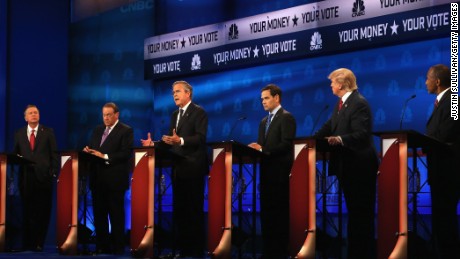
Watch the Republican debate last night? Learn much about economic issues, the supposed focus of the debate? Didn’t think so.

oct28debate

The substance of the debate was equivalent to this Onion news item: “Eerie: These Two Strangers, Thousands Of Miles Apart, Have Almost The Exact Same Initials”

The inanity and vacuousness of so much political news coverage today is frightening and candidates are part of the problem.

Consider these shallow, uninformative stories that ran recently in major media:

“Mike Tyson wants to see Trump in the White House”

“Supergirl” star responds to Jeb Bush calling her hot”

“GOP is like ‘Grumpycat’, Obama says”

Then we have politicians of all stripes all the way up to the president presenting their views on incredibly complex issues with 140 character tweets and Americans making voting decisions based on those misleading, one-sided tidbits.

Add to this noise the editorials and news stories about non-issues or that are so one-sided and without context that they are a waste of time to read.

The South Florida Sun-Sentinel, for example, just ran an editorial calling on Senator Rubio to resign because he has missed a lot of Senate votes during his campaign for the Republican presidential nomination. The Washington Post ran a follow-up article on what it called the “ferocious” editorial. Nightly network news highlighted the issue last night, too, but none of them bothered to provide any context for the reader or noted that voting record accusations are a common campaign tactic of little relevance.

Had any of the media bothered to do any research, they would have found that Senator Barack Obama missed votes TWICE as often during the 2008 campaign’s early going, and Hillary Clinton ended up doing even worse!

In the final quarter of 2007, leading up to the Iowa Caucuses and New Hampshire Primary, Obama missed 89.4 per cent of his opportunities to vote, while Clinton, in hot pursuit for the Democratic presidential nomination, missed 83.5 per cent.

Then there’s the issue of whether anybody really cares about missed Senate votes.

As Politico reported today, “Going after Rubio that way was just a mistake,” said one of Bush’s donors. “No one cares about missed f–king votes in the Senate. Washington cares about that. The media cares about that. And losing candidates care about that. Jeb sounded like he was losing. And Marco made him pay.”

And, of course, there are the endless horse-race stories showing this candidate up or that candidate down in the polls and offering nothing more of substance.

In the early months of the 2008 presidential campaign, for example, a study released by the Pew Research Center found that the media offered Americans relatively little information about the candidates’ records or what they would do if elected, with 63% of the campaign stories focused on political and tactical aspects compared to just 17% that focused on the personal backgrounds of the candidates, 15% that focused on the candidates’ ideas and policy proposals and just 1% of stories that examined the candidates’ records or past public performance. It has likely gotten even worse since then.

And of course there’s a mind-numbing amount of “gaffe” coverage, particularly online. When a candidate says something that could be portrayed as a gaffe, critics of all stripes jump on it, trying to magnify its importance and reach and generate public alarm about it.

And even if you try to take politics seriously, the media and the candidates often treat it all as mere entertainment, more like the contest on The Voice or the Great Race.

For the media, and too many politicians, it’s all theater, all razzle-dazzle, as Billy Flynn, the silver-tongued lawyer in “Chicago”, so aptly put it.

“It’s all a circus, kid,” Flynn said. “A three ring circus…the whole world – all showbusiness.”

ChicagoCircus

With the news diet that’s fed to them, it’s no wonder Americans are so ill-informed about politics. The result? We get the politicians the 1 percent pay for.